


Noxious Weed Facts
- Chinese clematis is a perennial vine with solitary yellow flowers (4 yellow sepals) and big, feathery long-tailed seed heads that can stick around all winter.
- It forms large colonies in disturbed areas like meadows, pastures, and rights-of-way (in Gilpin County, it’s been seen along Hwy 119 coming up from Clear Creek Canyon).
- It spreads by seed (starts setting seed mid-July in Gilpin). It can be toxic to livestock, harm young trees, outcompete plants, and its juice can cause blisters—best control is stopping seed production (hand-pull or weed-whack before it goes to seed) and don’t plant it as an ornamental; contact CSU Extension for herbicide guidance if needed.
Chinese clematis is perennial vine with solitary flowers with four yellow sepals (petal-like structures).
Large colonies may be found in disturbed areas, meadows, pastures, and rights-of-way.
Each flower produces numerous feathery long-tailed seed head fruits which are visible all winter.
The plant reproduces by seeds. In Gilpin County, Chinese clematis typically starts going to seed mid-July. This plant has been seen alongside Hwy 119 coming up from Clear Creek Canyon.
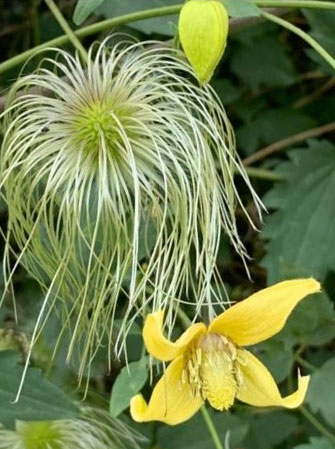
Prevent spread of this species by eliminating seed production from established stands, and discontinuing its use as an ornamental. Hand pulling or weed whacking before flowers go to seed will help keep seeds from spreading.
Contact CSU Extension Gilpin County for specific herbicide instructions.
Important Notes:
May be toxic to livestock
Can kill young trees
Brush outcompetes other plants
Juice from plants can cause blisters
Native look-alike: Western or White Virgin’s Bower Clematis
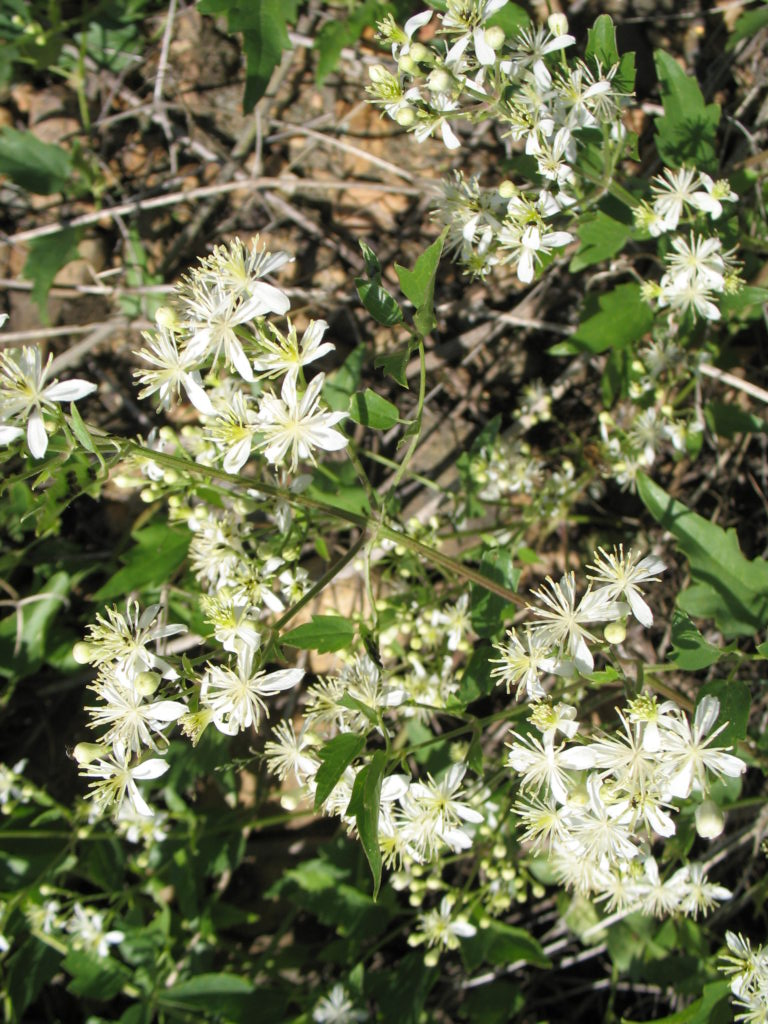
Gilpin County has several native Clematis which are NOT noxious weeds.
One of these is a vigorous, sprawling vine which can sometimes be mistaken for Chinese Clematis – particularly when it’s not in flower.
Western, or Virgin’s Bower Clematis, Clematis ligusticifolia, has white flowers (not yellow).
After they have gone to seed, you can tell them apart by the fact that Chinese clematis has solitary, larger seed heads (golf ball size), and the Native clematis has clusters of 3 seed heads (ping pong ball size) somewhat like the tines of a fork).
The native clematis can be valuable for erosion control and other ecosystem functions.