


Noxious Weed Facts
- Knapweeds can cut forage and infestations may reduce grazing capacity 50–75%.
- They “chemically cheat” by releasing compounds into soil that suppress neighboring plants.
- They come back without follow-up: Herbicides can work, but reinvades are common unless you also rebuild competition (like reseeding/encouraging desirable grasses) and stay consistent.
Knapweed can reduce cattle carrying capacity of rangeland or pastures by 50 to 75%. This plant secretes chemical into the soil that kills and prevents other plants from growing.
Diffuse knapweed is short-lived perennial, a biennial, or occasionally an annual. Reproduces and spreads from seed. Plant develops single shoot (stem), 1–2′ tall or more, usually branched toward top. Flowers usually white but may be purplish.
Spotted knapweed is short-lived, non-creeping perennial that reproduces from seed and forms new shoots each year from a taproot. Produces one or more shoots that are branched and 1–3′ tall. Rosette leaves can be 6″ long and deeply lobed. Leaves are similar to diffuse knapweed. Lavender to purple flowers are solitary on shoot tips. Flower heads of spotted knapweed are larger than those of diffuse knapweed.
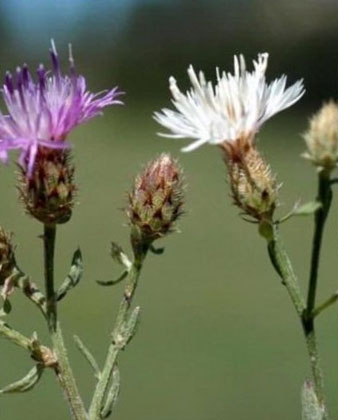
Diffuse and spotted knapweed are readily controlled with herbicides. Unless cultural techniques like planting desirable grasses are used, however, weeds will reinvade.
Contact Gilpin County Extension for specific herbicide instructions.
Important Notes
- Knapweed spreads rapidly
- Knapweed turns into tumbleweeds to disperse seeds
- Knapweed will reinvade unless consistently controlled
- State law: Diffuse knapweed must be eradicated or contained in Gilpin County. If you live in a “containment” area, it does NOT mean you can let the knapweed grow freely on your property.
State law: Diffuse knapweed must be eradicated or contained in Gilpin County. If you live in a “containment” area, it does NOT mean you can let the knapweed grow freely on your property.