


The reliability of the soil test results depends upon the quality of the sample submitted. A sample must reflect the overall or average fertility of an area, field, garden, or flower bed.
Tools
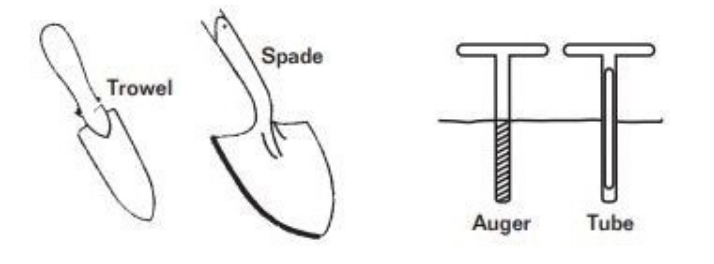
- A stainless steel soil-sampling probe, an auger, or a shovel/trowel (Figure 1)
- Clean bucket
- Plastic bags or water-proof lined paper bags
- Permanent marker
Sample Collection
Use a systematic and/or random sampling pattern to collect samples (Figure 2). Take 10 to 15 samples from the soil surface (0 inches) to a depth of 6 inches or 8 inches to form a representative composite sample.
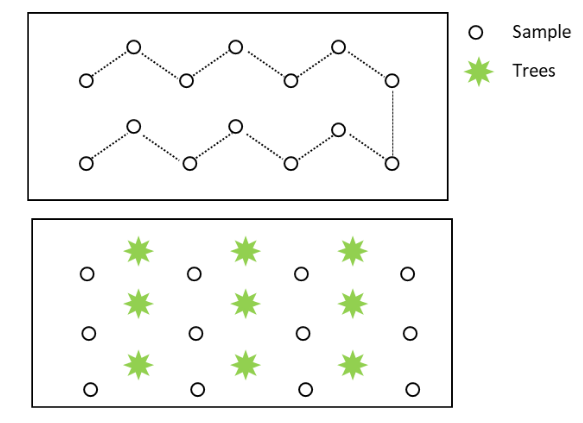
Sampling depth for turf or lawn soils is 2 inches to 3 inches. If you have areas with different crop growth, soil color, or fertilizer/amendment histories, take a sample from each area. Keep the samples separated.
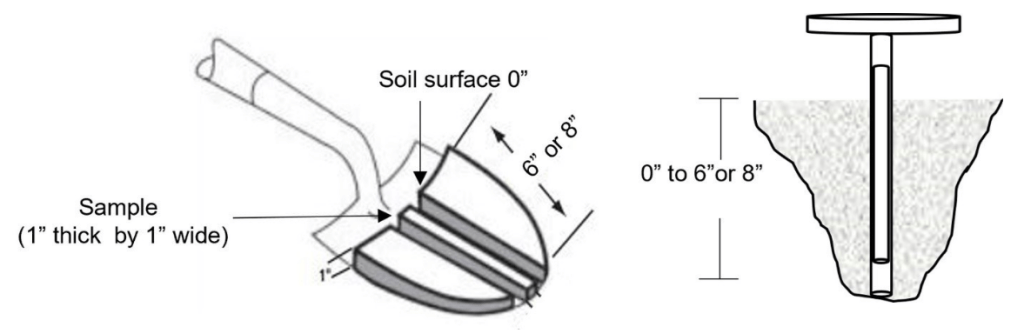
If a tool such as a spade is used, dig a V-shaped hole to sample depth (6 inches—8 inches); then cut a thin (approximately 1 inch thick) slice of soil from one side of the hole. For the sample, save a 1-inch-wide strip of soil from the center of the spade (Figure 3).
When using an auger for sampling, bore a hole to the desired sampling depth and then withdraw it. Replace the auger tip with a core sampler, lower it down the borehole in to the soil at the completion depth. Withdraw the tube core sampler and the sample collected.
Deeper subsoil samples (8 inches to 24 inches) are needed for nitrate-nitrogen (NO3-N), chloride (Cl–) and sulfate – S (SO4-S) analyses if nitrogen (N) and sulfur (S) fertilizer recommendations are of special importance. Because these nutrients are mobile in the soil, a test of available nitrogen (and/or chloride and sulfate) in the subsoil sample will provide a more complete picture of available mobile nutrients and can save fertilizer expenses. Keep each depth separated.
Make sure to remove and discard surface litter (crop residue, grass, wood chips, manure, roots, or rocks/gravel). Place each sample depth in a separated clean bucket, mix thoroughly until you have a homogeneous mixture. This is your representative composite sample.
Take and place two cups (approximately one pound) of representative sample into a plastic or water-proof lined paper bag. Using a permanent marker, label the bag with your name, sample depth increment, and some sort of sample identifier such as FIELD1, GARDEN1, LAWN, BACKYARD, etc. Fill out the appropriate submittal form. These forms are available at the CSU County Extension Offices and the CSU Soil, Water and Plant Testing Laboratory webpage. Make sure that the sample ID on your bag matches the ID on the submission form.
Shipping
Place sample(s) and submittal form in a sturdy box or envelope. Seal the box with packing tape and mail to the address in the submittal form. Do not include payment. You will receive an invoice and the soil testing results when testing is complete.
Other Resources
Soil, Water, and Plant Testing Laboratory
Location: 4780 National Western Drive, Denver, CO 80216
Email: soiltestinglab@mail.colostate.edu
Phone: (970) 491-5061