


Quick facts…
- Japanese beetle adults chew flower blossoms and leaves of many commonly grown plants.
- Japanese beetle larvae are a type of white grub that feeds on the roots of mainly grasses, nursery stock, ornamentals, and vegetables.
- Adults are best controlled by handpicking or with certain insecticide sprays.
- Japanese beetle traps can capture many adults but have never been shown to reduce damage to nearby plants.
- Japanese beetle larvae can be controlled with certain insecticides or by insect parasitic nematodes.
Introduction
For over a century, the Japanese beetle (Popillia japonica) has been one of the most seriously damaging insect pests of both turfgrass and landscape plants over a broad area of the eastern US. Recently, there have become a few permanent, reproducing populations of this insect in many communities along the Front Range of Colorado and on the Western Slope in Mesa County. At some of these sites, high numbers of Japanese beetles regularly occur and adult beetles cause significant damage to leaves and flowers of many susceptible landscape plants.
Figure 1
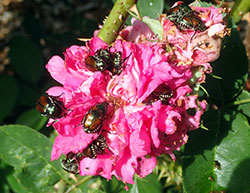
favored foods of Japanese beetles.
Description of the Japanese Beetle
The adult Japanese beetle has an oval form is about 7/16-inch in length, about the size of a coffee bean. It is generally metallic green with coppery-brown wing covers, which do not quite cover the tip of the abdomen. Along the sides are five patches of whitish tufts of hairs. The antennae are clubbed at the end and may spread to a fan-like form.
Japanese beetles belong to the same family of beetles as rose chafers—both are scarab beetles (Scarabaeidae)—a large group known for their stout bodies, clubbed antennae, and leaf-feeding adults. These beetles are closely related and often share similar life cycles, with larvae that develop underground and adults that feed on a wide range of plants.
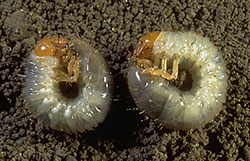
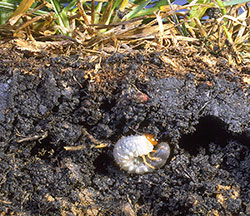
Figure 2
Japanese beetle larvae are a type of white grub that feeds on the roots of grasses and several other types of plant roots. They have a creamy white body with a dark head and the legs on the thorax are well developed. Normally the body curves into a “C-shape”. These features are also typical of other white grubs found in association with turfgrass in Colorado, such as masked chafers and May/June beetles. (Extension fact sheet Billbug and White Grub Management in Lawns discusses white grubs of turfgrass in more detail.) Japanese beetle larvae are slightly smaller than these other species when full grown, but they are best distinguished by closely examining the pattern of hairs on the hind end of the abdomen (‘rastral pattern’), which forms a distinctive V-shape. Their bodies are soft and slightly translucent, often with a darker hind end due to the contents of their digestive tract. A 10x hand lens is needed to view the hairs.
Figure 3
Photograph courtesy of David Shetlar, the
Ohio State University.
Japanese Beetle Damage
Japanese beetle larvae and adults can damage plants. However, the types of injuries produced by adults and larvae are very different.
Figure 4
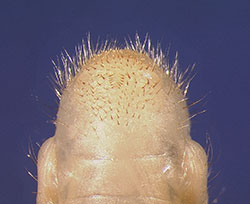
grubs of the Japanese beetle. The rastral pattern
is located on the underside of the tip of the
abdomen. Photograph courtesy of David Shetlar,
the Ohio State University.
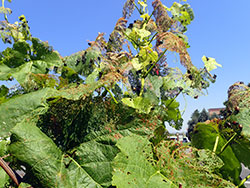
Injury by the adults is more obvious and is usually the primary concern in Colorado. Adults feed on leaves, buds, and flowers of many common garden and landscape plants (Table 1). On leaves, feeding is usually restricted to the softer tissues between the larger leaf veins, which results in a characteristic feeding pattern known and described as “skeletonizing”. More generalized ragged feeding occurs on softer tissues, notably flower petals; rose flowers are particularly susceptible to Japanese beetle injury. Damage on individual plants may be patchy, concentrated where aggregations of feeding beetles occur.
Japanese beetle larvae feed on roots of grasses, in a manner similar to other white grubs that damage turf. These injuries produce root pruning that limits the plant’s ability to acquire water. Damaged areas of turfgrass are more susceptible to water stresses and severely pruned roots can lead to plant death by drought. It is likely that there will be increasing turfgrass damage in areas where this species becomes established, adding to the damage done by native white grubs present in Colorado turfgrass (e.g., masked chafers, May/June beetles).
Figure 5
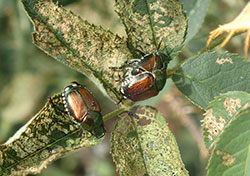
Table 1. Some plants that are most commonly damaged by Japanese beetle adults.
| Virginia Creeper | Grape |
| Rose | Crabapple, apple |
| American linden | American elm |
| American mountain-ash | Norway maple |
| Horsechestnut | Green beans |
| Raspberry |
Figure 6
Photograph courtesy of David Shetlar, the
Ohio State University.
Japanese Beetle Life History
Japanese beetle has a one-year life cycle. Adults may begin to emerge from the soil in early June and are usually most abundant in early summer – from late June through early August. However, some adults may be found into September.
As adults, Japanese beetles can be found feeding and mating on foliage and flowers of their host plants. Periodically, mated females will move in late afternoon to areas of turfgrass to lay eggs. They seek areas where soil is suitably moist and then dig 2-3 inches where they will lay a small cluster of eggs among the plant roots. They subsequently emerge and will resume feeding on host plants, returning to turfgrass later to lay more eggs. A total of 40-60 eggs may be laid by each Japanese beetle female during the course of her 4-8 week life span.
Figure 7
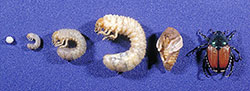
left to right: egg, larva (stage I), larva (stage II),
larva (stage III), pupa, adult.
Upon hatching from the eggs the grubs (larvae) seek out nearby plant roots and feed. During the time Japanese beetles are in the egg and earliest grub stage they are quite sensitive to drying and may die if soils temporarily dry during this period. Later stage larvae are less sensitive to drying. Japanese beetle larvae become nearly full-size by early September and their rapid development during late summer can cause extensive root pruning. Surface symptoms of injury may be present at this time, with damaged grass appearing drought stressed.
Larvae continue to feed until soil temperatures drop to about 60 degrees F, at which time the larvae move deeper in the soil where they remain through winter. All activity ceases when soil temperatures drop below 50 degrees F. Activity resumes as soils warm in spring and, after a feeding period of about 4-6 weeks, the larvae form an earthen cell and pupate. A few weeks later, the pupal stage is completed and the new adults emerge.
Control of Adult Japanese Beetles
Japanese Beetle Trapping. Traps are available that can capture Japanese beetle adults. These typically have a vane of yellow panels at the top with a funnel underneath into which the beetles fall after impacting the panels. A lure of floral-based compounds is used that is highly attractive to adults.
Large numbers of adult beetles can be captured in these traps and they are useful for detecting the presence of Japanese beetle for survey purposes. The traps also have some value in control where Japanese beetles are restricted to a very limited location; mass beetle trapping was a component of the Japanese beetle eradication in Palisade, CO in the early 2000s.
Figure 8
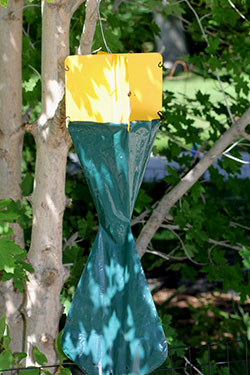
of the Japanese beetle.
Unfortunately, Japanese beetle traps are ineffective for control where Japanese beetle is well established over a large area, common now in many Front Range locations. Repeated trials have demonstrated that use of such traps does not reduce the number of beetles damaging nearby vegetation. Furthermore, the use of Japanese beetle traps often increases damage by Japanese beetles by drawing into the vicinity larger numbers of beetles than are captured in the traps. Because of this, Japanese beetle traps are not recommended for Japanese beetle control.
Hand picking. Hand picking beetles can sometimes be effective in small plantings. The beetles are easily picked or dislodged; shaking infested plants over a collecting container in the early morning, when temperatures are cool, can be particularly productive. Japanese beetles exhibit a defense behavior called thanatosis—playing dead—where they drop from plants when disturbed. A swift shake or knock to infested foliage causes the beetles to release their grip and fall to the ground, making them easy targets for hand-picking or for collecting in a container of soapy water, which quickly kills them. The regular removal of beetles prevents the feeding damage produced by the beetles, which can reduce the production of chemicals produced by wounded plants that are attractive to the adult beetles.
Figure 9
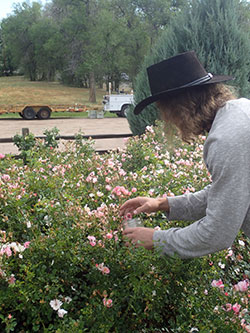
reduce damage by Japanese beetle.
Insecticides. There are several insecticides that can be used to help control damage by adult Japanese beetles (Table 2). These different insecticides vary considerably in features such as how long they can persist and control beetles, what plants they can be used on, whether they move systemically in the plant, and their hazard to desirable insects, notably pollinators.
If Japanese beetles are damaging flowering plants, this last feature, the potential for hazard to pollinators is very important in determining what kinds of insecticides can be used. Insecticides that are highly toxic to bees and can persist long enough to kill insects for days are hazardous to pollinating insects that visit the flowers. These include products with the active ingredients carbaryl, bifenthrin, beta-cyfluthrin, lambda-cyhalothrin, permethrin, and imidacloprid. These insecticides normally have label instructions to prohibit their use when there are flowers in bloom that are attractive to bees.
Abiding by the new EPA label language designed to protect pollinators is not only best practice—it’s a legal obligation for all pesticide applicators. These label instructions are enforceable under federal law and following them ensures applicators are doing their due diligence to minimize harm to bees and other beneficial insects.
Figure 10
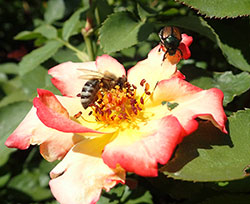
visiting flowers on which Japanese beetles
are feeding. In these situations, there must be
special care when using insecticides to avoid
killing pollinators.
Some insecticides, which are less toxic to bees or persist for only a short period, can be used on plants that are in flower if applications are made during times of the day–early morning and dusk–when bees are not active and visiting plants. Many applicators choose to spray at night when bees are inactive as an added precaution, allowing insecticides to dry thoroughly before pollinators visit the plants the next day. This practice helps reduce the risk of exposing beneficial insects to harmful residues. Examples of products include pyrethrins, azadirachtin, and acetamiprid.
A couple of insecticides do not have restrictions for use on plants in bloom because they have very little, if any, toxicity to bees. These include Bacillus thuringiensis var. galleriae (beetleJUS, beetleGONE!) and chlorantraniliprole (Acelepryn, Durentis). At present, the former are only available through mail order. Acelepryn and Durentis are available to licensed pesticide applicators.
Figure 11
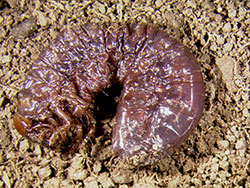
Heterorhabitis bacteriophora. Grubs that
are infected by this nematode turn a
reddish-brown color. Photograph courtesy of
David Shetlar, the Ohio State University.
Control of Japanese Beetle Grubs in Lawns
Japanese beetle grubs can damage turfgrass in the same manner as other turfgrass white grubs. (See Extension Fact Sheet Billbugs and White Grubs). Some cultural practices can limit damage and applied chemical or biological controls may also be useful. However, control of Japanese beetle larvae in a yard will have very little, if any, effect on the number of Japanese beetle adults feeding on trees, shrubs and garden plants. The insect is highly mobile so that problems with adult beetles typically involve insects that have moved a considerable distance.
Cultural Controls. Mowing can affect the susceptibility of lawns to grub damage. This is because the size of the root mass increases along with mowing height. Therefore, turfgrass that is mowed higher and has a larger amount of roots can better tolerate root damage that does occur. Conversely, lawns mowed shorter will have a smaller mass of roots and plants become more susceptible to grub damage.
Watering can have several effects. Japanese beetle eggs and the tiny early stage larvae are very susceptible to drying. If the top couple of inches of soil in a lawn can be allowed to dry a bit during the time eggs are being laid and hatching – July and early August – then many may be killed. Since higher temperatures during this period tend to make plants more susceptible to water stress, growing lawns in a manner that promotes deep root growth can allow the lawn to be more tolerant of some soil drying. One way that this can be achieved is through deep, but less frequent, irrigation during spring.
If grubs have already caused some root injury, usually in late August and September, then watering may need to be increased a bit to keep soils moist enough to promote regrowth of roots.
Anything that can improve growing conditions-watering, fertilization, core aeration, mowing-can allow turfgrass plants to better tolerate root damage white grubs produce. (See Extension Fact Sheet Lawn Care)
Biological Controls. Soil drench applications of certain kinds of insect parasitic nematodes can provide good control of Japanese beetle grubs in lawns. Specifically effective are certain nematodes in the genus Heterorhabditis (e.g., Heterorhabditis bacteriophora, H. megadis) and several biological control suppliers will provide these organisms. Applications of Heterorhabditis nematodes are made as a soil drench, preferably during cool, overcast periods, and must be immediately watered into the turfgrass. They should be applied when Japanese beetle larvae are present and active.
A new product being marketed for control of white grubs is a strain (galleriae) of the bacterium Bacillus thuringiensis that specifically affects adults and larvae of scarab beetles such as Japanese beetle. It is presently being sold as grubGONE! and is best applied against small larvae in early-midsummer.
Another biological control that has received considerable past attention for Japanese beetle control is milky spore (Paenibacillus popilliae), a bacterium that produces “milky disease” in Japanese beetle grubs. (The currently available formulation is sold under the trade name St. Gabriels’ Organics Milky Spore Powder.) Milky spore is applied to turfgrass areas where Japanese beetle grubs are active and may infect some of the grubs, producing a chronic infection that reduces survival and reproduction. Applications of milky spore powder will not produce immediate reductions in number of Japanese beetles. If an application of milky spore is able to result in successfully infecting some grubs, then milky spore will continue to reproduce and spread on its own. In areas of the eastern United States, where milky spore has long been widespread, it annually infects a small number of grubs, resulting in some reduction of the Japanese beetle populations (less than 5%).
Insecticides for grub control. Several insecticides (Table 3) are presently available that can provide excellent control of Japanese beetle grubs in lawns. Most commonly available are insecticides that are applied preventively to kill young grub stages. These include imidacloprid (Merit, Zenith, several retail products), chlorantraniprole (Acelepryn, Durentis, Scott’s GrubEx), and chlothianidin (Arena), all of which can provide control of Japanese beetle larvae over an extended period (several weeks-months). Applications of these types of products are best made just before eggs hatch or shortly after this time (typically mid-June to early July).
Rates of use are dependent on time of application with lower rates being adequate when applied against younger larvae in early summer. Higher rates are needed when late-stage larvae are present. Control will diminish if applications are made later in the season, when grubs are large, and these products will often give disappointing results when used in “rescue” treatments for existing infestations in advanced stages.
The insecticide trichlorfon (Dylox, BioAdvanced 24 Hour Grub Killer Plus Granules) has a more limited use for control of Japanese beetle grubs. This insecticide is able to move quickly into the soil and can provide fairly rapid kill compared to other treatments. However, it very rapidly degrades in soil, particularly high pH soils, common in Colorado. This insecticide is sometimes used for “rescue treatments”, applied to grubs present later in summer after all eggs have hatched.
There can be some risk to pollinators if insecticides are applied to lawns that have flowering plants attractive to bees. If flowering plants are present in a site that is to receive an insecticide application, it should be mowed immediately before treatment to remove the attractive blooms.
Insecticides containing only a pyrethroid (e.g., gamma-cyhalothrin, lamda-cyhalothrin, zeta-cypermethrin, permethrin, and bifenthrin) will not effectively control grubs. These insecticides are particularly good for persisting on turf surfaces. However, none of these will move into soil and cannot control larvae of either billbugs or white grubs.
Table 2. Insecticide options for control of adult Japanese beetles on leaves and flowers. Products with an asterisk * are packaged for sale to professional applicators.
| Trade Name/Insecticide Formulation | Active Ingredient | Insecticide Class | Application Method | Recommended Timing | Persistence | Comments | Pollinator Hazards, Cautions |
|---|---|---|---|---|---|---|---|
| Tristar*, Ortho Flower, Fruit, and Vegetable Insect Killer | acetamiprid | Neonicotinoid | Liquid/Spray | Early-Mid Spring | Moderate | Moves systemically within plants. Label allows use on some fruits and vegetables. | Can be used on plants that are in blossom but cannot be applied at times when bees are visiting (i.e., dusk, dawn applications allowed). |
| BioNeem, Azasol, AzaMax, AzaGuard*, others | azadirachtin | Unspecified botanical origin | Liquid/Spray | June-September | Short (Days) | Allowed for essentially all food crops. | Hazardous to bees if directly sprayed. Can be used on plants that are in blossom but cannot be applied at times when bees are visiting (i.e., dusk, dawn applications allowed). |
| beetleGONE!, beetleJUS! | Bacillus thuringiensis var. galleriae | Microbial | Liquid/Spray | June-September | Short (Days) | Acts as stomach poison that causes beetles to stop feeding very shortly (hours) after it is eaten. Beetles may not die for several days. | Very low hazard to bees. Can be applied to plants that are in flower and are being visited by pollinators |
| Ortho Max Insect Killer for Lawns and Gardens, Talstar*, Onyx* | bifenthrin | Pyrethroid | Liquid/Spray | June-September | Moderate-Long | Provides control of damage for about a week. | High hazard and can kill bees for days after application. Cannot be used on plants bees visit that are in bloom. |
| Sevin, Carbaryl | carbaryl | Carbamate | Liquid/Spray | June-September | Moderate-Long | Provdes control of damage for about a week. Label allows many food crop uses. | High hazard and can kill bees for days after application. Cannot be used on plants bees visit that are in bloomLabel allows many food crop uses. |
| Acelepryn SC*, Durentis* | chlorantraniliprole | Diamide | Liquid/Spray | June-September | Moderate-Long | Provides control of damage for about a week. No food crop uses are allowed. | Very low hazard to bees. Can be applied to plants that are in flower and are being visited by pollinators. Not marketed for retail. |
| Tempo, BioAdvanced Rose and Flower Insect Killer DualAction (with imidacloprid), BioAdvanced Vegetable and Garden Insect Spray | beta-cyfluthrin, cyfluthrin | Pyrethroid | Liquid/Spray | June-September | Moderate | Provides control of damage for days-week. Some uses allowed for products that solely contain beta-cyfluthrin; formulations with imidacloprid do not allow food crop uses. | High hazard and can kill bees for a day or two after application. Cannot be used on plants bees visit that are in bloom. |
| Triazicide Insect Killer for Lawns and Landscapes | gamma-cyhalothrin | Pyrethroid | Liquid/Spray | June-September | Moderate | Provides control of damage for days-week. Labeled for use on many vegetable and most fruit crops. | High hazard and can kill bees for days after application. Cannot be used on plants bees visit that are in bloom. |
| Merit, Mallet*, Bonide Systemic Insect Spray, BioAdvanced 2-in-1 Systemic Rose & Flower Care, BioAdvanced Tree & Shrub Protect & Feed, BioAdvanced Fruit, Citrus and Vegetable Insect Killer Hi-Yield Systemic Insect Granules, ferti-lome Tree & Shrub Systemic Insect Drench, others | imidacloprid | Neonicotinoid | Varies | June-September | Moderate | Sprays can provide control of damage for days-week. Some products may provide control for up to a year. Moves systemically within plants. | High hazard to bees. Do not apply when bees are foraging. Do not apply to plants that are flowering. Only apply after all petals have fallen off. |
| Bonide Eight Insect Control Vegetable, Fruit & Flower, Astro*, Permethrin, others | permethrin | Pyrethroid | Varies | June-September | Short-Moderate | Provides control of damage for a few days. Label uses include most vegetable and many fruit crops | High hazard and can kill bees for a day or two after application. Cannot be used on plants bees visit that are in bloom. |
| Pyganic*, many retail formulations | pyrethrins | Botanical | June-September | Short | Provides control of damage for a day or two. Uses allowed for essentially all food crops. | Hazardous to bees if directly sprayed. Can be used on plants that are in blossom but cannot be applied at times when bees are visiting (i.e., dusk, dawn applications allowed). |
| Common Name (Insecticide Class) | Trade Names | Persistence of control | Labeled Uses on Food Crops | Pollinator Hazards, Cautions |
|---|---|---|---|---|
| acetamiprid (neonicotinoid) | Tristar, Ortho Flower, Fruit, and Vegetable Insect Killer | Moderate persistence; provides control of damage for days-week. Moves systemically within plants. | Label allows use on some fruits and vegetables. | Can be used on plants that are in blossom but cannot be applied at times when bees are visiting (i.e., dusk, dawn applications allowed). |
| azadirachtin (unspecified, botanical origin) | BioNeem, Azasol, AzaGuard, AzaMax, others | Short persistence; provides control of damage for a couple of days. | Uses allowed for essentially all food crops. | Hazardous to bees if directly sprayed. Can be used on plants that are in blossom but cannot be applied at times when bees are visiting (i.e., dusk, dawn applications allowed). |
| Bacillus thuringiensis var. galleriae (microbial) | beetleGONE!, beetleJUS! | Persistence is 2-3 days. Acts as stomach poison that causes beetles to stop feeding very shortly (hours) after it is eaten. Beetles may not die for several days. | Many food crop uses are allowed. | Very low hazard to bees. Can be applied to plants that are in flower and are being visited by pollinators. |
| bifenthrin (pyrethroid) | Ortho Max Insect Killer for Lawns and Gardens, Talstar, Onyx | Persistence moderate-long; provides control of damage for about a week. | No food crop uses are allowed. | High hazard and can kill bees for days after application. Cannot be used on plants bees visit that are in bloom. |
| carbaryl (carbamate) | Sevin, Carbaryl | Persistence moderate-long; provides control of damage for about a week. | Label allows many food crop uses. | High hazard and can kill bees for days after application. Cannot be used on plants bees visit that are in bloom. |
| chlorantraniliprole (diamide) | Acelepryn SC | Persistence moderate-long; provides control of damage for about a week. | No food crop uses are allowed. | Very low hazard to bees. Can be applied to plants that are in flower and are being visited by pollinators. Not marketed for retail. |
| beta-cyfluthrin (pyrethroid) | Tempo, Bayer Advanced Rose and Flower Insect Killer (with imidacloprid), Bayer Advanced Vegetable and Garden Insect Spray | Moderate persistence; provides control of damage for days-week. | Some uses allowed for products that solely contain beta-cyfluthrin; formulations with imidacloprid do not allow food crop uses. | High hazard and can kill bees for a day or two after application. Cannot be used on plants bees visit that are in bloom. |
| gamma-cyhalothrin (pyrethroid) | Triazicide Insect Killer for Lawns and Landscapes | Persistence moderate; provides control of damage for days-week. | Labeled for use on many vegetable and most fruit crops. | High hazard and can kill bees for days after application. Cannot be used on plants bees visit that are in bloom. |
| imidacloprid (neonicotinoid) | Merit, Mallet, Zenith, Bonide Systemic Insect Spray, Bayer Advanced 2-in-1 Systemic Rose & Flower Care, Bayer Advanced Tree & Shrub Protect & Feed Bayer Advanced Fruit, Citrus and Vegetable Insect Killer Hi-Yield Systemic Insect Granules, Ortho Bug B Gon Year-Long Tree & Shrub Insect Control, ferti-lome Tree & Shrub Systemic Insect Drench, others | Moderate persistence; sprays can provide control of damage for days-week. Moves systemically within plants. | Variable, depending on formulation. Many products that have imidacloprid as the sole active ingredient also allow use on some fruits and vegetables | High hazard to bees. Do not apply when bees are foraging. Do not apply to plants that are flowering. Only apply after all petals have fallen off. |
| permethrin (pyrethroid) | Bonide Eight Insect Control Vegetable, Fruit & Flower; Bayer Advanced Complete Insect Dust for Gardens; Ace House & Garden Bug Killer2, Astro, Permethrin, others | Short to moderate persistence. Provides control of injury for a few days. | Label uses include most vegetable and many fruit crops. | High hazard and can kill bees for a day or two after application. Cannot be used on plants bees visit that are in bloom. |
| pyrethrins (botanical) | Pyganic, many retail formulations | Very short persistence; provides control for a day or two. | Uses allowed for essentially all food crops. | Hazardous to bees if directly sprayed. Can be used on plants that are in blossom but cannot be applied at times when bees are visiting (i.e., dusk, dawn applications allowed). |
Table 3. Insecticide and Biological Control Options for Control of Japanese Beetle Larvae (White Grubs) in Lawns
Grub Control Products Intended for Sale to Homeowners
| Trade Name/Insecticide Formulation | Active Ingredient | Insecticide Class | Application Method | Recommended Timing | Persistence | Comments | Pollinator Hazards, Cautions |
|---|---|---|---|---|---|---|---|
| Hi-Yield Grub Free Zone II | Imidacloprid | Neonicotinoid | Broadcast Granules | June-early August | Moderate-long | Weeks | Fairly fast (a couple of weeks) in providing control of grubs following application. Moves systemically in plants. Hazardous to bees if applied when flowering plants in lawns are present during application |
| BioAdvanced Complete Insect Killer | Imidacloprid & beta-cyfluthrin | Neonicotinoid | Broadcast Granules | June-early August | Moderate-long | Weeks | Moves systemically in plants. Hazardous to bees if applied when flowering plants in lawns are present during application |
| BioAdvanced Season Long Grub Control Plus Turf Revitalizer | Imidacloprid | Neonicotinoid | Broadcast Granules | June-early August | Moderate-long | Weeks | Moves systemically in plants. Hazardous to bees if applied when flowering plants in lawns are present during application |
| Bonide Grub Beater | Imidacloprid | Neonicotinoid | Broadcast Granules | June-early August | Moderate-long | Weeks | Moves systemically in plants. Hazardous to bees if applied when flowering plants in lawns are present during application |
| GrubEx | Chlorantraniliprole | Diamide | Broadcast Granules | May-June | Very long | Weeks | Moves relatively slowly into soil. Has some ability to move systemically in plants. Very low hazard to bees. Very low hazard to humans, pets. |
| Bayer Advanced 24 Hour Grub Killer Plus Granules | Trichlorfon | Organo-phosphate | Broadcast Granules | July-September | Short | Days | Fast acting. Used to control existing problems with white grubs. Must be watered in immediately after application. Breakdown is very rapid (days), particularly in high pH soils. Fairly low hazard to bees; where flowering weeds are present mowing before application greatly reduces risk to pollinators. Label recommends July -September |
| grubGONE! | Bacillus thuringiensis var. galleriae | Microbial (bacterium) | Broadcast | Mid-July – Mid-August | Short | Days | Best used after most eggs have hatched and grubs are still in young stages. Kills larvae through disruption of midgut. A very new product with little data yet available to make efficacy comparisons with other products. |
| HeteroMask | Heterorhabditis bacteriophora | Insect parasitic nematode | Mix with water and spray into soil | June-August? | Moderate?? | Days | These are living organisms (minute nematodes/roundworms). Treatments should be made when grubs are present and soil temperatures are warm. Control is usually rapid (days after treatment) and infected grubs turn a reddish-brown color. |
| NemaSeek | Heterorhabditis bacteriophora | Insect parasitic nematode | Mix with water and spray into soil | June-August? | Moderate?? | Days | These are living organisms (minute nematodes/roundworms). Treatments should be made when grubs are present and soil temperatures are warm. Control within days. Infected grubs turn a reddish-brown color. |
| Heterorhabditis bacteriophora | Insect parasitic nematode | Mix with water and spray into soil | June-August? | Moderate?? | Days | Packages of nematodes are available from a variety of online sellers and local garden centers. Look for products containing Heterorhabditis bacteriophora nematodes. | |
| St. Gabriel Organics Milky Spore | Milky spore (Paenibacillus popilliae) | Microbial (bacterium) | Broadcast | June-August? | Moderate?? | Years | Not a product that can be expected to provide any noticeable control for years. Milky spore will usually spread on its own over time once applied to a turfgrass site. Experience in areas where this organism has long been present indicates it provides modest effects, killing a small percentage (<5%) of the white grubs. Infected grubs turn a milky color |
Grub Control Products Intended for Sale to Professional Applicators
| Trade Name/Insecticide Formulation | Active Ingredient | Insecticide Class | Application Method | Recommended Timing | Persistence | Comments | Pollinator Hazards, Cautions |
|---|---|---|---|---|---|---|---|
| Merit | Imidacloprid | Neonicotinoid | Broadcast Granules | June-early August | Moderate-long | Weeks | Fairly fast (a couple of weeks) in providing control of grubs following application. Moves systemically in plants. Hazardous to bees if applied when flowering plants in lawns are present during application |
| Mallet | Imidacloprid | Neonicotinoid | Broadcast Granules | June-early August | Moderate-long | Weeks | Fairly fast (a couple of weeks) in providing control of grubs following application. Moves systemically in plants. Hazardous to bees if applied when flowering plants in lawns are present during application |
| Zenith 2F | Imidacloprid | Neonicotinoid | Spray | June-early August | Moderate-long | Weeks | Fairly fast (a couple of weeks) in providing control of grubs following application. Moves systemically in plants. Hazardous to bees if applied when flowering plants in lawns are present during application |
| Arena | Chlothianidan | Neonicotinoid | Broadcast Granules | May-August | Long | Weeks | Has long persistence. Can provide control if applied from May into August. Fairly fast (a couple of weeks) in providing control of grubs following application. Moves systemically in plants. Hazardous to bees if applied when flowering plants in lawns are present during application. |
| Acelepryn SC | Chlorantraniliprole | Diamide | Spray | May-June | Very long | Weeks | Moves relatively slowly into soil. Fairly slow (weeks) in providing control after application. Has some ability to move systemically in plants. Very low hazard to bees. Very low hazard to humans, pets. |
| Acelepryn G | Chlorantraniliprole | Diamide | Broadcast Granules | May-June | Very long | Weeks | Moves relatively slowly into soil. Fairly slow (weeks) in providing control after application. Has some ability to move systemically in plants. Very low hazard to bees. Very low hazard to humans, pets. |
| Durentis | Chlorantraniliprole | Diamide | Spray | May-June | Very long | Weeks | Moves relatively slowly into soil. Fairly slow (weeks) in providing control after application. Has some ability to move systemically in plants. Very low hazard to bees. Very low hazard to humans, pets. |
| Dylox | Trichlorfon | Organo-phosphate | Broadcast Granules | Short | Days | Must be watered in immediately after application. Breakdown is very rapid (days), particularly in high pH soils. Fairly low hazard to bees; where flowering weeds are present mowing before application greatly reduces risk to pollinators. | |
| HeteroMask | Heterorhabditis bacteriophora | Insect parasitic nematode | Mix with water and spray into soil | June-August | Moderate | Days | These are living organisms (minute nematodes/roundworms). Treatments should be made when grubs are present and soil temperatures are warm. Control is usually rapid (days after treatment) and infected grubs turn a reddish-brown color. |
| NemaSeek | Heterorhabditis bacteriophora | Insect parasitic nematode | Mix with water and spray into soil | June-August | Moderate | Days | These are living organisms (minute nematodes/roundworms). Treatments should be made when grubs are present and soil temperatures are warm. Control within days. Infected grubs turn a reddish-brown color. |
| Heterorhabditis bacteriophora | Insect parasitic nematode | Mix with water and spray into soil | June-August | Moderate | Days | Packages of nematodes are available from a variety of online sellers and local garden centers. Look for products containing Heterorhabditis bacteriophora nematodes. |
Reference: CSU Fact Sheet 5.601