


What the Nutrition Facts Label Tells Us
How much is one serving of this food?

- The size of one serving size is listed at the top, along with the number of servings in each package.
- The label tells you how many nutrients are in a serving, not how many are in the whole package.
What is the overall nutrient content of this food?
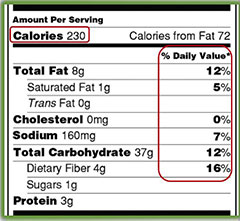
- Check how many calories are in each serving of food. On average, people need about 2,000 calories a day.
- Daily Value is the amount of a nutrient you should get each day. The % Daily Values tell you what percent of this daily amount is in one serving.
- 5% Daily Value or less means that a food is a low source of a nutrient. 20% Daily Value or more means that a food is a high source of a nutrient.
- Limit sodium, sugar, and saturated fat, but get enough fiber, vitamins, and minerals.
Am I getting enough vitamins and minerals?
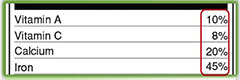
- These are not the only important vitamins and minerals, but they are ones that many Americans do not get enough of.
- Use the % Daily Value to make sure you are getting enough, and also to compare the nutrition of different foods.
Keep in Mind:
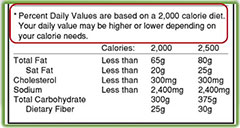
- The % Daily Values are averages for the whole population, based on an average 2,000 calorie per day diet.
- Your nutrient and calorie needs will vary somewhat based on your size, age, activity level, pregnancy, and other factors.
Understanding the Ingredients Label
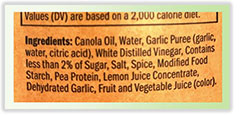
- The ingredients are listed in order, from highest to lowest. The first one in the list is present in the largest amount, by weight.
- The eight most common allergens must also be listed, either in the ingredients list OR they can be listed separately. These are: milk, egg, fish, crustacean fish, tree nuts, wheat, peanuts, and soybeans.
What’s New with Labels
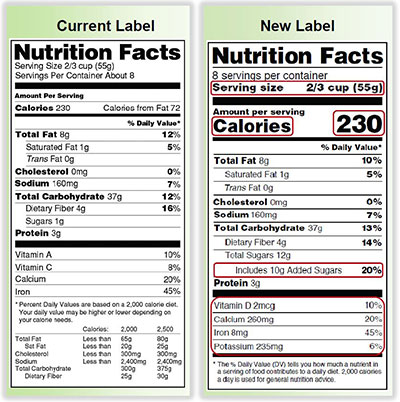
- Serving sizes are adjusted. For example, a 16 oz bottled drink must be labeled as one serving, not two, because it will likely be consumed in one sitting.
- The servings and calories are in larger type, to make them easier to read.
- “Added Sugars” are listed, to set them apart from the sugars that are found naturally in the food, for example in fruits.
- Added sugars should be less than 10% of your total daily calories.
- Americans are now more likely to not get enough Vitamin D and Potassium, so these replace Vitamins A and C.
Know what is in your food, read labels and make informed decisions about what you are consuming to optimize your health!
