


Value of a Soil Test
In the fields of agronomic crops, greenhouse crops, and turf, soil testing is a key tool in crop management for commercial producers.
In the home garden or landscape setting, soil testing is valuable in establishing a baseline, or in tracking changes, in soil limitations related to pH, salt levels, and the need for fertilizers. A special lead test would be of interest to homeowners with lead-based paints on older homes.
In some cases, soil testing may not paint the full picture. For example, soil test results for nitrogen can have limited use for the home gardener because the nitrogen level constantly changes in response to soil organic matter additions, soil microorganism activity, temperature, moisture levels, leaching, and nitrogen consumption by plants and other soil life.
Interpreting soil tests for landscape plants is difficult, as research to obtain general standards for those plants is lacking. A soil test for a maple tree, a native plant, or a gardener’s favorite peony, would be difficult to interpret based on standards used for general agronomic crops.
While a soil test provides information about a variety of characteristics important for plant health/growth, a standard soil test will not identify common garden problems related to over-watering, under-watering, poor soil drainage, soil compaction, diseases, insects, weed competition, environmental disorders, too much shade, poor varieties, or simple neglect.
Typical Test
A standard soil test typically includes the following:
- Texture (estimated by the hand – feel method)
- Organic matter (reported as a percent of the total dry soil weight)
- An estimated half a pound of nitrogen per 1,000 square feet will be released (mineralized to nitrate) during the growing season for each one percent organic matter present. This is dependent on various characteristics, such as climatic and soil conditions.
- pH
- Lime (CaCO3)
- In soils with “free lime,” sulfur will not effectively lower the pH
- Soluble salts (reported in mmhos/cm or dS/m)
- Nutrients (reported in parts per million), not limited to:
- Nitrate nitrogen
- Phosphorus
- Potassium
- Micronutrients such as copper, iron, manganese, and zinc
Additional tests could be run for special needs like lead content, heavy metals, or sodium problems.
Frequency
For a gardener, a soil test gives a useful baseline on soil salts, phosphorus, potassium, pH, and free lime content (or buffer index if acid).
In the neutral and alkaline soils of Colorado, repeat the test when changes are made to the crop being planted or to the soil (such as addition of larger quantities of manure, biosolids, or compost that may be high in salts), or approximately every one to three years to reestablish the baseline.
In other parts of the country where lime is routinely added to raise the pH on acid soils, a soil test may be needed annually.
Taking a Soil Sample
A soil sample may be taken at any time of year, although spring or fall sampling is usually the most convenient.
The results of a test are no better than the quality of the sample sent to the laboratory. The sample must be representative of the yard or garden being considered. Gardeners who try to shortcut the sampling procedure will not receive a reliable result.
Submit a sample for each area that receives different fertilizer and soil management treatments. For example, if the front and back lawn are fertilized and managed the same, the sample could include subsamples taken from both lawns and mixed together. Because garden areas are managed differently from lawns, the garden should be sampled separate from the lawn. Garden beds that receive differing amounts of fertilizers and soil amendments should be sampled separately from each other as well.
Samples are most easily collected using a soil tube or soil auger. A garden trowel, spade, bulb planter, or large knife also works. Discard any sod, surface vegetation or litter before sampling. Sampling depth is critical and varies for the type of test taken and for various labs. Follow sampling depth directions given by the laboratory. [Table 1]
Table 1. Sampling depth requirements for typical soil tests.
| Crop | Sample Depth (Inches) |
|---|---|
| Garden beds (vegetable & flower) | 0 through 6-8 inches |
| Lawns | 0 through 2-3 inches |
| Agricultural crops | 0 through 8 inches |
Figure 1. Soil sample sites.
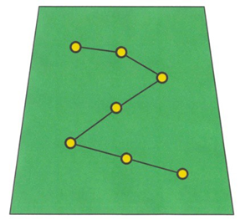
Use a systematic and/or random sampling pattern to collect samples (Figure 1). The number of samples you need to collect depends on the size and variability of the sampling area. In general, more samples are better as they provide a more accurate representation.. Take five or more subsamples from a relatively small area in the home lawn, flower border, or vegetable garden. Take ten to fifteen subsamples for larger areas.
Collect the subsamples in a clean plastic bucket, thoroughly mixing the subsamples together until you have a homogeneous sample. Do not oven-dry the sample.
Place about two cups of the soil mix into the sample bag or box. Label the sample container with an identifier (e.g., front lawn, vegetable garden, or flowerbed), your name, and sample depth. Keep a record of the area represented by each sample taken. Send the samples to a soil-testing laboratory, along with any forms required by that laboratory.
Climate and soil vary considerably in different parts of the country, so it is important to select a local laboratory that processes the alkaline calcareous soils of the mountain west. Future testing should be done with the same laboratory to make comparisons.
Soil tests are available from many local commercial providers as well as the CSU Soil Testing Lab.
Soil Test Recommendations
In production agriculture, it is common for a grower or fertilizer dealer to split a sample and send it to different laboratories. Because individual laboratories do not necessarily use the same soil test procedures, their availability indexes (the reported available nutrients) can, and frequently do, differ.
Laboratories can also differ in the objectives behind their recommendations. For example, are maximum yields the primary objective? In this scenario, the recommendations will likely be for increased fertilizer application, which can mean increased costs, and higher potential for leaching of fertilizers into ground water. In another example, the crop’s net return may be the primary objective, involve reducing production costs, (for instance, by reducing fertilizer use).
Plant needs and fertilizer practices may also impact recommendations. For example, before laying new sod add a single dose of fertilizer that is high in phosphorus, since phosphorous is important for the development of new roots. After establishment, the sod is maintained through annual additions of nitrogen fertilizer. Thus, context is critical in determining the appropriate recommendations (e.g., is a single or annual phosphorous application recommended?).
The recommendations resulting from a soil test need to be made by the laboratory doing the work, based on cropping information provided by the grower/gardener.
Home Soil Test Kits
Home soil test kits have questionable value. The accuracy of some tests is based on the pH of the soil being tested (e.g., a common phosphorous test is accurate only for soils with a pH less than 7.3). They may have questionable accuracy when testing the alkaline soils of the west. They also typically do not provide very precise metrics or any recommendations, so making decisions, such as determining fertilizer rates, based on home soil tests can be difficult.
The accuracy in home soil test procedures may, at best, give a ballpark reading but not precise accuracy. For example, the calibration on a home soil pH kit will tell the gardener that the soil has a pH level between 7 and 8. How close to 7 or 8 makes a huge difference for the growth of some plants. More precise measurement requires more expensive equipment.
This publication, reference GardenNotes #221, is developed as part of the Colorado State University Extension Master Gardener Program.