


Essential ingredients for the composting process include microorganisms, organic matter, water, and air (oxygen). The microbes that cause decomposition naturally occur on plant wastes. Compost starters or inoculums are not needed to start decomposition. The compost needs to be moist to the touch, but not soggy (excluding air). Air (oxygen) is essential for microbes. Too fine of particle size, excessive water, large amount of soil, and packing of materials may decrease oxygen levels.
What Items Should and Should Not be Composted?
Materials To Use
- Leaves.
- Garden debris free of diseases and weed seeds (i.e., carrot tops, chopped corn stalks, pea vines, spent flowers, etc.).
- Weeds, free of seeds.
- Kitchen scraps free of meat, dairy, fats, and oils.
- Shrub and tree trimmings smaller than one-quarter inch in diameter.
- Hay, straw, and other plant residues.
Materials To Avoid
- Weeds with seeds; seed may not be killed if compost pile(s) do not heat to 145°F.
- Diseased plants, including tomato and potato vines and potato peelings.
- Tree branches greater than quarter inch in diameter; large sizes should be run through a chipper first, as they will be very slow to decompose.
- Fats, oils, grease, meat, and dairy products (slows decomposition and attracts pests.)
- Kitchen scraps with meat, dairy, fats, oils, or grease.
- Pet or human feces may transmit diseases.
- Synthetic or plastic fiber does not decompose.
- Wood ash and lime drive up the pH of the soil.
Materials To Use With Limitations
Large amounts of grass clippings. Due the small particle size and high nitrogen of grass clippings, they tend to smell unless mixed with brown materials. Instead recycle the nutrients back into the lawn by not bagging.
Manure. Manures may contain strains of Escherichia coli and other bacteria that cause human illness. If manure is composted for food gardens, a four-month curing process following composting is necessary to reduce pathogens.
Large amounts of plants/weeds treated with pesticides (including herbicides, insecticides, and fungicides). Most pesticides readily break down in the composting process and present no threat as long as the decomposition process has been completed.
Large amounts of high tannin-containing leaves (oak and cottonwood). These are slow to decompose but can be used in small quantities if chopped well and mixed with other materials.
Large amounts of juniper, pine, spruce, and arborvitae trimmings. Resins in these highly resinous wood and leaf cuttings protect these materials from decomposition and extend the time needed for composting in comparison with other plant materials.
Large amounts of paper products. Newsprint is best recycled through recycling collection operations rather than converted to compost. If paper is composted due to a shortage of dry materials, add no more than 10% of the total weight of the material being composted. Higher amounts create imbalances in the carbon to nitrogen ratio. Do not use color printed glossy magazines as inks may not be safe as a soil additive.
Large amounts of soil. Some gardeners like to sprinkle small amounts of soil into the compost bin as a source of microbes. However, this is not necessary as small amounts of soil are routinely added with the roots of weeds and other plants. Large amounts of soil increase weight, decrease oxygen infiltration, and can suffocate microorganisms.
What Is the Carbon to Nitrogen Ratio?
For optimum processing, the ratio of carbon to nitrogen in the compost needs to be around thirty to one. This is typically the combination of two parts green materials with one-part brown materials. Compost piles too high in carbon will be slow to process or may not decompose. Piles too high in nitrogen develop strong ammonia odors. [Table 1]
Processing works best if the green and brown materials are mixed before adding to the pile. An alternative is to layer the green and brown materials. Layers should not be more than two inches deep for fine materials and six inches deep for coarse materials.
When only brown materials are used, nitrogen fertilizer may be added to supply the needed nitrogen for decomposition. The standard rate is one half cup ammonium sulfate (or equivalent) per bushel of brown materials.
Table 1. Examples of Green and Brown Materials
| Green Material | C:N ratio | Brown Materials | C:N ratio |
|---|---|---|---|
| Vegetable wastes | 12-20:1 | Dry leaves | 30-80:1 |
| Coffee grounds | 20:1 | Corn stalks | 60:1 |
| Grass clippings | 12-25:1 | Straw | 40-100:1 |
| Cow manure | 20:1 | Bark | 100-130:1 |
| Horse manure | 25:1 | Paper | 150-200:1 |
| Poultry manure | 10:1 | Wood chips | 100-500:1 |
| Poultry manure, with litter | 13-18:1 | Sawdust | 100-500:1 |
What Is the Ideal Location for the Compost Bin?
Choose a composting site carefully. Considerations include the following:
- Partial shade avoids baking and drying in summer but provides some solar heating to start the composting action.
- Wind protection prevents too much moisture loss.
- Water source to keep the pile moist but not soggy.
- City ordinances often prohibit compost bins within ten to twenty feet of property lines.
- Convenience for loading and unloading of materials away from yard activities.
What Is the Ideal Size and Type of Compost Bin?
Structures are not necessary for composting but do help prevent wind and marauding animals from carrying away plant wastes. Open compost piles can be used in less-populated rural locales, but structures are necessary in urban areas. Many composting structures can be purchased or built. They vary in how well they can be managed to meet the requirements for effective decomposition under Colorado environmental conditions.
Wire and wood structures are common for home composting. An inexpensive, easy-to-build type is made from hardware cloth (a stiff, lightweight wire mesh found with fencing materials at many hardware stores). A four-foot high by thirteen-foot length will make a small bin four feet across. Use wire to hold the length of hardware cloth into a round hoop. To unload the bin, unhook the wires holding the hoop in the circle.
Structures built of wire dry out faster, depending on exposure to drying winds. Plastic covers or tarps are often used to protect the outer layer from drying out. Covers are removed to add water and plant materials and to aerate the pile.
Wood structures do not dry out as much but are more expensive to purchase or build.
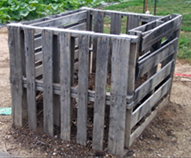
An inexpensive and easy to build bin is made from a wooden pallet. Use wire and deck screws to fasten sides, add hinges to the front section for easy access. The cost runs between $5 and $25. [Figure 1]
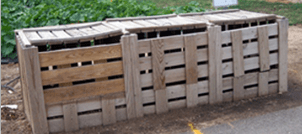
An efficient wood structure is the three-chambered bin system that allows plant material to be aerated by turning it from one bin to the next as it decomposes. New materials are put in the first bin to begin decomposition. After a few weeks, it is turned to the second bin for active decomposition. As the process naturally slows, it is turned to the third bin for further curing. [Figure 2]
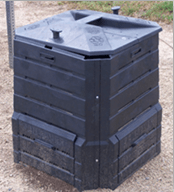
Many brands of small home compost bins are available commercially typically running $80 to over $100. Some are manufactured from recycled plastics. They work well for small yards that produce few plant wastes. [Figure 3]
Size – A minimum volume of material is necessary to build up the heat for efficient composting. When materials are heavy in green materials, keep the bin smaller to allow for better aeration. Three feet by three feet by three feet is considered the minimum size to allow for heating. This small size may be adequate for small yards with limited materials to compost. If composting fall leaves and materials high in brown materials, a larger bin (measuring five feet by five feet) may keep the processing going through the winter months.
In-ground pit composting presents problems with turning or aerating the plant material and can pool water, which leads to undesirable low oxygen conditions.
What Is the Routine Care of a Compost Pile?
The breakdown of organic yard wastes is a biological process dependent on microorganism activity. Like most living things, these microbes require favorable temperatures, moisture, oxygen, and nutrients.
Temperature – Plant-digesting microbes operate in a temperature range of 70°F to 140°F, with breakdown occurring slowly at the lower temperatures. Well-managed compost rapidly breaks down in summer when compost temperatures quickly reach 120°F to 130°F. If summer heat plus the heat produced by active microbes causes the temperature of the plant mass to exceed 160°F, the microbes will die.
In Colorado winter temperatures, a well-constructed five foot by five-foot pile will continue processing throughout the winter. Smaller piles will cool, stopping microbe activity and extending the time required to produce a finished product. In the spring, small piles may need to be turned and mixed with additional materials to enhance processing.
Moisture and Oxygen – Moisture and oxygen are essential to microbial activity. In a region with limited rainfall such as Colorado, add moisture regularly to maintain composting. If parts of the composting material dry out, many microorganisms in the dry areas die. Even when moisture is added, the microbes that remain require time to multiply and resume plant digestion. The net result is slower composting. However, excess moisture displaces air and slows breakdown. Surplus water creates low oxygen conditions, favorable for certain microbes to multiply and produce foul odors. The best description of the proper moisture level is moist or damp but not soggy. The entire mass of plant wastes should be moistened uniformly to the point where only a few drops of water can be squeezed from a fistful of plant material.
The size of plant particles that go into the compost also affects aeration. Large particles allow a lot of air to circulate around the plant chunks, but breakdown is slow because microbes can act only on the outside, not on the inside of the large chunks. Particles chopped into smaller chunks increase the surface area for microbes to operate. Particles chopped too small will compact and restrict air flow. Moderate-sized plant pieces of 0.5 to 1.5 inches are the best size to use and can be produced by hand or machine shredding. Chop woody materials into a smaller size. Leave soft plant parts in larger pieces for effective composting. Fluff or turn the material with a pitchfork or aerator tool at regular intervals to provide additional aeration and to distribute microbes throughout the compost.
Nutrients – The microbes that break down plants use the plants for food. Nitrogen is the most important food nutrient because a nitrogen shortage drastically slows the composting process. Woody and dried plant materials tend to contain little nitrogen in comparison to the total mass of the material. However, green plant material contains a high percentage of nitrogen. A mix of two parts green to one-part brown material yields the best nitrogen balance. Add a plant fertilizer high in nitrogen when green materials are scarce.
Maintenance
How should materials be layered in the compost pile?
Mixing of green and brown materials before placing it in the bin speeds decomposition. Otherwise, alternate layering of green and brown materials.
Does a compost pile require turning?
No, but turning speeds decomposition and turns weed seeds and diseased plants into the center of the pile where temperatures are higher. Use an aeration tool to reach into the compost and lift and move plant materials. Turn the entire mass occasionally to provide uniform aeration.
What other routine care does a compost pile require?
Keep it moist but not soggy. If overly wet, it will stink. Being dry stops the activity of microbes. The compost should feel moist to touch. However, it is too wet if more than a few drops of water can be squeezed out.
Will the compost process kill plant disease organisms and weed seeds?
Only if the pile heats above 145°F and is turned regularly. Few home compost piles heat adequately; thus it is advisable not to compost weeds with seeds and diseased plants.
Can fresh materials be added to the bin during processing?
Yes, if small amounts are occasionally added. However, if a lot of materials are available, it would be better to start a new pile rather than combining a lot of fresh materials with nearly finished compost.
How can you tell when compost is finished?
It will reduce in size by about half, will have lost the identity of the materials, and will smell “earthy.” It typically takes three to nine months, depending on type of materials, climatic conditions, and tending.
Table 2. Compost Troubleshooting
| Problem | Cause(s) | Solution |
|---|---|---|
| Rotten odor | Anaerobic conditions (the lack of oxygen) Excess moisture Compaction Small particle size | Turn the pile Make smaller pile Add dry, porous materials |
| Ammonia odor | Too much nitrogen (low C:N ratio) | Mix in brown materials |
| Outside of pile is dry | Dry Colorado air | Water regularly and cover with tarp |
| Low temperature pile | Pile too small Insufficient moisture Poor aeration Lack of nitrogen Cold weather | Make larger pile Add water when turning pile Turn pile to aerate Mix in green materials or add N fertilizer Increase pile size in winter |
| Pests (Rats, Bears, Raccoons, Insects) | Presence of meat, dairy, or fatty wastes | Do not compost kitchen scraps with meat, dairy, fats, oils, or grease |
This publication, reference GardenNotes #246, is developed as part of the Colorado State University Extension Master Gardener Program.