


Structural Pruning Basics
Structural pruning of trees is undertaken with the broad objective of developing and maintaining a branch structure which is less prone to failure. It can be conducted on trees of any age; however, it is most effective, and mostly undertaken, on young-to-middle-aged trees as their branch structure can be more easily changed. A mature tree’s structure can be changed to some extent using the principles of structural pruning. Doing so may take many years, especially in cool, dry climates such as Colorado’s where trees grow relatively slowly.
Landscapes are fundamentally different than the forests where most trees evolved. In a forest setting, trees compete with their neighbors for light. This incentivizes them to have a single tall trunk, be relatively narrow, and have fewer and smaller lateral branches in their lower canopy. In a landscape setting, there is less competition for light. Trees in landscapes tend to be wider, have multiple competing leaders, and have larger and longer lateral branches. Trees evolved to support their forest form and are at a higher risk of failure in landscapes without structural pruning.
Determining Good Structure
Trees are less likely to fail if:
- They have a single dominant leader.
- Lateral branches have a strong attachment to their parent branch which means:
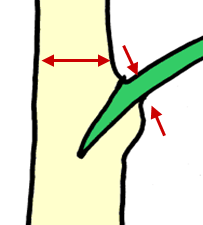
- Lateral branches are less than half the size of their parent branch, so they form a branch collar. [Figure 1]
- They have wider branch unions and more horizontal branching.
- Branch unions are free of bark inclusions (bark pressed against bark rather than connected by sound wood).
- Scaffold branches are spaced with 3% or more of the expected mature height of the tree between them.
- They have a live crown ratio (the proportion of tree which is canopy versus bare trunk below the canopy) of 60% or greater.
For additional information on a tree’s life cycle, refer to CMG GardenNotes #101, IPM and Plant Health Care. For additional information on branch collar development, refer to GardenNotes #611, Tree Growth and Decay. For additional information on pruning cuts, refer to GardenNotes #612, Pruning Cuts.
Time of Year to Prune
Structural pruning is typically done in late winter before trees break dormancy. This is a good time to prune from a tree health perspective as wounds will close quicker and the tree generally has a high amount of stored energy from the previous growing season. It is also easier to evaluate the tree’s branch structure and make decisions about where to prune before the tree leafs out. Pruning is generally avoided during the spring growth flush as tissues in branches can easily separate at this time. Mid-summer is also a good time for pruning. Major pruning should not be done from early fall to mid-winter due to the risk of frost cracks and the fact that trees are dormant during this time and cannot actively respond to recovery from pruning. Minor pruning (branches two inches or less in diameter and less than 10% of the trees foliage removed) can be done anytime.
Acceptable Size of Pruning Cuts
If possible, all pruning cuts should be two inches in diameter and smaller. Pruning cuts larger than four inches in diameter should be made only in cases where there are no other options to achieve a critical pruning objective. Large pruning cuts increase the potential for decay.
Pruning Dose (Percent of Live Foliage Removed)
The amount of foliage which can be removed in a given pruning is referred to as the “pruning dose.” Until a newly planted tree becomes established, pruning should be limited to dead and broken branches and correcting major structural defects. Once a tree has established following transplant, the amount of live foliage or number of live buds that can be removed depends on the tree’s age and health and the pruning cycle (frequency) for the tree.
The American National Standards Institute (ANSI) standards state that 25% of a healthy tree’s foliage is the maximum that can be removed each year. This is a good starting point and is useful in forming specifications for pruning. Mature trees are less tolerant of pruning. However, from a plant health perspective, no more than 10% of a mature tree’s foliage should be removed annually. Young trees can tolerate more pruning. Up to 50% of a young tree’s foliage can be removed annually if needed. These percentage guidelines are maximums. In situations where trees are pruned annually, the appropriate pruning dose would be lighter. However, if a tree goes several years between pruning cycles, the appropriate dose might be higher. Remove as little foliage as possible while still completing your pruning objectives. Trees that are in poor health or under stress should be pruned more lightly. Trees that are under persistent drought stress should not be pruned.
Terms Used to Describe Branches
Permanent Branch – A branch selected to be part of the permanent structure of the tree. This means it will never intentionally be removed. Also referred to as scaffold branches.
Temporary Branch – A branch that will be removed at some point as the tree grows, usually before it reaches two inches in diameter. Normally these are low branches below the permanent crown, or branches located between permanent scaffold branches.
Dominant Trunk/Central Leader – The main trunk of a tree from which primary scaffold branches originate.
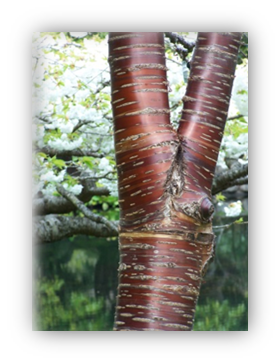
Codominant Trunks/Leaders – When trees have two or more upright competing leaders of near equal size. This condition is a major structural defect as the unions between codominant leaders do not develop a branch collar and are prone to having included bark. Trees with codominant trunks are more likely to suffer damage or fail from snow and wind loading. [Figure 2]
Parent Branch – A larger branch that smaller lateral branches originate from.
Structural Pruning Objectives for Young Shade Trees
- Remove dead, damaged, crossing, or rubbing branches.
- Maintain a single dominant leader to near the top of a tree’s canopy.
- Keep temporary branches less than half the size of their parent branch and remove them before they grow larger than two inches.
- Choose well-spaced permanent branches and maintain them at less than half the size of their parent branch.
- Maintain a live crown ratio of 60% or greater.
To achieve these objectives, structural pruning manages the growth rate of a tree’s branches through pruning. If part of a branch is removed, it will have fewer leaves to perform photosynthesis and will grow slower than if it had not been pruned. This also means that over time it may become relatively smaller compared to its parent branch.
Strategies for Structural Pruning of Young Shade Trees
Here are general strategies to achieve structural pruning objectives (adapted from An Illustrated Guide to Pruning, 3rd Edition, Dr. Edward Gilman).
Before Beginning Structural Pruning: Remove Dead and Damaged Branches
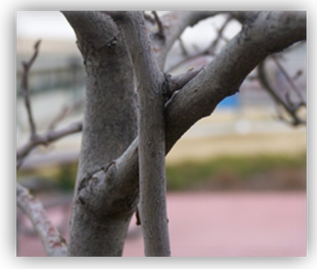
Start by removing dead, damaged, crossing, or rubbing branches from the tree. Any dead material removed does not count toward your pruning dose. However, live branches removed at this point should be considered part of your pruning dose. [Figure 3]
Strategy 1 – Select and maintain a single dominant central leader.
Select a trunk to be the tree’s dominant leader and remove or shorten all competing leaders. Generally select an upright growing branch that has the best combination of larger size and more vertical growth near the center of the tree’s canopy.
Structural Pruning in Practice, Strategy 1:
A tree has two competing leaders. One of the two, normally the most vertical or tallest, is selected to be the dominant leader. The other is shortened with a reduction cut. It will grow more slowly as it will have less leaves going forward. Additionally, shortening the competing leader may allow the main leader to get more sunlight and thus grow more rapidly. Shortening the competing leader subordinates it to the unpruned leader which is now the central or dominant leader. Another possibility is that the competing leader could be removed completely to achieve our objective of having one dominant leader.
The correct choice to shorten or remove the competing leader in this example is based on several factors including: the relative and absolute sizes of the branches involved, how much of the pruning dose for the tree we can afford to use, and the branching structure of the tree. If the competing leader is approaching two inches in diameter it might be best to remove it before it gets larger and develops heartwood. On the other hand, if it is larger than four inches in diameter, it is probably best to shorten it rather than risk exposing heartwood by removing it. If the branches are less than two inches in diameter and equal in size so a branch collar has not developed, it might be better to shorten the branch so that it can develop a collar over time. However, if the branches are equal in size but are approaching a size that makes them too large to remove without an increased risk of decay, it might be best to remove the branch regardless of whether there is a collar. There are a lot of factors that go into making this sort of pruning decision, and it takes knowledge and experience to be comfortable making them.
Strategy 2 – Select the lowest permanent branch.
It is often desirable to raise the canopy (remove lower branches) to provide clearance for human and vehicle traffic. For shade trees in lawns, patios, and along sidewalks, the lowest permanent branch is normally seven to ten feet above ground level. On smaller ornamental trees, lower branching may be preferred. Over streets, the lowest branches should be 14 feet or higher. In wooded settings, the canopy is raised to 10 feet as a fire prevention technique. Many newly planted trees are short enough that they have no permanent lateral branches at the time of planting, meaning most or all the branches present at planting will be strategically removed over time.
Strategy 3 – Keep branches below the permanent crown from growing too large and remove them over time.
Once the lowest permanent branch has been selected, it is easier to identify how to manage other branches. All branches below this branch are temporary and should be kept relatively small through pruning. They should be kept less than half the size of their parent branch (which is normally the tree’s trunk). They should be removed over time before they reach two inches in diameter. The growth rate of branches can be managed by using removal and reduction cuts to remove foliage from them, which in turn will reduce their growth rate.
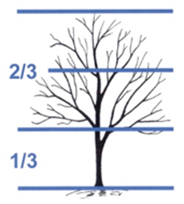
At least 60% of a tree’s height should be canopy as opposed to bare trunk (the live crown ratio should be 60% or greater). Do not raise a tree too high or too rapidly. Lower limbs provide energy to support the development of proper trunk taper (i.e., proper diameter growth of the main trunk) and help distribute wind load placed on the tree. This means lower branches should be kept short by pruning and be removed gradually over time. Temporary branches are often reduced by pruning and retained for many years before being removed. [Figure 4]
If lower branches grow larger than four inches in diameter, shortening them with proper pruning cuts may be a safer option than removing them.
Strategy 4 – Develop branch structure in the tree’s permanent canopy by selecting well-placed permanent branches.
Above the lowest permanent branch there is a mix of temporary and permanent branches. The permanent branches are often referred to as scaffold branches. When selecting scaffold branches, look for branches that are well spaced with branch unions that have desirable traits (e.g., wide branch angles, a well-developed branch collar, and no included bark).
Spacing of Scaffold Branches – When selecting scaffold branches, space branches so the space between permanent branches equals approximately 3%-5% of the tree’s expected mature height. Table 1 shows spacing based on 5% of a tree’s expected mature height.
Table 1. Scaffold branch spacing based on 5% of mature tree height
| Mature Tree Height | Minimum Scaffold Branch Spacing |
|---|---|
| 20 feet | 1 foot |
| 30 feet | 1.5 feet |
| 40 feet | 2 feet |
| 50 feet | 2.5 feet |
| 60 feet | 3 feet |
| 70 feet | 3.5 feet |
| 80 feet | 4 feet |
Select scaffold branches with an even radial distribution around the tree’s trunk. Try not to select branches on the same side of the tree which are directly above or below other nearby scaffold branches. [Figure 5]
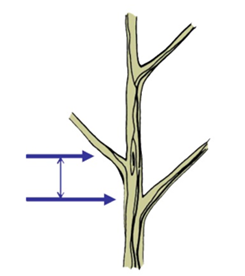
Poorly spaced or clustered branches can negatively impact the way a tree responds to wind and snow loading by concentrating the load placed on the tree at one point on the trunk, increasing the risk of failure. Additionally, clustered branches are less likely to form proper branch collars. [Figure 6]

Selecting Branches with Strong Unions
When selecting scaffold branches, try to select outward growing branches with a wide angle of attachment rather than upward growing branches. Narrow unions are prone to having included bark (bark pressed against bark rather than connected by sound wood). The presence of included bark is a critical defect. Branches growing closer to horizontal continually bear a greater gravitational load and thus develop more reaction wood (additional wood which is anatomically stronger) on the tops or bottoms of branches, making them stronger and more resistant to wind and snow loading.
Strategy 5 – Remove temporary branches in the tree’s permanent crown before they get too large.
Temporary branches in a tree’s permanent crown are branches growing between permanent scaffold branches. They should be managed in the same way as temporary branches below the permanent crown. They should be kept relatively small through pruning (less than half the size of their parent branch) and be removed before they grow larger than two inches in diameter.
Strategy 6 – Maintain all scaffold branches at half the diameter of the trunk or less in size.
Branches that are half the diameter of their parent branch have a stronger connection due to the development of a branch collar. Scaffold branches that are growing too large relative to the trunk can have their growth slowed with proper removal and reduction cuts.
Another way to think about this strategy is to keep all branches less than one-half the diameter of their parent branch so they develop a branch collar. Temporary branches also benefit from having a collar as it can help prevent decay from entering the tree. In this document, management of temporary branches is covered in Strategies 3 and 4.
Strategy 7 – Remove or shorten branches whose unions have bark inclusions.
Bark being included within the union between branches makes the union much weaker and prone to failure. Branches with inclusions should be shortened with reduction cuts or removed.
Bark inclusions can be identified by looking for bark which rolls smoothly into the union rather than creating a rough ridge where the branches meet (the branch bark ridge). Old inclusions develop an “elephant ear” appearance as the tree tries to grow over them. Included bark is also more common on upright growing branches. Some species of trees are more prone to forming bark inclusions than others (e.g., trees in the genus Tilia).
This publication, reference GardenNotes #613, is developed as part of the Colorado State University Extension Master Gardener Program.