


This publication outlines considerations for tree placement in the home landscape. The average life of a tree in the landscape is less than twenty years due to poor design and planting techniques. Homeowners and landscape designers often place trees in situations where trees have little chance to establish and thrive. Successful tree planting and establishment need attention in these six areas:
- Functional design.
- Tree species diversity. (Avoid monocultures.)
- Plant selection.
- Pre-planting handling.
- Planting techniques.
- Post-planting care.
Tree Placement in Landscape Design
In landscape design, the placement of trees needs careful considerations to function and design elements, as well as to the needs of the trees. Trees are typically the major plant structures in a landscape. Trees give architectural form and organization to spaces. In landscape design, trees should not be randomly placed around the property. Rather, place trees as specimens, group plantings, or mass plantings.
Specimen Trees – The individual tree becomes the landscape feature. It is set off from other trees and plant materials by unique spacing, form, color, and/or texture. Specimen trees are often, but not always, a focal point in the design.
Group Plantings – In group plantings, the trees as a unit become the landscape feature. Groupings are often the same species. Try to avoid monocultures to prevent insect and disease issues. In group plantings, do not mix contrasting forms. An Allée could be considered a group planting. This is when parallel rows of trees are planted, such as along a driveway or street. Try to mix tree species, as it will help to avoid issues that can occur with monocultures. One method to mix the species would be to graduate the height by using different species. Be creative and use trees that like similar conditions.
Mass Plantings – In mass plantings, individual trees lose their identity and appear as one larger unit in the design. A group planting may grow into a mass planting as trees mature. Use trees in odd numbers to create interest. Mix species to avoid monocultures in mass plantings.
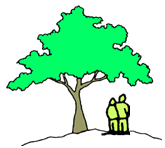
Trees serve several key roles in landscape design. They often define space. Their spreading branches create a canopy that forms a ceiling for an outdoor room which could be a very pleasant experience. [Figure 1]
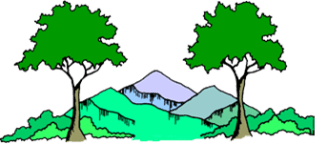
Trees are used to frame and mask views. Vertical views are effectively framed with trees on both sides. The yard should flow into the view. Avoid specimen plants that draw attention away from the view. [Figure 2]
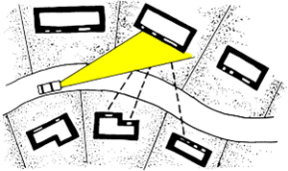
When framing a house, consider trees in front and to the sides as well as trees that can be viewed over the roofline. For framing, use the point of reference from which most people would view the house rather than straight on. [Figure 3]
Trees and Energy Conservation
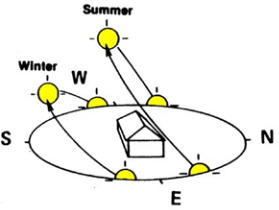
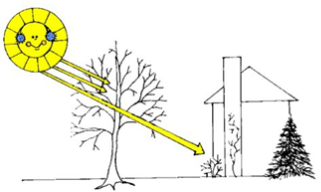
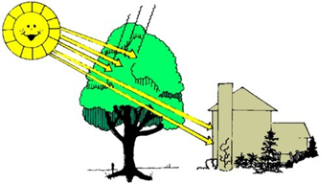
Tree placement can play a significant role in energy conservation. Winter sun entering south-facing windows can effectively heat many homes. Summer shade on south- and west-facing windows provides summer cooling. In evaluating shading and heating patterns, be aware that shade patterns change with the season and with the latitude. [Figure 4]
Maximizing Winter Solar Heating
Homes with south facing windows have great potential to capture winter solar heat.
In the winter, deciduous tree branches reduce the sun’s radiation by 37%. For winter energy conservation, avoid planting trees where they would shade the windows in the winter, and open drapes to allow the sun’s energy into the home. Winter shade patterns are large, approximately 2½ times the mature height of the tree at Colorado latitudes. [Figure 5]
Maximizing Summer Cooling
On a clear summer day, trees block 70-90% of the sun’s radiation. When properly placed, trees can reduce air conditioning demand by 10-30%. In parts of Colorado including the mountain communities, where temperatures typically cool in the evening, shading a home may adequately moderate temperatures without the expense of air conditioning. [Figure 6]
Evapotranspiration – Under the right conditions, a tree can transpire hundreds of liters of water in one day, having the effect of two central air conditioning units. Under dry conditions (including water restrictions that prohibit landscape irrigation) evapotranspiration shuts down, photosynthesis stops (trees live off carbohydrate reserves), and the cooling effect is reduced. Community temperatures may rise significantly when landscape irrigation restrictions prohibit outdoor watering.
Shading the House
In shading the house, there is a two to three hour lag time on sun heat hitting the house and the house becoming extremely hot. Shading priorities at Colorado latitudes include the following:
- Shade south and west windows.
- Shade south walls.
- Shade west walls.
- Shade air-conditioning units.
Shading Pavement
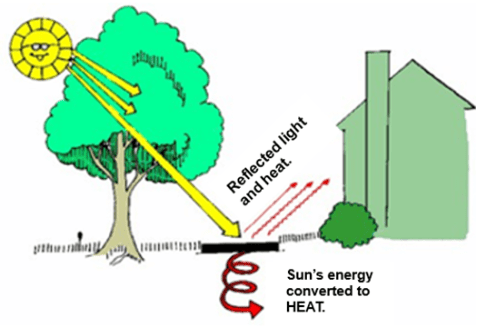
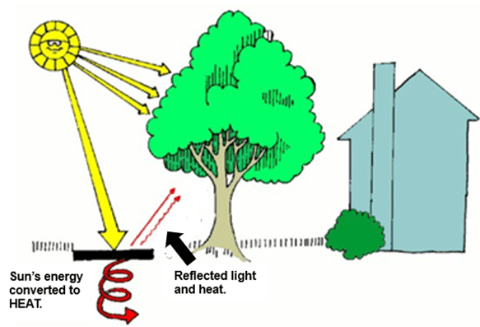
As shown in Table 1, a paved area stores approximately 50% of the sun’s energy. In comparison, a grass area only stores only 5% of the energy and uses 50% for evapotranspiration, resulting in a cooling effect. This cooling effect is only operational when the grass has water for active growth.
Table 1. The Sun’s Energy
| Paving | Bare Soil | Grass | |
|---|---|---|---|
| Percent Evaporation | 15% evaporation | 15% evaporation | 50% evapotranspiration |
| Percent of Sun’s Energy Reflected | 40% | 30% | 20% |
| Percent of Sun’s Energy Stored | 50% | 30% | 5% |
| Characteristics | Hot surface, hot air | Hot surface, limited evaporation | Cool surface, high evaporation |
Mulches will affect the amount of absorbed and reflected heat from the sun’s energy. Wood mulches will evaporate 50% of soil mulch, thus producing a cooling effect. Artificial turf and rock mulches absorb and reflect the sun’s energy all day and continue to give off heat at night. The reflection and drying effect of rocks can affect plant health and increase the need to water. If using rock, try to shade 50% of the area with trees.
Another important cooling technique is to shade pavement and other heat-storing materials like the patio, driveway, artificial turf, and rock mulch areas. Also, minimizing paved surfaces helps keep the living area cool. [Figure 7]
Trees and other plant materials may also be used to shield the living space from stored and reflected heat. [Figure 8]
Shading Streets
Older communities with tree-lined streets are noted for the pleasing, inviting surroundings that street trees create. Shaded streets are 10°F to 40°F cooler. However, street trees are often predisposed to poor growth and limited life spans due to poor soil conditions and constricted growing areas. Tree roots can spread under a sidewalk into open lawn areas beyond. Root spread under a street is dependent on the soil properties created during road construction.
When the planting strip between the street and sidewalk is less than eight feet wide, tree health, vigor, and life span will be reduced. In most communities, planting strip width is set by the city ordinance in effect at the time of development.
An effective alternative for tree-lined streets is to plant trees in the lawn eight feet in from the street. This may give trees a better soil environment for root growth, resulting in improved tree vigor, growth, and longevity. In this situation, trees are also less likely to be hit by cars or damaged from road repairs. Eliminating the narrow planting area between the street and sidewalk is also an important water conservation technique as the “mow strip” can be difficult to irrigate efficiently.
Noise Abatement With Trees and Shrubs
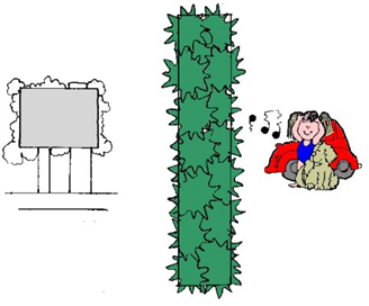
Tree and shrub hedgerows, and shelterbelts are effective in abatement noise pollution. To be most effective, place the hedgerow close to the noise source away from the living area. The hedgerow should be twice as long as the distance from the noise source to the living space. To be effective, the hedgerow needs to be dense. A few trees and shrubs here and there do little to abate noise. [Figure 9]
Other Environmental Benefits of Trees
A community forest has many important benefits, including:
- Energy savings from heating and cooling.
- Noise abatement.
- Carbon dioxide reduction.
- Air-pollution abatement.
- Hydrology (slows stormwater runoff, natural filtration).
- Improves property values.
To maximize environmental benefits, the goal in community forestry is to increase tree canopy. Tree canopy is the overhead cover that trees provide. Most cities have goals for their urban forest tree canopy. The City of Denver’s 2021 canopy cover was 19% with a goal of 24%, which is higher than most cities in Colorado.
Here in the west, we have a great need to plant more trees in our communities. In wooded communities, there may be a need to thin the forest for fire protection and forest health.
To maximize the benefits of our community forests, homeowners and community leaders need to recognize that the primary benefits occur from large trees. We need to enhance efforts to protect and maintain large trees. We need to plan for protecting and keeping large trees in landscape design. Small specimen trees may add to the landscape design, but large trees provide significantly more environmental benefits. We need to plant trees in situations where they have the potential to reach a mature size with longevity. A healthy community forest has a variety of sizes, species, and densities.
Growing Space
Size is a primary consideration in tree selection. Trees should fit in the available growing space without pruning. This is of primary concern under utility lines, as utilities have the right-of-way. Frequent pruning required to keep utility lines clear adds to our utility rates. This is also a concern when planted too close to structures and needed road/street clearance.
As discussed previously, environmental benefits are significantly greater with larger trees. Consider large tree species wherever space allows. With proper structural training, large trees have minimal potential for storm and wind damage.
Homeowners often desire fast-growing trees. However, fast-growing species are typically more prone to insects, diseases, internal decay, and breakage. Fast-growing species typically have shorter life spans.
Rooting Space
Rooting space should be a primary consideration in tree selection. The mature size, growth rate, and longevity of a tree are directly related to the available rooting space. Many trees in the landscape are predisposed at planting to a short life and limited growth potential due to poor soil conditions and limited rooting space.
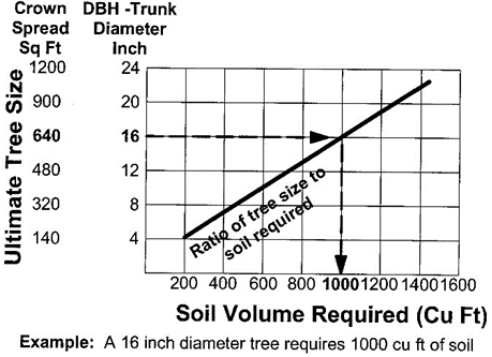
Figure 10 shows the relationship between root space and ultimate tree size. For example, a tree with a sixteen-inch diameter requires 1,000 cubic feet of soil or a thirty-two foot square. Tree roots can grow outward to twice the spread of the tree canopy or more depending on the species and the environment. On a compacted, clayey soil, rooting depth may be restricted to twelve to eighteen inches or less and spread would be an area thirty-six feet in diameter. Anything less in available space will reduce tree size, growth rates, vigor, and longevity.
Tree roots can generally cross under a sidewalk to areas with regular irrigation like a lawn. The ability of roots to cross under a street depends on the road base properties. A good road base does not typically support root growth due to compaction and low soil oxygen availability. The rooting area does not need to be rounded; it can be about any shape. Trees can share rooting space.
Trees in Planters
Trees are often placed in planters and other sites with limited rooting potential. If the roots cannot escape the planting site (root vault) into other soils, the following can occur:
- Root growth will slow when the root vault area is filled.
- Tree growth will slow.
- Tree health will decline.
- Routine tree replacement will be required.
Home gardeners and landscape designers need to understand that with restricted rooting space, growth potential, and longevity are reduced.
This publication, reference GardenNotes #631, is developed as part of the Colorado State University Extension Master Gardener Program.