


Sand, Silt, and Clay
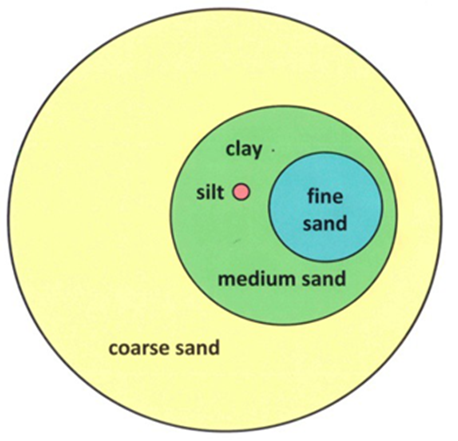
Texture refers to the size of the particles that make up the soil. The terms sand, silt, and clay refer to relative sizes of the soil particles. Sand, being the larger size of particles, feels gritty. Silt, being moderate in size, has a smooth or floury texture. Clay, being the smaller size of particles, feels sticky. [Table 1 and Figure 1]
Table 1. The Size of Sand, Silt, and Clay
| Name | Particle Diameter |
|---|---|
| Clay | Less than 0.002 mm |
| Silt | 0.002 to 0.05 mm |
| Very fine sand | 0.05 to 0.10 mm |
| Fine sand | 0.10 to 0.25mm |
| Medium sand | 0.25 to 0.5mm |
| Coarse sand | 0.5 to 1.0 mm |
| Very coarse sand | 1.0 to 2.0 mm |
| Gravel | 2.0 to 75.0 mm |
| Rock | More than 75 mm |
Soil Texture
The USDA soil texture triangle gives names associated with various combinations of sand, silt, and clay. A coarse-textured or sandy soil is one comprised primarily of medium to coarse size sand particles. A fine-textured or clayey soil is one dominated by tiny clay particles. Due to the strong physical properties of clay, a soil with only 20% clay particles behaves as sticky, gummy clayey soil. The term loam refers to a soil with a combination of sand, silt, and clay sized particles. For example, a soil with 30% clay, 50% sand, and 20% silt, is called a sandy clay loam. To calculate and plot soil texture classes based on the percent sand, silt, and clay, visit the USDA Natural Resources Conservation Service soil texture calculator.
https://www.nrcs.usda.gov/resources/education-and-teaching-materials/soil-texture-calculator
Identifying Soil Texture by the “Jar Test”
- Spread soil on a newspaper to dry. Remove all rocks, trash, roots, and such. Crush lumps and clods.
- Finely pulverize the soil.
- Fill a tall, slender jar (like a quart jar) one-quarter full of soil.
- Add water until the jar is three-quarters full.
- Add a teaspoon of powdered, non-foaming dishwasher detergent.
- Put on a tight-fitting lid and shake hard for 10 to 15 minutes. Shaking breaks apart the soil aggregates and separates the soil into individual mineral particles.
- Set the jar where it will not be disturbed for 2 to 3 days.
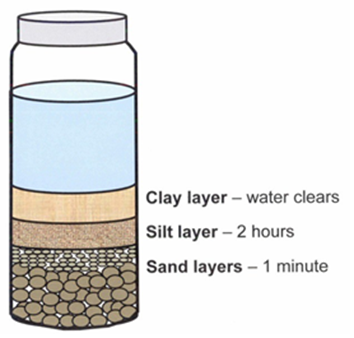
- Soil particles will settle out according to size. After 1 minute, mark on the jar the depth of the sand.
- After 2 hours, mark on the jar the depth of the silt.
- When the water clears, mark on the jar the clay level. This typically takes 1 to 3 days; some soils may take weeks.
- Measure the thickness of the sand, silt, and clay layers.
- Thickness of sand deposit.
- Thickness of silt deposit.
- Thickness of clay deposit.
- Thickness of total deposit.
- Calculate the percentage of sand, silt, and clay.
- Clay thickness, divided by total thickness, equals percentage of clay.
- Silt thickness, divided by total thickness, equals percentage of silt.
- Sand thickness, divided by total thickness, equals percentage of sand.
- Turn to the USDA NRCS soil texture calculator or the USDA soil texture triangle tolook up the soil texture class.
Identifying Soil Texture by Feel
Place soil in palm of hand. Add a small amount of water and knead the soil into a smooth and plastic consistency, like moist putty.
Feel test – Rub moist soil between fingers.
- Sand feels gritty.
- Silt feels smooth.
- Clays feel sticky.
Ball squeeze test – Squeeze a moistened ball of soil in the hand.
- Coarse texture soils (sand or loamy sands) break with slight pressure.
- Medium texture soils (sandy loams and silt loams) stay together but change shape easily.
- Fine textured soils (clayey or clayey loam) resist breaking.
Ribbon test – Squeeze a moistened ball of soil out between thumb and fingers while squeezing upward. Form a ribbon of uniform thickness and width. Allow ribbon to emerge and extend over the forefinger, breaking from its own weight.
- Ribbons less than 1 inch before breaking:
- Feels gritty = coarse texture (sandy) soil.
- Not gritty feeling = medium texture soil high in silt.
- Ribbons 1 to 2 inches before breaking.
- Feels gritty = medium texture soil.
- Not gritty feeling = fine texture soil.
- Ribbons greater than 2 inches = fine texture (clayey) soil.
Note: A soil with as little as 20% clay will behave as a clayey soil.
A soil needs 45% to over 60% medium to coarse sand to behave as a sandy soil. In a soil with 20% clay and 80% sand, the soil will behave as a clayey soil.
- Start: place soil in palm of hand. Add water drop-wise and knead into a smooth consistency, like moist putty. Does the soil remain in a ball when squeezed?
- No – Sand
- Yes-with the ball of soil in your hand, gently flatten one end of the ball between your thumb and the edge of your index finger, making a uniform ribbon. Allow the ribbon to extend over your index finger, breaking under its own weight. Does the soil form a ribbon?
- No – Loamy Sand
- Yes – What kind of ribbon does it form?
- A ribbon less than 1” long before breaking – Loam
- Sandy Loam – A pinch of moistened soil rubbed between the thumb and forefinger feels very gritty
- Loam – A pinch of moistened soil rubbed between the thumb and forefinger feels equally gritty and smooth.
- Silt Loam – A pinch of moistened soil rubbed between the thumb and forefinger feels very smooth.
- A ribbon between 1-2” long before breaking – Clay Loam
- Sandy Clay Loam – A pinch of moistened soil rubbed between the thumb and forefinger feels very gritty
- Clay Loam – A pinch of moistened soil rubbed between the thumb and forefinger feels equally gritty and smooth.
- Silty Clay Loam – A pinch of moistened soil rubbed between the thumb and forefinger feels very smooth.
- A ribbon 2” or longer before breaking – Clay
- Sandy Clay – A pinch of moistened soil rubbed between the thumb and forefinger feels very gritty
- Clay – A pinch of moistened soil rubbed between the thumb and forefinger feels equally gritty and smooth.
- Silty Clay – A pinch of moistened soil rubbed between the thumb and forefinger feels very smooth.
- A ribbon less than 1” long before breaking – Loam
This publication, reference GardenNotes #214, is developed as part of the Colorado State University Extension Master Gardener Program.