


Types of Frost
Advective frosts occur when a cold front moves into the area. Temperatures may drop significantly below critical levels thereby making crop protection questionable.
Radiation frosts occur on calm clear nights that lack cloud cover to hold in heat. Radiation frosts at the beginning and end of the growing season are typically only a few degrees below critical levels, making crop protection worthwhile.
Coverings
Blankets and Sheets
Grandma’s old method of covering the garden with blankets and sheets works well as long as the fabric remains dry. If the fabric absorbs water, evaporative cooling can lead to colder temperatures adjacent to the blanket. To recharge the heat stored in the soil, the blankets and sheets must be removed in the daytime.
Floating Row Covers
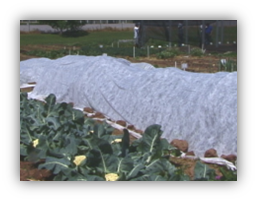
Floating row covers are lightweight fabrics that lay directly over crops. Because they transmit light and allow airflow, they provide crop protection over an extended period of time without being removed. Depending on the material and grade, they can provide up to 10°F of frost protection, cut wind on tender plants, and screen out some insects. On insect pollinated crops, covers must be removed for pollination to occur. [Figure 1]
Floating row covers are popular in commercial vegetable production where crops planted in large blocks are easily covered with row covers. Many brands and fabric types are commercially available.
Covers Supported by Frames
Covers made from synthetic fabric, 4 or 6-mil plastic, flexible twin-wall polyethylene plastic, and polyvinyl alcohol films are the most common covers. The covers need to be held off the plants to prevent the plants from freezing where they touch the cover and to allow the plants room to grow. They need to be opened or vented on sunny days and removed entirely if you live in a hot summer area. Two-inch holes cut in the sides of a plastic cover at two to three foot intervals will reduce overheating. Thinner fabric row covers can provide plants with some shade and cooling from the summer sun.
Types of Frames
Gardening catalogs carry wire hoops for use in “tunnel” or cloche gardening. You can also make your own hoops with electrical conduit, bendable PVC pipe, PEX plumbing tubing or heavy-duty irrigation tubing. You may need a hoop bender if you use electrical conduit. Black irrigation tubing may heat up in the sun and lose its rigidity.
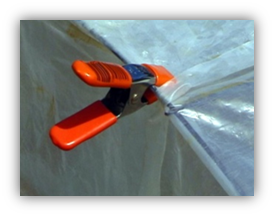
Hoops are placed at three to five foot intervals depending on the wind exposure of the site. The covered hoops will form a tunnel-shape down the growing bed. Bury the edges of the cover a few inches into the soil or weigh down with rocks, leaving at least one side accessible. You can also use clips to secure the cover to the hoops. On a raised-bed box made with lumber, staple the plastic to one side of the box, weigh down with rocks, or attach the hoops with clips.
This type of covering is popular with commercial tomato, pepper, and melon growers for an early start to the growing season. It provides frost protection, protects tender plants from cold spring wind, and provides warmer growing temperatures inside the tunnel. Tunnels are removed when warm weather arrives and the danger of frost is past.
Plastic Covered Cold Frame Made With Concrete Reinforcing Mesh
An easy cold frame structure for a growing bed is made with 4-mil clear plastic (polyethylene film) draped over concrete reinforcing mesh. The structure is easily opened during warm days and closed for cold nights. It works well with a four foot wide, raised-bed garden system. [Figure 2]

The frame is concrete reinforcing mesh, available at hardware and lumber stores. This stiff wire mesh typically comes five feet wide, in 50 and 100 foot rolls. A six foot length is required to make a Quonset-type frame over a four foot wide growing bed. In trials, the low and spreading shape was ideal for trapping heat from the soil during a frosty night.
Cover the frame with clear, 4-mil polyethylene plastic. It typically is sold in ten feet by twenty-five foot rolls. For a four foot wide raised bed box, place a three and a half foot wide section on each side, overlapping at the top. On a raised bed box, staple the plastic to the sides of the wood box. In soil bed applications, bury the plastic a few inches along the sides.
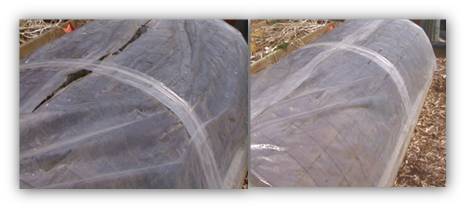
Hold the plastic onto the frame with small clips available at local hardware stores. Clothespins do not hold in the wind. Another method is to use a series of six inch wide, belt-like plastic straps arching over the frame (above the plastic cover) and stapled onto the box. Open and close the cover by sliding it between the frame and the belt-like straps. Hold the plastic closed at the ends with a rock or brick. [Figure 3]
During the day, the covering MUST be opened, at least a slit, to prevent overheating. With just an hour of sun, temperatures under a closed cover can quickly rise to over 130°F! [Figure 4]
On cool days, open the top a crack to prevent excessive heat build-up. On a warm day, the plastic can be slid down the side, ventilating and providing crops exposure to the outdoors. On freezing nights, close the cover completely. On warm nights, the covers may be left open a crack. On stormy days with full cloud cover and no direct sun, the cover may remain closed. [Figure 4]
Not only will the covers provide frost protection, but they also increase growing temperatures for early crop growth and provide protection from cold winds.
In trials in Fort Collins, Colorado, a plastic cover on a frame typically provides 3°F to over 6°F of frost protection. It works well for cool season crops that are somewhat tolerant of frosty nights and adds two to six weeks or more on both ends of the growing season. For warm season tomatoes and summer squash crops (being intolerant of a frosty nip), adding a small light inside the cold frame provides even better frost protection.
Adding Space Blankets
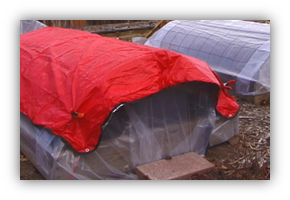
On extra cold nights, placing an aluminum space blanket over the plastic on the frame significantly adds to the frost protection. With the aluminized side placed down (towards the plants), a space blanket reflects 99% of the heat. They are readily available where camping gear is sold. [Figure 5]
In trials in Fort Collins, topping a plastic-covered, concrete mesh cold frame with a space blanket prevented freezing when outside temperatures dipped to 0°F following a sunny spring day. The space blanket must be removed each day to recharge the soil’s stored heat.
Lights for Additional Heat
Christmas tree lights – For additional protection, add Christmas tree lights inside the cold frame. In Fort Collins trials, one 25 light string of C-7 (mid-size) Christmas lights per frame unit (four feet wide by five feet long) gave 6°F to over 18°F frost protection. Lights were hung on the frame under the plastic and turned on at dusk and off at dawn. Christmas lights work better than a single, large light bulb in the center by eliminating cold corners and edges. [Figure 6]
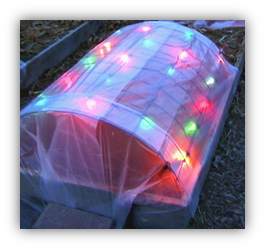
Space blanket with Christmas tree lights – For the gardener really wanting to extend the growing season, try Christmas lights plus a space blanket. One 25 light string of C-7 (mid-size) Christmas lights per frame unit (four feet wide by five feet long) with a space blanket on top gave 18°F to over 30°F frost protection in Fort Collins trials.
Wall O’ Water™
The Wall O’ Water™ and other similar products are a cone-shaped ring of connected plastic tubes filled with water that surrounds a single plant, like a tomato, pepper, or summer squash. [Figure 7]
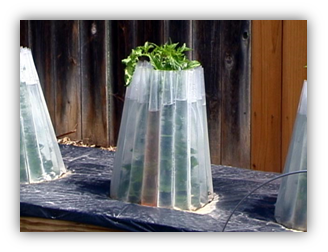
This device works on the chemistry principle of heat release in a phase change; there is a significant amount of heat released as water freezes (changes from the liquid phase to the solid or ice phase). These provide frost protection typically down to temperatures in the mid-teens. It also provides wind protection for tender plants and, growing temperatures may be slightly warmer inside a product like this.
They are helpful to get a few extra weeks head start on vine ripe tomatoes. However, an extra early tomato may outgrow the protection and the tops may be nipped back by frost.
Both cold air temperatures and cold soil temperatures are limiting factors in early crop production. When using a Wall O’ Water or other similar products to start early crops, warm the soil with black plastic mulch.
This publication, reference GardenNotes #722, is developed as part of the Colorado State University Extension Master Gardener Program.