


Quick facts…
- The sunflower stem weevil has been an occasional sunflower pest for many years but has become a key pest on the western High Plains since 1995.
- A degree-day model can be used to determine when sunflower stem weevil adults emerge in the spring. This has practical implications for timing of weevil scouting and management.
- Planting after June 1 in northeastern Colorado will reduce the risk of sunflower stem weevil damage.
- Thinner sunflower planting rates allow thicker sunflower stalks, which assists sunflower plants to stand better.
Field Biology
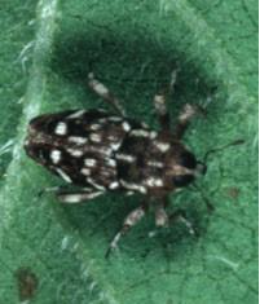
The sunflower stem weevil, Cylindrocopturus adspersus LeConte, has been a key sunflower pest on the western High Plains since the 1995 growing season. The adult weevil is about 3/16 inch (5 mm) in length, grayish-brown in color, and covered with irregular white spots (Figure 1). As is typical of weevils, its mouthparts form a beak that is tucked underneath the head. The female emerges from overwintering chambers in the base of previous-year sunflower stalks mid-May through June. She feeds on leaves of current-year sunflowers and then mates with males that overwintered in the same fashion. Foliar damage from adult sunflower stem weevil feeding does not cause significant yield losses. Approximately two weeks after emergence, the female starts laying eggs in stems of sunflower plants with at least six to eight leaves (growth stage V6-V8) in the growth cycle. The female chews a hole in the lower stem near the point of attachment of the cotyledon leaves, places a single egg in the hole and covers it with frass (insect excrement).
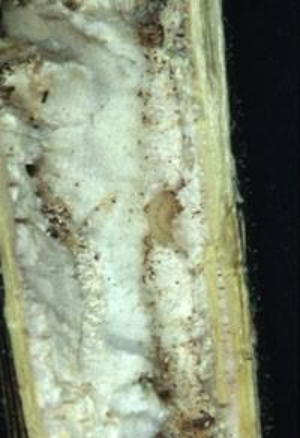
Newly hatched larvae chew through the subepidermal tissue to the vascular tissue where they feed until fully grown. As fall approaches, they migrate to the base of the sunflower stalk (Figure 2) where they prepare overwintering chambers in the woody tissue (cambium). Damage to cambium tissue during the construction of overwintering chambers makes the sunflower plant prone to lodging, especially during high winds. Losses associated with lodging are the main economic impact of the sunflower stem weevil. Other less significant losses are caused by damage to vascular tissue and by feeding injury that allows entrance for pathogens associated with diseases such as Phoma Black Stem.
Management Strategies for Sunflower Stem Weevil
Effective management of sunflower stem weevil can be achieved by delayed planting or by strategic insecticide applications to prevent egg laying. Insecticide applications need to be timed when adults are present, but before egg laying occurs. Considerations for properly timed foliar insecticide treatments include stem weevil development, crop development, and stem weevil counts. Insecticides will control adults but not developing larvae after egg laying. Fall tillage that destroys the overwintering chambers at the base of the stalks has also been recommended but may not be compatible with soil conservation practices. In addition, planting thinner stands produces thicker sunflower stalks which aids in preventing lodging when stem weevils are present in plants. Crop rotations have also had no effect on stem weevil populations, as adults are somewhat mobile.
Delay Planting to Avoid Sunflower Stem Weevil Damage
Planting after June 1 results in sunflower plants that are too small to be attractive to the weevil during the peak egg-laying period. Stem weevil damage in crops seeded after this date generally is reduced to the point that it is unlikely that an insecticide treatment will be needed. Keep in mind, however, that sunflower yield and quality will be reduced in sunflower crops planted after June 15.
Degree-day Prediction of Sunflower Stem Weevil Development
Adult sunflower stem weevils start to emerge from their overwintering chambers after about 330 degree-days (base 42F) have accumulated, based on two years of study at several locations in Colorado, Kansas and Nebraska. Actual emergence dates are affected by weather and location and vary from early May to early June. Fifty percent and 90 percent of adult emergence occur at approximately 700-900 and 900-1200F, respectively. Emergence is usually complete by the second week of June. Egg laying starts 10 to 14 days after emergence and can continue into early August. Larvae hatching from eggs laid later in the season have poor survival.
Scouting for Sunflower Stem Weevil
The degree-day model has practical implications for stem weevil management. Start field scouting for sunflower stem weevil when at least 300 degree-days (base 42F) have accumulated in your growing area (usually mid-May) and plants have developed to the point that they are attractive to the weevil for egg laying. Begin scouting at sunflower growth stage V2-V4 and continue until early July. Approach the plants to be scouted carefully because adult sunflower stem weevils tend to drop to the soil if they detect movement or abrupt changes in shadows. This makes scouting difficult because they are very hard to see when on the soil. Move at least 75 feet into the field before you start scouting. Examine five plants at a site and scout at least five sites per field. Sites should form an X pattern that covers most of the field. Inspect the entire plant, giving special attention to upper and lower leaf surfaces, leaves, leaf axils, the lower stem, dried cotyledon leaves, and cracks in the soil around the base of the plant.
Foliar insecticides
Consider a foliar treatment with a registered insecticide to prevent egg laying if more than eight sunflower stem weevils are found on the 25 scouted plants. Foliar insecticides registered for use against sunflower stem weevil are listed in the current High Plains Integrated Pest Management Guide for Colorado, Western Nebraska and Wyoming.
Be sure to read, understand and follow all insecticide label instructions!