


Quick facts…
- Wood borers are insects that develop underneath the bark of trees and shrubs. Certain beetles and moths are the most common borers.
- Insecticides can best control most shade tree borers if they are applied when adult insects are laying eggs on tree trunks.
- Most wood borers attack only trees that are stressed due to drought, injury, or disease. Consequently, any means of promoting vigorous tree growth and reducing stress should be considered the primary approach for borer management.
- Certain wood borers, such as emerald ash borer, peachtree borer, and Zimmerman pine moth, are capable of damaging healthy trees.
- The emerald ash borer is an exceptionally destructive wood borer.
Introduction
Several kinds of insects develop by tunneling in some manner within the branches, trunks or roots of trees and shrubs. The largest number of these are known as wood borers, which include various beetles, moths, and an odd family of wood boring wasps (horntails).
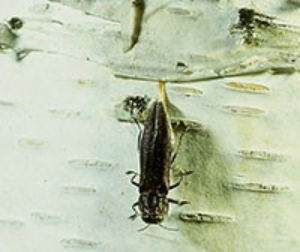
Figure 1: Bronze birch borer laying eggs under bark crevice. Photograph by David Shetlar, The Ohio State University.
Most wood borers lay their eggs on the bark and the immature stage (larva) that follows chews into the plant to feed, creating tunnels or gouges within the plant as it develops. When larvae have completed their development, typically in one to two years, they transform to the adult form which then emerges from the plant to mate and lay eggs that produce the next generation.
Some wood borers can seriously damage plants, by cutting through cambium tissues that move water and nutrients or through significant structural weakening. Examples of these more “aggressive” wood borers that occur in Colorado include peachtree borer, Zimmerman pine moth, and emerald ash borer. However, many wood borers cannot successfully attack healthy plants. These will only be found in plants, or parts of plants, which have been previously damaged by wounds, infected with canker producing fungi, or are severely stressed due to recent transplanting, drought, storm damage, or root injuries. Most of the more common wood borers that occur in Colorado are included in Table 1.
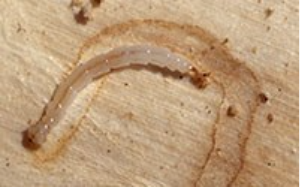
Figure 2: Bronze birch borer larva, a type of flatheaded borer.
Types of Wood Borers
Metallic Wood Borers/Flatheaded Borers (Coleoptera: Buprestidae)
The beetle family Buprestidae are known as both metallic wood borers and flatheaded borers, terms that refer to the adult and larval stages of these insects, respectively. The adults (metallic wood borer) are elongated-bodied beetles that have a metallic sheen. Most metallic wood borers are green, bronze, or blue, but brightly colored species also occur. The adults feed on leaves of host trees and shrubs, and females lay eggs in crevices of the bark. The larva that occurs within the plant (flatheaded borer) is pale colored with dark jaws, often very elongated, and has a flattened area behind the head.
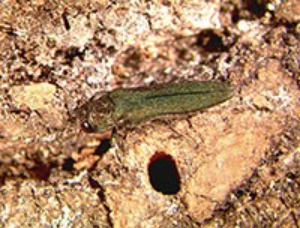
Figure 3: Emerald ash borer adult next to D-shaped exit hole. Photograph by David Shetlar, The Ohio State University.
Flatheaded borers feed just under the bark, making meandering tunnels through the cambium, phloem, and outer xylem tissues of the plant. These wounds restrict movement of nutrients in the plant which may result in a progressive thinning of the leaf canopy. On the trunks and limbs there is little or no evidence of infestation, but when adults emerge from the plant they chew a distinctive D-shaped exit hole. Flatheaded borers typically take a year to complete development. Flatheaded borers that commonly cause plant injuries include emerald ash borer, bronze cane borer, gamble oak borer, bronze birch borer, and flatheaded appletree borer.
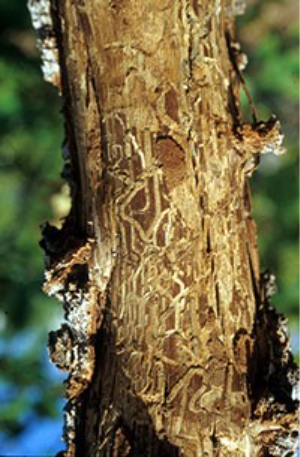
Figure 4: Extensive tunneling injuries produced by larvae of the Gambel oak borer. Photograph by David Leatherman.
Longhorned Beetles/Roundheaded Borers (Coleoptera :Cerambycidae)
The beetle family Cerambycidae are known as both longhorned beetles and roundheaded borers, terms that refer to the adult and larval stages of these insects, respectively. The adults (longhorned beetles) are named for the very long antennae typical of the adult. They are medium to large beetles that are usually brown or gray, but some have bright patterning. When laying eggs the adult will first chew a small pit and then insert the egg underneath the bark. The larva that develops within the plant (roundheaded borer) is pale colored with dark jaws and has an elongated body that is generally round in cross-section.
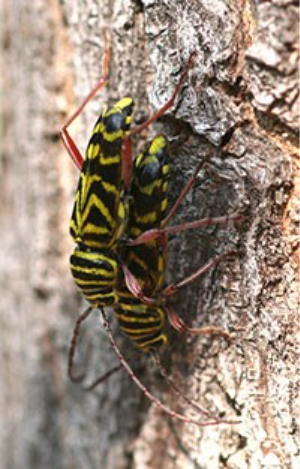
Figure 5: Mating pair of locust borers, a type of longhorned beetle.
Roundheaded borers will initially feed in areas around the cambium but most will later borer deeply within the plant. The tunnels produced are oval in cross section and they may cause significant structural weakening of the plant. In late stages, the larvae may make an opening on the trunk and expel sawdust, which is often coarse and stringy. When adults emerge from the plant they chew an oval-shaped exit hole. A generation may be completed in a year, but some species take two or more years to develop. Most roundheaded borers are only found in trees that are in serious decline or have been recently cut or killed. However, there are a few species, such as poplar borer in aspen and locust borer in black locust, which can seriously damage live trees.
Weevils (Coleoptera: Curculionidae)
The beetle family Curculionidae, known as weevils, contains a great many species in Colorado, but only one is a wood borer of note, the poplar and willow borer. It is almost always found in small diameter (1 to 4 inch) trunks, with shrubby willows being the most common hosts. Infestations are often indicated by the presence of a coarse sawdust-like excrement that plugs the exit hole.
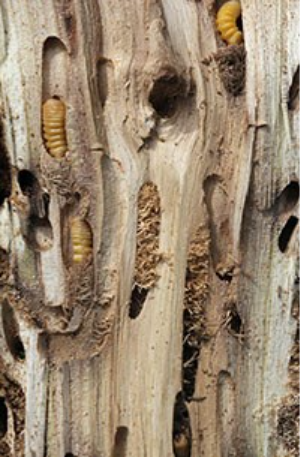
Figure 6: Locust borer larvae (roundheaded borers) and tunneling of black locust.
Clearwing Borers (Lepidoptera: Sesiidae)
Moths in the family Sesiidae are known as “clearwing borers”. This refers to a feature of their wings, which are largely absent of scales that cover wings of most moths and butterflies. They have an overall appearance that resembles a wasp or bee, although they are harmless. Because they are such close mimics of stinging insects, clearwing borers can largely avoid attacks by birds and are one of the few moths that fly during the day. Eggs are laid on the surface of the bark.
Most all larvae of clearwing borers develop in either the lower trunk or upper roots of the plant and many are referred to as “crown borers” since they concentrate feeding in the upper root crown. Clearwing borer larvae are pale colored, with dark jaws and have an overall appearance somewhat similar to a roundheaded borer. However, they are distinguished by having five pairs of very short leg-like structures (prolegs) on the underside of the abdomen, each marked with a series of tiny hooks (crochets).
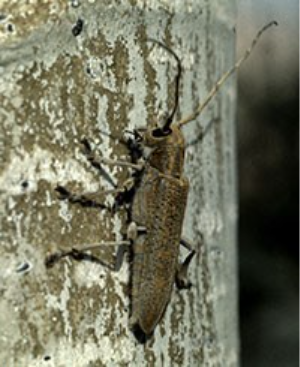
Figure 7: Poplar borer, a common borer of aspen.
Clearwing borer larvae concentrate feeding in areas under the bark, making large gouging wounds. More extensive tunneling may also occur in the interior of the lower trunk. When full grown, the larvae will excavate an area just underneath the bark and chew into the bark so that only a paper-thin area remains. They then transition to the pupal stage positioned just underneath this opening. When the adult moths are ready to emerge, they wriggle to push through the bark, pulling the pupal case through the opening. After the adult moths extract themselves, the pupal case often will remain extruded from the plant or drop to the base of the plant.
Development (from egg to adult) requires a year to complete. Many clearwing borers can seriously damage even healthy plants. Significant species in Colorado include lilac/ash borer, peachtree borer, and currant borer.
Pyralid Borers (Lepidoptera: Pyralidae)
The moth family Pyralidae contains a great many species, but only a few are wood borers. In Colorado, two species occur – both of which attack pines – pinyon pitch mass borer and Zimmerman pine moth. Both develop in the trunks or larger branches of their host plants, producing large gouging wounds under the bark. A large amount of pitch (sap) oozes from and covers these wounded areas. The larvae are pinkish or gray and possess five pairs of short prolegs on the abdomen, each of which is tipped with a circle of fine hooks. More information on Zimmerman pine moth is found in Fact Sheet 5.591 Zimmerman Pine Moth.
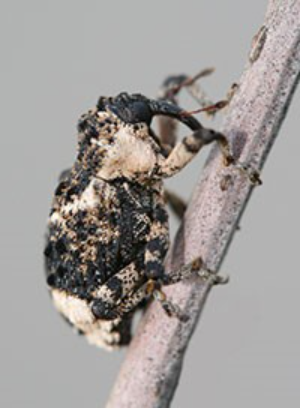
Figure 8: Poplar and willow borer, a type of weevil that develops as a borer in the stems of willows.
Carpenterworms (Lepidoptera: Cossidae)
The moth family Cossidae are known as carpenterworms. Adults are large moths and the larvae grow to be large caterpillars that tunnel deeply into trunks. The most common species, known as the carpenterworm (Prionoxystus robiniae), can develop in a wide variety of deciduous trees, but is most often found in cottonwoods and poplars. The life cycle of the carpenterworm is unusually long, taking 3-4 years to complete. The appearance of carpenterworm larvae is somewhat similar to those of clearwing borers.
Horntails (Hymenoptera: Siricidae)
Horntails are a family (Siricidae) of nonstinging wasps that develop as wood borers within trunks and branches of dead or dying trees. Several species are present in forested areas that attack recently killed or cut pines. Only one species, known as the pigeon tremex (Tremex columba), attacks deciduous trees, such as ash, elm, and maples. The pigeon tremex, and a primary natural enemy of the insect, are covered in
Horntails are incapable of attacking trees in good condition and the pigeon tremex will only develop within trees that are in the end stages of decline and have low moisture content. However, horntails may slightly accelerate tree death by introducing white rot fungi into trunks, which are introduced with the aid of their long ovipositor that is used to insert eggs into the wood. (The decay produced by white rot fungi can also structurally weaken wood.) When adult horntails emerge from the trees they cut a circular emergence hole about the diameter of a pencil.
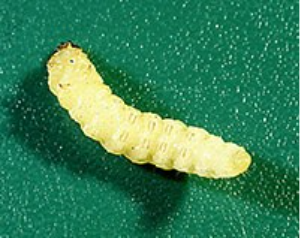
Figure 9: Larva of the peachtree borer. On the underside are several pairs of prolegs, tipped with an oval rig of small hook. That presence of prolegs distinguishes the borers that develop into moths. Photograph by David Shetlar, The Ohio State University.
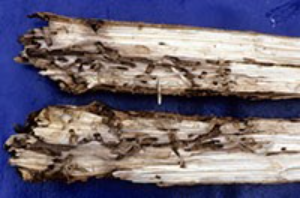
Figure 10: Damage to the base of an ash tree produced by lilac/ash borer.
Wood Borer Management
Promote host plant resistance
All trees have some ability to defend themselves from attacks by wood borers. Defensive chemicals are produced in the tree in response to borer wounding that may weaken and kill young borers. Callus tissue growth may be stimulated by wounding and encapsulating young borers. Trees that are well hydrated also become less suitable for attack. In the case of conifers, large flows of resin may be produced that can drown an invading insect. The intensity of tree defenses is related to tree condition, particularly the amount of energy reserves that had been stored by the plant and the level of water stress.
Consequently, any means of promoting tree health should be considered the first approach for managing most borers. This begins with the proper selection of trees and shrubs that are well adapted to the site; poorly adapted plants may be particularly susceptible to borers. Plants should also be maintained with pruning, eliminating damaged or overshaded limbs. Providing adequate moisture to the roots with timely irrigation, including in fall and winter, and/or the use of suitable mulches can be extremely important in limiting damage by many borers.
However, there are a few kinds of borers in Colorado that may not be controlled by tree defenses alone. The best example of an “aggressive borer” that can kill healthy trees is emerald ash borer, that was confirmed in the Colorado Front Range in 2013 and has continued its spread. Peachtree borer, gamble oak borer, Zimmerman pine moth, and locust borer are other borers that may seriously damage trees in good condition.
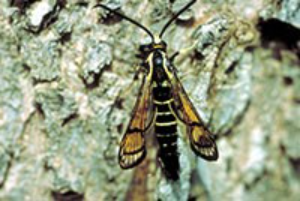
Figure 11: Adult male of the peachtree borer, a type of clearwing borer.
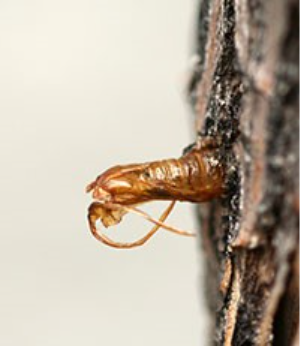
Figure 12: Pupal skin of the lilac/ash borer remaining extruded from the trunk after the adult emerged from the tree.
Preventive insecticide bark sprays.
With very limited exceptions it is not possible to control wood borer larvae that have already entered the plant where they become well protected. However, all wood borers will emerge from the tree or shrub when they reach the adult stage and become vulnerable to treatment. At this point insecticides sprayed onto the trunks can kill adults as they crawl on the bark and very young borers that emerge from eggs laid on the surface. This can prevent damage that could be produced by the next generation of insects.
The types of insecticides that are effective for this purpose have fairly long persistence when applied to bark and should be capable of killing wood borers for several weeks. Presently three insecticides applied as bark sprays are used for control of wood borers: bifenthrin, permethrin, and carbaryl (Table 1).
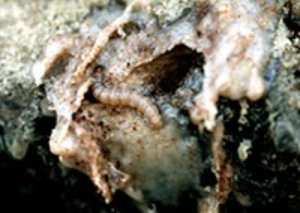
Figure 13: Larva and damage by the pinyon pitch mass borer.
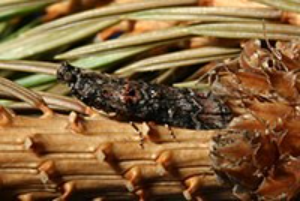
Figure 14: Adult of the Zimmerman pine moth. Photograph by David Shetlar, The Ohio State University.
The optimal timing for preventive trunk sprays is about the time when the adult stages of the wood borer are first present. For some species, such as the lilac/ash borer, adults emerge and begin to lay eggs in mid-to-late spring. Others emerge later; some only first become active on the outside of the plant beginning in midsummer. A summary of some of the more common wood borers, and their period of adult activity (flight period), is in Table 2.
Preventive trunk sprays are the easiest and cheapest means to effectively control almost all borers. A notable exception is emerald ash borer, the most aggressive and damaging wood borer in Colorado. Emerald ash borer is best controlled by the use of certain systemic insecticides applied to the soil or as trunk injections.
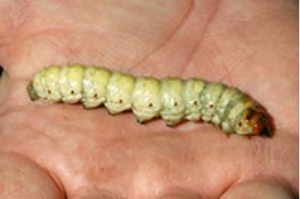
Figure 15: Larva of the carpenterworm.
Soil-applied systemic insecticides
The insecticide imidacloprid can move systemically within plant. When applied as a soil drench over the roots of a tree or shrub and watered into the soil imidacloprid can be used to control some kinds of wood borers.
The kind of borers that can be most effectively controlled by imidacloprid are flatheaded borers. These are a kind of beetle larva that feed in areas under the bark where imidacloprid will move in sufficient concentration to kill susceptible insects.
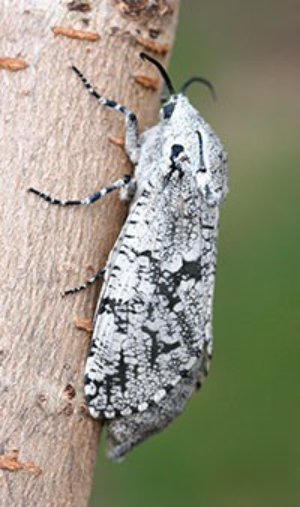
Figure 16: Adult of the carpenter worm. Photograph by David Leatherman.
It will take time for imidacloprid to be taken up by the plant, often 2-3 weeks. Therefore, it is best applied around the time when insects are beginning to lay eggs, or a little before. It is critical that the soil is kept moist enough for the insecticides to move to the roots. Systemic insecticides applied to dry soil will not be effective.
Many borers are not well controlled by soil applications of imidacloprid. Beetle larvae that spend much of the time in the interior of the trunk, such as roundheaded borers, will have little exposure to the insecticide. Imidacloprid is also not effective against larval stages of moths, such as clearwing borers, carpenterworms and pyralid borers.
Soil applications of imidacloprid can result in the movement of some of the insecticide into flower nectar. This can then be collected by bees and other flower-visiting insects. Therefore, the use of this insecticide for borer control should not be applied on plants that produce flowers that are attractive to bees. This includes lindens, crabapples, plums and some cherries. Prior to application, it is federal law to read and obey the pesticide label. Strong language is present in the label instructions of most imidacloprid products and these must be followed to avoid risks to pollinators.
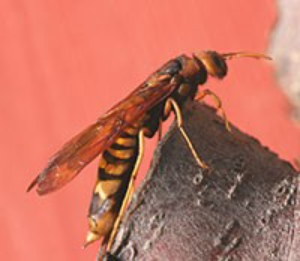
Figure 17: Adult of the pigeon tremex.
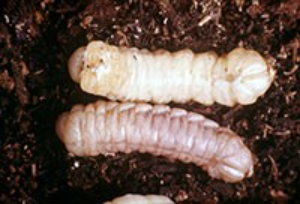
Figure 18: Larvae of the pigeon tremex.
Trunk sprayed systemic insecticides
Insecticides containing the active ingredient dinotefuran (Safari, Transtect, Zylam) can be applied to the trunks and will then move systemically within the tree. These applications can be effective to control wood boring beetles (metallic wood borers, longhorned beetles).
Dinotefuran trunk sprays may move more rapidly into trees than are insecticides used in soil application. Optimal time of application for borer control can be around the time of first expected adult emergence and egg laying or for a month or two after that period. However, on trees that produce flowers that are attractive to pollinators, applications should be applied only after flowering, since this insecticide can move into nectar. Trunk spray applications require considerable expertise and should only be made by licensed pesticide applicators.
Trunk injected systemic insecticides
Some insecticides can move systemically in plants but must be physically injected into trunk. The most common insecticide used for this purpose is emamectin benzoate. Azadirachtin, a naturally derived product from seeds of the neem tree, can also control some borers when trunk injected. Both are presently used frequently in Colorado to control emerald ash borer.
Trunk injections require specialized equipment and considerable skill to be used effectively and not cause undue wounding. These can only be done by trained pesticide applicators and are often more expensive than trunk sprays. However, the insecticides used for trunk injections can control most kinds of wood borers, and emamectin benzoate may provide reliable control for 2 or 3 years. Trunk injections also become more attractive when there are conditions at a site that prevent use of sprayed or soil-applied insecticides.
Resources Related to Emerald Ash Borer
| Table 1. Insecticides used to control wood borers in trees and shrubs | |||
| Insecticides used as preventive trunk sprays | |||
| Active ingredient | Trade name(s) (retail) | Trade name(s) (commercial application) | Comments |
| permethrin | Hi-Yield 38 Plus Turf, Termite and Ornamental Insect Control1 | Astro, Permethrin, others | Label allows use on many fruit trees |
| bifenthrin | None1 | Onyx, Talstar | No label uses for food crops |
| carbaryl | None1 | Sevin SL, Carbaryl 4L | Use allowed on most all fruit crops |
| Systemic insecticides used as a soil drench | |||
| imidacloprid | None | Merit, Mallet, Zenith, others | Only effective against flatheaded borers. Restrictions for use on plants that produce flowers and are visited by bees. These products are only available at licensed pesticide dealers. |
| dinotefuran | None | Safari, Transtect, Zylam | Effective against flatheaded borers and roundheaded borers; not recommended for clearwing borers. Do not apply prior to bloom on plants that produce flowers that pollinators visit. |
| Systemic insecticides used as a trunk spray | |||
| dinotefuran | None | Safari, Transtect, Zylam | Applications are made as a coarse spray to lower trunk. Effective against flatheaded borers and roundheaded borers; not recommended clearwing borers. Do not apply prior to bloom on plants that produce flowers that pollinators visit. |
| Systemic insecticides used as a trunk injection | |||
| emamectin benzoate | None3 | Tree-AGE G4, Tree-AGE R10, ArborMectin, Boxer, ArborJET | Can provide control for 2-3 years. May be effective against all types of common borers. |
| azadirachtin | None3 | TreeAzin, AzaSol, AzaGuard, others | Naturally-derived insecticide. May be effective against all types of common borers. |
| 1 Carbaryl, bifenthrin and other permethrin containing products are sold at retail stores but label instructions do not allow use rates that are effective for wood borers. 2 Also contains the insecticide chlothianidan. 3 Requires specialize equipment and can only be applied by commercial applicators. | |||
| Table 2: Flight periods and hosts of common shade tree borers in Colorado. | ||
| Common Name | Common Hosts | Typical Flight periods |
| METALLIC WOOD BORERS (Coleoptera: Buprestidae) | ||
| Flatheaded apple-tree borer Chrysobothrus femorata, | Apple, maple, oak, other hardwoods | June-August |
| Chrysobothris texana | Junipers | Mid-June-early August |
| Emerald ash borer Agrilus planipennis | Ash | late May-early August |
| Bronze birch borer Agrilus anxius | Birch | June-July |
| Honeylocust borer Agrilus difficilis | Honeylocust | June-July |
| Bronze poplar borer Agrilus ligarus | Aspen, other Populus | June-August |
| Bronze cane borer Agrilus cuprescens | Raspberry, currant, rose | late May-June |
| Gambel oak borer Agrilus quercicola | Oak | early June-late July |
| LONGHORNED BEETLES (Coleoptera: Cerambycidae) | ||
| 1Cottonwood borer Plectodera scalato | Willows, poplars, cottonwoods | July-August |
| 1Locust borer Megacyllene robiniae | Black locust (Robinia) | August-September |
| Poplar borer Saperda calcaratar | Populus, willow | June-August |
| Redheaded ash borer Neoclytus acuminatus | Ash, fruit trees, other hardwoods | April-June |
| Pine sawyers Monochamus species | Pines, spruce, fir | May-October |
| Blackhorned pine borer Callidium antennatum | Pines | May-June |
| WEEVILS (Coleoptera: Curculionidae) | ||
| Poplar and willow borer Cryptorhynchus lapathi | Willow, poplar | July-August |
| CLEARWING BORERS (Lepidoptera: Sesiidae) | ||
| Lilac/ash borer Podosesia syringae | Ash, lilac, privet | April-June |
| Cottonwood crown borer Sesia tibialis | Cottonwood | mid June-July |
| Peachtree borer Synanthedon exitiosa | Prunus | mid June-late August |
| Currant borer Synanthedon tipuliforme | Ribes | late May-June |
| Viburnum borer Synanthedon viburni | Viburnum | June-July |
| CARPENTERWORMS (Lepidoptera: Cossidae) | ||
| 2Carpenterworm Prionoxystus robiniae | Elm, maple, ash | June-July |
| PYRALID BORERS (Lepidoptera: Pyralidae) | ||
| 1Pinyon pitch mass borer Dioryctria ponderosae | Pinyon, ponderosa pine | June-August |
| 3Zimmerman pine moth Dioryctria zimmermani | Austrian, Scots pine | August-September |
| HORNTAILS (Hymenoptera: Siricidae) | ||
| Pigeon tremex Tremex columba | Maple, elm, ash, other hardwoods | late July-August |
| 1 Life cycle often takes 2 years to complete. 2 Life cycle takes 3-4 years to complete. 3 Larvae remain on bark and exposed to treatment until late April. | ||
Disclaimer: This publication may contain pesticide recommendations that are subject to change at any time. These recommendations are provided only as a guide. It is always the pesticide applicator’s responsibility, by law, to read and follow all current label directions for the specific pesticide being used. Due to ever-changing labels and product registrations, some of the recommendations given in this writing may no longer be legal by the time you read them. If any information in these recommendations disagrees with the label, the recommendation must be disregarded. No endorsement is intended for products mentioned, nor is criticism meant for products not mentioned. The author(s), Colorado State University, and Colorado State University Extension assume no liability resulting from the use of these recommendations. Beginning July 1, 2024, pesticide products containing neonicotinoid active ingredients and do not meet the listed product type exemptions, are considered “limited – use” pesticides and may only be sold by a licensed dealer.