


Quick facts…
- Managers have limited options for controlling invasive weeds like bulbous bluegrass and halogeton without impacting co-occurring desirable plants.
- The pre-emergent herbicide indaziflam (Rejuvra®) controls bulbous bluegrass and halogeton, but managers should consider the specific characteristics of each species when planning restoration treatments and evaluating success.
- Managers should be aware that it may take several years for control to become apparent when using indaziflam to manage bulbous bluegrass.
- Short-term halogeton control may be achieved with Rejuvra® treatment, but long-term reinvasion is possible and follow-up treatments may be necessary to maintain long-term control (2+ years).
Introduction
Bulbous bluegrass (Poa bulbosa L.) and halogeton (Halogeton glomeratus L.) are introduced weeds that invade rangelands in Colorado and other western states. While different, both these species generally reduce the resources available for desirable plants and limit the production of forage for livestock and wildlife in invaded areas. Recent trials in northwest Colorado suggest that the pre-emergent herbicide indaziflam (Rejuvra®, Envu) can help land managers effectively control these species and mitigate their impacts on important rangeland resources. Indaziflam is unique because it remains near the soil surface after application, which limits impacts to deeper-rooted perennials and selectively targets annual and short-lived plants.1
Bulbous Bluegrass
Bulbous bluegrass is a short-lived perennial grass that was likely first introduced to North America in the early-1900s (Figure 1). In some areas and situations, this grass can also grow as an annual. It is native to Eurasia and was initially considered valuable for complimenting other grasses in pastures and turf, even being considered for use in seed mixes intended to restore areas invaded by cheatgrass (Bromus tectorum L.).2 Similar to cheatgrass, bulbous bluegrass matures early in the growing season, limiting its value for livestock and wildlife. Preventing bulbous bluegrass dominance is important to maintain the ecosystem services provided by rangelands, but managers have limited options for managing bulbous bluegrass without impacting co-occurring desirable species.
Halogeton
Halogeton is an annual forb that was first identified in North America in 1934 near Wells, Nevada (Figure 1), where it was initially confused with Russian thistle (Salsola spp.).3 It is toxic to livestock and, although it is often not preferred when other forage is available, halogeton can result in livestock losses and sometimes requires careful grazing management.3 Halogeton is very tolerant of soils with high concentrations of salt. Salt readily leaches out of decaying halogeton tissues after it dies, increasing salt concentrations near the soil surface, which promotes increasing and persistent halogeton dominance. Reducing halogeton abundance is an important objective for rangeland managers threatened by halogeton dominance.
Bulbous Bluegrass and Halogeton Management with Rejuvra®
Trial Methods
We established two herbicide trials in Moffat County, CO in 2019. Bulbous bluegrass treatments were applied spring 2019 on private property approximately 10 miles northeast of Craig, CO, and halogeton treatments were applied late-summer on a private ranch in the Powder Wash region in the northeast portion of Moffat County. Broadcast applications of several different herbicide treatments were applied to small replicated experimental plots. Herbicide treatments included indaziflam (Rejuvra®), rimsulfuron (Matrix®, Corteva), imazapic (Plateau®, BASF), chlorsulfuron (Telar XP®, Envu), and metsulfuron-methyl (Escort XP®, Envu). Product trade names will be used henceforth for consistency and ease of interpretation. At both locations, we monitored weed species cover at various points in time after application, ranging from five to 48 months after treatment. See Table 1 and Table 2 for more details about the bulbous bluegrass and halogeton trials, respectively.
Bulbous Bluegrass
In our trial, no treatment reduced bulbous bluegrass cover to less than 20% when initial evaluations occurred (5 months after treatment), but treatments that included Matrix or Plateau with Rejuvra® provided decent control 14 months after treatment (13% and 15% bulbous bluegrass cover respectively, compared to 78% in untreated control plots; Figure 2). By the end of the study all treatments that included Rejuvra® provided comparable control (Figure 2), but Rejuvra® applied on its own at the 7 oz/ac rate provided the greatest reduction in bulbous bluegrass cover (9% cover compared to 49% cover in untreated control plots; Figure 2; Figure 3), suggesting that Rejuvra® on its own is sufficient for long-term bulbous bluegrass control. Rejuvra® lacks post-emergence activity and only controls vegetation prior to emergence.1,4 Our results suggest that Rejuvra® can prevent new establishment of bulbous bluegrass, but it may take several years for plants established at the time of treatment to die off and control to become apparent.
Key conclusions and management considerations include:
- Rejuvra® treatment at 5 and 7 oz/ac provided good long-term control of bulbous bluegrass, but managers using Rejuvra® should be aware that bulbous bluegrass may persist for several years after application. This does not necessarily indicate that treatment was ineffective, and control is likely to improve over time as bulbous bluegrass plants established prior to treatment die off.
- Treatments that did not include Rejuvra® (Plateau and Matrix) provided short-term suppression, but bulbous bluegrass cover was comparable to the untreated control 2+ years after treatment (Figure 3).
- If immediate control is desired, managers should consider mixing Rejuvra® with a post-emergent herbicide capable of killing established bulbous bluegrass; both Matrix and Plateau provided comparable suppression of bulbous bluegrass in the earlier years of our trial with only transient injury to established perennial plants.
Halogeton
All treatments that included Rejuvra® resulted in nearly complete control of halogeton 11 and 22 months after treatment in our trial (Figure 4; Figure 5), while Telar and Escort provided minimal suppression for the duration of the trial. Importantly, halogeton began to re-establish in Rejuvra®-treated plots later in the trial, with halogeton establishment observed 36 months after treatment and increasing abundance observed 48 months after treatment (Figure 4; Figure 6). Telar and Escort are both recommended for halogeton management, with Telar widely considered the most effective herbicide for halogeton management in rangelands.5 We cannot be sure why Telar and Escort provided minimal control of halogeton in our trial, but most sources suggest treating halogeton in the spring when using these herbicides,4 while our treatments were applied later in the summer (Table 2).
Key conclusions and management considerations include:
- Rejuvra® treatment at 5 and 7 oz/ac provided excellent pre-emergence control of halogeton, but control diminished over time, suggesting retreatment will likely be necessary 2-3 years after application to maintain control.
- Co-occurring perennial vegetation, which our site lacked, may promote longer-term halogeton control and reduce the need for retreatment by competitively suppressing halogeton and other invasive plants.
- Integrating Rejuvra® treatment with other revegetation practices (e.g., seeding, planting) may also reduce the need for retreatment by increasing desirable vegetation abundance and promoting competitive suppression of halogeton and other weeds after initial treatment.
Developing strategies for integrating Rejuvra® treatment with revegetation is an active area of current research. In general, establishing desirable vegetation prior to Rejuvra® treatment is advised to limit herbicide impacts to seeded species.
Concluding Thoughts
Bulbous bluegrass and halogeton pose serious threats to important rangeland resources in Colorado and other western states. Our results demonstrate that Rejuvra® can be an effective tool for managing these problematic invaders. Managers should be aware that it may take several years for control to become apparent after treatment when using Rejuvra® to manage bulbous bluegrass.
Additionally, while near complete short-term halogeton control may be achieved with Rejuvra® treatment, long-term reinvasion is possible and follow-up treatments may be necessary to maintain long-term control. In both cases, managers should assess the presence of co-occurring perennial vegetation when planning treatments since new desirable plants are unlikely to immediately establish after Rejuvra® is applied.
Where possible, intervening proactively (i.e., establishing desirable perennials) prior to invasive species dominance is the best strategy. When weeds dominate communities and proactive management is no longer an option, managers should consider revegetation prior to Rejuvra® application to avoid impacts to seeded species.
References
1. Clark, SL (2020). Using herbicides to restore native species and improve habitat on rangelands and wildlands. Outlooks on Pest Management, 31: 57-60.
2. Hull AC, Stewart G (1948). Replacing cheatgrass by reseeding with perennial grass on southern Idaho ranges. Journal of the American Society of Agronomy, 40: 694-703.
3. Young JA, Martinelli PC, Eckert RE, Evans RA (1999). Halogeton: a history of mid-20th century range conservation in the intermountain area. USDA Publication 1553, 60p.
4. Rejuvra® product label. Envu. Accessed 15-December-2025. https://bynder.envu.com/m/54a941473b6cea58/original/Digital_VM_Rejuvra_label_NA_US_EN.pdf
5. DiTomaso JM, Kyser GB et al. (2013). Weed Control In Natural Areas in the Western United States. Weed Research and Information Center, University of California. 544p.
Tables
Table 1: Bulbous bluegrass (Poa bulbosa) trial summary
| Application Date | 7-May-2019 |
| Evaluation Timings | 5, 14, 25, and 39 months after treatment |
| Experimental Treatments* | Untreated Control |
| Rejuvra 5 oz/ac | |
| Rejuvra 7 oz/ac | |
| Matrix 3 oz/ac | |
| Matrix 3 oz/ac + Rejuvra 7 oz/ac | |
| Plateau 7 oz/ac | |
| Plateau 7 oz/ac + Rejuvra 7 oz/ac | |
| *All treatments included a 0.25% v/v non-ionic surfactant. | |
Site Description: Bulbous bluegrass cover = 50-75%; bulbous bluegrass approx. 6” tall and primarily vegetative when treatments were applied; other plants present at the site included low sagebrush, smooth brome, western wheatgrass, Sandberg’s bluegrass, and several perennial native forbs.
Table 2: Halogeton (Halogeton glomeratus) trial summary
| Application Date | 13-August-2019 |
| Evaluation Timings | 11, 22, 36, and 48 months after treatment |
| Experimental Treatments* | Untreated Control |
| Rejuvra 5 oz/ac | |
| Rejuvra 7 oz/ac | |
| Escort 1 oz/ac | |
| Escort 1 oz/ac + Rejuvra 5 oz/ac | |
| Telar 1 oz/ac | |
| Telar 1 oz/ac + Rejuvra 5 oz/ac | |
| *All treatments included a 0.25% v/v non-ionic surfactant. | |
Site Description: Halogeton cover > 90%; halogeton rosettes were actively growing when treatments were applied; other plants present at the site included sparse intermediate wheatgrass and smooth brome.
Figures
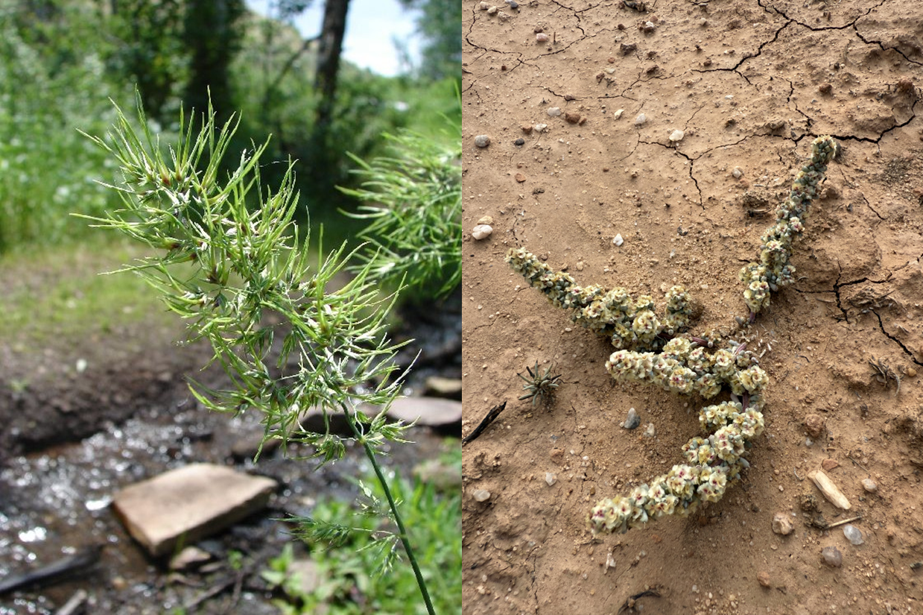
Figure 1. Bulbous bluegrass (Poa bulbosa; left) and halogeton (Halogeton glomeratus; right). Photo credits: bulbous bluegrass – BLM; halogeton – A. Stoneburner.
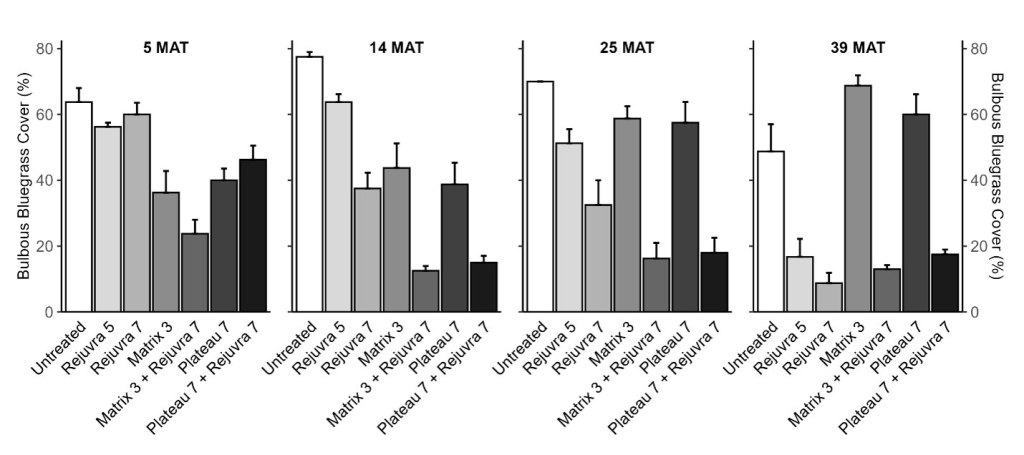
Figure 2. Mean (±SE) bulbous bluegrass (Poa bulbosa) cover 5, 14, 25, and 39 months after treatment (MAT) in herbicide treated plots and untreated control plots at trial location near Craig, CO. See Table 1 for more information.
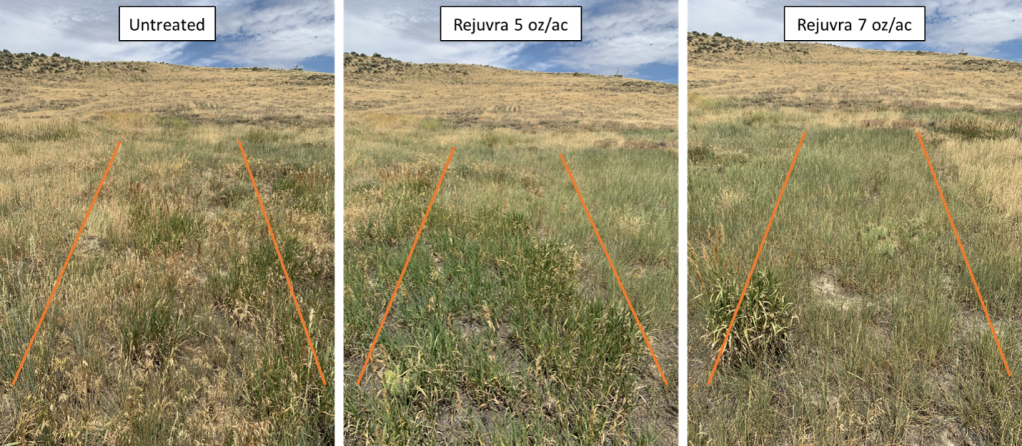
Figure 3. Photos of plots treated with 5 and 7 oz/ac of Rejuvra® and an untreated control plot at trial location near Craig, CO. Photos were taken 39 months after treatment. Nearly all of the light brown vegetation is bulbous bluegrass (Poa bulbosa). See Table 1 for more information. Photo credits: J. Courkamp.
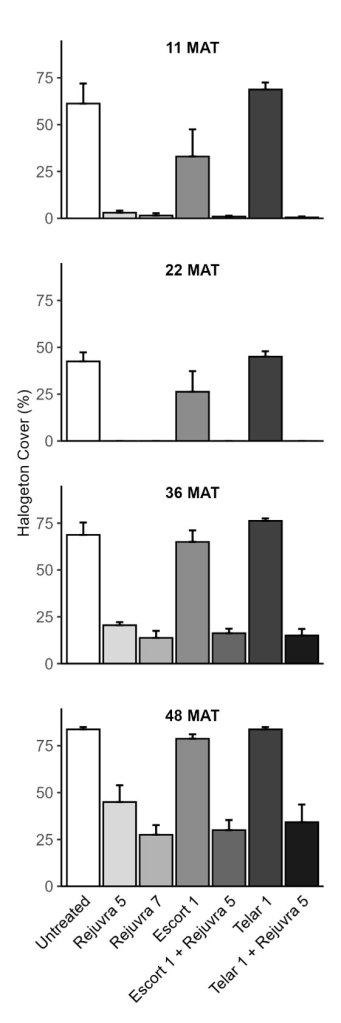
Figure 4. Mean (±SE) halogeton (Halogeton glomeratus) cover 11, 22, 36, and 48 months after treatment (MAT) in herbicide treated plots and untreated control plots at trial location in the Powder Wash area of northwest Moffat County, CO. See Table 2 for more information.
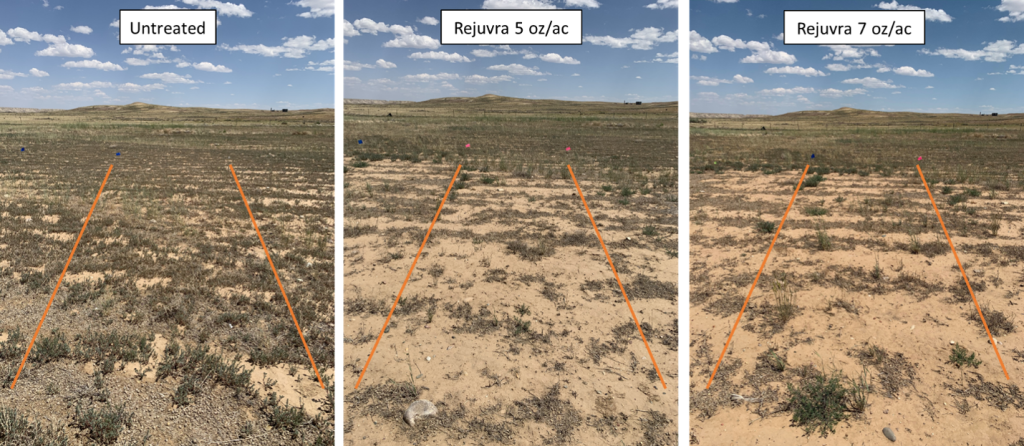
Figure 5. Photos of plots treated with 5 and 7 oz/ac of Rejuvra® and an untreated control plot at halogeton (Halogeton glomeratus) trial location in the Powder Wash area of northwest Moffat County, CO. Photos were taken 22 months after treatment. Nearly all visible vegetation is halogeton. See Table 1 for more information. Photo credits: J. Courkamp.
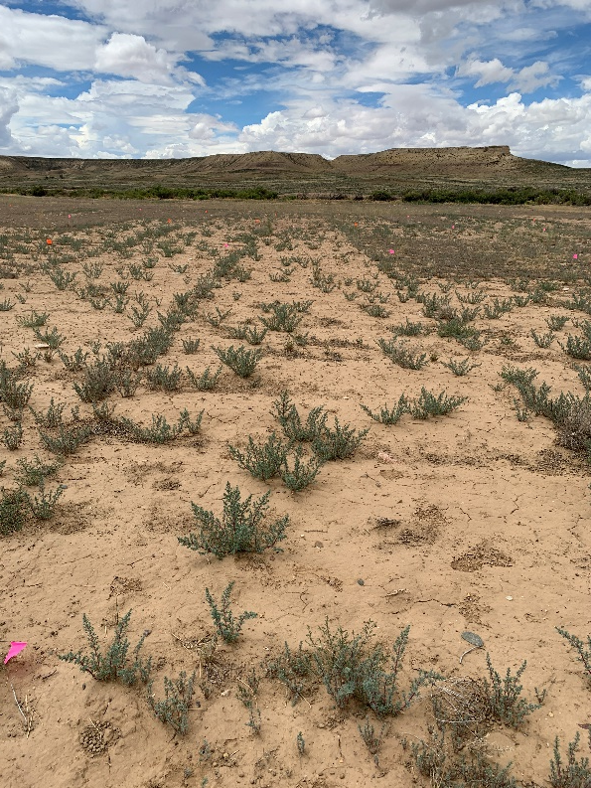
Figure 6. Halogeton re-establishing in a plot treated with 7 oz/ac of Rejuvra® at halogeton (Halogeton glomeratus) trial location in the Powder Wash area of northwest Moffat County, CO. Photo was taken 48 months after treatment. Photo credit: J. Courkamp.
Disclaimer: This publication may contain pesticide recommendations that are subject to change at any time. These recommendations are provided only as a guide. It is always the pesticide applicator’s responsibility, by law, to read and follow all current label directions for the specific pesticide being used. Due to ever-changing labels and product registrations, some of the recommendations given in this writing may no longer be legal by the time you read them. If any information in these recommendations disagrees with the label, the recommendation must be disregarded. No endorsement is intended for products mentioned, nor is criticism meant for products not mentioned. The author(s), Colorado State University, and Colorado State University Extension assume no liability resulting from the use of these recommendations. Beginning July 1, 2024, pesticide products containing neonicotinoid active ingredients and do not meet the listed product type exemptions, are considered “limited – use” pesticides and may only be sold by a licensed dealer.