



Solitary Bee Hotels
Photo courtesy of Grace Hanley Wright
Bee hotels (a.k.a. bee houses) have become a popular addition to backyard landscapes. In Colorado, we have over 900 bee species! Approximately 30% of those bees build nests in cavities or pre-existing tunnels, such as those used to make “bee hotels.”
Leafcutter bees and mason bees are among the most common solitary bees seen nesting in bee hotels. Cavity-nesting bees may also nest in between patio stones or other landscape infrastructure if they have cavities of the right size and diameter.
Things to Know
It’s important to make sure these habitats are built and maintained correctly. If not, they can negatively impact bee health. For best practices in building and maintaining a bee hotel, check out the following fact sheets:
- Building and Managing Bee Hotels for Wild Bees by Michigan State University Extension
- Creating a Bee Hotel by Nebraska Extension
Key points to keep in mind
Bee Hotel Location
- Keep bee hotels protected from rain, moisture, wind, and insect predators
- Attach them securely to a post, building, or isolated tree, about 4-5 feet off the ground
- Face hotels south/southeast so they have light in the morning
- If possible, locate them close to flowering plants
Bee Hotel Construction
- Stem bundles: Different nesting materials and tunnel diameters will bring a variety of bees
- Wood block: Drill holes 3/32 to 3/8 inches in diameter and separate holes by at least ¾ of an inch apart. Stem length or hole depth should range from 5-8 inches. Length/depth should increase as diameter increases.
- Possible hotel frame materials can include wood, milk carton, cinder block, plastic bucket, or cut PVC pipe. When using wood, be sure the material is untreated.
- Provide an overhang to protect the nest from rain.
Maintenance
- Be hotels must be cleaned seasonally so they don’t harbor pests and diseases.
- Clean tubes out each year. If possible, consider having two sets of tubes, one in the hotel and one clean and ready. Alternatively, replace tubes each year.
- Monitor for moisture, ant infestations, paper wasp nest, predatory birds, and spider webs during the season.
- At end of season (late fall before first freeze), move nest to new location (still outside/in the cold) where it will be protected from weather, moisture, and birds. Monitor for when bees begin to emerge. Place old hotel where bees are emerging near a new hotel so that bees leave the old nest but come back to a clean, new one.
Frequently Asked Questions
Adding a bee hotel to your landscape provides you the opportunity with see some of the biodiversity of species that lives in our garden landscapes. In addition to bees, you may notice some solitary hunting wasps nest in the bee hotel.
The wasps that nest in your bee hotel are NOT nuisance wasps like the western yellowjacket and the European paper wasps. Solitary hunting wasps do not bother people. They are not attracted to human food sources or human activity. We have a wide variety of species of solitary hunting wasps, and most of the time they go unnoticed. Solitary hunting wasps provide valuable pest control services. Depending on the species, they will hunt pest caterpillars, crickets, and spiders.
These wasps post no harm to the bees nesting in your hotel. They are simply looking for a protected place to nest for their offspring. Since solitary hunting wasps keep to themselves, the risk of getting stung is very low.
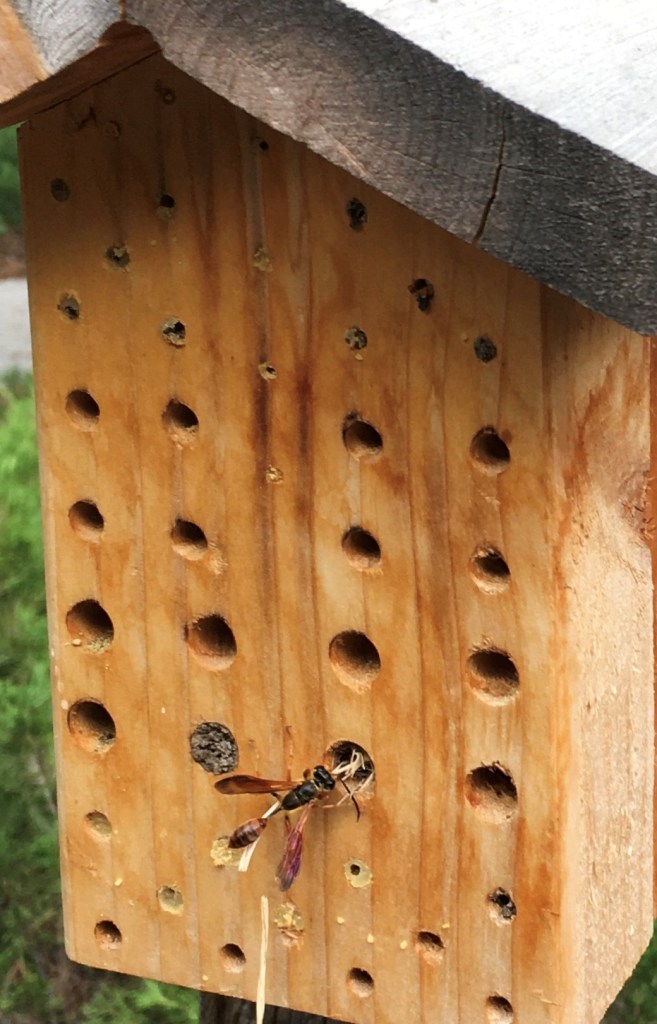
A solitary hunting wasp nesting in a bee hotel. Photo: Susan Tamulonis
The risk of getting stung from a bee at a bee hotel is extremely low. Over 90% of all insect stings are caused by the western yellowjacket, which will not nest in your bee hotel. Yellowjackets are scavenger wasps that can be aggressive, especially when their underground colony is threatened.
Other insect stings are usually from the European paper wasp or honey bees, both which could sting to protect their colony. Solitary bees such as the bees that nest in hotels are highly unlikely to sting since they do not have a colony to protect. The male bees cannot sting. The females can sting, but you would need to handle the bee, or have the bee pressed up against your skin to get stung. Bee hotels are often a great way to enjoy bee in your landscape without the worry of getting stung.
Sometimes insect hotels for purchase have narrow, vertical slots that are marketed as butterfly boxes or butterfly hibernation boxes. There is no research or evidence to support that butterflies will use these boxes. One study found that these slots are most likely to be used by the European paper wasp, a nuisance and invasive wasp species (Baker and Potter, 2020). European paper wasps feed on a variety of caterpillars including butterfly caterpillars. To avoid potential wasp nests in your vertical slots of your hotel, consider sealing up the slots. Learn more about attracting butterflies and other pollinators to your landscape by Creating Pollinator Habitat.

A European paper wasp nest inside a vertical slot marketed as a butterfly box. Photo: Lisa Mason
References
Baker, A.M., & Potter, D.A. (2020). Invasive paper wasp turns urban pollinator gardens into ecological traps for monarch butterfly larvae. Sci Rep 10, 9553. https://doi.org/10.1038/s41598-020-66621-6
Bauer, E. C., Lynch, L. I., Golick, D. A., Weissling, T. J. (2021). Creating a Solitary Bee Hotel. Nebraska Extension. https://extensionpublications.unl.edu/assets/pdf/g2256.pdf
Brokaw, J., Isaacs, R. (2017). Building and Managing Bee Hotels for Wild Bees. Michigan State University Extension. https://pollinators.msu.edu/publications/building-and-managing-bee-hotels-for-wild-bees/’