


Quick facts…
- Ips is a common group of bark beetles that infest pine and spruce trees.
- Ips beetles rarely attack healthy trees. Most problems with ips occur in newly transplanted pines or when plants are under stress.
- Several generations of ips can occur in a season.
- There are 11 species of ips beetles found in Colorado. .
Introduction
Ips beetles, sometimes known as “engraver beetles,” are bark beetles that damage pine and spruce trees. They develop under the bark and produce girdling tunnels that can cause dieback and kill trees. Eleven species of ips beetles occur in Colorado (see Table 1 below).
Table 1. Common ips beetles (Ips species) affecting pines and spruce in Colorado.
| Species | Hosts | Comments |
|---|---|---|
| Ips hunteri | Spruce | This is a common species affecting Colorado blue spruce in landscape settings. Upper portions of the tree are typically infested first. |
| Ips pilifrons | Spruce | A forest species often called the “spruce ips”; tends to infest the upper part of fallen trunks. |
| Ips pini | Ponderosa, lodgepole | The most common species associated with other pines pines in Colorado. |
| Ips knausi | Ponderosa pine | Common at base of trunk and in fresh stumps. |
| Ips calligraphus | Ponderosa pine | Largest ips species in Colorado; often in main trunk. |
| Ips confusus | Piñon, rarely other pines | Periodically kills piñons over large areas. |
| Ips latidens | 3- and 5-needled pines | |
| Ips borealis | Engelmann spruce | |
| Ips integer | primarily Ponderosa pine | |
| Ips woodi | Limber pine | |
| Ips mexicanus | Lodgepole and limberpines |
Ips beetles are not considered as destructive or aggressive as bark beetles in the genus Dendroctonus (mountain pine beetle, spruce beetle, Douglas-fir beetle). Normally ips beetles limit their attacks to trees that are in decline due to root injuries, wounding, or other stresses. However, under widespread conditions which allow improved survival and large population build-ups, ips beetles are a considerable threat to living trees. Two factors that recently contributed to ips beetle problems in Colorado include prolonged drought stress and the creation of freshly-cut wood (which is a preferred breeding site) from forest homeowner efforts to reduce wildfire hazards.
Ips beetles are small (1/8 to 3/8 inch long), reddish-brown to black beetles. They have a pronounced cavity at the rear end, which is lined with three to six pairs of tooth-like spines, depending on the species. The latter feature distinguishes them from other bark beetles (see Figure 1)
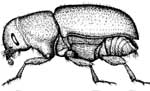
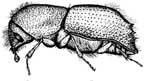
Figure 1. Adult Dendroctonus (left) versus Ips (right). Note gradually curved wing of Dendroctonus. Actual size of Dendroctonus from 1/8 to 1/3 inch, Ips 1/8 to 3/8 inch.
Symptoms of Ips Beetle Injury
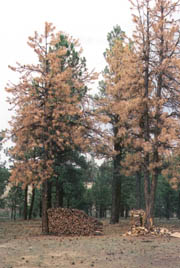
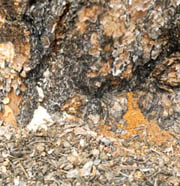
As adult ips beetles enter trees and tunnel a yellowish- or reddish-brown boring dust is produced and accumulates in bark crevices or around the base of the tree. When the larva tunnel, affected parts of the tree become discolored (“fade”) and die. These symptoms may be limited to parts of the tree, such as a single branch or the top. However, unlike mountain pine beetle, infestation by ips beetles does not necessarily mean the whole tree will die, but over time, attacks may progress as later generations “fill” the tree which can cause the tree to die.
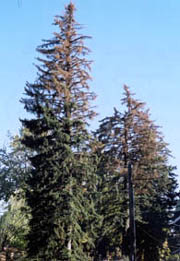
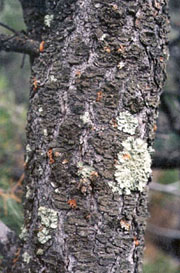
Small round holes in the bark of infested trees indicate the beetles have completed development in that part of the tree and the adults have exited. The presence of these holes peppering the bark show that the beetles have moved to another part of the same tree or to neighboring trees.
Woodpeckers are common predators of ips beetles. Their presence may also indicate bark beetle activity. Woodpeckers often remove the tree bark in an effort to eat the beetle larva. This habit results in ragged holes or patches of missing bark on the tree.
Generalized Life History
Adults overwinter under the bark or in surrounding litter at the tree base. They begin to attack weakened trees in the spring. Initially the male enters the tree, constructs a cavity under the bark, known as the “nuptial chamber.” Females are attracted to the tree by chemicals (pheromones) produced by the male.
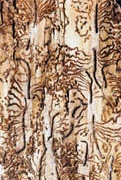
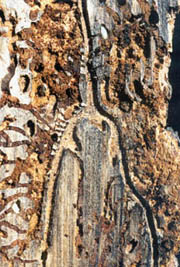
After mating, females (usually three) excavate egg galleries off the central chamber. The tunnels produced by the adults appear as a “Y”- or “H”- shaped pattern. These galleries are mostly free of boring dust, which is pushed out of the entrance hole as the adult beetles work. These “cleared out” galleries have a different appearance than the debris-filled galleries of Dendroctonus. Eggs are laid along the gallery and young larvae soon hatch and begin tunneling smaller lateral galleries that lightly etch the sapwood. The young larvae are small grubs, about 1/4 inch long when mature, white to dirty gray, legless, with dark heads. In Colorado, two to four generations of these beetles develop per year
Management
To prevent ips beetle attacks, use practices that promote vigorous tree growth. Properly placing trees in landscape plantings is important to allow optimal growing conditions as the tree matures. Adequate – but not excessive – water may be needed. Root injuries caused by mechanical damage, compaction, or disease should be avoided.
Freshly-cut material that results from pruning or thinning practices (called “slash”) should be removed from the vicinity of valuable trees. Never stack green or infested coniferous wood next to living coniferous trees. Green woody material should be chipped or treated so that the inner bark area is destroyed. Ips larvae will not survive standard chipping or debarking treatments. Other treatments could include scattering (as opposed to piling) slash to promote rapid drying.
Trees at risk of ips attack include newly transplanted trees, trees suffering root injuries from construction, and trees surrounded by large breeding populations of ips beetles. These types of trees can benefit from preventive insecticide applications.
Insecticides are used as drenching preventive sprays on trunks and larger branches. These insecticides need to be applied prior to adult beetle infestation. (Remember that overwintering beetles begin emerging in spring as soon as daytime temperatures consistently reach 50 F to 60 F.) However, timing can be difficult to determine since ips beetles can have multiple, overlapping generations and life cycles. Adults have been observed entering trees during warm days as early as late-February on through November. Because of this extended activity, two treatments (early spring and summer) may be needed to protect trees during high-risk conditions.
Insecticides used to prevent ips include either permethrin, bifenthrin, or carbaryl (Sevin) as the active ingredient. There are many products currently on the market containing these active ingredients. Follow the manufacturer’s recommendation for the proper rate for bark beetle treatment. Bark beetle applications at the labeled rate should provide at least three months control of ips beetles.
When a preventively-sprayed tree later dies of beetle attack, it is usually for one of the following reasons:
- The tree was sprayed after it was attacked
- The spray was applied at too dilute a rate
- The entire bark surface of the susceptible part of the tree was not sprayed
- The material wore off and was no longer effective.
Note: Concentrations of insecticides used to control bark beetles are often considerably greater than those used for insects on foliage. To avoid needle burning, try to limit the application to the bark, particularly when using liquid (emulsifiable concentrate) formulations that have increased risk of causing plant injuries.
Insecticide applications are not needed when ips beetles do not pose a serious risk to healthy trees. Ips problems are often an issue for a few years, then lessen naturally to non-threatening levels. This is the normal condition in Colorado. A rule of thumb when deciding if preventive treatments are needed is to survey for infested groups of bark beetle-killed trees (as determined by dead foliage) within sight of the live trees in question. Transplants or recently disturbed trees in natural forest areas or near other known sources of ips may warrant protection. Tree value is also a consideration. There is often more interest in protecting high-value trees, such as those around residences, golf courses, or in other highly visible settings.
No chemical treatment exists for trees or wood already infested by ips beetles. In rare cases where it is feasible to reduce the threat to live trees by killing beetles within infested trees before they exit, treatments involve bark removal, chipping the wood into small pieces, covering piles with a double-layer of 6-mil thick clear plastic sealed around the edges with soil to heat (solarize) the wood, or physical removal of infested material from the site to an area a mile or more from susceptible trees.
Reference: CSU Fact Sheet 5.558