


Quick facts…
- As the name implies, the Colorado Great Sand Dunes tiger beetle (Cicindela theatina) is found only in dune ecosystems of the Great Sand Dunes National Park
- Colorado Great Sand Dunes tiger beetles are predators that are well-adapted to moving on sandy soil and may be active at surface temperatures up to 160°F (60°C)
- Beetles exhibit surprising bursts of speed when hunting or threatened, moving at speeds approaching 10 ft/sec
- Larvae develop below-ground and are also predatory; development can take up to 2 ½ years
- Incidental trampling of larval burrows by humans and cattle are the largest threat to their conservation
Introduction
Adult Colorado Great Sand Dunes tiger beetles (Cicindela theatina, Family: Cicindelidae) are about half an inch long (13 mm) and have brightly-colored iridescent blue or green heads. The presence of ‘violin shaped’ markings on the elytra are easily distinguishable, and this character differentiates them from the closely related and co-occurring big sand tiger beetle, Cicindela formosa (Figure 1). The latter species is also reddish to brown in appearance, and both are found in the same habitats in Great Sand Dunes National Park.
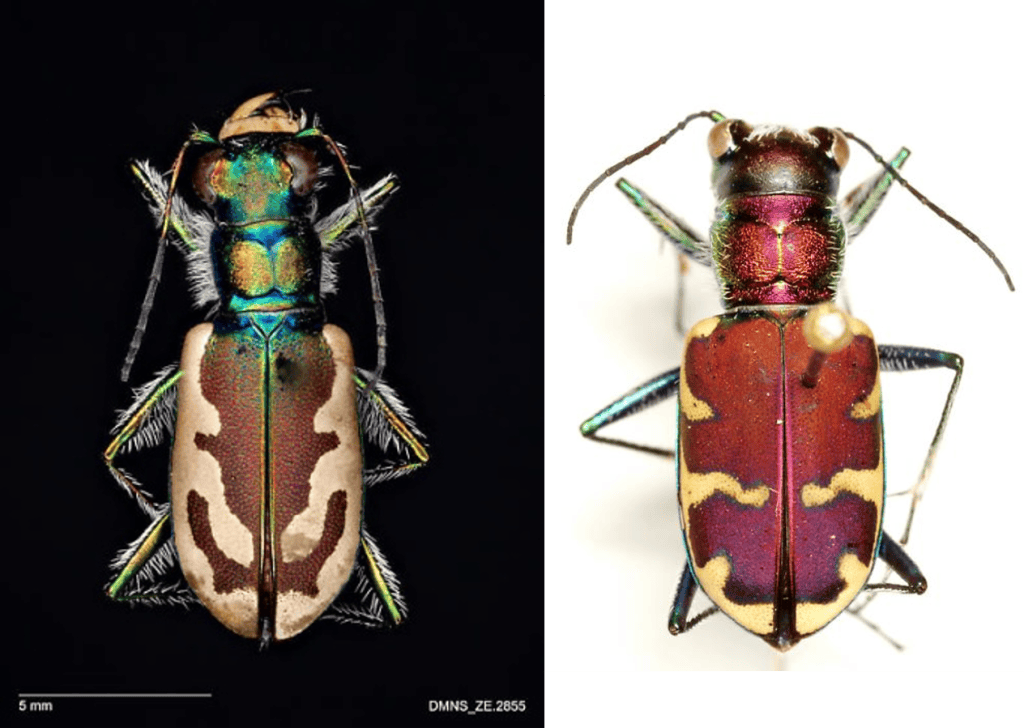
Figure 1. A comparison of the dorsal view of Colorado Great Sand Dunes tiger beetle (Cicindela theatina, panel A) and the big sand tiger beetle (C. formosa, panel B). Although similar in size and appearance, the violin marking and green or blue head helps to distinguish C. theatina from C. formosa.
Adults are highly mobile predators that rely on bursts of speed to overtake prey. However, adults will also scavenge on dead insects they encounter. Like other tiger beetles, C. theatina has relatively long legs proportional to their body length, which allows them to reach high movement speeds (up to 10 ft/sec) surprisingly quickly. Other Cicindela species are the fastest insects on land. Their long legs also help to regulate their internal temperatures via ‘stilting’ behaviors, where individuals temporarily lift themselves higher above the ground surface to generate air movement and cool down. Their style of foraging for prey is described as ‘stop and go’ hunting, where hunting adults will pursue prey and then briefly stop to re-orient before continuing pursuit. This occurs because their rate of visual processing is slower than their movement speed, and adults moving at top speed may be momentarily blinded (Gilbert 1997).
To avoid inclement weather conditions and predation by nocturnal predators, adults often excavate shallow burrows (~5 cm in depth, or 2 inches) where they spend the night (Pineda and Kondratieff 2003). Adult beetles are mostly active in the morning but may resume hunting or burrowing activity mid-afternoon. They are capable of continuing to forage even when ground surface temperatures are very high, in excess of 40 or 50°C (104-122°F). Analysis of insect DNA found in the C. theatina gut indicates they mostly feed on other small beetles, moths, spiders, and flies or other small flying insects (Table 1). They are also parasitized by miniscule wasps in the Eulophidae family.
Table 1. Arthropod DNA identified from the Cicindela theatina gut by the author in 2025.
| Family name | Common name | Notes |
| Chrysomelidae | leaf beetles | Herbivores |
| Eulophidae | eulophid parasitoid wasps | Likely parasitizes C. theatina |
| Hydropsychidae | net-spinning caddisflies | Aquatic, beetles feed on winged adults |
| Lygaeidae | seed bugs | Herbivores and omnivores |
| Muscidae | house flies | Saprophages, sometimes predators |
| Noctuidae | owlet moths | Herbivores |
| Pyralidae | snout moths | Herbivores |
| Sicariidae | recluse spiders | Predators |
| Staphylinidae | rove beetles | Omnivores and predators |
Like the adults, larvae are also predatory. Because C. theatina larvae live and develop primarily in underground burrows up to 1 m (3 feet) deep (Bauer 1991), few observations exist to describe their feeding behaviors. Informal tests in the field and laboratory indicate that larvae will accept mites, ants, and a variety of small beetles as prey items (Pineda and Kondtratieff 2003). Larvae typically hunt by waiting at the entrance of their burrows and ambushing prey passing near the burrow entrance, dragging their prey into the burrow where they are consumed. The larvae have large mandibles and a large chitinous head, but also possess a hooked ‘hump’ that prevents them from being dragged out of their burrows by struggling prey (Figure 2).
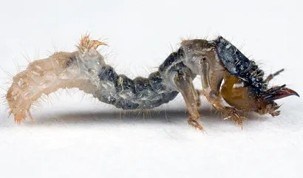
Figure 2. Tiger beetle larvae (Cicindelidia sedecimpunctata, another species found in the southwestern region). Note the prominent hump and protruding reverse ‘hooks’ on the fifth abdominal segment. Image credit: Sharman Russell.
Distribution and life history
Cicindela theatina is found only in the dune ecosystems of the Great Sand Dunes National Park, across an area representing approximately 115 mi2 (290 km2) of habitat (Figure 3). This area is characterized by sand dunes and berms interspersed with alkaline flats, as well as expanses of sparsely vegetated sand sheet, ruderal grassland, and ‘coppice dunes’ created from blowing sediment that settles at the base of small trees and shrubs (Andrews 1981).
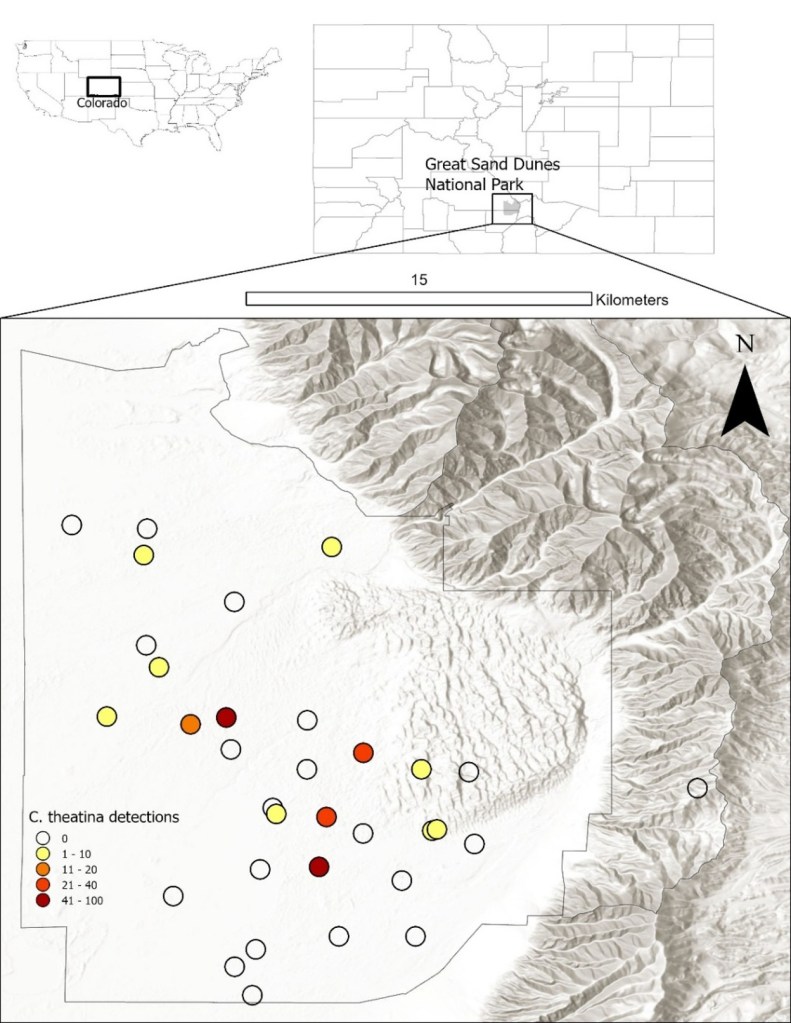
Figure 3. The detection of Cicindela theatina in a recent survey of the Great Sand Dunes National Park (2024-2025). Colored points represent beetle abundance in locations where C. theatina was detected.
Because of this extremely limited distribution, C. theatina is one of the only sand dune tiger beetle species that is classified as truly ‘endemic’ in North America (Acorn 1991). In surveys performed in 2024-2025 by the author, beetles were detected in about a third of sampled locations and mostly in locations with very sandy soils (>50% sand).
The life cycle of C. theatina typically takes about 2 ½ years to complete (Figure 4). New adults emerge in early summer (typically late May) and mate by June. Following coupling, males may remain attached to females for several hours as a form of ‘mate guarding’ to prevent subsequent matings by other competing males. Females excavate burrows in dry, sandy soils where the lay eggs. These larval burrows typically only have a single egg laid in them. Each female beetle lays about 30 to 50 eggs in a single season.
After about two weeks, larvae emerge from hatched eggs and move to the ground surface where they begin feeding on prey items and develop through three larval molts, or ‘instars’. By late August of their first year they enter diapause, which is a state of reduced metabolic activity similar to hibernation, where they remain for a period of approximately one year. During this time they are essentially inactive inside their burrows.
At the end of diapause, 3rd instar larvae pupate and emerge as teneral adults; meaning their exoskeletons are not fully hardened immediately after emergence, and they will diapause again through the winter months and emerge as sclerotized (hardened), reproductive adults in May of the following year (Pineda and Kondratieff 2003).
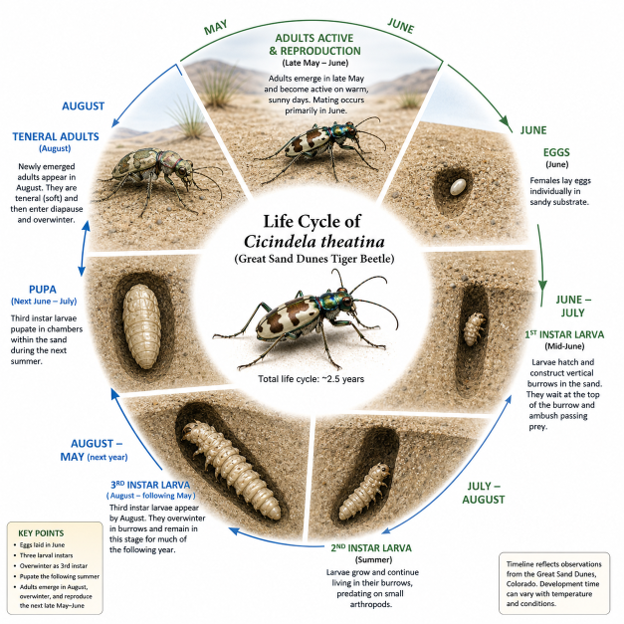
Figure 4. Generalized life cycle of Cicindela theatina. New adults emerge in May and mate by June; thereafter eggs are laid in subsurface sandy burrows and develop over a period of approximately 2.5 years. Image was reconstructed from the descriptions found in Pineda and Kondratieff (2003), using AI tools.
Conservation concerns
As a highly localized endemic species, C. theatina is a high-priority conservation target. Visitors to their habitat in the Great Sand Dunes National Park should refrain from collecting them as souvenirs. Trampling of larval burrows by cattle can be harmful to C. theatina, and adults fail to emerge from 75% of trampled larval burrows (Bauer 1991). It is possible that in high-traffic recreational areas few adult C. theatina are observed because of incidental damage to burrows by human visitors. In general, efforts to reduce soil compaction in areas where beetles are detected are important for their conservation. They may also compete with other more widespread tiger beetles for habitat, including the co-occurring look-alike C. formosa.
References
- Acorn JH. 1991. Habitat associations, adult life histories, and species interactions among sand dune tiger beetles in the southern Canadian Prairies (Coleoptera: Cicindelidae). Cicindela 12:17-48.
- Andrews S. 1981. Sedimentology of Great Sand Dunes, Colorado. In: FG Ethridge, RM Flores (Eds.), Recent and Ancient Nonmarine Depositional Environments: Models for Exploration. Society of Economic Paleontologists and Mineralogists Special Publication No. 31, Tulsa, Oklahoma. P 279-291.
- Bauer K. 1991. Observations on the developmental biology of Cicindela arenicola Rumpp (Coleoptera: Cicindelidae). The Great Basin Naturalist 51:226-235.
- Gilbert C. 1997. Visual control of cursorial prey pursuit by tiger beetles (Cicindelidae). Journal of Comparative Physiology 181:217-230.
- Pineda PM, Kondratieff BC. 2003. Natural history of the Colorado Great Sand Dunes Tiger Beetle, Cicindela theatina Rotger. Transactions of the American Entomological Society 129:333-360.