


Introduction
The number of small acreage properties continues to increase throughout Colorado. Owners of these properties have a variety of goals for use of their land, including wildlife habitat, enjoyment of open space, farming enterprises, livestock grazing, greenhouse crop production, forestry, and horticultural activities.
Colorado contains over 18 million acres of pastureland and rangeland in farms and ranches, representing the majority of the state’s agricultural land base according to the 2022 USDA Census of Agriculture. This land not only supports the crucial agricultural products of the state but also sustains important ecological services like wildlife habitat, watershed functions and rural economies.
Grasses thrive in Colorado because they are adapted to the state’s dry climate, drought cycles, grazing, and periodic fires. Their deep root systems allow them to efficiently use water, recover from disturbance, and dominate landscapes where many other plants struggle to survive.
Grazing has been central to Colorado agriculture since the late 1800s. Native grasslands that once supported bison now support cattle and sheep, making ranching one of the state’s most important agricultural industries. Grazing allows productive use of Colorado’s vast semi-arid rangelands, which are often better suited for livestock than crop production
With Colorado’s strong agricultural and ranching heritage, and a higher demand for food and fiber, many non-native grass species were introduced to increase forage production, extend grazing seasons, improve livestock nutrition, and provide reliable hay supplies for periods when fresh forage was limited. These species were often selected for their ability to establish quickly and remain productive in areas where degraded native grasses might require more time to become established.
Species such as crested wheatgrass were once considered an ideal solution for Colorado’s challenging conditions, including dry climates, cold winters, and hot summers. While these grasses have proven highly resilient, their widespread use has also contributed to reduced plant diversity in some pastures and rangelands. Today, maintaining or restoring species diversity is increasingly recognized as an important goal in regenerative grazing and rangeland management, as diverse plant communities can improve ecosystem resilience, soil health, wildlife habitat, and long-term forage productivity.
This publication was developed to help small-acreage landowners understand the fundamentals of livestock forage production and grazing management. It provides information on common forage grasses grown in Colorado, the role of legumes in pasture systems, and key considerations for establishing or renovating pastures.
Understanding how forage species grow, their seasonal growth patterns, appropriate grazing rotations, hay harvest timing, and site-specific species selection can help landowners provide high-quality forage for livestock while maintaining soil health and pasture productivity. Sound management practices also reduce the need for costly pasture renovation and reseeding, which are often the result of overgrazing or poor species selection.
This guide introduces the most common forage grasses used in Colorado, their adaptations and growth characteristics, and best management practices for pasture establishment and renovation. It also covers stocking rates, grazing strategies, and other essential considerations to help landowners develop productive, resilient, and sustainable pastures that provide long-term benefits for both livestock and the land.
Pasture Revegetation
Reseeding pastures can cost around $200-400 per acre (CSU Extension). Ensuring the process is done correctly will help avoid repeated costs, additionally, proper management once pasture is established will ensure the long-term sustainability of the seeded forages.
The first step in pasture revegetation is determining whether reseeding is truly necessary. In many cases, pasture productivity can be restored through improved grazing management rather than reestablishment. Overgrazing is a common cause of pasture and rangeland decline on small acreages, but if desirable forage species are still present, allowing adequate recovery time, reducing grazing pressure, controlling undesirable vegetation, and implementing a rotational grazing system that matches stocking rates to the land’s carrying capacity can often restore pasture health and vigor without the expense of reseeding. These grazing management practices are discussed in the Grazing Management chapter.
In addition to the high cost of reseeding, many grasses require multiple years to become fully established and grasses should not be grazed before they are established to prevent animals from uprooting young plants. Where reseeding is needed, selecting the right species for your site and intended land use, purchasing quality seed and preparing a good seedbed will result in successful and long-lived perennial pastures.
Efficient use of water is crucial for plant establishment. On irrigated sites, coordinating seeding with irrigation schedules will help maintain seedlings alive, while on dryland pastures dormant seeding during the winter or spring will give the best chances of success, although dryland reseedings often require second attempts due to the unpredictability of precipitation.
When seeding or reseeding a pasture, there are some driving variables that will determine what grows best in your area. It is important to evaluate and get familiar with those to better select the species that adapt to those areas rather than try to correct the site conditions through management. Those site considerations include soils, water or moisture availability and time of seeding.
Site considerations
Soils
The process of revegetating a pasture starts by analyzing the site environment, such as its topography, soils, and amount of water it receives. Soils are the foundation and nutrient source for plants, and some plant species are better adapted to specific soil textures. Knowing the type of soil texture in the area to be reseeded is a first step to selecting an adequate forage species. A soil map of your land can be created using the online NRCS Web Soil Survey located at websoilsurvey.nrcs.usda.gov.
Loamy soils are the most versatile texture for plants because they have a balance of sand, sil, and clay particles. Plant establishment on sandy soils can be difficult because they do not retain as much moisture as clays or loams. Clay soils are more susceptible to heavy compaction and plant establishment may require mechanical cultivation prior to seeding, however these soils have a great capacity to hold moisture.
Saline soils are found throughout the state of Colorado. Soil salt content is measured in millimhos per centimeter (mmhos/cm), decisimens per meter (dS/m) and parts per million (ppm), also found on a soil test as Electrical Conductivity (EC). Soil EC above 4.0 dS/m is considered saline and reduces seed germination and plant nutrient absorption. EC levels of 12 or greater will only support a few forage species. More information, consider reviewing the Saline Soils fact sheet.
Water availability
Forage species should also be selected based on how much water the site receives. Dryland species are needed for sites that receive only natural precipitation. A difference of only 2 inches of average annual precipitation is enough to change the species that will survive the best. For example, thickspike wheatgrass performs better in areas receiving 12 to 13 inches of moisture than its closely related cousin, western wheatgrass. Grass species options increase as precipitation rises above 14 inches per year, however, the palatability of the species and growth season also need to be considered.
Sites near rivers, creeks, canals or ponds are sub irrigated when underground water is within reach of plant roots. They can be more productive than dryland sites and should be seeded with forage species that take advantage of the extra available water.
For irrigated pastures, determine how much irrigation water is available. Pastures are short of water if one or two irrigations are made in the spring and no (or limited) water is available in the summer. Different species are recommended for short-water versus adequate-water situations. It is recommended to test the quality of irrigation water, as high salts and nitrates can limit plant growth.
Time of seeding
Dormant seeding is recommended for dryland fields. This approach places seed in the soil before the growing season so it can take advantage of any moisture as soon as it becomes available. The dormant-seeding window extends from November 15 to April 15, as long as the soil is not frozen. Planting before March 1 ensures seeds are already in place and ready to grow with early spring rains, helping landowners avoid the challenges of trying to seed on wet soil or between rainstorms.
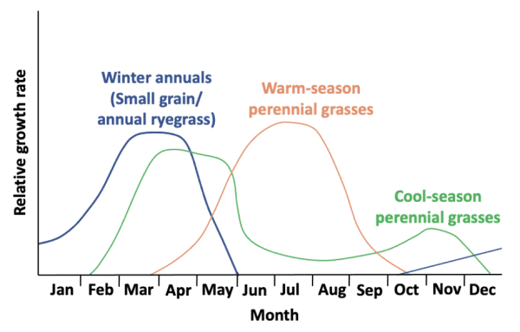
Grasses break dormancy when soil temperature and moisture are favorable. Cool-season grasses will germinate and emerge in March or April. Warm-season grass seeds will lay dormant longer and germinate in May.
If irrigation water is available, forage seeds can be planted 6 to 8 weeks before the first hard freeze, generally late August to early September.
Buying seed
State and Federal laws require seed dealers to label all seed offered for sale. The label must list seed origin, purity, species identity, percent germination, and weed seed content. It also must list the seed lot number and the company or person responsible for label content.
As previously discussed, successful reseeding is rarely guaranteed in Colorado, especially because of the variability of moisture availability throughout the state. Buying good quality seed can help achieve better results. Local seed companies often provide a a wider variety of grass and legume species and cultivars, have better traceability of where their product comes from and can provide customized seed mixes or recommend you an adequate seed mix for your intended use and area.
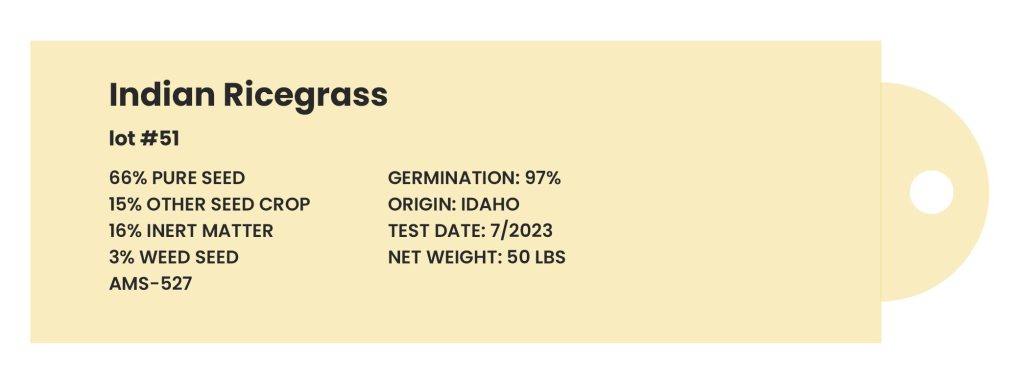
Origin. All seed lots offered for sale in Colorado must have the state of origin listed on the seed tag or state if the origin is unknown. It must be stated on the tag if the origin of the seed is unknown. Seed with origin close to the location where it will be planted will be more adapted to the local conditions.
Purity. Is the percentage of desirable seed species in the bag. Purity % + inert matter% + weed seed %+ other crop seed % must add up to 100%. Inert matter includes small sticks and stems, chaff, and infertile flowers. Inter matter content over 15% makes the seeds difficult to plant, however, some native grasses like the bluestems, gramas and Indiangrass have higher inert matter percentage because they are hard to clean. Drills with seed-box agitators are recommended to plant these seeds.
Weed Seed. The label should indicate that no prohibited noxious weed seeds are present. For other weed seeds, Colorado Seed Law states that they cannot total more than 2% by weight.
Germination. Total viable seed includes the percentage of all seed that germinates in a lab analysis, plus the amount of hard and dormant seed. Species vary regarding the amount of hard and dormant seed, but dormant seeds are not undesirable; the higher the total germination, the better. Germination for most grass species should not be lower than 60%. Germination of chaffy seeds may be lower.
Species Identity. Forage seed is sold as Common, VNS (Variety Not Stated), or Certified. Certified seed is typically the most expensive, but it provides assurance that the stated variety is accurate. When certified seed is unavailable, verifiable seed varieties are a reliable alternative. Some VNS lots may also originate from high-quality blends of different verifiable varieties. If neither certified nor verifiable varieties are accessible, choosing seed with a known origin and proven adaptation to the intended planting area is a good alternative.
Estimating amount of seed needed: Pure live and bulk seed
Seed is sold and purchased on a Pure Live Seed (PLS) basis because of the differences in purity between seed lots and germination. PLS is calculated by multiplying seed purity by seed germination. Use the decimal representation of a percent (proportion) when calculating bulk seeding rates. In other words, 70% purity equals 0.70.
Planting based on PLS seeding rates ensures that the number of seeds planted on the ground matches the desired number of plants that have the potential to germinate and being growth. PLS factors out the dead seeds, weed seeds, and inert matter in seed lots that will not produce desired plants.
The PLS value should be used to determine the amount of bulk seed to purchase. Bulk seed is the retail product in seed bags. The bag’s weight includes that of PLS, dead seeds, weed seeds, and inert matter.
If you want to plant 5 PLS pounds per acre of a grass on 10 acres, first calculate the PLS for the seed lot. For example, the seed lot label (Figure 1) indicates that the seed purity is 66% and the germination is 97%.
PLS = 0.66 × 0.97 = 0.64 The PLS
To calculate pounds of bulk seed to buy and plant:
(PLS lb/acre) ÷ (PLS) = bulk lb/acre seeding rate
(5 PLS lb/acre) ÷ (0.64) = 7.8 bulk lb/acre
(7.8 bulk lb/acre) x (10 acres) = 78 lb total bulk seed
When using a grass drill, using about 5 more pounds of seed than needed might help push down seed through the seeding tubes as the box empties.
Solo and mixed seedings
Solo plantings (monocultures) or mixed seedings are good options that offer different benefits depending on the intended use and management of the land. Mixed seedings are more ecologically desirable because they offer stand diversity, more resistance to disease and insect problems and endure different extremes in climatic conditions. Mixtures can also make a more efficient use of available moisture, light and nutrients through the growing season.
Dryland and irrigated pasture seed mixes are often available on the retail market and through Conservation Districts. These mixes often contain combinations of native and introduced grasses, so careful observation should be done to ensure these pre-made mixes contain species that fulfill the intended uses and management of the property. Seed prices tend to be higher on orders of less than 50 pounds.
Mixed pastures can include various combinations of grasses and legumes. Mixing plants with different seasons of growth is generally not advised on small acreages. While these mixes can extend the grazing season of dryland pastures (less so on irrigated pastures), they are best seeded in separate pastures for ease of management. Cool season pastures, for example, can be used in spring and again in the fall (depending on moisture). Warm season pastures can be used in the summer while cool season grasses are dormant. However, these types of systems may not be suitable for small dryland parcels.
Mixed stands of cool- and warm-season grasses often become dominated by the cool-season species over time. Cool season grasses are often favored by winter and early spring moisture and nutrients, while warm season grasses remain dormant and use the leftover moisture in late spring or summer. Summer rains may be of little benefit as they are often inconsistent in timing and amount. Warm-season grasses will dominate if the cool-seasons are continually overgrazed in the spring.
Native and introduced species mixes are also challenging, since many introduced species tend to establish quicker than natives, creating an advantage of those over native grasses. Mixes of native species interact well and tend to complement each other. Simple mixes of three to four species for irrigated pastures are often recommended. In dryland sites, using a wider variety of species may be more suitable. This is especially true in sites where water tables, soil salt content and soil textures are variable. Each species will be established on the microsite to which they are better adapted. More details on warm season and cool season grass species and native and introduced species can be found in this guide.
Advantages of grass–legume mixtures are discussed in the “Legume” section of this publication. Legumes perform best when paired with shorter, less aggressive grasses. However, some legume species can cause bloat in cattle and sheep due to their rapid digestion. This fast breakdown releases gases quickly inside the rumen, which can become life-threatening if not properly managed.
To reduce the risk of bloat, the proportion of bloat-causing legumes such as alfalfa and clovers should not exceed 25% of the pasture composition. Careful attention should be given to managing legume–grass pastures, as livestock often prefer legumes and may overgraze them if not allowed adequate time for regrowth.
Mixed stands should have species similar in palatability (the degree of being desired by livestock), regrowth ability, time of maturity, and competitiveness. Livestock will favor and overgraze the more palatable species in unbalanced mixes. Balanced mixes foster optimum forage quality when harvested for hay.
Grass monocultures can be suitable in certain situations because they are easier to manage in terms of forage regrowth and maintain consistent palatability. Grasses such as pubescent wheatgrass, tall fescue, smooth brome, and crested wheatgrass are often best managed as monocultures. However, careful consideration is needed before planting these species, as they can spread beyond their intended area and become invasive or difficult to control. Despite this risk, they often provide high-quality forage and show strong resilience to drought and cold winters.
Species suggestion
A summary description of growth season and habits can be found on Appendix A. When deciding on a grass species consider the growth height and intended purpose of the pasture. Some grasses are optimal for hay cutting while some others are better suited for grazing. More characteristics of grasses and legumes can be found on Appendix B and C. The individual species descriptions in this publication also provides information on species that grow well together and their adaptability do different management scenarios.
Designing a seed mix
On customized seed mixes, seeding rate for each species needs to be calculated based on the PLS for each species and its weighted proportion in the mix. PLS may be different depending on the seed supplier and seeding rates vary within species, seeding method and location of the seeding. Additionally, considering the price of the species to be seeded can impact the percentage of that species to be used in a mix, and should be considered in addition to the desirable composition of the mix.
An example of a custom seed mix can be found below:
Desirable species and percentages:
- 30% sideoats grama
- 30% big bluestem and
- 40% switchgrass
Step 1: Determine the PLS for each species (from seed tag)
| A Purity |
B Germination |
C PLS (A×B) |
|
|---|---|---|---|
| Sideoats grama | 0.70 | 0.80 | 0.56 |
| Big bluestem | 0.60 | 0.80 | 0.48 |
| Switchgrass | 0.90 | 0.90 | 0.81 |
Step 2: Adjust the mix for PLS pounds per acre.
| D Desired Mix (%) |
E lb PLS/acre (solo planted) |
F lb PLS/acre in mix (D×E) |
|
|---|---|---|---|
| Sideoats grama | 30 | 4.5 | 1.4 |
| Big Bluestem | 30 | 5.5 | 1.7 |
| Switchgrass | 40 | 3.0 | 1.2 |
Step 3: Adjust the mix for bulk pounds per acre.
| F lb PLS/acre |
G lb bulk seed/acre (F÷C) |
|
|---|---|---|
| Sideoats grama | 1.4 | 2.5 |
| Big bluestem | 1.7 | 3.5 |
| Switchgrass | 1.2 | 1.5 |
| Total bulk seeding rate in lb per acre (Sum of G)= | 7.5 | |
Other characteristics to consider for grass seeding
Bunch and sod-forming grasses
Perennial grasses can be classified by their growth habits into bunch grasses or sod-formers. Bunchgrasses grow in distinct clumps with upright, tufted growth and minimal lateral spread, and often leave small areas of bare soil between clumps. Sod-forming grasses spread horizontally through rhizomes or stolons creating a dense mat that fills in any gaps of bare ground.
Bunchgrasses typically have more leaves than sod-forming species. Many have leaves grouped near the plant base. They typically produce more forage than sod-formers but need more intensive grazing management to optimize productivity. For example, grass growth will be delayed if the growing points are defoliated, this is especially risky in the elongation phase of a bunch grass, when the seeds talks are developing. Some species raise their seed stalks earlier during the growing season than others. However, some bunchgrass species such as orchardgrass, perennial ryegrass, and meadow brome continually initiate new tillers, and their production is impacted little by defoliation.
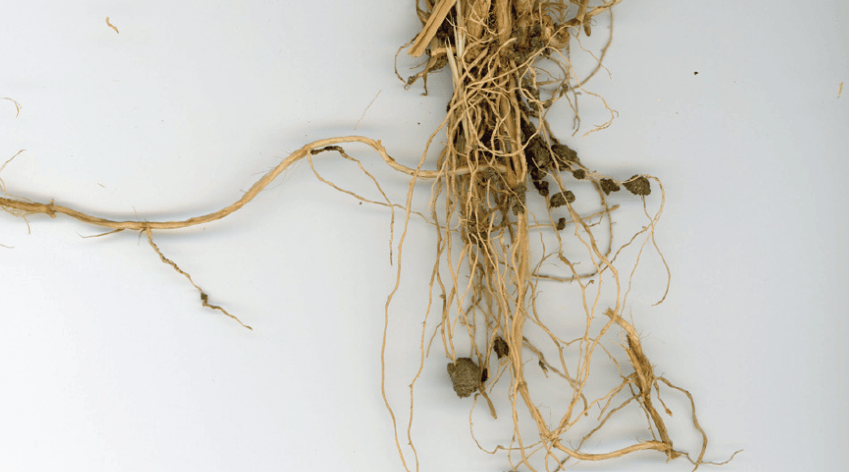
Sod-forming grasses have underground stems, called rhizomes, which run parallel to the soil surface. Rhizomes form a sod that can tie the soil together, making these grasses a good option for erosion control. New above-ground shoots are sent up from nodes located along the rhizomes. These shoots tend to fill in and cover bare spots on the soil. Examples of sod-formers are Kentucky bluegrass, western wheatgrass, and smooth brome.
Pastures dominated by sod-formers are not as rough as those dominated by bunchgrasses. Sod-formers are typically less productive but often tolerate more grazing than bunchgrasses because they grow new shoots from rhizomes.
Warm- and cool-season grasses
We have referenced a plant’s growth season throughout this guide. Grasses can either be cool season or warm season, but either between those two kinds, some grasses being growth earlier or sooner in the season and that can play a key role in terms of grazing management.
Grasses that grow during spring and fall when temperatures are still cool are known as cool season grasses. Their growth and forage production peaks in the spring and fall and go dormant in the summer when temperatures starts rising. These plants are also known as C3 plants, which refers to its photosynthetic pathway, which relies on the enzyme Rubisco.
Rubisco binds oxygen, especially with warm temperatures, which causes the plant to enter photorespiration. This process reduces carbohydrate production in the plant, causing slow growth. C3 plants become less efficient at high temperatures and with low water availability they go dormant.
With insufficient irrigation, these grass species will look brown during the summer, however, with enough water they can remain green. This is the case with most lawn grasses, like Kentucky bluegrass, which under summer irrigation remain green and productive during the heat of the summer.
Warm season grasses being growth around mid-May (on a typical year), when soil temperatures reach 60°F. These grasses use the C4 pathway, which relies on the PEP carboxylase enzyme, which does not bind oxygen. This mechanism prevents photorespiration entirely, even under high heat.
Because of that pathway, C4 grasses are more efficient at fixing CO2, especially under high heat. They require more energy (carbohydrates) to function, but they store water more efficiently and maintain higher productivity in hot, dry conditions. They tend to be more drought tolerant than C3 grasses and can be a good option for water efficiency. Corn and Sorghum are examples of C4 annual grasses, buffalograss and blue grama are some native perennial warm season grasses.
Native and introduced grasses
Native grasses evolved with the climate and soils of the area. They typically live longer than introduced species and require little maintenance. Because they have evolved with the soil types and characteristics of the region, they typically do not require supplemental fertilizers. Native grass seeds tend to have higher prices, some species are difficult to harvest and can make availability scarce on some years. They typically take three to four years to become bully established, grazing is not recommended until grasses are established.
Introduced grasses evolved outside of North America and were imported for their production potential and their ability for faster establishment. They respond better to fertilizer and irrigation than native grasses and seed costs can be lower. Introduced grasses may not have the longevity of native grasses and may require renovation more frequently.
Introduced grasses, brought into the United States in the late nineteenth century, became popular because of their adaptability to local growing conditions. They are often highly productive and quick to establish, but some species can aggressively colonize landscapes and displace other plants if not properly managed. In Colorado, brome hay is frequently assumed to be the standard when purchasing grass hay for livestock, as brome has been managed for hay production for generations. However, several native grass species can be equally productive and nutritious. For example, big bluestem can reach a crude protein content of 11–12% at harvest, comparable to smooth brome. Ultimately, choosing between native and introduced species depends on key factors such as soil type, irrigation availability, and intended use, each of which plays an important role in selecting the right grass for a pasture.
Legumes
Legumes are broadleaf plants or forbs, often high in protein. Some species form symbiotic relationships with bacteria that live in their nodules (or knots) located on their roots. These bacteria is called Rhizobia and can convert nitrogen from the air into plant available forms. This fixed nitrogen is provided to the legume, and another small portion becomes available to any grass growing in their proximity over time. Each legume requires a specific species and strain of Rhizobia for nodule formation. Inoculation with Rhizobia is often needed for some legumes to ensure nodulation.
Depending on the legume species, and soil moisture, legumes can increase forage production. Alfalfa is usually the top choice because it fixes the most nitrogen. Legumes can also produce more forage during the summer than cool season grasses and improve forage quality factors such as palatability, digestibility and nutrient content.
Plant varieties
When choosing seeds for pastures, either from grasses or legumes, and even other crops and ornamental plants, different varieties (also known as cultivars) may be available. These varieties have been specifically developed to enhance some of the properties of the plant like their adaptability, yield potential or aesthetic values. Each species listed on this guide provides a list of commonly available or planted varieties for this plant, although availability can change from one season to the other. Additionally, for some crops like alfalfa, many varieties are bred and developed every year to achieve market needs and address different challenges or conditions related to its production.
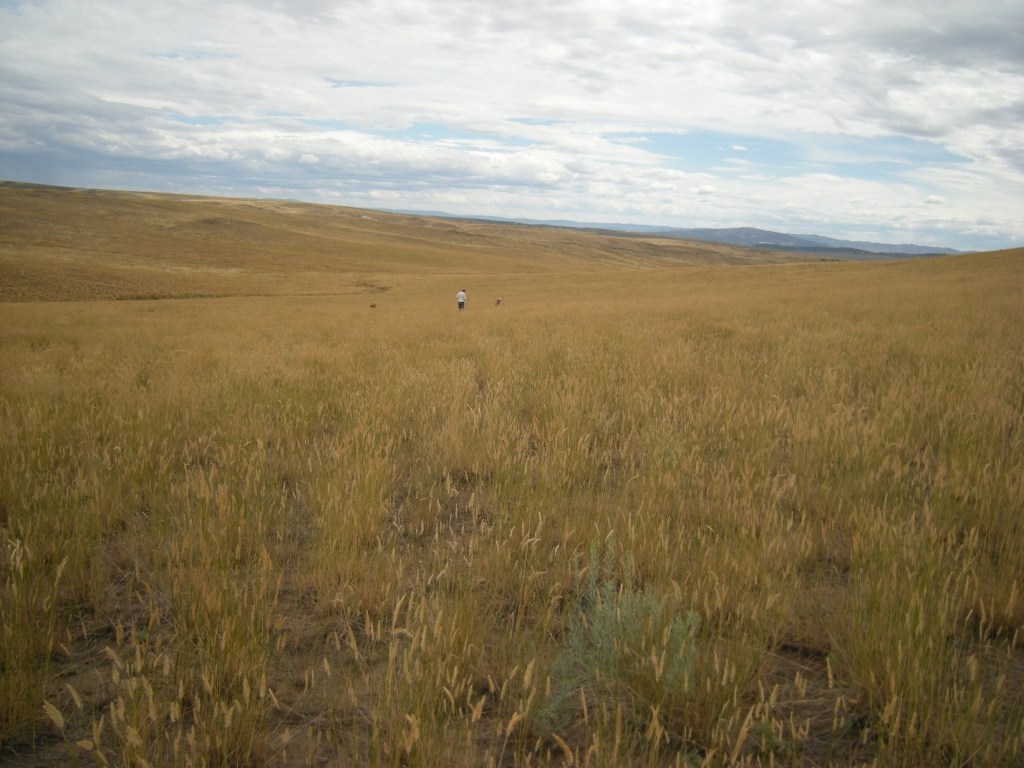
Plant Establishment
Weed management
A key step for pasture revegetation and maintenance is weed management. Sites that are dominated by weeds will be less productive and newly seeded grasses or legumes will struggle to establish because they have to compete against highly opportunistic invasive weeds.
An integrated weed management approach is the most effective and it involves incorporating a combination of mechanical, chemical, biological and cultural practices to mitigate and prevent weed infestations. For example, frequent mowing, combined with fall herbicide applications can be very effective against some perennial weeds like Canada thistle. After new forage is established, maintaining a healthy forage stand (not overgrazing) will help prevent weed re-infestations.
All commercial herbicides, either synthetic or organic contain a label with directions, best management practices, re-entry intervals and proper equipment and management instructions. Reading and following herbicide label instructions is the law.
The best methods and timing of control will depend on each weed’s lifecycle. Annual weeds germinate, grow and reproduce within one year or less and are best managed before seed production. Examples of annual weeds include kochia and Russian thistle. Biennial weeds are plants that survive through two years. They germinate and remain as a rosette during the first year and bold and produce flowers and seeds the second year. These should also be managed prior to seed production, mechanical removal of the rosette or herbicide applications are very effective during the first year of their lifecycle.
Perennial plants live for many years, and like many of the perennial grasses, they can store carbohydrates in their root systems, go dormant during the winter and/or summer and continue to grow and reproduce for many years if left unmanaged. Simple perennials reproduce by seeds only, however, there are creeping perennial plants that have the ability to reproduce through vegetative tissue. This is the case for field bindweed. Frequent defoliation through cutting or mowing can suppress these plants but complete control of these plants is difficult and often requires a combination of mechanical removal and herbicide applications for the course of many seasons.
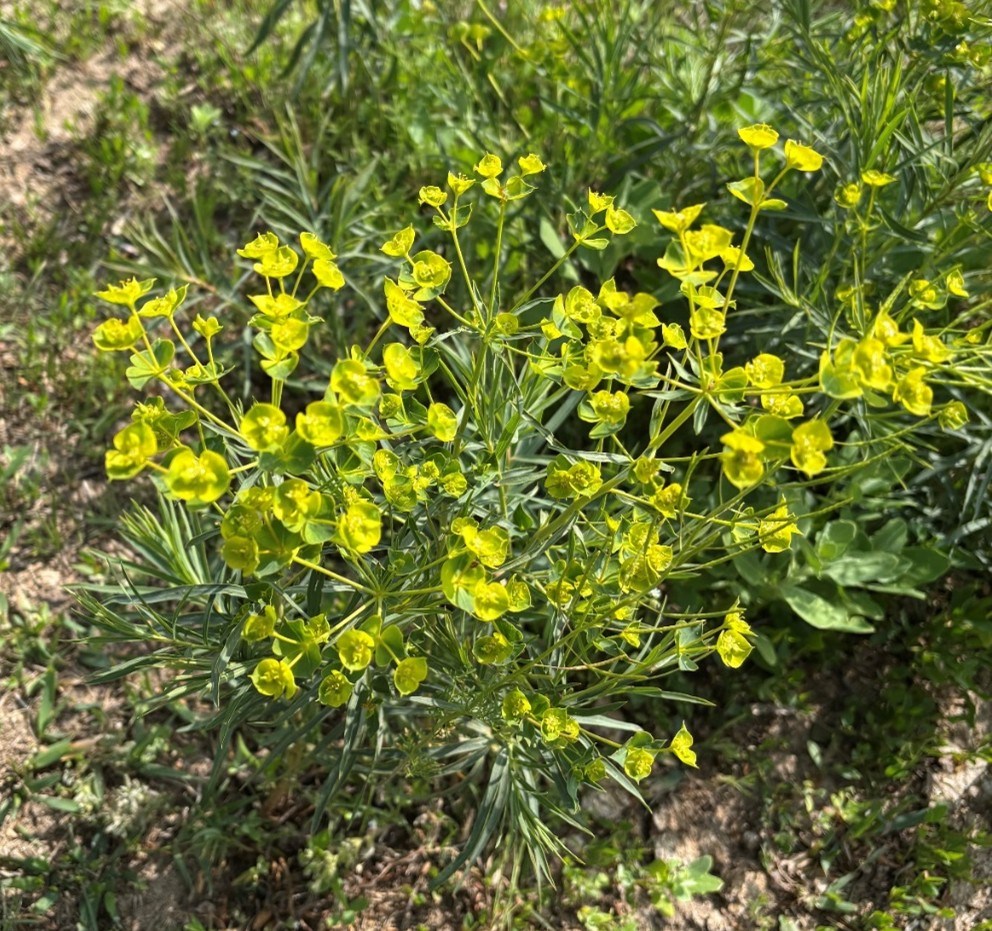
The Colorado Noxious Weed Act is a legal document that classifies weeds by required management in different lists, based on their distribution and control efforts, ranging from mandatory eradication for rare species to recommended suppression for widespread species. Noxious weeds are designated as such because of their capacity to spread and their potential to harm ecosystems, agricultural land, private property and potential risks to the health of animals, ecosystems or people. Private and public landowners have a legal duty to control noxious weeds in their property. Counties and municipalities are empowered to enforce compliance.
Soil testing
Taking soil tests annually offers many benefits, whether you plan to fertilize existing pastures, reseed or overseed them. Nitrogen, phosphorus, and potassium are key nutrients that require close attention, as deficiencies can limit forage yields. However, excess levels of these and other nutrients can create water quality concerns. A soil analysis provides the exact amount of nutrients your plants need.
For an accurate soil test, collect at least 10 sub-samples from different areas of your field, mix them thoroughly in a clean bucket, and submit a pint-sized portion to a certified soil testing laboratory. The lab will include fertilizer recommendations with your results. Submit samples at least four weeks before seeding.
For dryland seeding, apply no more than 30 pounds per acre of nitrogen fertilizer; higher rates will only encourage annual weed growth. Adding phosphorus (20–80 pounds per acre) will improve seedling vigor and root development.
Seedbed preparation
Forages can be established in either clean-tilled or stubble-mulch seedbeds. Clean-tilled seedbeds are prepared by cultivating the soil with a sweep, chisel, disc, or plow. This approach offers several advantages, including improved seed-to-soil contact, more uniform stand establishment, reduced competition from existing vegetation, better incorporation of fertilizers and organic amendments, and more consistent drill depth and seed placement. On sites smaller than one acre, a power tiller may be a practical option for achieving similar results.
Clean tillage can leave susceptible soils vulnerable to erosion. Although it is not always economically feasible, incorporating well-rotted manure or compost into the soil can improve forage establishment and productivity. In sandy soils, organic amendments increase water-holding capacity and nutrient retention, while in clayey soils they improve soil structure, aeration, and drainage.
Plowed soils may need to be disced as a second operation. Smoothing and firming are accomplished with harrow, field cultivator, or roller/packer implements. The seedbed should be firm enough that a person’s footprint does not sink deeper than one-half inch. Clods should not be over 2 to 3 inches in size.
Stubble-mulch seedbeds are advised for dryland soils to reduce soil erosion. Plant stubble (standing plant stems) protects establishing forages by buffering wind, improving soil moisture, and decreasing soil temperature and weed competition. Planting on existing vegetation is a viable option. Annual crops, known as cover crops, can also be established and mowed, killed or harvested before seeding.
Sorghum and forage millet can be used as cover crops in areas at up to 7,000 ft in elevation. Sterile sorghum varieties can also be viable options. As they do not produce seeds at maturity. Cereal crops, such as oats, are a good option at elevations above 7,000 feet.
Sorghum and forage millet can be planted from late May through June 30, before grass seed planting in the fall. Sorghum can be seeded at a rates of 4 to 8 lb/acre. The lower rates are recommended for clay soils in dryer conditions, while 8 lb/acre can be seeded on irrigated sites. Forage millet can be seeded at rates of 25 to 30 lb/acre on irrigated land and 8 to 10 lb/acre on dryland.
Sorghum should be seeded at 1 to 1 ½ inches deep using a seed drill, and forage millet can be seeded at ¾ to 1 inch deep. These species can be cut for hay in late summer or early fall, leaving a 6 to 10 inch stubble height. Taller stubble heights may be needed on sandy soils.
Grass seeding methods
Forages can be seeded using a drill or broadcasting seed across the soil surface. Drilling is the recommended method for grass seeding and is essential for planting into stubble mulches. Drills with a seed box agitator for fluffy seeds, double-disc openers, depth bands, and packer wheels are the best choice for grass seedings. Small-seeded legumes can also be seeded with a drill, but seeds need to be placed separate from grass seeds to adjust the flow rates appropriately.
Drills allow proper seeding depth, good seed-to-soil contact, and protection of seed from climatic extremes and wildlife predation. If the drill does not have packer wheels, roll or drag the field after planting to increase seed-to-soil contact.
Large-seeded grasses should be planted to a ½ inch depth, small-seeded legumes at ¼ inch depth on loam or clay soils or ½ to 1 inch depth on sands. Coated alfalfa seed performs well at ½ inch depth on sands.
Rows should be 7 to 12 inches apart. Cross-seeding pastures may give pastures a more appealing look when seeding bunchgrasses only. Plant 50% of the seeds in each direction.
Broadcast seeding can be done with an agricultural seeder, a whirl seeder, or by hand. For larger areas, an agricultural seeder such as a Brillion is an effective tractor-drawn implement for establishing grasses and legumes. It drops seed from its boxes onto the soil surface and then presses it in with trailing rollers to ensure good seed-to-soil contact. Brillions work well on clean-tilled seedbeds, but they are generally not accessible to most small acreage owners.
A whirl seeder is a small, hand-powered and inexpensive spreader commonly used for short-distance applications such as grass seed, fertilizer, or ice melt, typically reaching up to five feet. After seed is broadcasted whether by hand or with a whirl seeder, it should be covered by pulling drags, pipes, harrows, chains, or rollers across the soil to improve soil coverage.
Broadcasting requires twice the amount of seeding rates than drilling. Seed covering efforts are useful for protecting seeds from the elements but some seeds will still be left exposed in the soil surface. These seeds are usually lost to rodents and birds or dry out and die after germinating.
Early stand management
As mentioned earlier, successful forage establishment on dryland is never guaranteed. A dry spring season may result in seedlings drying out and dying shortly after germination. As a result, the reseeding process may have to be repeated. Growth might seem extremely slow during the first year of establishment as the grass attempts to establish its root system. Most of the growth during this time occurs underground, this can result in weak-looking seedlings, but these might recover and begin more vigorous growth in the second and third years.
Newly established dryland grasses should not be grazed until after they set seed, which depends on soil moisture availability, climatic conditions, and individual species. Native plants do not establish quickly and will need up to four years of growth before being grazed. Introduced grasses on dryland will need at least one year from seeding before being ready for grazing. Irrigated introduced grasses can often be lightly grazed during the seeding year once their roots cannot be pulled up by livestock., usually once the plant has at least four leaves and one or two tillers showing. Some irrigated forages like birdsfoot trefoil establish slowly over two to three years. Irrigated stands can be harvested for hay during the establishment year if a 6-inch stubble is left.
Weeds can cause poor stand establishment because they compete for water, space, light, and nutrients. A moderate cover of weeds, however, can shade emerging forage plants and provide a protective environment. On most sites, weeds will need to be controlled during the forage establishment year and possibly during the second year. Mow weeds to 6 inches high, two or three times during the establishment year. Remove mowed material if it is thick enough to smother new plants. Herbicide options exist for newly seeded grasses that have reached at least the three-leaf stage. Herbicides cannot be used on grass-legume mixes because they will kill either the grass or legume.
Grazing Management
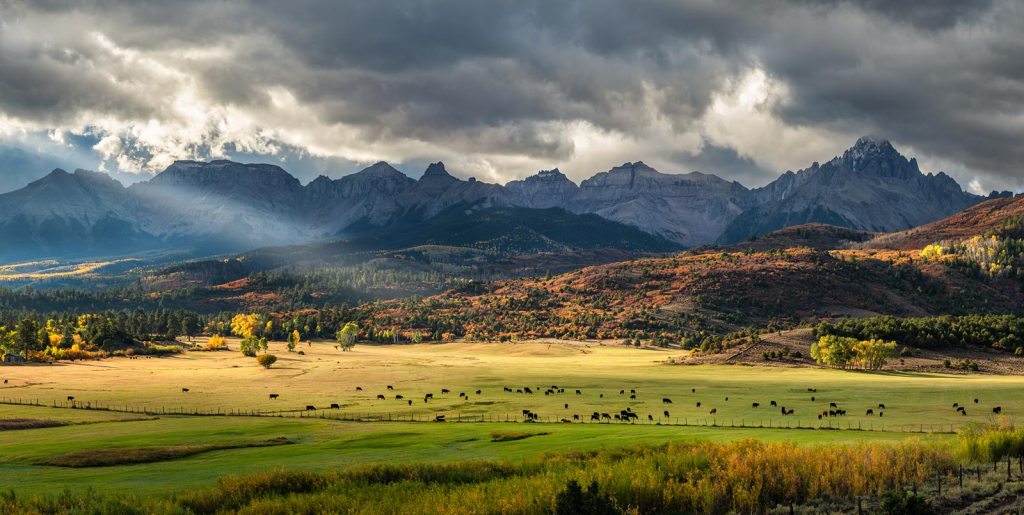
Good pasture management sustains forage production, encourages animal health, and discourages weed invasion. It protects soil and increases water infiltration rates and soil organic matter content.
Many dryland pastures in Colorado receive an average of only 12 to 16 inches of precipitation annually. Average precipitation, however, is rarely received in a given year. Most years have precipitation totals below the average, which can be as little as 9 inches. Often a major proportion of precipitation never enters the soil and is lost to evaporation or runoff. As a result, many dryland pastures in Colorado exist in a near-desert climate, creating a fragile environment for forage health and survival. Dryland pastures are more susceptible to these changes, although irrigated pastures are often limited by water available in that ditch during that year.
Proper grazing management on small acreages should aim to preserve forage stands. Animal nutrition and turnout time should be taken into consideration on a grazing rotation but ultimately, a sustainable grazing management plan will always consider leaving some of the plant for proper regrowth.
How a grass grows
Perennial grasses grow from growing points called meristems, located near the base of the plant and close to the soil. Leaves emerge from these growing points, expand upward and capture sunlight for photosynthesis. The carbohydrates produced during photosynthesis are used for new leaf growth, root development and storage in crowns, roots and stems. Perennial grasses survive from year to year because they are capable of retaining energy reserves in their root systems.
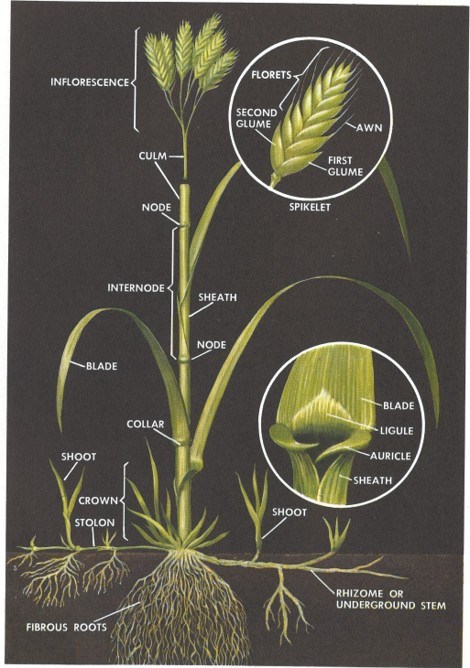
As grasses mature, they develop vertical stems and their growing points move higher above the ground. When these growing points are removed through grazing or mowing, the plant can no longer rely on them for regrowth. Instead, it must produce new shoots using stored carbohydrate reserves rather than energy generated through photosynthesis. If this occurs repeatedly, the plant’s energy reserves become depleted, leaving less energy available to break dormancy, recover from stress, and sustain vigorous growth. Over time, plant productivity and persistence decline, which is a common consequence of overgrazing.
Overgrazing
Overgrazing is often he main reason for pasture decline. It results from not allowing grazed plants adequate time for regrowth, and not reducing the grazing pressure (time and/or animal numbers) during drought. Overgrazing reduces plant health and eventually causes desirable forage plants to die. In addition, overgrazed pastures also degrade through increased soil erosion and loss of soil organic matter, reduced water infiltration, and increased weed invasion.
Small acreage dryland pastures, in particular, can fall rapidly into poor condition from overgrazing. Uninformed grazing managers often expect more from dryland pasture plants than what plants can actually produce. Adequate plant regrowth does not occur when forages are either grazed continuously too close to the ground, or regrazed before reaching a target height.
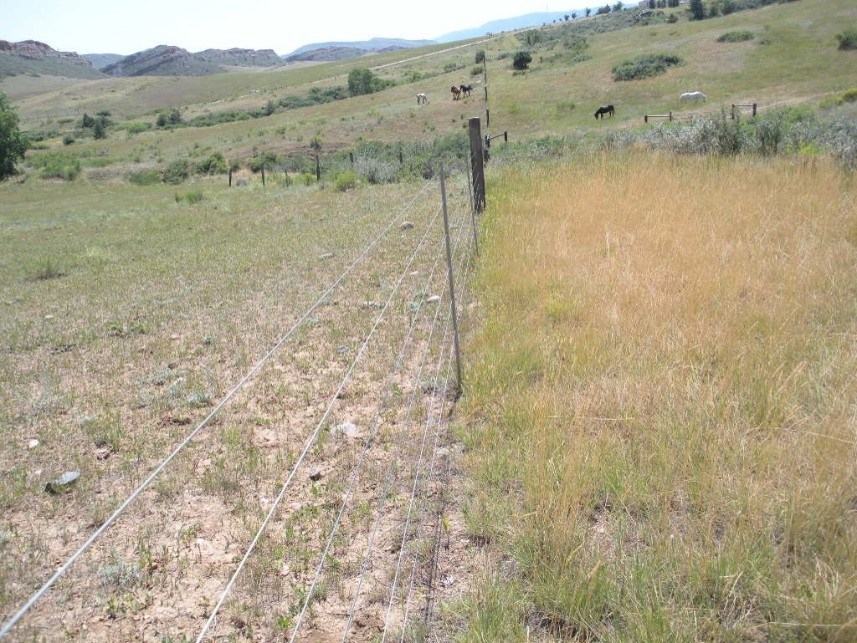
The time needed for adequate regrowth depends on the forage species, climate, soil moisture, and time of year. On dryland pastures, 30- to 90-day recovery periods may be needed; on irrigated land, 15 to 30 days. Cool-season grasses regrow faster during cool weather in the spring or sometimes fall; warm-season grasses recover during hot summer weather. Both groups of grasses require adequate soil moisture to support regrowth during the recovery period. Overgrazing can occur when grazing of cool-season grasses is not stopped before dry, hot weather comes in June. These grasses will go dormant and not regrow, leaving the plants with low root and stem base food reserves.
Sometimes pastures may be grazed non-uniformly and more frequently during the rapid plant growth period of early spring with no major negative impacts. In this scenario, the animals will return and re-graze plants, leaving the taller plants alone. The taller plants are not as tender and desirable as the fresh regrowth, so they will continue to grow, while the newer plants get a second grazing. Close attention is still necessary because if regrowth continuously grazed, those plants will lose vigor and die if not allowed to recover.
Drought years can cause a rapid decline in root carbohydrate reserves. These conditions exists when precipitation is 75% of average or lower for several months. This, combined with overgrazing, greatly increases the risk of grass mortality. To reduce this risk, grazing management should be conservative during both drought periods and the growing season following drought. This means grazing fewer animals for shorter periods of time, leaving more leaves and stems for plant survival and regrowth.
Grazing management guidelines
Grazing management refers to grazing at the right time and intensity to maintain sufficient plant cover, protect the soil, and maintain or improve the quantity and quality of forage. Proper grazing management techniques are improved when managers are familiar with the forages in the pasture, their growing season and the animals that will be grazing the pasture. It requires “being on the ground” and being aware of how both forages and animals are performing. Grazing management is both and art and a science.
A major consequence of poor grazing management is that desirable forages will be replaced by undesirable weeds like Russian thistle, downy brome, kochia, and bindweed. Using grazing management to return a poor-condition pasture back to one in good condition is a difficult, long-term process. This task can also be costly because interseeding and a reduction of livestock numbers may be necessary. Good grass and legume stands are difficult to reestablish under dryland conditions. A primary goal of grazing management should be to prevent pastures from deteriorating in the first place. A rule of thumb for proper grazing management is the “take half, leave half principle” for grasses. This means that once animals have grazed half of the height of the grasses in the field, they should be removed to allow grasses to grow back. As mentioned previously, this requires you to learn and understand the full-heigh of the grass species in your field. Table 1. Provides a list of common forage grasses and minimum stubble heights for various species after pasture has been properly grazed.
To understand grazing management, certain terms must be defined and understood:
Stocking Rate
Stocking Rate is the number of animals that graze a pasture over a period of time. It factors in the grazing animal, the available forage, and the length of grazing time. Stocking rates need to be adjusted according to the amount of forage available at the beginning of a grazing period. Available forage changes throughout the year in response to climate, soil moisture, rest period length, adn the grazing history of the pasture. Stocking pastures too heavily will reduce forage regrowth opportunity, reduce animal performance, and initiate a decline in pasture condition. An example of a stocking rate is 0.5 Animal Unit Months per acre (AUMs/ac). This means one acre provides enough forage to support half of an animal unit for one month. In other words, one animal unit could graze a single acre for half a month before needing to move, or it would require two acres to meet its forage needs for a full month and avoid overgrazing.
Animal Units
One Animal Unit (AU) is equivalent to a 1,000-pound cow or five sheep, each weighing 200 pounds. This metric can be applied to all farm animals, and the number of animal units per species or category of animal can be adjusted up or down depending on its weight. For example, a cow weighing 1,300 pounds would be equivalent to 1.3 AUs. This also means that a 1,300-pound cow is estimated to eat 30% more forage compared to a 1000 lb. cow.
Proper Grazing Use
Managing livestock in a way that ensures enough leaf area is left for the plant to maintain vigor and regrowth potential. Once proper use is achieved, forages should be allowed to regrow by moving animals to another pasture or into a corral.
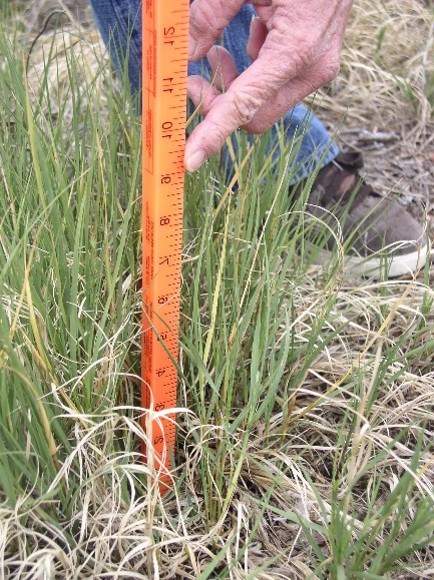
One approach to evaluate proper grazing use is to monitor the pasture currently being grazed for how much forage is left, as opposed to how much has been consumed. This involves looking at how uniform the plants are grazed, and the stubble height (how much growth is left standing) of the grazed plants. When grazing is evaluated correctly and animals are moved at the right time, plants have the best opportunity to regrow as rapidly as possible.
A properly grazed pasture will have an uneven look. Most plants will have been grazed to the minimum stubble height; a small percentage may be shorter. The remaining plants will be tall and either lightly grazed or ungrazed. A pasture is overgrazed if it continually looks like it has been mowed and the forage is uniformly short. Ungrazed plants or patches are normal and result from plants being trampled, fouled by dung or urine, or from natural grazing patterns.
Table 1 lists minimum stubble heights for various forage species after a pasture has been properly grazed. Tall, warm-season grasses include big bluestem, sand bluestem, prairie sandreed, and switchgrass. A small percentage of forages will have stubble heights either shorter or taller than those heights listed. Some of these exceptions are noted in Table 1.
If pastures are continuously grazed (never allowed a 30-day or more rest period), stubble heights should be double the listed height to achieve proper grazing. On smooth brome-alfalfa mixed pastures, smooth brome can occasionally be grazed down to 2-3 inches to favor alfalfa stands.
Minimum stubble heights should still be maintained during the dormant season. Grazing too severely during dormancy can injure plant crowns and reduce stem base carbohydrate storage needed for spring growth. Maintaining minimum stubble heights through winter also allows the stubble to trap snow, protecting the plants and enhancing soil moisture in the spring.
Table 1: Minimum stubble heights for various species after a pasture has been properly grazed
| Forage | Minimum Stubble Height (inches) |
|---|---|
| Cool-season grasses | |
| Most species | 4 |
| Crested wheatgrasses | 3 |
| Western wheatgrass | 3 |
| Tall wheatgrass | 6 |
| Warm-season grasses | |
| Tall species | 6 |
| Little bluestem | 4 |
| Sideoats grama | 4 |
| Blue grama | 2 |
| Irrigated grasses | |
| Most Species | 4 |
| Kentucky bluegrass | 2 |
| Legumes | |
| Alfalfa | 3-4 |
| Birdsfoot trefoil | 4-6 |
| Sainfoin | 3-4 |
| Clover (white) Clover (alsike and red) |
2 4 |
Carrying Capacity
Carrying Capacity is the average number of livestock that can be sustained on a management unit (pasture) compatible with management objectives for the unit. It is similar to stocking rate, but on a more refined level. In addition to site characteristics, it is a function of management goals and management intensity.
Setting the carrying capacity is the most important grazing management decision. Carrying capacities are estimates based on expected forage production and performance. They are refined based on experience, grazing methods, and goals.
The amount of forage a pasture produces varies with available moisture, soil types, and pasture condition. Average total forage production (on an air-dry matter basis) ranges from 300 to 2,000 pounds per acre per year on most dryland pastures in Colorado. In contrast, irrigated pastures produce 1 to 6 tons per acre with 4 tons per acre being a good average for the state.
Not all of the forage produced in a year can be grazed. Pastures that are grazed properly will have about 50% of their total forage left as stubble. An additional 25% will be lost to trampling, insects, rodents, and fouling. This leaves 25% of the forage available for livestock consumption. A portion of the 25% wastage can be grazed beneficially in properly managed pasture rotation systems.
Calculating a pasture’s carrying capacity
- Determine the annual forage production per acre:
The estimated total annual forage production/acre can be obtained through forage clippings or estimates from platforms such as Web Soil Survey or the Carrying Capacity app. Contact your local NRCS office to obtain forage clippings for your property.
- Calculate usable forage:
- lb of usable forage/acre = lb total annual forage production/acre × 0.25 (25% livestock consumption)
- Total lb of usable forage/year = lb of usable forage/acre × total acres in pasture
- Convert to grazing days for one animal unit (AU)
One AU consumes an average of 2-3% of their body weight daily (1 AU= 1000 lb cow), or approximately 25 lb of air-dry- forage per day.
Days of grazing/year = Total lb of usable forage/year ÷ 25 lb/day
Note that you might need to adjust depending on the animal species, for example, a 1,000-pound horse typically grazes and tramples more forage than a 1,000-pound cow and is equivalent to 1.25 AUs. An average horse will eat and trample 31 pounds of air-dry forage per day. Table 2 contains a list of common grazing species and their equivalent to Animal Units. The AUE for different species can be used to calculate carrying capacity.
Table 2. Animal Unit Equivalent for different species
| Animal Species | AUE |
|---|---|
| Cow/calf pair | 1.00 |
| Cow (1000 lb) | 1.00 |
| Steer | (Weight × 0.03)/30.42 |
| Calf (8-12 months) | 0.70 |
| Calf (weanling to 8 months) | Weight × 0.70 |
| Doe/kid pair | 0.25 |
| Donkey | 0.60 |
| Draft horse | 1.60 |
| Ewe/lamb pair | 0.30 |
| Llama | 0.50 |
| Mature bull | 1.50 |
| Miniature horse | 0.37 |
| Horse | 1.30 |
| Weaned kid | 0.15 |
| Weaned lamb | 0.15 |
The following is an example of calculating carrying capacity:
Assume a 30-acre pasture produces an average of 1,000 pounds of annual forage per acre. One 1,000-pound horse (1.25 AU) will graze it.
- 1,000 lb/acre × 0.25 (25% utilization) = 250 lb of usable forage/acre
- 250 lb of usable forage/acre × 30 acres = 7,500 lb of total usable forage
- 7,500 lb/ (31 lb grazed /day by a 1,000 lb horse) = 242 days of grazing by one horse to achieve proper grazing use.
Conversely, 2 horses grazing on the same property could remain on pasture for 121 and maintain proper grazing.
7,500 lb/ (62 lb/day (2 horses eatinch 31 lb/day each) = 121 days.
To convert to carrying capacity value:
242 days of grazing / 30 acres = 8 horse days per acre (or 10 AU days/acre)
In other words, enough forage exists on one acre of this pasture to meet the horse’s needs for 8 days per year.
In the above example, the same 8 days of grazing on 1 acre can also provide enough forage for:
- 6 sheep
- Twelve 100-lb animals (since they are the equivalent to 1 horse or 1.25 AUs)
Similarly, one 1,000-lb cow can graze on one acre for 10 days, which is equivalent to 5 sheep or ten 100-pound animals because they are equivalent to 1 cow or 1.00 AU.
Carrying capacities calculated in the above manner are estimates for average production years. Adjust these estimates based on experience, stubble height monitoring, animal weights, and for dry or wet years.
Table 3 provides an example of how land area and the number of animal units grazing a hypothetical dryland pasture in Colorado influence turnout times. This example considers only forage demand and forage supply and assumes that 30 acres provides enough forage to meet the demands of one animal unit for 365 days while leaving adequate plant residual on site.
The daily turnout times are not recommendations for grazing management as no consideration has been given to timing of plant growth, planning for adequate recovery (plant regrowth without grazing pressure), distribution of grazing use, and timing of grazing use.
Table 3. Carrying capacity scenario in hours per day
| Land Area | ||||
|---|---|---|---|---|
| Animal Units | 30 Acres | 10 Acres | 5 Acres | 2.5 Acres |
| 1 | 24 hrs/day | 8 hrs/day | 4 hrs/day | 2 hrs/day |
| 2 | 12 hrs/day | 4 hrs/day | 2 hrs/day | 1 hrs/day |
| 3 | 8 hrs/day | 2.6 hrs/day | 1.3 hrs/day | 40 hr/day |
| 4 | 6 hrs/day | 2 hrs/day | 1 hr/day | 30 min/day |
| 5 | 4.8 hrs/day | 1.6 hrs/day | 50 min/day | 24 min/day |
| 6 | 4 hrs/day | 1.3 hrs/day | 36 min/day | N/A |
| 8 | 3 hrs/day | 1 hrs/day | 30 min/day | N/A |
| 10 | 2.4 hrs/day | 50 min/day | 24 min/day | N/A |
General pasture management guidelines
- Get familiar with a pasture’s carrying capacity and manage it accordingly. Know the pasture’s carrying capacity and manage grazing accordingly. If a pasture supports a horse for only 300 days, do not graze it for 301 days unless moisture conditions provide additional grazeable forage growth.
- If you have more animals than the carrying capacity of the pasture, some must either be sold or removed and fed in a corral or holding pasture.
- Overgrazing can occur in two ways: leaving your livestock on a pasture for too long or not allowing enough time for the forage to regrow after grazing.
- Manage livestock grazing in your pasture by monitoring minimum stubble heights (see Table 1) and the appearance of the whole pasture. Move animals off pasture once minimum stubble height is reached in some areas. The pasture should not look mowed, but rough with areas of taller and shorter grasses. Allow regrazing only after the forage has had time to regrow adequately. A rule-of-thumb is to let the plants regrow to twice their minimum stubble heights before allowing grazing.
- Avoid grazing livestock when pastures are wet to minimize plant trampling, damage to plant crowns and to prevent soil compaction.
- Spring can be a critical time for forages as they are using root and stem base reserves for growth. Delay grazing until plants reach 5 or 6 inches in height (three to five leaves for grasses). Cool season grasses may be grazed slightly heavier in spring due to favorable regrowth conditions, but they still require sufficient recovery time after grazing. Early spring grazing can also be a cause of pasture-induced laminitis in horses if grazed too soon.
- Start the grazing rotation on a different pasture every year. Pasture health will benefit from protecting plants during the “boot stage” when the grasses are elevating their seed heads. Cool season grasses head out in late spring; warm season grasses in mid- to late summer.
- Rotational grazing systems allow you to manage your pasture more intensively. If the system is managed correctly, forest harvest efficiency increases. A rotation system will require the pasture to be fenced off into at least two smaller paddocks, but a minimum of 4 is often recommended (see Figure 7 for a rotational grazing plan example). Animals are rotated between the paddocks in time intervals which depend on the season, weather conditions, soil type, and forage condition, tethering can also be a tool to restrict grazing areas for rotational grazing. Typical rest periods are 30 days to 90 days, depending on the time of year and the amount of water available.
- Restrict animal access to rivers, creeks, and ponds to protect water quality.
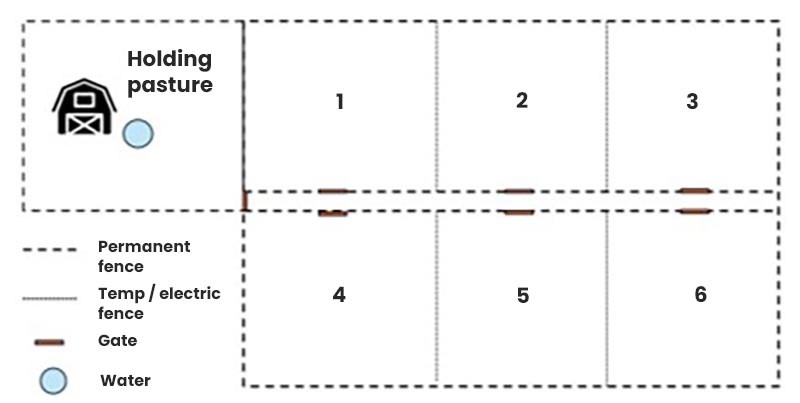
Many small dryland pastures do not grow enough forage to feed a horse for a year, or even a month. Rotating animals between a holding pasture and different sub sections of the pasture provides an alternative that allows fresh forage, pasture management and turn-out times. Animals should be rotated based on forage regrowth rather than calendar time.
Ungrazed pastures
Ungrazed established pastures can still be managed to maintain grass health. Mowing every other year can help recycle plant nutrients by depositing older plant tissue into the soils, increase light penetration through the plant canopy and encourage new leaf growth. Tall, unmanaged grasses may die off and deteriorate if left unmanaged. Mowing is usually not recommended during drought.
Monitor your pasture on a yearly basis for noxious weeds and control them when found. Areas with low densities of desirable vegetation will likely have heavy annual weed infestations. Successful long-lasting control of these weed species can be achieved by applying mechanical or chemical treatment before seed production. Reseed weedy areas after control at the appropriate time to get a good forage stand that will prevent future weed infestations.
Grass Species and Varieties
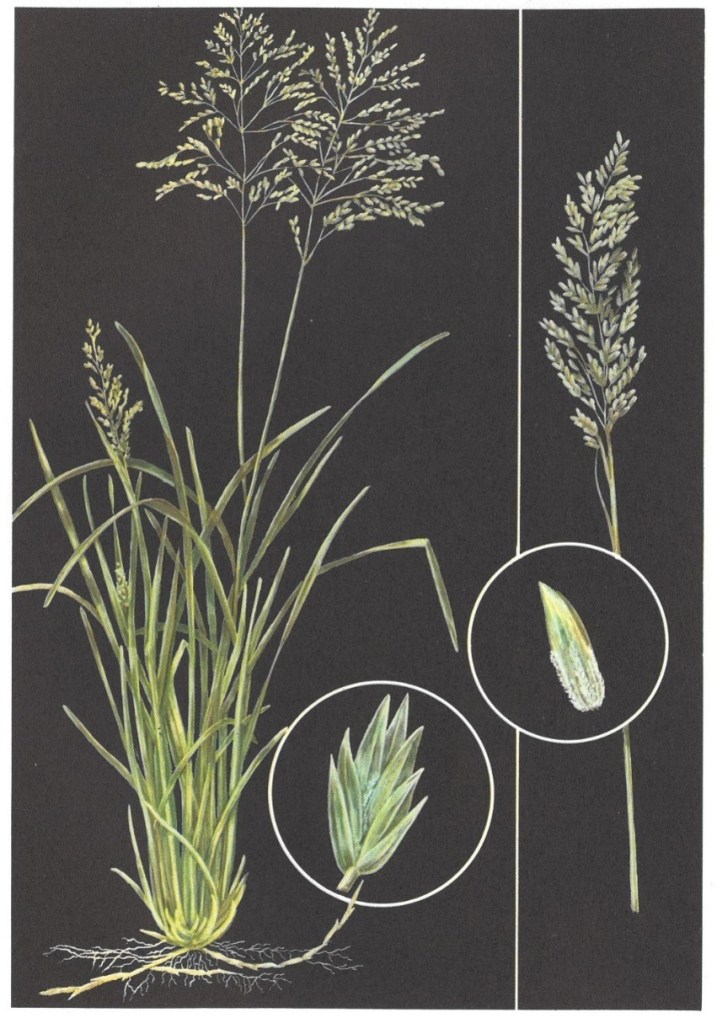
Kentucky bluegrass (Poa pratensis) is a cool-season grass that originated from Europe and has naturalized in many Colorado locations. It is an aggressive sod-former when moisture is adequate and palatable grass that allows close grazing. Bluegrass needs irrigation or subirrigation to maintain summer growth, or it will go dormant after daily maximum temperatures reach 90°F. It regrows in the fall with adequate moisture. Stems are 1 to 2 feet tall with leaves 2 to 7 inches long. Kentucky bluegrass is not very productive as forage in Colorado, so it is not commonly planted in pastures, however it is one of the most common lawn grasses.
Use for Hay. Not a good hay grass because of low-growing leaves.
Use for Pasture. Kentucky bluegrass provides good grazing and tolerates trampling but is not highly productive. Overgrazing or undergrazing bluegrass for short periods is not harmful. Because it tolerates trampling and overgrazing, it works well as a component of horse pastures, and is most popular in Northeastern States of the country. Keep between a height of 2 and 6 inches. White clover combines well with bluegrass in pastures.
Varieties:
- ‘Troy’: is a 1995 release from Montana; it withstands grazing well and it has a tall, erect growth habit.
- ‘Ginger’: tolerates grazing and a wide range of soils. Not very drought tolerant but very nutritious and cold-hardy.
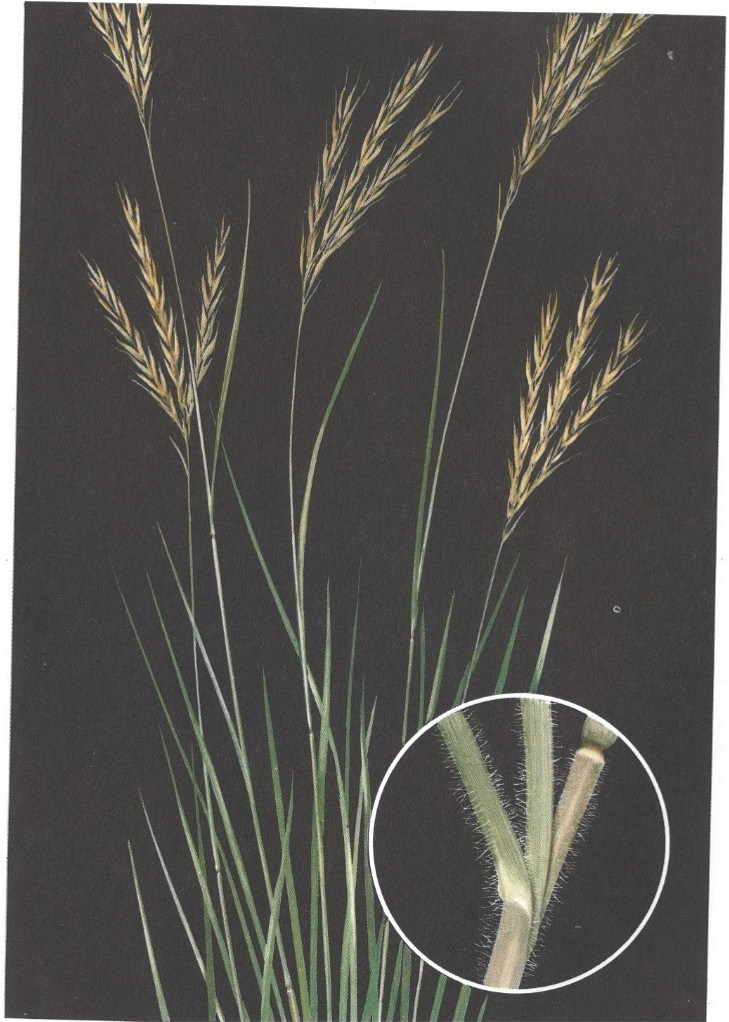
Big Bluestem (Andropogon gerardii) is a native, warm season grass that grows 3 to 6 feet, with 4- to 20-inch-long leaves. It is also known as “turkey foot” grass because of the arrangement of the three seed heads that occur at the top of stalks. It is slightly sod-forming and heads out in late summer. Performs well on dryland sites, although it responds well to irrigation. This species mixes well with switchgrass, little bluestem, and yellow Indiangrass.
Use for Hay. This grass makes good hay if cut before seedheads form.
Use for Pasture. Relished by all livestock classes before maturity, it becomes tough and unpalatable after maturity. If not managed well, it will quickly be grazed out of pastures.
Varieties:
- ‘Kaw’: cultivar released in 1950 by the Kansas Agricultural Experiment Station. Late maturing, superior leafiness.
- ‘Pawnee’: late maturing cultivar, recommended for zones 5-6. Moderately long, dark green leaves; seedhead hairiness varies; a 1963 Nebraska release.
- ‘Champ’: late maturing but matures 7 to 10 days earlier than ‘Pawnee’; leafy. A 1963 release from Nebraska.
- ‘Bonilla’: excellent winter hardiness because of its northern origin. A release from North Dakota. Forage production exceeds ‘Bison’ but not as much as ‘Champ’ and ‘Kaw’. Limited availability.
- ‘Bison’: matures 30-48 days earlier than ‘Kaw’, ‘Champ’ and ‘Pawnee’. Shorter in height, a 1989 North Dakota release. Limited seed availability.
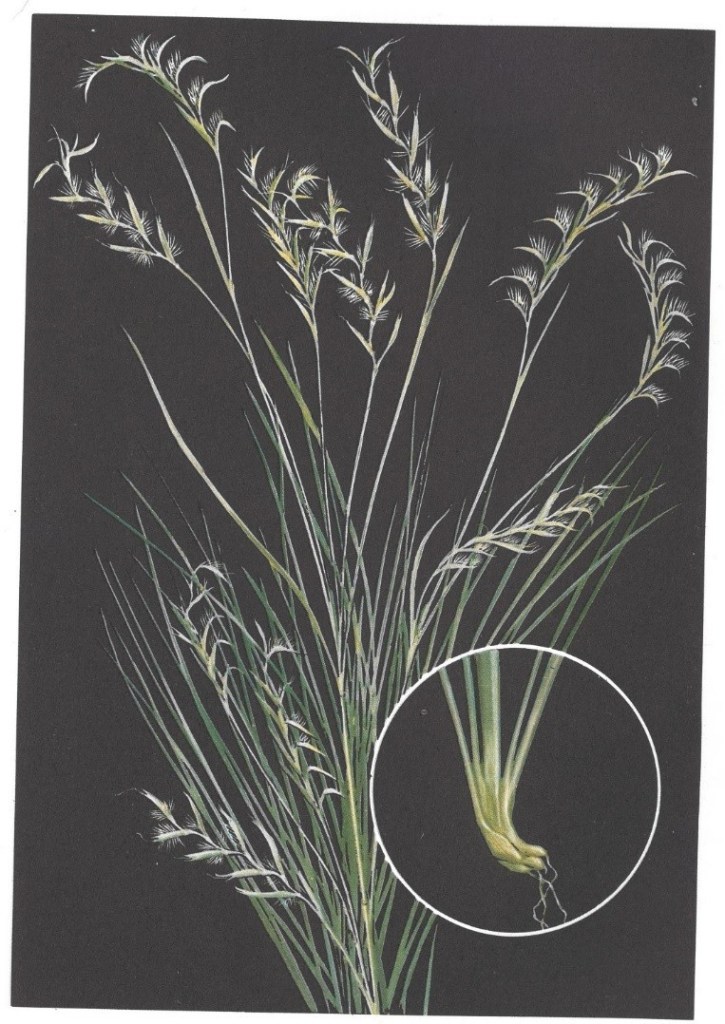
Little bluestem (Schizachyrium scoparium) is a native, warm season bunchgrass that grows 18- 40 inches tall, with leaves 3 –10 inches long. It is adapted to most soil and heads out in late summer. Performs well in dryland sites receiving at least 14 inches of precipitation. More drought resistant than big bluestem. This bluestem mixes well with big bluestem, sideoats grama, prairie sandreed, and sand bluestem.
Use for hay. Not recommended for hay as a first option but can provide good quality hay when part of a native grass hay field. Best hay quality and production is achieved by cutting at the time of initial seed set (source: nrcs.usda.gov).
Use for pasture. Less palatable than big bluestem, which allows for somewhat more relaxed grazing management, best aplatability is in early summer and it rapidly decreases once seed heads appear. Not preferred by sheep.
Varieties:
- ‘Cimarron’: a 1979 release from southwest Kansas: Improved forage production, can grow on 12-inch precipitation sites. Good seed availability.
- ‘Blaze’: leafy, late-maturing named after the bright red color it holds through winter. A 1967 release from Nebraska. Commonly used as an ornamental variety.
- ‘Camper’: Long and narrow leaves. A 1974 release from Nebraska. More adapted to the plains northeast of Colorado.
- ‘Aldous’: Originated in mid-Kansas. Tall, leafy, and vigorous. Medium-late maturity. Good seed availability.
- Native VNS: native “Variety Not Stated” little bluestem seed can often be the most available. Seed source usually adapted to the eastern plains of Colorado.
- ‘Pastura’: a variety that is rated highly. A 1963 release from New Mexico; good seedling vigor, medium height, greener in color compared to other varieties, plants are non-lodging at maturity with dense, basal leaf growth. seedheads are less hairy. Seed availability is low.
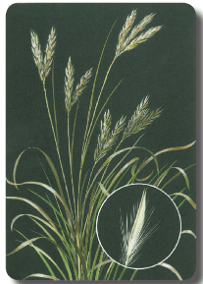
(Andropogon hallii) is a native, tall warm season grass that grows 3-8 feet tall, leaves grow 8-12 inches long. It is adapted to sandy soils and helps bind these soil particles through its sod-forming growth habit. Sand bluestem looks similar to big bluestem but has hairier seedheads with shorter awns and a more bluish or grayish color and is more prominently rhizomatous. Tends to hybridize with big bluestem.
Use for hay: A high producer when mixed with other grasses adapted to sandy soils. Do not cut for hay during establishment. Cut no closer than 4 inches above the soil, generally 1-3 weeks before seed head formation. Palatability decreases significantly during seed head formation.
Use for pasture: Sand bluestem provides good summer grazing and is relished by all classes of livestock, particularly horses and cattle. It has only fair palatability during the winter.
Varieties:
- ‘Garden’: An informal variety from the Nebraska panhandle. Vigorous, tall and leafy, a good choice for hay production. Commonly used on conservation plantings because of its high adaptability and dense canopy on sandy soils.
- ‘Woodward’: A 1955 Oklahoma release; more adapted to the southern Great Plains; individual plant characteristics may vary within a stand but are considered superior for leafiness and seed production.
- ‘Goldstrike’: variable in plant height and rhizome length. It is a 1973 Nebraska release. Seed availability is limited.
- ‘Elida’: Highly rated variety but with limited seed supply. Superior forage and seed production compared to ‘Woodward’, matures approximately two weeks later than ‘Woodward’. Originated from east central New Mexico, recommended for sites receiving 14 inches or more of precipitation. Released in 1963.
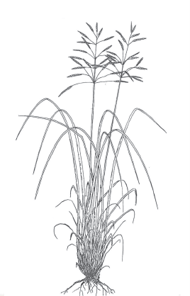
Meadow brome (Bromus biebersteinii) is a cool-season grass that originated in Southeast Asia. It is a bunchgrass with short rhizomes and grows 24 to 48 inches tall. Adapted to irrigated sites but can grow in dryland that receives at least 14 inches of precipitation. Adapted to many soil textures from coarse gravely to medium texture, grows best on well drained soils. It has some drought tolerance to withstand less than full-season irrigation.
Establishes rapidly and is more winter hardy than other irrigated grasses like orchardgrass.
It is a good competitor on mixed pastures but not as aggressive as smooth brome and less likely to become sodbound. It recovers faster than smooth from haying or grazing. Highly palatable to livestock and wildlife.
Use for Hay. Compared to smooth brome, it has a higher leaf-to-stem ratio, better fall regrowth, and matures 7 to 10 days earlier. Seed heads have longer awns than smooth brome. It mixes well with alfalfa and other legumes.
Use for Pasture. Meadow brome is well suited to grazing on irrigated pastures and mixes well with other grasses such as orchardgrass, smooth brome, and perennial ryegrass. Allow the plant to remain at least 6 inches tall before a killing frost to encourage winter hardiness.
Varieties:
- ‘Cache’: is a 2004 release from Utah, selected for improved seedling establishment and increased yields on irrigated and semi-irrigated fields.
- ‘Fleet’ and ‘Paddock’: are two varieties from Canada with exceptional winter hardiness, they grow well under Colorado conditions.
- ‘Regar’: earlier heading than ‘Manchar’ smooth brome; seeds germinate rapidly, outstanding regrowth after being cut or grazed. A 1966 release from Idaho, well adapted for pastures.
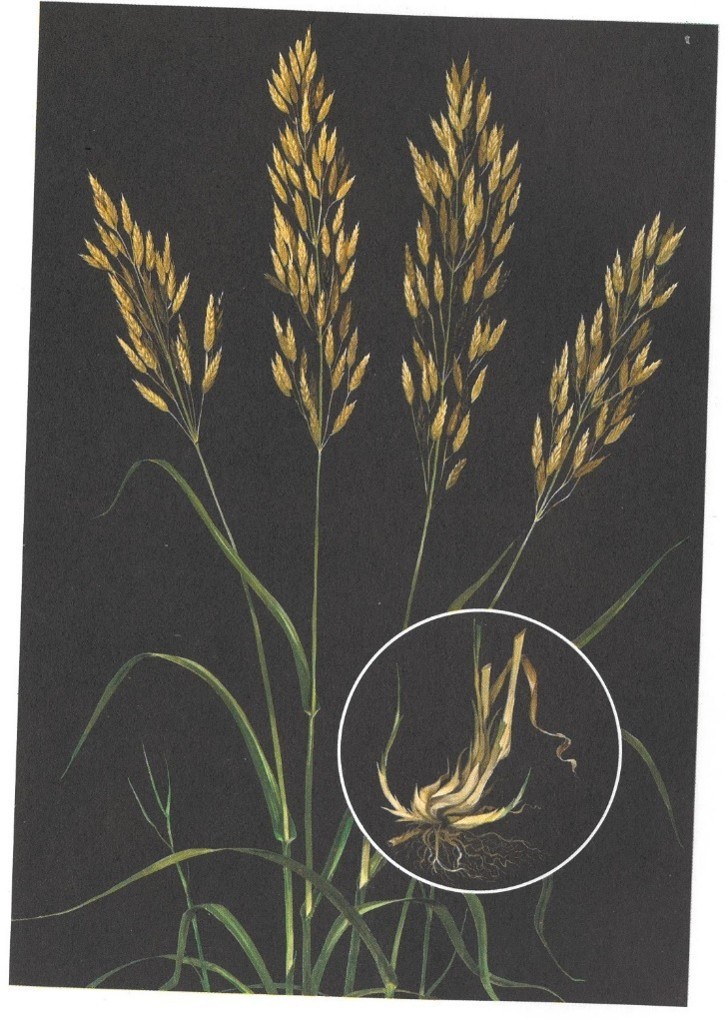
Smooth brome (Bromus intermis) is a cool-season grass that originated in Eurasia. It is a mid-height grass that grows 2 to 4 feet tall with leaves 6 to 16 inches long. It is an aggressive sod-former that can become sod bound if not adequately fertilized with nitrogen. Growth of sod-bound stands can sometimes be improved by tilling (i.e. ripping) the soil. Smooth brome has good spring growth but goes dormant in the summer under short-water conditions and it regrows in the fall with adequate moisture. It has an extensive root system that helps it draw water and nutrients from deep soil layers, which gives it adaptability to dry conditions and poor soils. Unique to this brome is that it has no awns (beards) on its seedheads. Smooth brome leaves have a distinctive “W” wrinkling located a short distance below their tips. It provides high quality livestock forage.
Use for Hay. This is an excellent grass for hay fields that are short on irrigation water. Cut it for hay when seedheads emerge for best quality and quicker regrowth. Expect only one cutting per year; two cuttings with adequate irrigation water. The combination of brome and alfalfa can lead to yields up to three times higher compared to smooth brome grown by itself. If not mixed with a legume like alfalfa, it requires annual applications of nitrogen fertilizer to remain productive.
Use for Pasture. Highly palatable, high in protein content and relatively low in crude-fiber content. Optimal use of this grass for grazing is in the spring when grasses are rapidly growing, graze lightly to encourage continued growth during this time of the year and avoid grazing below 4-6 inches in height. Adequate stocking rates is crucial to ensure regrowth since growing points can be quickly grazed out of the plant, forcing it to regrow from their root reserves.
Varieties:
- ‘Lincoln’: strongly rhizomatous and aggressive, which is typical of “Southern Types”; commonly used on reclamation and erosion control due to its aggressive sod-forming characteristics. Has more basal leaves, earlier spring growth and better drought resistance compared to ‘Manchar’. Additionally, it establishes easier but recovers slower after cutting or grazing; good for dryland or irrigated plantings; certified seed availability is limited.
- ‘Manchar’: is a “Northern Type” of bromegrass. Weaker sod-former than ‘Lincoln’. Shorter and finer stemmed, matures earlier, is more winter hardy, recovers rapidly after cutting and is the first choice for mixing with alfalfa.
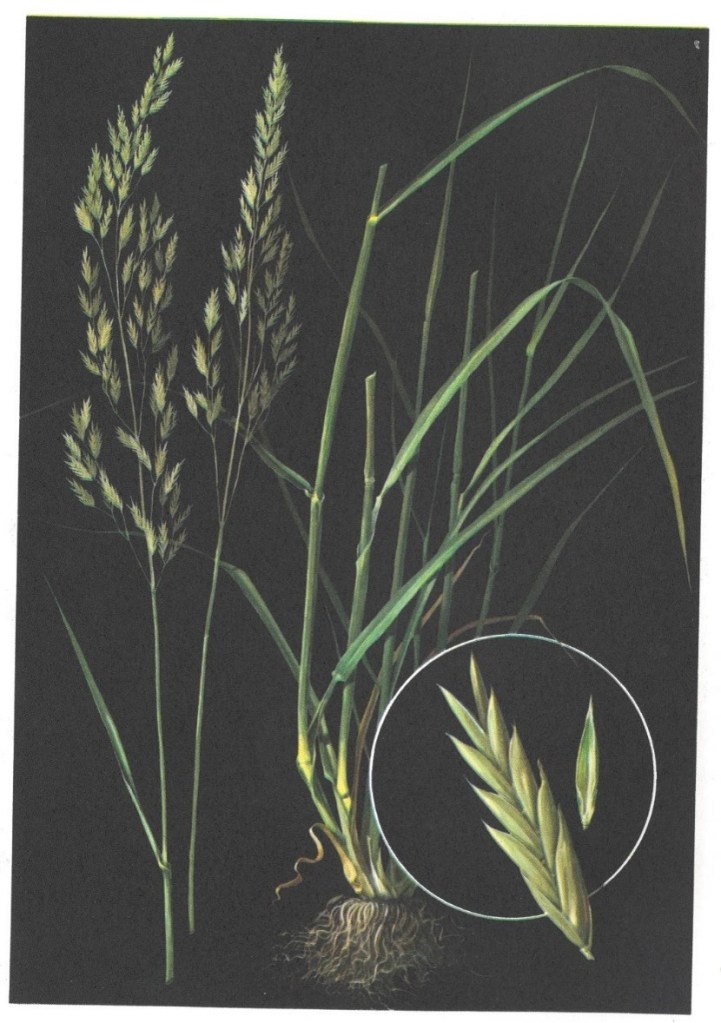
Tall fescue (Festuca arundiaceae) is a cool-season grass that originated in Europe and grows 3 to 4 feet tall. It forms multi-leafed bunches that cover the soil better than some sod-forming grasses. Tall fescue prefers clay or clay loam soils and adapts well to low fertility soils with poor drainage and high salinity, and relatively tolerant of drought and overgrazing. It’s tough leaves have only fair palatability to livestock. This means it must be managed carefully for optimum use and feed quality.
Many tall fescue stands in the United States are infested with an endophyte fungus that lives inside the plants. The fungus produces an alkaloid (ergovaline) that is toxic to livestock and can be detected only by laboratory analysis. The toxin can cause fescue foot in cattle and summer fescue toxicosis in cattle, sheep, and horses. Additionally, the toxin can cause weight loss, lower pregnancy rates, and problems with reproduction and milk production. High soil nitrogen levels seem to enhance the toxicity. Fescue lameness is more common in late fall and winter. Toxicosis risk increases when air temperatures are over 75 to 80°F. The severity of the symptoms can change from field to field and year to year.
The toxin is most concentrated in seeds and is only transmitted from field to field by infected seed. It benefits the grass by providing insect, drought, and heat resistance. Infected fields cannot be cured with a fungicide application. Endophyte-free seed can be purchased to ensure having non-infected tall fescue.
Toxicosis and fescue foot have not been found to be major concerns in Colorado fescue stands, even though endophyte-infected seed has been planted. To minimize toxicity potential, keep plants young and vegetative, don’t use grass during hot weather, or dilute by mixing with other grasses or legumes. Mares in their last trimester of pregnancy or when lactating should not consume tall fescue.
Some laboratories can conduct tests to determine the presence of the fungus toxin ergovaline in tall fescue. To collect samples clip grasses from 20 random locations of the field and combine them into one lot, most laboratories require 500 g of dried forage to be sent for testing. Air-dry the sample lot away from direct sunlight. Seal it in a polyethylene freezer bag and label with your name and contact information and send it to one of these laboratories for analysis. Different laboratories may have specific requirements for sample submittal; make sure you contact them and follow their guidelines.
- Iowa State University Veterinary Diagnostic Laboratory in Ames, IA
- Agrinostics Ltd. Co. in Watkinsville, GA
- Oregon State University Endophyte Service Laboratory in Corvallis, OR
- University of Missouri Veterinary Medical Diagnostic Laboratory in Columbia, MO
- University of Kentucky Veterinary Diagnostic Laboratory in Lexington, KY
Use for hay. Best hay quality is achieved when harvesting at the boot stage or at the very first sign of heading. Otherwise, hay quality is good but palatability is fair to poor.
Use for Pasture. Tall fescue is productive season-long with adequate moisture and is a high yielder of pasture forage. Relatively slow establishment and new stands can be seriously damaged by either overgrazing or grazing too soon. It has a tough root system that withstands trampling. Best utilization is achieved by grazing monocultures to a 2- to 4- inch stubble height with a rotational plan to encourage regrowth and maintain palatability. In mixed species pastures, a heavy stocking rate is needed to ensure tall fescue is grazed, otherwise, livestock will choose other forages first. Tall fescue loses quality and palatability soon after heading.
Newer, endophyte-free varieties: Examples include ‘Fuego’, ‘Forager’, ‘Johnstone’, ‘Mozark’, ‘Martin’ and ‘Penngrazer’. Check with your seed dealer about availability and adaptability to your location and situation.
- ‘FSG 402TF’: Endophyte free varietye released by Farm Science Genetics. Adapted to dryland sites, high yields with superior summer regrowth. Needs at least 15” of precipitation annually.
- ‘Fawn’: Endphyte-free. Adapted for pastures, hay, turf and erosion control. More suited for cooler regions. Improved early growth and seedling vigor compared with ‘Kentucky 31’ and ‘Alta’.
- ‘Arido’: Low endophyte variety. Medium-early maturing, Taller than ‘Fawn’. Longer panicle and flag lead. Selected for excellent spring vifor and seed yield potential. Permorms well for hay and managed grazing.
- ‘MaxQ’: contains a novel or friendly endophyte that does not cause animal health problems. Released for the south central area of the country. Additional varieties with this trait may be available in your area.
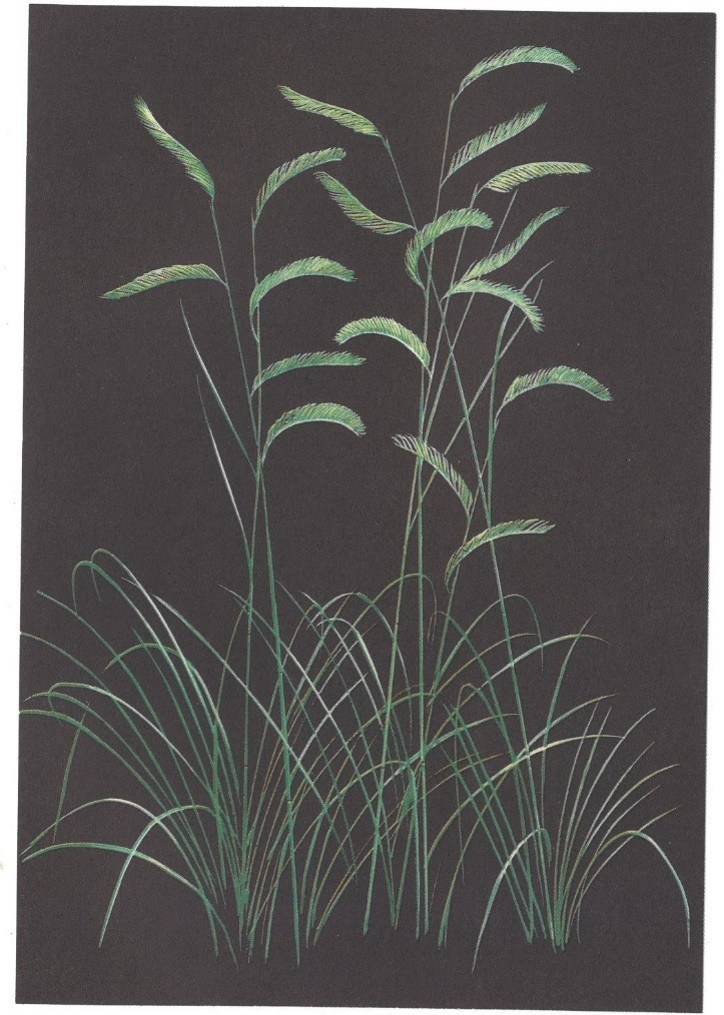
Blue grama (Bouteloua gracilis) is a native, warm-season grass that is prevalent in the shortgrass prairie. It is a short grass with seed stalks 8 to 24 inches tall, and curly leaves 2 to 6 inches long. Blue grama can grow in a wide range of soil types, from sandy and clay soils to alkaline and saline areas, but it is not well adapted to wet or poorly drained soils. It most commonly grows in bunches, though it also has the capacity to form dense sods.
It is one of the best drought tolerant grasses and mixes well with buffalograss, sideoats grama, western wheatgrass, and green needlegrass.
Use for Hay. Not suitable for hay as a result of short leaf growth.
Use for Pasture. Blue grama withstands trampling and grazing fairly well. Because leaves grow short, it is not very productive but supplies excellent summer or winter pasture feed. Do not graze this grass to less than 2 inches tall. It is one of the most drought-tolerant species and recovers well from drought. Cures well on stem, making it suitable for winter or dormant season grazing.
Varieties:
- ‘Hachita’: a 1980 release from New Mexico; superior forage producer; better than average drought tolerance. Additional to it’s forage value, it provides valuable protection from soil erosion and is well suited for lawns. Seed is widely available.
- ‘Lovington’: A 1963 New Mexico release; good seedling vigor; leafy, can produce up to 15% more forage compared to other varieties, very drought resistant.
- ‘Alma’: A 1992 release in collaboration with New Mexico State University, Colorado State University and USDA NRCS. Upright growth, good seedling vigor.
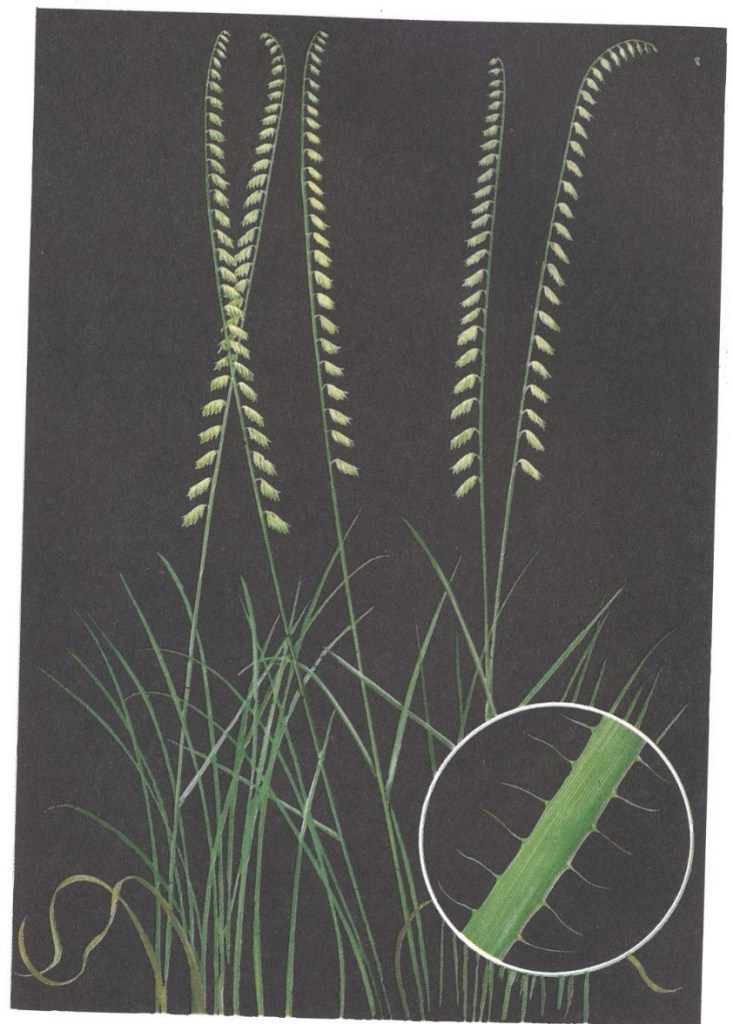
Sideoats grama (Bouteloua curtipendula) is a native, warm season bunchgrass. It is a mid-height plant with seed stalks that grow 1 to 3 feet tall and leaves 2 to 8 inches long. Its name comes from the way individual flowers hang from one side of the seed stalks. Stiff hairs exist along the margins of the leaf blades. Sideoats grama turns a brownish-red color in the fall and is adapted to a wide range of soils, except loose sands and dense clays. Its drought tolerance is less than blue grama, but more than big bluestem. It mixes well with blue grama and bluestem species.
Use for Hay. Sideoats grama is suitable for hay when cut at the early-heading stage. It provides moderate yields with good quality.
Use for Pasture. Less palatable than blue grama but produces more volume. Has a longer growing season, greening up sooner in the spring and staying green later in the fall. It cures well in the plant and keeps fair forage value even during the dormant season.
Varieties:
- ‘El Reno’: Selected for its outstanding leafiness, forage production and vigor and winter hardiness. A 1944 release by Kansas, not as adapted to Colorado but seed is commonly available.
- ‘Vaughn’: Good seedling vigor, drought tolerant; more adapted to a wide variety of environmental conditions, from part-shade to spring flooding and fires during the dormant season. It is an easy establisher, mostly adapted to eastern Colorado. A 1940 New Mexico release, good seed availability.
- ‘Niner’: Winter hardy, matures more evenly than ‘Vaughn’, great palatability and vigorous growth. Performs better on medium to heavy textured soils. A 1984 release from New Mexico. Seed supply may be limited.
- ‘Butte’: Winter hardy and long lived; earlier maturing; better for areas with short growing seasons, easier than other varieties to establish on difficult planting sites; Released in 1958 from Nebraska.
- ‘Pierre’: Exceeds in vigor and leafiness. Weakly rhizomatous, good stand persistence, good for erosion control. A 1960 release from south Dakota, more adapted to areas North and East of Colorado.
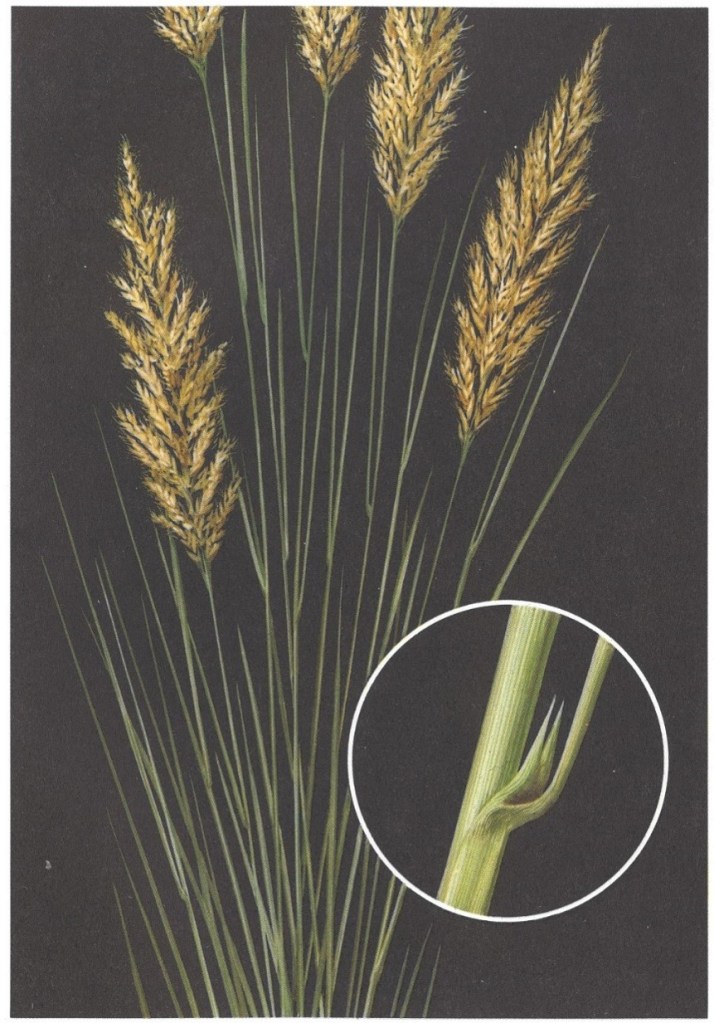
Yellow Indiangrass (Sorghastrum nutans) is a native, warm-season grass that is a bunch sod-former. Stems grow 3 to 8 feet tall from leafy clumps, with leaves up to 2 feet long. The seedheads have a characteristic golden bronze to yellow plume-like inflorescence. Seeds have a long and prominent bent awn. It is adapted to sandy soils and needs additional moisture on loamy soils. Indiangrass tolerates periodic flooding and high water tables.
Yellow Indiangrass matures in late summer to fall, later than big bluestem. It responds well to nitrogen fertilizer and supplemental water. Salt tolerance is moderate. It is compatible with the bluestems and switchgrass.
Use for hay. Provides excellent hay when cut before or soon after heading. Production potential is similar to big bluestem.
Use for pasture. Indiangrass palatability is high in the summer and declines with maturity. It does not tolerate close summer grazing. Maintain a stubble height of 4-6 inches during the winter to prevent damage.
Varieties:
- ‘Cheyenne’: late maturing, good forage type; Oklahoma origin; more adapted to eastern Colorado border and more recommended for Oklahoma and Texas range and pasture plantings, One of the most available seed varieties in Colorado.
- ‘Nebraska 54’: Good seedling vigor, tall, leafy and moderately late-maturing; Nebraska origin; good seed availability.
- ‘Osage’: Tall, leafy variety, good vigor and late maturing. A 1953 Oklahoma release. Moderate seed availability in Colorado.
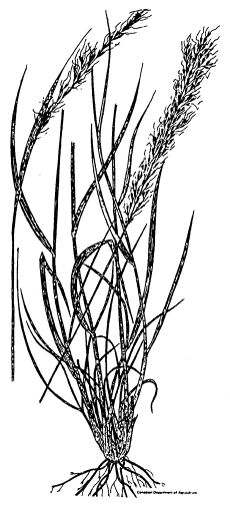
Green needlegrass (Nassella viridula) is a native, cool-season bunchgrass associated with blue grama on clayey, dryland soils, it is an important native grass in Northern Great Plains rangelands. It has an abundance of palatable basal leaves that recover well after being grazed or cut. Green needlegrass is a mid-height grass with stems that grows 2 to 3 feet tall and leaves 3 to 12 inches long. A relatively early spring grower, it heads in June and matures in July. Although seeds have awns (beards), they are not typically troublesome to livestock. It mixes well with western wheatgrass and blue grama.
Seeds can remain dormant for two to three years before germination, and seedlings are slow in developing, which makes this species hard to establish but once established, it is very vigorous.
Use for Hay. Although green needlegrass has mostly basal leaves, it provides good quality hay with a relatively high crude protein content. Hay is readily consumed by livestock.
Use for Pasture. Green needlegrass can maintain palatability and good nutrient quality through the summer with good soil moisture and may provide good winter grazing. It is more palatable to cattle and horses than to sheep and goats. Let fully-developed awns fall before continuing grazing. Excessive grazing pressure will reduce green needlegrass plants in pastures. More suited for mixes rather than monocultures.
Varieties:
- ‘Lodorm’: selected for low seed dormancy; a North Dakota release.
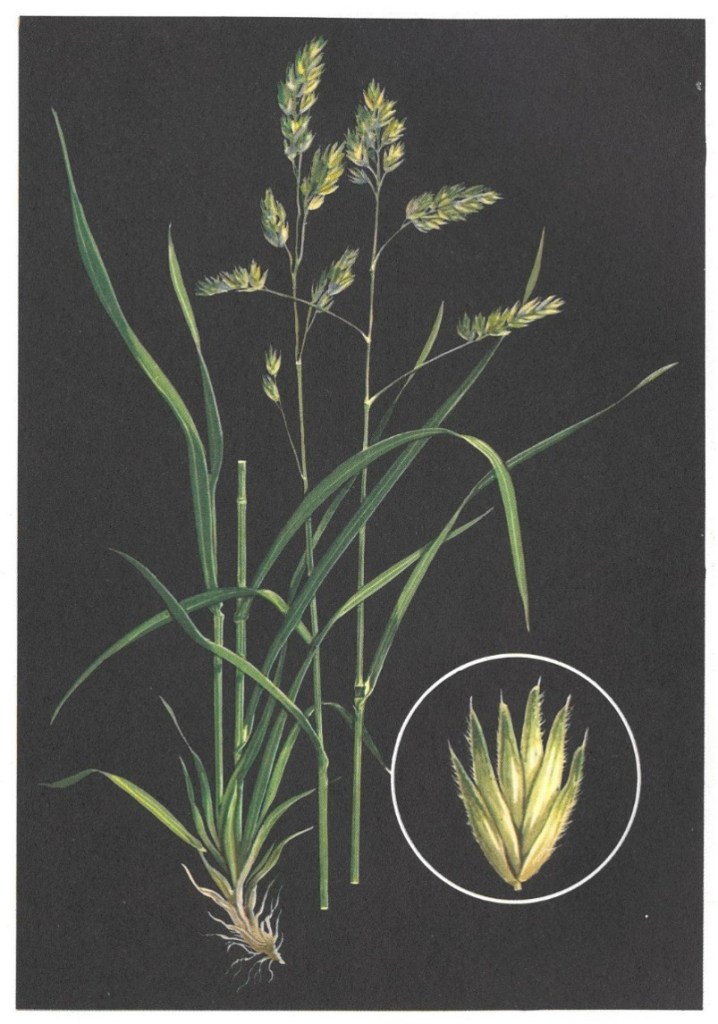
Orchardgrass (Dactylis glomerata) is a high quality, cool-season grass that originated in Europe. It grows 2 to 5 feet tall, has leaves 4 to 16 inches long, and has one-sided seedhead clusters. Orchardgrass produces numerous leafy stems and recovers rapidly from grazing or cutting, it is a highly palatable grass for all classes of livestock, adapted to irrigated or high moisture sites and needs adequate soil moisture to survive winters. Orchardgrass does not tolerate flooded conditions. Choose early maturing varieties for improved winter hardiness. It combines well with legumes since it is a bunchgrass; many varieties mature about the same time as alfalfa.
Use for Hay. Orchardgrass is an excellent hay grass that can produce more than six tons per acre of high quality hay. I Higher yields are expected when mixed with alfalfa. Cut for hay when plants are in the boot stage or shortly thereafter.
Use for Pasture. Orchardgrass is highly palatable to cattle, making rotational grazing important to prevent selective grazing; graze 8- to 9- inch tall plants down to no less than a 4-inch stubble. Proper grazing management also helps reduce the development of seed stalks by keeping grasses in a vegetative stage, which is more palatable than mature stems. Although orchardgrass is well adapted to frequent grazing, it does not recover well from continuous or close grazing and is susceptible to trampling. It may perform well under shade or partial shade areas.
Dryland Variety:
- ‘Paiute’: Low growing, heat resistant variety. Under arid conditions, growth is characterized by numerous basal leaves and leafy culms. Flowering stems can grow up to 15 to 18 inches tall while leaves remain around 12 inches long. It has been reported to live for up to 20 years in arid conditions but requires at least 16 inches of annual precipitation. Although drought tolerant, dry winters increase winter kill risk. It is best suited to the sagebrush-grass and mountain shrub plant communities.
Irrigated Varieties:
- ‘Latar’: Exceptionally leafy, stems may grow from 20-59 inches tall, late maturing variety, suited for hay. Leaves are low in lignin content and have high digestibility. matures the same time as alfalfa; recovers quickly after cutting or grazing; good winter hardiness. Released in 1957.
- ‘Potomac’: Early maturing, better suited for monocultures rather than mixes. Not recommended to grow with alfalfa due to stage of maturity but performs excellent as a monoculture. More compatible with clovers. A 1954 release from Oregon.
- ‘Crown Royale’: Late maturing, developed for less clumping than other varieties. Quick re-growth, ideal for grazing or hay with good winter hardiness. Needs at least 16 inches of water annually.
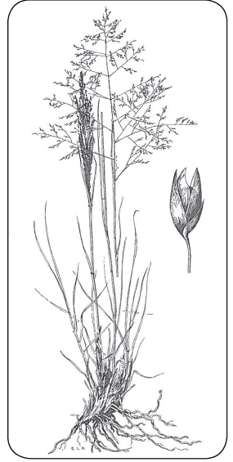
Alkali sacaton (Sporobolus airoides) is a warm-season, native bunchgrass that can form sods or wide bunches. It can grow up to 60 inches. It is native to the western half of the United States and is adapted to saline and non-saline soils ranging from coarse to fine textured. Established plants can tolerate drought and water inundation, but does not adapt well to shade, grows best in areas receiving 12 to 18 inches of precipitation. Summer fires can cause severe injury to the plants but otherwise, they are resistant to fire. Provides good forage and recovers well from moderate grazing.
Alkali sacaton can reproduce from tillers and seeds but can be difficult to establish on grass seedings due to the small seed size. It mixes well with western wheatgrass and switchgrass on sites with soil electrical conductivity of up to 9 mmhos/cm.
Use for Hay. Alkali sacaton produces hay of fair quality if cut at early heading.
Use for Pasture. Cattle and horses graze alkali sacaton freely before the plants reach maturity. As it matures, sacaton becomes coarse, tough, and unpalatable. Sacaton has good grazing tolerance; keep grazing down to maintain quality. It does not cure into good winter feed.
Varieties:
Most seed is available as Variety Not Stated (VNS).
- ‘Salado’: good forage production and improved seedling vigor; a 1983 New Mexico release; limited seed availability.
- ‘Saltalk’: good germination and establishment on saline sites; improved palatability; withstands flooding; a 1981 Oklahoma release; limited seed availability.
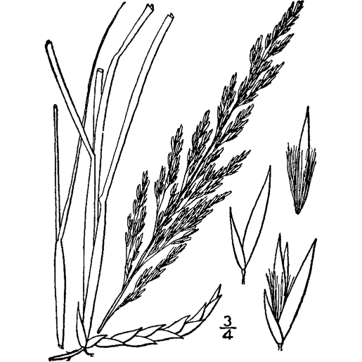
Prairie sandreed (Calamovilfa longifolia) is a native, warm-season grass that is adapted to sandy sites. It is a sod-former that grows 2 to 5 feet tall and is a good soil stabilizer. This plant is very drought resistant and tolerant of alkaline soils but not adapted to high soil salinity.
Leaves are typically 8-12 inches long, but longer leaves are not uncommon. Typical of native grasses, prairie sandreed can take two to four years to become established. It is a low seed producer with leaves that are highly palatable to livestock, but coarse stems are rarely grazed on. Sandreed mixes well with sand and little bluestems.
Use for hay: Prairie sandreed hay quality is fair to good. Cut at the heading stage.
Use for pasture: Highly valued in rangelands as it beings growth earlier than other warm season grasses. It provides good summer grazing but is susceptible to trampling despite its rhizomatous nature. This plant tends to become coarse and woody if allowed to grow too tall under grazing. It cures well on the stem, which gives it value as a winter forage and more grazing tolerance than bluestems.
Varieties:
- ‘Goshen’: Selected for higher leaf and seed production. Primarily used in mixtures to stabilize sandy soils. A 1976 Montana release.
- ‘Pronghorn’: Superior leaf rust resistance compared to ‘Goshen’ with similar forage yields; a 1988 Nebraska-Kansas release.
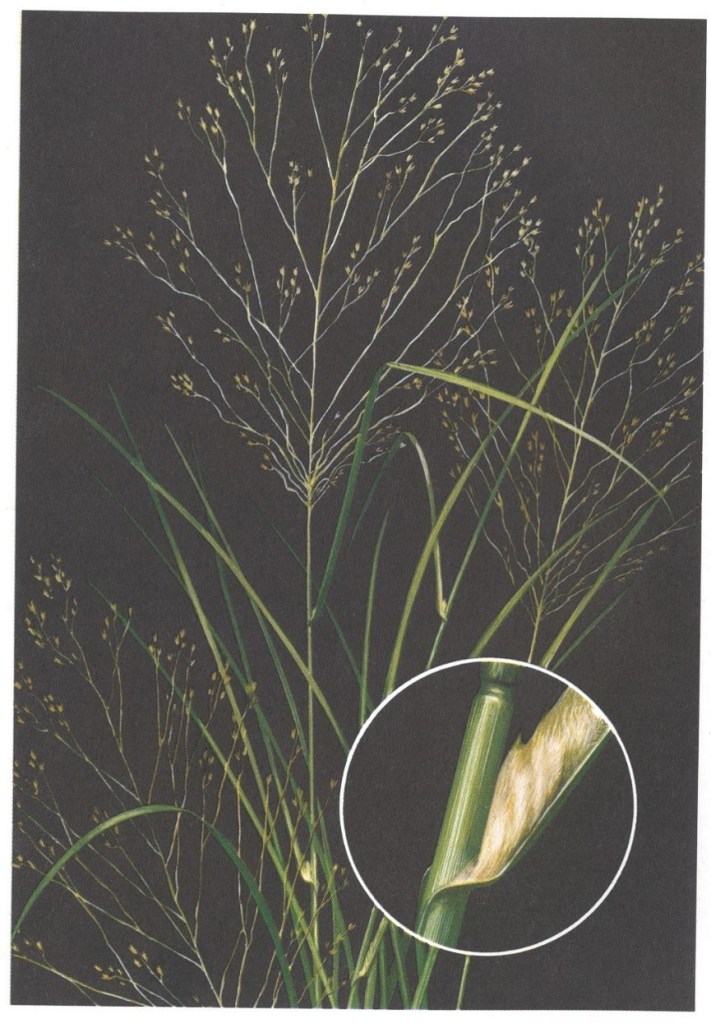
Switchgrass (Panicum virgatum) is a native, warm season, moderately sod-forming grass. Adapted to a wide range of soil types but does not tolerate high water tables. Switchgrass performs best on sites receiving 16 inches or more of annual precipitation. Seed stalks grow 3 to 5 feet tall; leaves 1 to 2 feet long. It cures to a colorful reddish-brown by winter. Switchgrass seed is smooth and plants easily. Pure stands of switchgrass respond well to nitrogen fertilizer and are often recommended for hay and pasture uses. Not recommended as forage for small ruminants and horses, as some plants may contain toxic Saponins that cause photosensitization and liver damage. Compatible grasses are big bluestem, little bluestem, and yellow Indiangrass.
Use for hay: Switchgrass has many leaves on upright stems and makes good hay on sites with adequate moisture. Best quality is obtained when harvested at the boot stage. Palatability quickly declines at maturity as plants become stemmy and rough. Hay quality declines rapidly after heading.
Use for pasture: Switchgrass is palatable to all livestock but nutrient content and palatability declines rapidly as stems mature in late summer. It is vulnerable to close grazing in late spring and early summer. Leave a residual stand of at least 8 inches for quicker spring regrowth.
Varieties:
- ‘Blackwell’: wide range of adaptation, good seedling vigor, outstanding growth in late spring and early summer, leafy, good producer, resistant to rust and other diseases. A preferred variety for biofuel production. A 1944 Kansas release. Most commonly available variety.
- ‘Nebraska 28’: Fine stemmed, early maturing; adaptable to diverse soils. A 1949 Nebraska release.
- ‘Trailblazer’: greater palatability than “Pathfinder”; similar in maturity length. A 1984 Nebraska released. Good seed availability.
- ‘Pathfinder’: Late maturing, easy to establish, winter hardy and leafy. Excellent performance for late spring or summer grazing pastures. A 1967 Nebraska release.
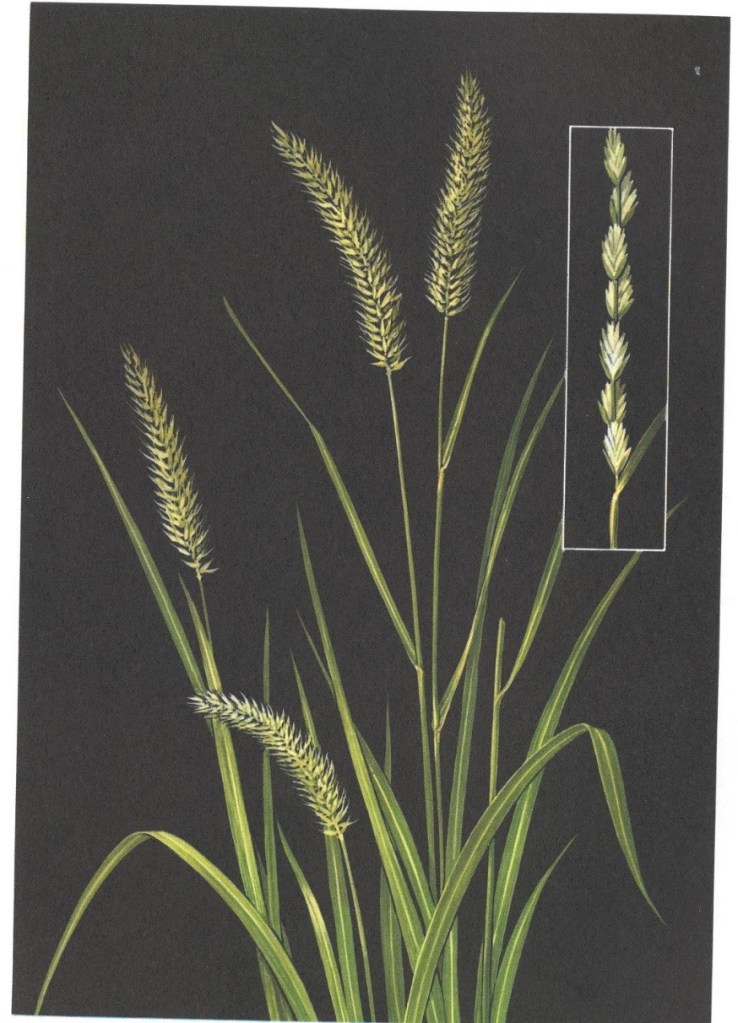
Crested wheatgrass (Agropyron cristatum) is a cool-season grass that originated in Russia. All but one variety are bunchgrasses and they are adapted to a wide variety of soils. They can perform well with as little as 8-9 inches of annual precipitation and are some of the most cold-hardy grasses that can thrive in areas that have a frost-free period of 140 days or less.
Plants grow 8 -30 inches tall. Leaves are 2-8 inches long. Crested wheatgrasses provide forage two to three weeks earlier than most other grasses but become dormant with hot temperatures in early June. Crested wheatgrass recovers well after grazing and is an aggressive spreader that tends to form monocultures. Plants can become unthrifty in dense stands without persistent legumes or nitrogen fertilization.
Use for hay. Crested wheatgrass provides good quality hay if cut soon after heading. Its fine stems cure quickly and well but it is rarely harvested for hay because crested wheatgrass looses palatability and quality quickly after heading.
Use for Pastures. Crested wheatgrass is very tolerant of grazing. Grazing between April though May provides the best forage quality with high protein and palatability but forage quality is poor from June through August. Fall grazing may be suitable in years with enough moisture for regrowth. Crested wheatgrass can tolerate heavy grazing thanks to its extensive root system.
Graze during the establishment year after frost to remove growth that inhibits spring grazing.
Varieties:
- ‘Standard type’: Agropyron desertorum, more productive and remains greener under drought than ‘Fairway’. Withstands close grazing and trampling. Adapted to many types of soils but performs better on medium textured soils. Does not tolerate salty soils or long periods of flooding. Cultivars include ‘Norman’ and ‘Summit’.
- ‘Fairway’: Agropyrum cristatum Is a different type than the ‘Norman’ or standard type. Was recognized in 1950 and is characterized by shorter, denser and fine stems, and more leafiness. Thickens better than ‘Nordan’ but has slower establishment and shorter growth. It performs better at higher elevations than Nordan. Cultivars of this type include: ‘Douglas PVP’, ‘Ephraim’, ‘Parkway’, ‘Roadcrest’ and ‘Ruff’.
- ‘Ephraim’: Moderately spreading in areas receiving over 14 inches of annual precipitation. Mid-height, low maintenance ground cover, has been successfully used as a turf grass option; good for stabilizing disturbed areas and for around farm buildings; a 1983 release.
- ‘Hycrest’: a cross between ‘Nordan’ and ‘Fairway’; compared to the parents, ‘Hycrest’ yields 15 to 20% more forage, has more and finer leaves, is quicker establishing, and emerges from a deeper planting depth; more stemmy than other crested wheatgrasses; adapted to 12 inches or more of annual moisture; a 1984 release.
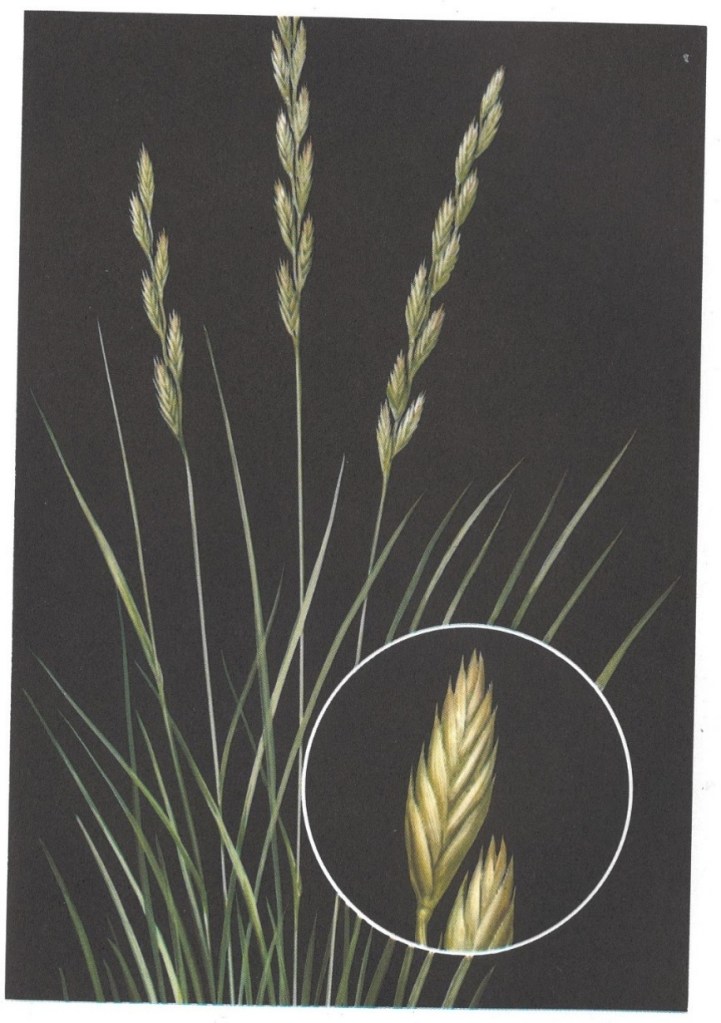
Intermediate (also known as Kernza) and pubescent wheatgrasses (Thinopyrum intermedium and Thinopyrum intermedium spp. barbulatum) are cool-season grasses originating in Eurasia. The two are closely related, and a small percentage of intermediate wheatgrass plants may exhibit pubescent (short, hairy or fuzzy) seed heads, which can make it difficult to distinguish between intermediate and pubescent varieties. Leaves are 2-6 inches long and they can have a green or blueish color.
Pubescent wheatgrass is generally more drought-tolerant and winter-hardy than intermediate wheatgrass. Both species remain green longer than most introduced grasses and provide fair to excellent forage for all classes of livestock and wildlife, depending on the plant’s growth stage.
These grasses demonstrate strong seedling vigor and are easy to establish. They are well-suited for use on disturbed sites and for erosion control due to their dense, rhizomatous root systems.
Intermediate wheatgrass is best adapted to areas receiving approximately 12–13 inches of annual precipitation, while pubescent wheatgrass performs well in areas with at least 11–12 inches. Sites below 3,500 feet in elevation typically require higher moisture levels. Stands of both grasses respond well to nitrogen fertilization.
Use for Hay. Intermediate and pubescent wheatgrasses are tall and produce good hay yields. Quality is good if cut before flowering. These are good grasses for acreages short of irrigation water and have superior performance under irrigation compared to smooth brome. Intermediate varieties respond better to supplemental water. They are compatible with alfalfa.
Use for Pasture. These grasses provide good spring to late summer forage. Keep grazed to 4- to 8-inch height for best quality and livestock acceptance. Stands of intermediate varieties can decline after five years of close grazing on dryland but has better stand persistence when grazed at the early vegetative stage rather than during late boot stage. Pubescent wheatgrass can provide excellent gains to yearlings that compare to those on orchardgrass. Growth usually begins earlier than native grasses. They do not freeze back as easily as smooth brome in the fall and some regrowth can be grazed at this time
Intermediate varieties:
- ‘Oahe’: Vigorous and leafy but coarse stemmed. Selected for its uniform green color, drought tolerance, and high yields. It is suited for hay, winter hardy, and a rapid sod-forming type. A 1969 release from South Dakota, this variety dominates seed availability.
- ‘Reliant’: Medium height, excellent performance for hay, either alone or with alfalfa, recommended for sites receiving 14 inches of annual precipitation or more. Matures two to three days later than other varieties. A 1991 release from North Dakota.
- ‘Slate’: Selected for its strong rhizomatous spread, erect growth and broad flat leaves. Not tolerant of alkaline soils. More adapted to eastern Nebraska.
- ‘Tegmar’: A dwarf variety, about half the size of other varieties, vigorous rhizomatous growth, and highly drought tolerant. Preferred choice for erosion control and soil stability. Not recommended forage.
- ‘Rush’: Superior seedling emergence, good regrowth after spring grazing, wide leaves, high forage and seed production. A recommended variety for grazing, hay production and soil stabilization, not suited for alfalfa mixtures. Released in Idaho by the Aberdeen Plant Materials Center.
Pubescent varieties
- ‘Luna’: Seed heads mostly pubescent with short stiff hairs. Good seedling vigor and fast establishment. High producer, known as the most drought resistant of the taller growing wheatgrasses, not the most efficient under irrigation. Long-lived and highly rhizomatous. Basal leaf blades are hairy. A 1963 New Mexico release, highly available.
- ‘Manska’: Superior nutritive value than other varieties and recommended for pasture and hay production in the northern and central Great Plains regions that receive at least 14 inches of annual precipitation. A 1992 release from North Dakota.
- ‘Topar’: a Pacific northwest release with dense sod-forming habit vigorous growth and late maturing. Adapted to poor fertility and higher elevations.
NewHy wheatgrass (Elymus hoffmannii) is the name of the variety of the quackgrass and bluebunch wheatgrass hybrid. Released in 1995, It combines the vigor, productivity, salinity tolerance and persistence of quackgrass with drought resistance, low growing habit and forage quality of bluebunch wheatgrass. NewHy can tolerate some soil salinity and is more palatable than tall wheatgrass on these sites. Only certified seed is sold to protect it from being confused with quackgrass seed. As a result, seed cost is more expensive than average. NewHy does not have the overly aggressive rhizome development of quackgrass.
Use for hay: The somewhat upright growth habit makes it harvestable as hay. Responds well to two irrigations per growing season. NewHy responds well to N fertilization rates of 50-100 pounds per acre on irrigated sites. It is compatible with alfalfa.
Use for pasture: NewHy has good palatability, digestibility and protein content. It tolerates moderate grazing pressure after establishment and has good regrowth after grazing.
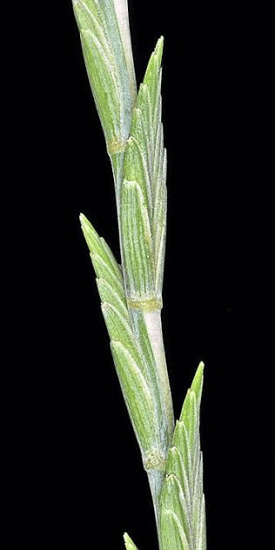
Tall wheatgrass (Thinopyrum ponticum) is a tall, cool-season bunchgrass that originated in Eurasia. Can have leafy stems of 3 to 7 feet tall, typically rough or hairy. Tall wheatgrass starts growth and matures later than most cool season grasses.
It is recommended for sites receiving at least 12-14 inches of precipitation. Although not as drought tolerant as crested wheatgrass, it performs well in sagebrush, and juniper sites and responds well to irrigation and fertilization.
It is well adapted to wet, alkaline soils where water table is from a few inches to several feet below ground surface. Tall wheatgrass exhibits strong salinity tolerance, showing only about 10% decline in yield at a salinity level fo 10 mmhos/cm, and roughly a 50% reduction at 20mmhos/cm.
Use for hay: Tall wheatgrass makes only fair hay quality because of its coarse stems and leaves but it can produce high yields. Cut before or at early heading when it is higher in crude protein and total digestible nutrients than other wheatgrasses.
Use for pasture: Tall wheatgrass provides a long grazing period with good summer growth. Some regrowth may occur in the fall when enough moisture is available. Tall wheatgrass needs to be frequently grazed to maintain the more palatable vegetative stage, however it does not tolerate close grazing below 6 inches. It is best managed as a monoculture where cattle graze it readily before heading, sheep will graze it in more uneven patches. Old coarse growth can prevent livestock from grazing plant regrowth.
Varieties:
- ‘Jose’: Selected for drought and saline tolerance. Improved palatability due to its less coarse texture compared to other varieties, basal leaves are 20 to 24 inches long. A 1966 New Mexico release. Most commonly available variety.
- ‘Alkar’: Late maturing, stemmy bunchgrass with a distinctive bluish-green color, intensified by drought or alkaline soil conditions. Large seeds and good seedling vigor. Fair palatability, can be used as standing hay for winter feed. A 1951 release most adapted to western Colorado or irrigated sites.
- ‘Platte’: Winter hardy with short rhizomes. Flowers in July. A 1972 release. Poor seed availability.
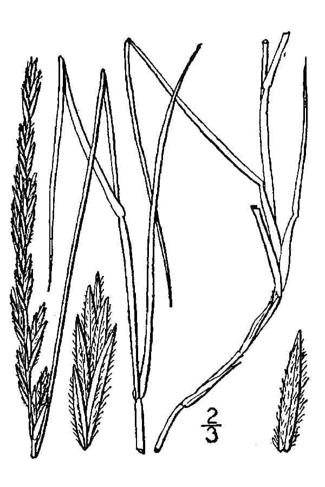
Thickspike wheatgrass (Elymus lanceolatus) is a mid-height, cool-season, native grass, closely related to western wheatgrass but more adapted to sandy and silty sites. It is a good sod-former, drought resistant and salt tolerant plant. It grows best on sites receiving 8 to 20 inches of precipitation but has been successfully established on sites receiving as little as 5 inches of annual precipitation. It is cold tolerant and can withstand moderate periodic flooding but not long periods of inundation or poorly drained soils.
It grows from 1 to 3 feet tall and begins growth earlier than western wheatgrass. This grass is readily grazed and palatable from spring to early fall. It is moderately tolerant to grazing but tends to become wiry with maturity.
Associated species include needlegrass, sand dropseed, prairie sandreed, needle-and-thread and Idaho Fescue.
Use for hay: Provides good nutritional value but is a relatively low forage producer. Hay production is limited to native grass hay when planted in association with other species.
Use for pasture: High protein levels in the spring, considered desirable forage for all classes of livestock. Established stands can tolerate fairly heavy grazing but stubble should remain at 6 inches to ensure proper regrowth.
Varieties:
- ‘Critana’: has excellent seedling vigor, quick establishment on critically disturbed sites, variable genetic expression but generally abundant fine leaves. A 1971 release.
- ‘Bannock’: Rapid establishment, moderate sod former, high forage production and drought tolerance. Released in 1995.
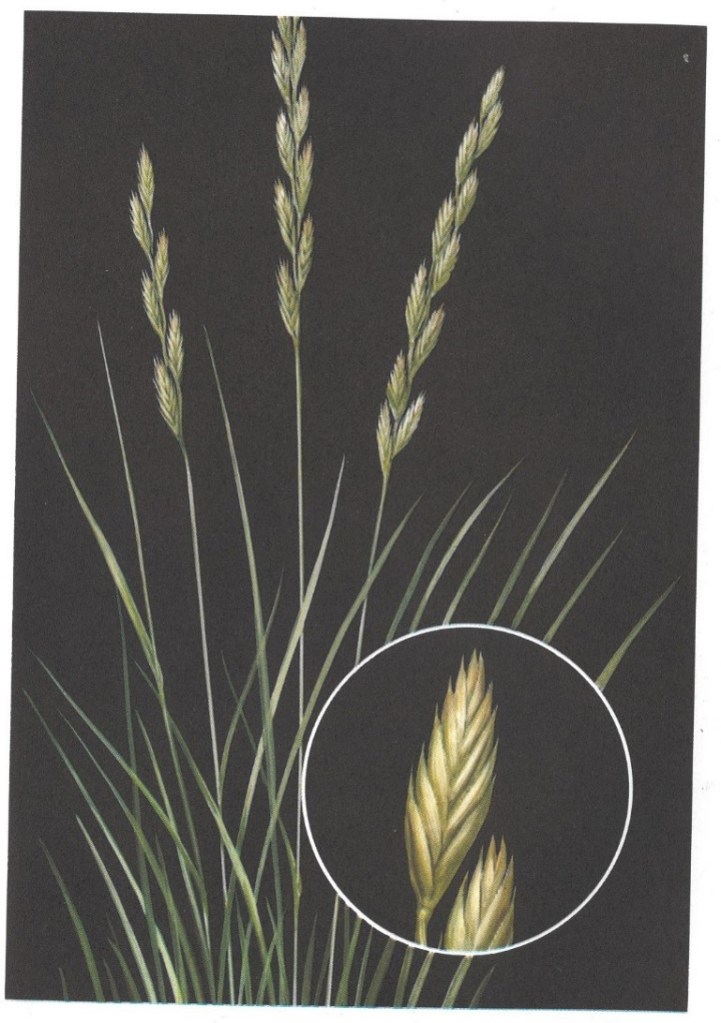
Western Wheatgrass (Pascopyrum smithii) is a cool-season, native sod-former and a major grass of the eastern plains. It is a long-lived grass with an extensive, very strong rhizomatous root system. Very competitive and excellent erosion control plant.
It grows 1 to 3 feet tall. It is adapted to dryland silty to clayey sites where it is often found with blue grama. Western wheatgrass withstands flooding and silting in lowland sites and grows well on sites receiving 10-14 inches of annual precipitation. Behaves as an increaser plan on rangeland sites receiving 20 inches or more of precipitation. It requires two years of growth before hardy top growth is seen. This grass mixes well with native bunchgrasses such as blue grama, green needlegrass, and sideoats grama by filling in bare space. It can grow in partial shade and tolerates heavy grazing and fires.
Use for hay: Western wheatgrass is a common hay grass in drainages of the eastern plains. Hay quality is good. Cut it in the early-bloom stage for best quality.
Use for pasture: Western wheatgrass is resistant to grazing and provides good forage from spring through summer. It cures well when standing and can be used for winter grazing. Despite stiff leaves, it rarely becomes coarse enough to prevent sheep from grazing. Like all cool-season grasses, it needs to have an opportunity to regrow after being heavily grazed in the spring. Western wheat will be grazed out with annual, close grazing in the spring.
Varieties:
- ‘Arriba’: Released for dryland hay production, grazing and conservation seedlings. superior uniformity and rate of emergence, seedling vigor and forage production. Great performer in eastern Colorado. Good seed availability.
- ‘Barton’: Strongly rhizomatous and leafy. High forage and seed producer. A 1970 release from Kansas. Dominates seed availability.
- ‘Rosana’: Moderately fine stemmed, adapted to clay soils and overflow sites. Released for seedling vigor an ease of establishment. Tight sod former, recommended for depleted sites and disturbed rangelands of the Northern Grait Plains and Intermountain regions.
- ‘Recovery’: Superior seedling vigor, faster establishment and ability to emerge from deep planting depths.
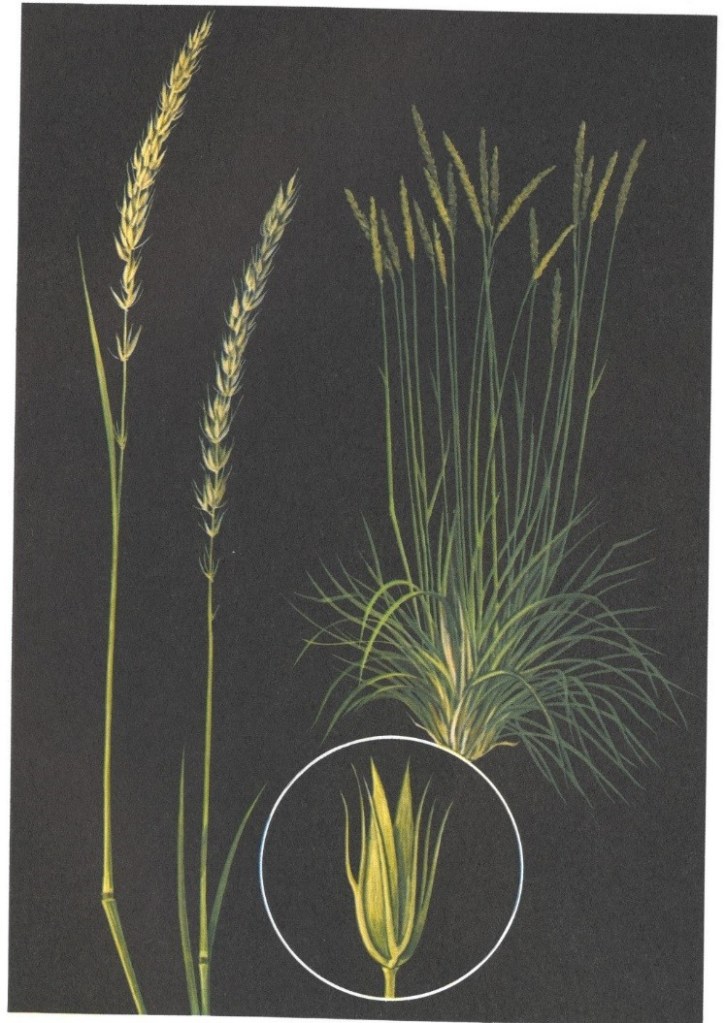
Russian wildrye (Psathyrostachys juncea) is a cool season, dryland bunchgrass that originated in central Asia. Stems grow 1 to 3 feet high with many basal leaves 6 to 18 inches long. It has high digestibility and an exceptionally long season of use.
Russian wildrye can draw water from up to 4 to 5 feet deep thanks to its extensive root system, which makes it a very drought tolerant plant. The dense root system also makes it an excellent competitor against weeds once the plant is well established. It can tolerate EC levels of up to 12 mmhos/cm
It is difficult to establish, most adapted to clay or loamy soils and particularly difficult to establish on sandy soils. It mixes well with legumes but careful management is required due to the high palatability of legumes. This grass begins growth to weeks later than crested wheatgrass but has better fall regrowth and summer availability when enough moisture is available.
Use for hay: Russian wildrye is poor as a hay species because its basal leaves are largely unharvestable.
Use for pasture: Russian wildrye is an excellent dryland pasture grass that is palatable to all livestock. It remains palatable and cures well in the stem, keeping good forage quality in late summer and fall. A good strategy is to graze lightly in the spring, saving regrowth for late summer and fall when other grasses are not available.
Varieties:
- ‘Bozoisky-Select’: Improved seedling vigor and forage yield. More leafy and establishes more vigorously than ‘Vinal’ and ‘Swift’.
- ‘Mankota’: Good seedling emergence at up to 2-inch planting depth. Good stand establishment and resistance to leafspot diseases and lodging. Good forage quality and seed yields.
- ‘Bozoisky II’: Excellent seedling vigor at a deep planting depth, good vegetative vigor, production and drought resistant. Better establishment than ‘Bozoisky-Select’ in southern Wyoming but comparable characteristics otherwise. A 2004 release from Utah.
- ‘Swift’: Excellent establishment, vigor and ability to emerge from deep seedings. No visual differences from other cultivars.
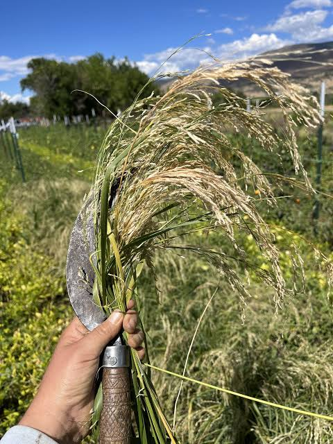
Teff (Eragrostis tef) is a newly introduced summer annual forage grass, originally from Ethiotpia. It is a leafy and fine-stemmed grass that contains higher crude protein and Total Digestible Nutrients (TDN ) than other annual forages. Although it is generally a low producer, it is highly palatable as hay for horses, llamas and alpacas.
Teff grain is well known for it’s traditional use in Ethiopian cuisine and because of it’s gluten-free seeds but has gained more popularity in the United States as a forage grass, particularly because of its lower levels of nonstructural carbohydrates (NSC) and excellent nutritional value for cattle. Teff’s soft stems and leafiness make it highly palatable for hay and grazing.
Planted from late May through July, teff is highly sensitive to cool temperatures and is best suited as a summer annual crop. Because its seeds are extremely small, careful drill calibration is essential. A firm seedbed and packing after seeding helps ensure proper seed-to-soil contact and successful establishment. Seeding depth should not exceed ¼ inch, and rates should remain between 4–6 pounds per acre, although some sources recommend up to 8 lb/acre depending on the soil condition; planting too densely can lead to poor stands and limited tillering.
Teff is resilient to heat and short periods of water stress, it establishes quickly and suppresses weeds if planted at the right depth. It will winterkill and can be easily terminated with chemical applications. Teff can also serve as a good alternative following the termination of cereal grains or alfalfa. For best uniformity, it is typically planted as a monoculture, as it tends to mature at different times than perennial forage grasses.
Use for hay: Teff makes excellent hay, but baleage and silage are also feasible options. Teff hay takes longer to dry compared to cool season grasses. Best harvest time is when the plant is in early boot stage, about 45 to 55 days after planting. A second cutting may be possible if plants are cut no lower than 3 to 4 inches and left to rest up to 45 days.
Use for pasture: Teff is planted very shallowly and develops a delicate root system that can be easily uprooted when animals graze. Before allowing grazing, perform a tug test by grasping a small handful of forage and gently pulling upward, similar to how an animal would graze. If the plant pulls out of the ground, soils may be too wet or loose, or the roots may not yet be fully established to support grazing.
Leave a 2–3 inch stubble after grazing to promote healthy regrowth. Be aware that heavy hoof traffic can damage plants, especially while root systems are still developing.
Legume Species and Varieties
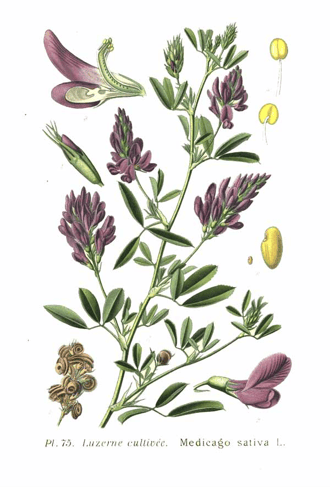
Alfalfa (Medicago sativa or crosses with M. falcata) is the well-known “Queen of forages” due to its high nutritional value. Plants have trifoliate (three-branched) leaves, alternately arranged. The flowers can vary from purple to yellow or white and grow in tight bunches called racemes. Plant crowns produce many stems that can grow 3 feet tall with good moisture. Taproots can be 10 to 30 feet long.
Alfalfa is adapted to a wide range of soil textures but needs well drained soils, coated seed has better establishment on sandier soils. It can tolerate some alkalinity and salinity. There are hundreds of varieties and many more are developed yearly both by private and public breeders. Choosing from dryland or irrigated varieties make some of the most important decisions for better performance but there are also improved varieties for winter hardiness, enhanced forage yields, pest resistance, forage quality. Alfalfa is a common addition with warm-and-cool season grasses.
During establishment, companion crops like Italian ryegrass, oats, spring barley and spring triticale can help control erosion, especially on sandier soils. Alfalfa can live up to 8 years, but in many occasions, high profitable yields stop at around 4-5 years, after which, a crop rotation is recommended. Alfalfa plants produce toxins that inhibit the germination and establishment of new alfalfa plants, therefore, alfalfa rotation and renovation is recommended until the toxins are removed from the soils.
Use for Hay. Alfalfa needs approximately 6 inches of water to produce one ton of cured hay. Cut plants at the 1/10th bloom stage (every 30 to 35 days) to foster stand longevities of six to eight years. Weed control prior to establishment is crucial and proper weed management during the crop life will help preserve stand life and forage quality. Three to four cuttings can be expected on irrigated land and one on dryland. Irrigated fields in Colorado can yield up to 6 tons per acre. Alfalfa weevil can be a seriously destructive insect pest in May.
Use for Pasture. Alfalfa is highly desired by all livestock. Do not graze closer than 4 to 6 inches to the ground and allow for at least a 30 day rest period. Alfalfa can cause bloat in cattle and sheep, which results from gases trapped in the main stomach. If left untreated, bloating will cause death. Refer to the “Legume” section of this publication for information on managing bloat.
Varieties:
Dryland: Upright and semi-upright varieties used for hay, creeping and low growing varieties are better suited for grazing.
- Ladak: Yellow flowered, semi prostrate (grows close to the ground). It has the ability to produce a heavy first cutting but is slow to recover. Is adapted to wetter sites and is winter hardy. Better suited for hay cuttings rather than grazing. Seed is widely available.
- Ladak II: Developed from Ladak, drought resistance, superior yield production compared to Ladak. Recommended for dryland hay curring on areas receiving at least 10 inches of precipitation.
- Vernal: One of the oldest lines of varieties. Performs well at high soil pH. It is fine stemmed and leafy, recovers well after cutting. Good establisher and adapted to grass mixtures. Winter hardy.
- Ranger II: Excellent drought tolerance, adapted to multiple soil types, superior forage than it’s predecessor ‘Ranger’. Adapted to irrigated and dryland conditions.
- Alfagraze: Great performance on grazing systems thanks to its deep crowns, leafy stems and fast recovery. Roundup Ready resistant. Cultivars include ‘Alfagraze 300 RR’ and ‘Alfagraze 600 RR’.
- Falcata: Drought tolerant, yellow flowered. It is commonly used as a nitrogen fixing legume on rangelands. More creeping roots than purple flower varieties. Winter hardy and tolerates high soil pH. Falcata is not recommended for solo plantings and is rather a component of grass seed mixes, due to its shorter size, it is not highly competitive against other vegetation. Dormancy helps this variety survive challenging conditions.
Irrigated: Irrigated alfalfa varieties are being improved constantly and there are hundreds of available varieties suited for hay or grazing. Blends of two or three varieties are available that are good producers of high quality hay. Contact your local extension specialist or seed dealer for current recommendations.
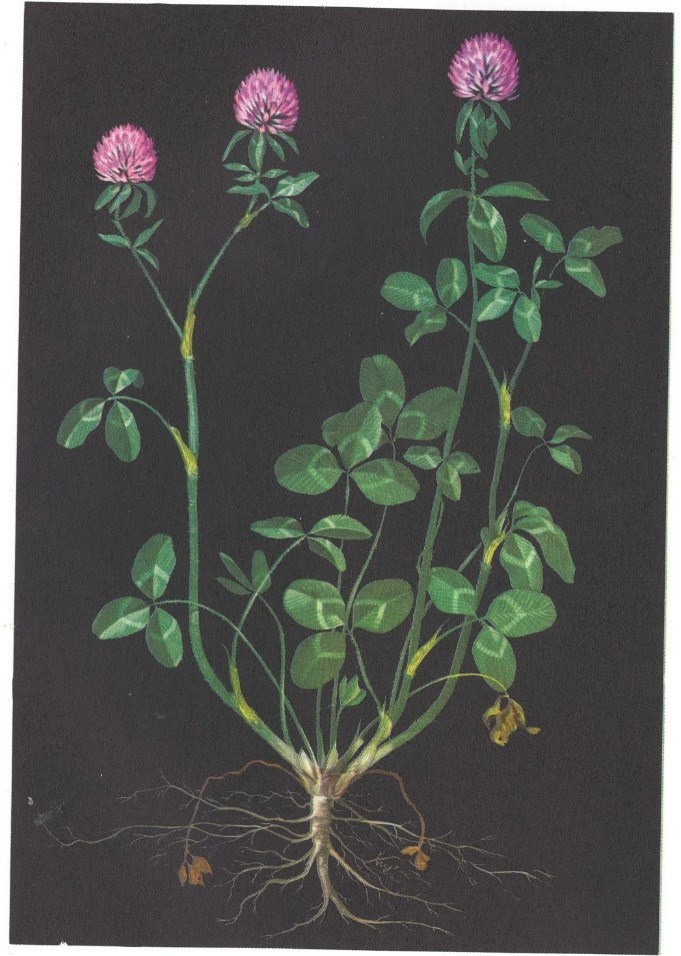
Red clover (Trifolium pratense) is a short-lived (two to four years) legume that self-reseeds easily. Three to ten hollow, hairy stems grow from a thick crown to a length of two feet. Each leaf is divided into three leaflets (clover type), each with a halo or light-colored spot in the middle. Flowers are rose-purple in color. Red clover is adapted to medium to fine-textured soils. It has a high production capacity. Most roots are in the top 12 inches of soil and require irrigation and moderate temperatures to survive.
Compared to alfalfa, red clover is more tolerant of acid and poorly drained soils, less tolerant of soil salinity, and similar in bloat hazard. Clover has high nutritional value but horses that consume mold infested clover or alfalfa can get “slovers”, a non-fatal, reversible condition, that causes excessive salivation. Not the most common choice for Colorado pastures.
Use for Hay: Red clover combines well with irrigated grasses to make high quality hay. Cut at the early-bloom stage for best yield and quality. High yields and stem moisture from red clover dominated stands can make cut plants hard to cure. Red clover has poor color preservation, which can result in hay that appears dull, but quality remains the same. Compared with alfalfa, red clover hay has about two-thirds as much protein, and slightly more digestible nutrients and net energy. Delay the first cutting until 80 days after emergence (late-flower stage).
Use for Pasture: Red clover is suited for livestock grazing. Manage similar to alfalfa to reduce bloat hazard. To encourage rapid regrowth, avoid heavy defoliation, especially of early growth.
Varieties:
- Single-cut: also known as late flowering or mammoth red clover; most common to high altitude meadows above 6,500 feet; produces a heavy flush of shoots. regrows well enough after its one cutting to provide good fall pasture but not for another cut of hay. Easier to establish.
- Double-cut: also known as early flowering or medium red clover; it provides two cuttings per year and tends to be shorter-lived. Reseeds well and is more adapted to lower elevations than single-cut. Better regrowth after cutting.
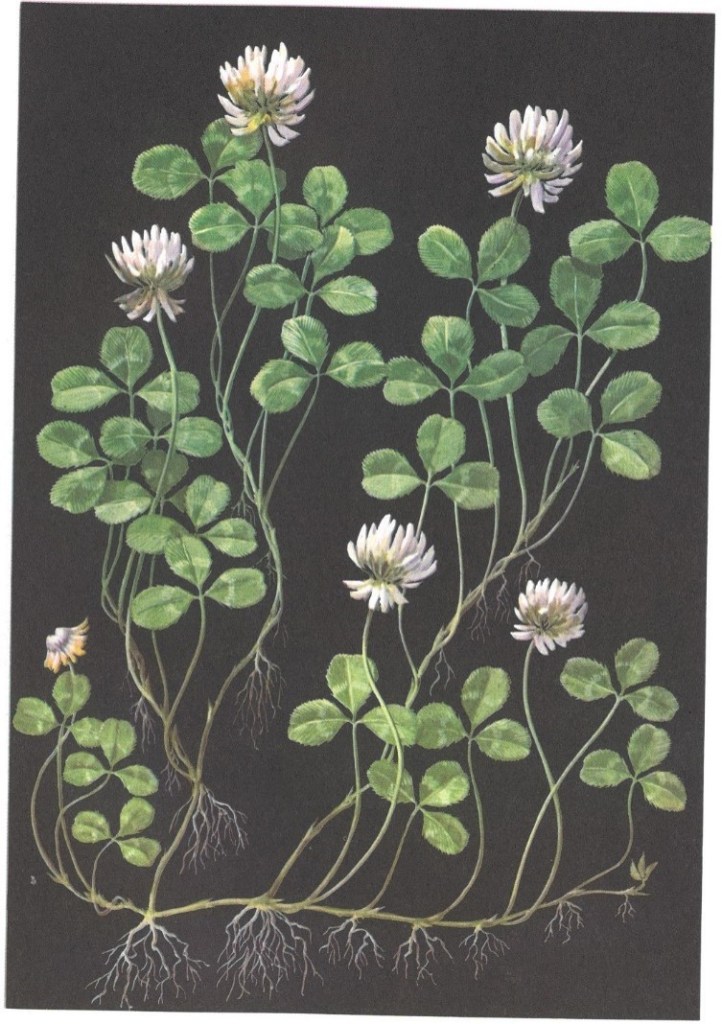
White clover (Trifolium repens) is a true clover with three leaflets per stem. It originated in the eastern Mediterranean or in Asia Minor and is white-flowered. White clover is rather shallow rooted and spreads via stolons (above ground horizontal shoots). It needs moisture to persist and prefers well-drained soils. Leaves usually have V-shaped white marks in the middle. White clover is not tolerant of saline or alkaline soils (a pH of 5 to 7 is best), but is tolerant of summer heat. Inoculate white clover seed with appropriate rhizobia before planting to achieve the full benefits of nitrogen fixation.
Mix white clover with irrigated grasses for best pasture use. Seed four to six weeks before the dry, hot season arrives. More than 50% white clover in a pasture can cause bloat in cattle and sheep. White clover is not tolerant of shade, frequent grazing intervals with short residue heights tends to favor clover. Rest periods are crucial for regrowth and peristance. White clover contains phytoestrogens, a compound that mimics animal estrogen that may affect female animal reproduction.
Varieties:
1 – ‘Ladino’: This “giant” form of white clover grows 8 to 12 inches tall, which is two to four times taller than the intermediate type. It is the most commonly sold white clover for forage. High in protein and digestibility but cutting for hay is generally not recommended, ‘Ladino’ is not tolerant of close grazing. Leave 3 inches of stubble with grass and allow regrowth to an 8-inch height. Seed at one pound per acre with grass to keep bloat hazard low. Ladino will winter kill somewhat in dry soils and it requires high soil phosphorus.
2 – Intermediate Types: Many varieties, also known as ‘common’ characterized for dense stolons that spread aggressively and are more tolerant to close grazing. Height can vary between tall and small, tends to live between two to three years. ‘Grassland Huia’ and ‘White Dutch’ are commonly available varieties.
3 – Small types: Also known as low-growing or wild, commonly found in lawns, it can provide good forage but will be shaded out in pastures by taller grasses, rapid regrowth but short height does not allowe for hay cuttings. Not a heavy producer but persists well under heavy and acontinuous grazing. Grows fairly early in the spring with fair summer regrowth.
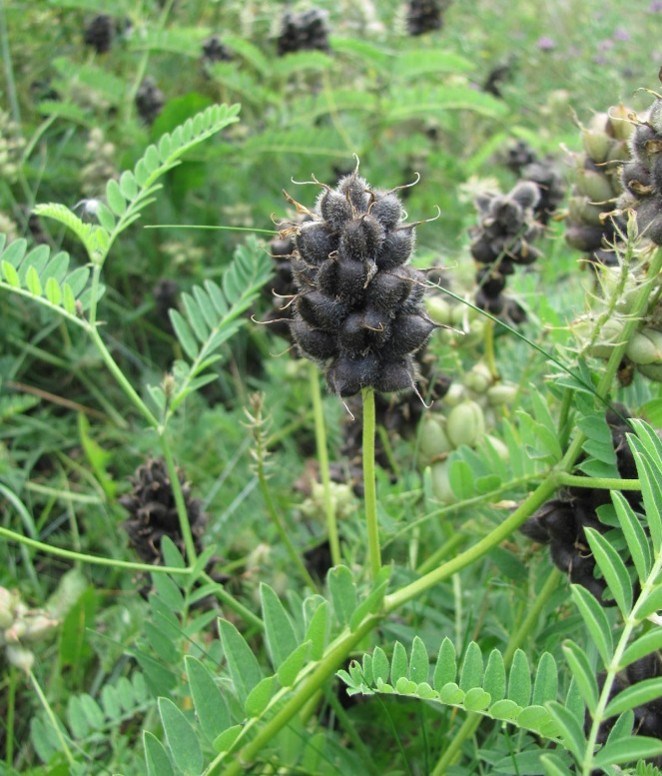
Cicer milkvetch (Astragalus cicer) is a very long-lived perennial native to Europe with vigorous, creeping rhizomes. Leaves are divided into over 21 small, sparsly hairy leaflets, located opposite to each other along the stems. Plants can reach heights of 4 to 10 feet but tend to become more trailing in nature as they mature. Flowers are pale yellow to white with green to red seed pods that turn black as they mature.
Cicer milkvetch is considered a non-bloating legume and does not contain harmful alkaloids nor does it accumulate toxic amounts of selenium. It adapts well to well drained soil textures and subirrigated conditions with water 3 to 6 feet below the soil surface. It has some drought tolerance in areas receiving at least 16 inches of annual precipitation but perform better at 18 to 35 inches of mosuture. Cicer responds well to irrigation and has good winter hardiness. It can adapt to pH levels between 6.0 to 8.1 and is moderately salt tolerant.
Cicer milkvetch has weak seedlings and may take two to three years to establish, however, after establishment, it is an aggressive spreader that can take over pastures. Seeds should be inoculated with rhizobia before planting to perceive all the nitrogen fixing benefits. Seeds must be scarified adequately to ensure germination.
Compared with alfalfa, Cicer beings spring growth and matures two weeks later and is more drought tolerant of late spring and early fall frost. It has goo summer regrowth potential and mixes well with smooth brome, orchardgrass and tall fescue. Additionally, Cicer milkvetch has a high value for wildlife and pollinators
Use for hay: Cicer milkvetch is well suited for hay but expect a maximum of two crops. Moisture content is typically 4-8% higher than alfalfa and sainfoin at harvest, drying time is approximately 3 days longer than other legumes. Crimping and turning windrows can help speed the drying time. Cicer milkvetch has a high leaf to stem ratio, approximately 40% higher than alfalfa, which makes it highly nutritious; however it is not as palatable as other legumes.
Use for pasture: Cicer is tolerant of grazing, however it is not readily consumed by livestock, and heavy grazing pressure is needed to ensure grazing use. It has been reported to cause some photosensitization problems in sheep. Cicer recovers well from grazing as new growth is stimulated in buds of rhizomes. Graze plants carefully towards the end of the establishment year and during the second year. Graze when the plant is 8 to 12 inches down to a 4-inch stubble height.
Varieties:
- ‘Lutana’: selected for rapid spring growth and recovery after cutting, better suited for areas where alfalfa is affected by frost or excessive moisture. A 1970 release from Montana.
- ‘Monarch’: Improved seedling emergence over Lutana with similar forage yields. A Colorado release.
- ‘Windsor’: Selected for superior regrowth. A 1993 release from Colorado.
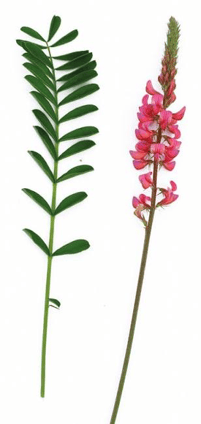
Sainfoin (Onobrychis viciaefolia) originated in Europe and Asia and is a deep-rooted legume with 20 to 50 pink flowers per head. Blossoms appear one to two weeks before those of alfalfa. Leaves are divided into 11 to 27 small opposite leaflets. It is a very robust legume that can grow 3 feet tall. Stems are semi-erect, hollow, coarse, and succulent.
Sainfoin adapts well to all soil textures and high pH sites (up to a pH of 8). It is heat, drought, and cold resistant. Not adapted to saline or acidic soils and does not thrive in wet areas, frequent irrigation or areas with high water tables. Often difficult to establish. Sainfoin-specific rhizobia have not been found, so established plants often need nitrogen fertilization. Life expectancy is approximately three years and it is compatible with bunchgrasses more than sod-forming grasses.
Use for hay: Sainfoin is well suited for hay cutting as it grows upright and is easily cut. Since regrowth is poor, cut at about half bloom to full bloom stage. Sainfoin cures well even though cut plants have slightly higher water content than alfalfa, first cutting is usually higher as well. Sainfoin protein content is slightly less than alfalfa. Seed in alternate rows with grass for best establishment and longevity.
Use for pasture: Sainfoin is well suited for pastures, it does not cause bloat and is grazed in preference to alfalfa. Grazing at the bud or early bloom stage and maintaining a stubble height above 8 inches (or 30% of the plant height as stubble) will extend stand life. Sainfoin grows ahead of alfalfa in the spring (in March) to provide early, high protein grazing.
Varieties:
1 – ‘Eski’: Adapted to areas receiving at least 13 inches of annual rainfall, and subirrigated sites. Selected for winter hardiness.
2-‘Remont’: Similar yields to Eski but begins growth earlier in the spring and has quicker regrowth. Higher yield potential on irrigated sites.
3 – ‘Shoshone’: High tolerance to northern root knot nematode compared to Remont.
5 – ‘Delaney’: Developed to be a multiple-cut sainfoin with significantly higher yields than ‘Remont’, and ‘Eski’.
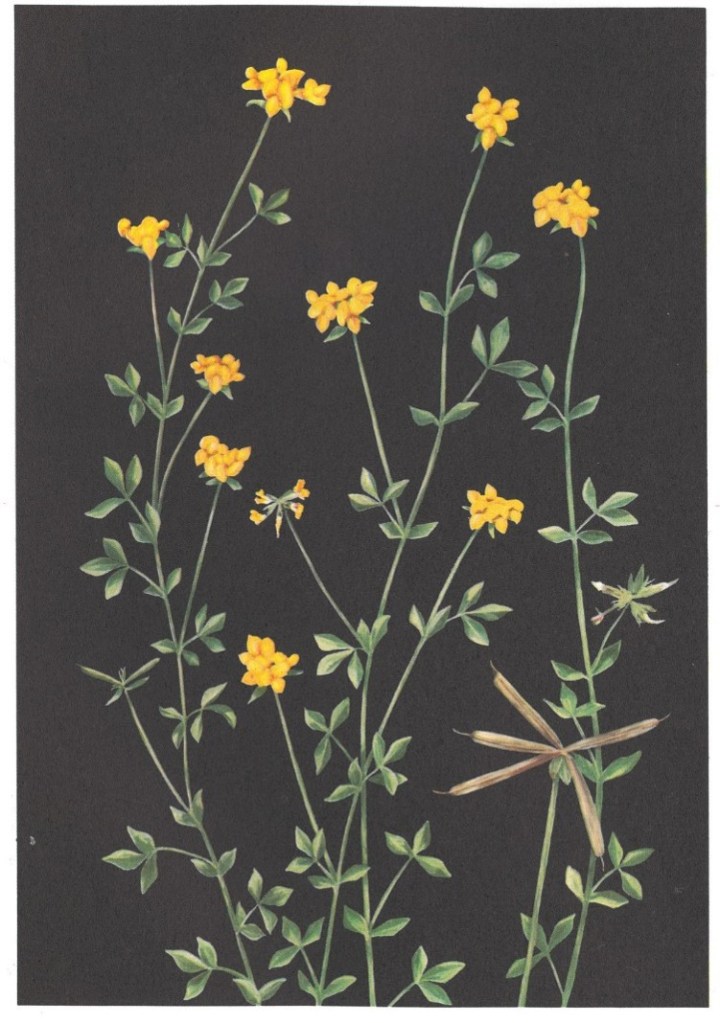
Birdsfoot trefoil (Lotus corniculatus) is native to Europe and parts of Asia. It is a long0lived perennial with a deep taproot and many lateral roots. It is a leafy legume with fine stems that are prostrated to erect and can grow 1 to 2 feet in length. Flowers are bright yellow with orange to red-tinged areas. It performs much better than alfalfa on poorly drained, clay soils. It is winter hardy and good performer on low fertility and alkaline soils with a pH lower than 8. Established stands naturally reseed themselves well, even if closely grazed.
New seedlings are slow to establish; it can take up to two years to become fully established. Trefoil should be used lightly during this time, as well as protected from weed growth. Seeds are very small and sensitive to seeding depth, which should not exceed ½ inch. Performs best on sites receiving at least 20 inches of annual precipitation.
Birdsfoot trefoil grows best as a monoculture because it is shade sensitive. It can perform reasonably well with non-aggressive grasses such as orchardgrass or meadow brome. Seed in alternate rows with grasses for best stand establishment and longevity.
Use for hay: Erect varieties are suited for hay harvesting and generally yield about 67% more forage than alfalfa. Semi-erect types are easily hayed when grown with grasses. Hay quality is similar to alfalfa when cut at the early-bloom stage. Because growth is initiated from auxiliary buds on stems, a taller stubble needs to be left at cutting.
Use for pasture: Birdsfoot trefoil is highly palatable and does not cause bloat in livestock. It withstands grazing better than most legumes, but because regrowth occurs from auxiliary buds on stems, pasture must be managed for taller stubble heights and adequate regrowth time. Trefoil maintains good production through the grazing season, providing extended forage availability. Allow four to six weeks of rest between grazing and let the plant grow 6 to 10 inches before grazing.
Varieties:
1 – Lower growing/ semi-erect types: Higher tolerance to close grazing compared to erect types. ‘Norcen’, ‘Leo’ and ‘Empire’ are commonly available varieties.
2 – Erect types: Better suited for hay. ‘Viking’ and ‘Empire’ are two commonly available varieties.
Appendices
Appendix A: Species suggestions for various sites
| Site and Species | Growth Habit* | Season of Growth | Origin** |
|---|---|---|---|
| Clay and loam Soils | |||
| Crested wheatgrass | B | Cool | I |
| Russian wildrye | B | Cool | I |
| Green needlegrass | B | Cool | N |
| Western wheatgrass | S | Cool | N |
| Intermediate/pubescent wheatgrass | S | Cool | I |
| Sideoats grama | B | Warm | N |
| Little bluestem | B | Warm | N |
| Big bluestem | S | Warm | N |
| Switchgrass | S | Warm | N |
| Blue grama | S | Warm | N |
| Yellow Indiangrass | S | Warm | N |
| Alfalfa | S | Warm | N |
| Sandy Soils | |||
| Thickspike wheatgras | S | Cool | N |
| Prairie sandreed | S | Warm | N |
| Switchgrass | S | Warm | N |
| Big bluestem | S | Warm | N |
| Sideoats grama | B | Warm | N |
| Yellow Indiangrass | S | Warm | N |
| Sand bluestem | S | Warm | N |
| Little bluestem | B | Warm | N |
| Alfalfa | – | – | I |
| Saline Soils | |||
| Tall wheatgrass | B | Cool | I |
| Intermediate/pubescent wheatgrass | S | Cool | I |
| Alkali sacaton | B | Warm | N |
| Russian wildrye | B | Cool | I |
| Western wheatgrass | S | Cool | N |
| Sideoats grama | B | Warm | N |
| Green needlegrass | B | Cool | N |
| Switchgrass | S | Warm | N |
| ‘NewHy’ Wheatgrass | S | Cool | I |
| Site and Species | Growth Habit * | Season of Growth | Origin ** |
|---|---|---|---|
| Gravelly Foothills | |||
| Big bluestem | S | Warm | N |
| Little bluestem | B | Warm | N |
| Crested wheatgrass | B | Cool | I |
| Sideoats grama | B | Warm | N |
| Thickspike wheatgrass | S | Cool | N |
| Western wheatgrass | S | Cool | N |
| Prairie sandreed | S | Warm | N |
| Alfalfa | – | – | – |
| Subirrigated | |||
| Smooth brome | S | Cool | I |
| Western wheatgrass | S | Cool | N |
| Int/Pub wheatgrass | S | Cool | I |
| Tall wheatgrass | B | Cool | I |
| Switchgrass | S | Warm | N |
| Big bluestem | S | Warm | N |
| Yellow Indiangrass | S | Warm | N |
| Alfalfa | |||
| Birdsfoot trefoil | |||
| Irrigated – Adequate water | |||
| Orchardgrass | B | Cool | I |
| Meadow brome | B | Cool | I |
| Kentucky bluegrass | S | Cool | I |
| Tall fescue | B | Cool | I |
| Alfalfa | |||
| Clovers | |||
| Cicer milkvetch | |||
| Irrigated- Short water | |||
| Smooth brome | S | Cool | I |
| Intermediate wheatgrass | S | Cool | I |
| Big bluestem | S | Warm | N |
| Int/pubescent wheatgrass | S | Cool | I |
| Yellow Indiangrass | S | Warm | N |
| Switchgrass | S | Warm | N |
| Alfalfa | |||
| Cicer milkvetch | |||
| Sainfoin | |||
| Low Maintenance Areas (short grass; not grazed) | |||
| Blue grama | S | Warm | N |
| Buffalograss | S | Warm | N |
| ‘Ephrain’ crested wheatgrass | S | Cool | I |
*S = sod former, B = bunchgrass, **N = native, I = introduced
Appendix B: Characteristics of grasses
| Plant Species | Growth Habit | Growth Season | Origin | Moisture Minimum | Soil Adaptation | Seedling Vigor | Yield potential | Longevity | Drought Tolerance | Grazing Tolerance | Recovery Rate | Salt tolerance |
|---|---|---|---|---|---|---|---|---|---|---|---|---|
| Kentucky bluegrass | Sod | Cool | Europe | Irrigated | si, c | fair | low | exc. | fair | good | good | fair |
| Big Bluestem | sod | warm | native | 14”-18” | s, c | fair | high | exc. | fair | fair | fair | Fair/poor |
| Little bluestem | bunch | warm | native | 14” | s, si, c | fair | high | exc. | fair | fair | Fair/good | Fair/poor |
| Sand bluestem | sod | warm | native | 14”- 30” | s | fair | high | exc. | fair | fair | good | poor |
| Meadow brome | bunch | cool | Eurasia | 16” | s, si, c | exc. | medium | good | fair | good | good | poor |
| Smooth brome | sod | cool | Europe | 16” | s, si, c | good | medium | fair/good | fair | fair | fair/poor | fair |
| Tall fescue | bunch | cool | Europe | irrigated | s, si, c | good | high | good | fair | good | good | good |
| Blue grama | bunch | warm | native | 10” | s, si, c | fair | low | exc. | exc. | good | good | fair |
| Sideoats grama | bunch | warm | native | 12” | si, c | fair | medium | good | good | fair | fair/good | fair/good |
| Yellow Indiangrass | Bunch, moderate sod | warm | native | 14” – 18” | s, si, c | fair | medium | good | fairi | fair/good | fair | fair |
| Green needlegrass | bunch | cool | native | 12”-18” | si, c | fair | medium | good | fair | fair | fair | fair |
| Orchardgrass | bunch | cool | Eurasia | irrigated | s, si, c | exc. | medium | fair | fair | fair | exc. | fair |
| Alkali sacaton | bunch | warm | native | 12” -18” | si, c | poor | medium | good | poor | fair/good | fair/good | exc. |
| Prairie sandreed | sod | warm | native | 10-16” | s | fair/poor | high | good | fair | fair | good | poor |
| switchgrass | sod | warm | native | 14”-16” | s, si, c | poor | good | exc. | fair | fair | good | fair |
| Crested wheatgrass | bunch | cool | Asia | 8”-12” | s, si, c | exc. | medium | good | exc. | good | exc. | fair |
| Int/pub wheatgrass | sod | cool | Eurasia | 12”-15” | s, si, c | good | high | fair | fair/good | fair/good | good | good |
| NewHy | sod | cool | Developed in the U.S. | 13” | si, c | Fair/good | medium | exc. | fair/good | good | good | exc. |
| Tall wheatgrass | bunch | cool | Eurasia | 12” – 14” | s, si, c | fair/poor | high | good | fair | fair/good | fair | exc. |
| Thickspike wheatgrass | sod | cool | native | 8”-20” | s, si | fair | medium | Good/fair | Exc. | good | good | Fair |
| Western wheatgrass | sod | cool | native | 10” – 14” | si, c | fair | medium | good | Exc. | good | good | fair |
| Wildrye Russian | bunch | cool | N. Asia | 8” | S, si, c | poor | medium | Exc. | Exc. | good | Exc. | good |
| Teff | – | warm | Africa | 3 ”/monht during growing season | S, si, c | good | good | – | Exc. | poor | Exc. | fair |
| s= sand, si = silt, c = clay, exc.= excellent | ||||||||||||
Appendix C: Characteristics of legumes
| Plant species | Moisture Requirements | Seedling Vigor | Yield Potential | Stand Longevity | Recovery Rate | Drought Tolerance | Poor Drainage Tolerance | Causes Bloat | Salt Tolerance |
|---|---|---|---|---|---|---|---|---|---|
| Alfalfa | a | good | high | good | a | a | a | yes | fair |
| Red clover | high | Exc. | high | Poor/fair | fair | poor | good | yes | Poor |
| White clover | high | Exc. | a | good | good | poor | fair | yes | Poor |
| Milkvetch cicer | low | poor | high | Exc. | fair | fair | fair | no | Fair |
| Sainfoin | Low/medium | good | medium | good | Fair/poor | fair | poor | no | poor |
| Trefoil birdsfoot | low | poor | medium | fair | Fair/poor | fair | good | no | Fair/poor |
| a = depends on variety, exc. = excellent | |||||||||
Photo gallery of grasses in this guide
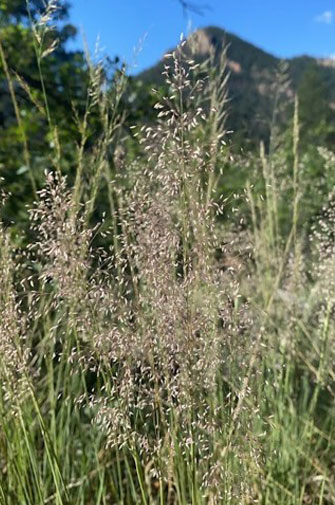
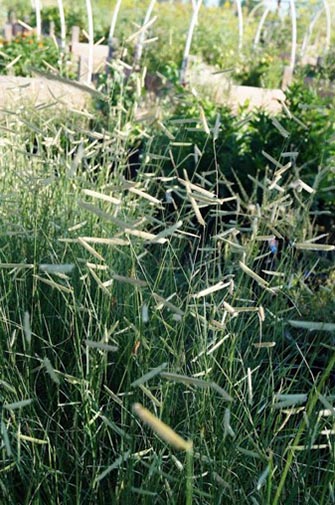
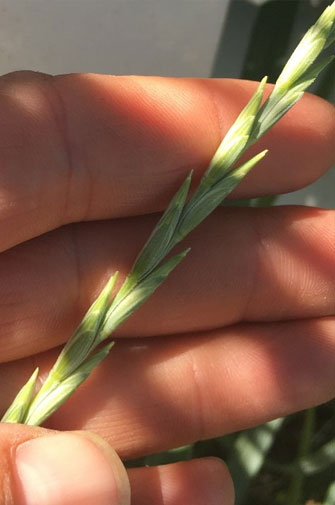
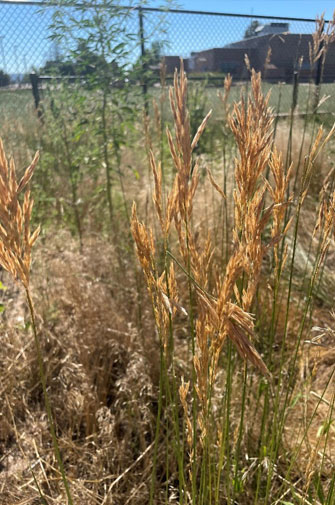
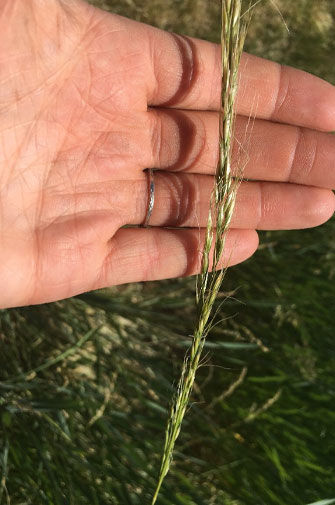
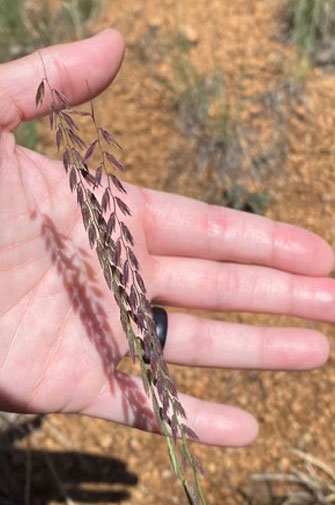
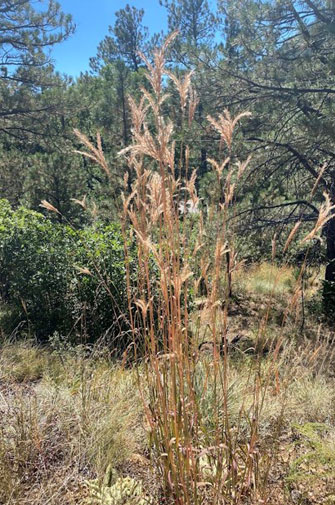
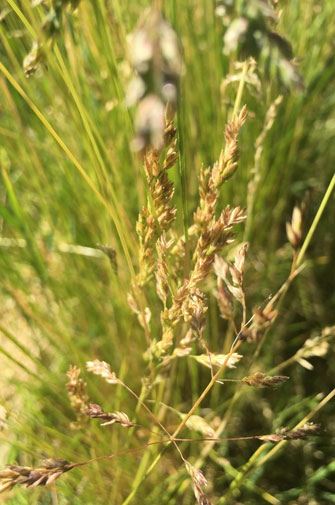
Photo Credits
- Retta Bruegger: Kentucky bluegrass, green needlegrass, pubescent wheatgrass
- Karla Melgar Velis: Smooth brome, leafy spurge
- Alissa Zurbuchen: Alkali sacaton, big bluestem, sideoats grama, blue grama
References
- Beiermann, J. A., & Tranel, J. E. (2026, April). 2025 land rental & custom rates for Colorado farms & ranches. Colorado State University Extension. https://abm.extension.colostate.edu/wp-content/uploads/sites/61/2026/04/2025-CustomRates-Final.pdf
- Broyles, P. J. (2004). Sand bluestem (Andropogon hallii Hack.) (Plant guide). U.S. Department of Agriculture, Natural Resources Conservation Service, Kansas Plant Materials Center. https://plants.sc.egov.usda.gov/DocumentLibrary/plantguide/pdf/pg_anha.pdf
- Bush, T., Ogle, D., St. John, L., Stannard, M., & Jensen, K. B. (2012). Plant guide for orchardgrass (Dactylis glomerata). U.S. Department of Agriculture, Natural Resources Conservation Service, Aberdeen Plant Materials Center. https://www.nrcs.usda.gov/plantmaterials/idpmcpg11489.pdf
- Creech, E., Laca, M., Barnhill, J., & Olsen, S. (2012). Teff hay production guidelines for Utah. Utah State University Extension. https://digitalcommons.usu.edu/cgi/viewcontent.cgi?article=2397&context=extension_curall
- Hall, M. (2025, February 10). Orchardgrass. Penn State Extension. https://extension.psu.edu/orchardgrass
- Hall, M., & Cherney, J. H. (2025, February 11). Birdsfoot trefoil. Penn State Extension. https://extension.psu.edu/birdsfoot-trefoil
- Horn, B. E. (2011). Nitrogen use efficiency of cool-season perennial forage grasses planted with and without alfalfa under irrigation for hay production (Final Report No. FW08-307). Sustainable Agriculture Research and Education (SARE). https://projects.sare.org/project-reports/fw08-307/
- Hybner, R. M., & Jacobs, J. (2012, September). Intermediate wheatgrass (Thinopyrum intermedium): An introduced conservation grass for use in Montana and Wyoming (Plant Materials Technical Note No. MT-80). U.S. Department of Agriculture, Natural Resources Conservation Service. https://www.nrcs.usda.gov/plantmaterials/mtpmctn11288.pdf
- Kallenbach, R., & Roberts, C. (2026, June). Red clover. University of Missouri Extension. https://extension.missouri.edu/publications/g4638
- Knudson, M. (2005). Green needlegrass (Nassella viridula) plant guide. U.S. Department of Agriculture, Natural Resources Conservation Service, Bismarck Plant Materials Center. https://www.nrcs.usda.gov/plantmaterials/ndpmcpg6033.pdf
- Kreager, D., Gelley, C., & Jagger, C. (2025, February 17). Teff for forage production (ANR-0165). Ohio State University Extension, Ohioline. https://ohioline.osu.edu/factsheet/anr-0165
- Lawrence, T. (1979). Swift, Russian wild ryegrass. Canadian Journal of Plant Science, 59(2), 515–518. https://doi.org/10.4141/CJPS79-082
- McIntosh, D., & Bates, G. (2018). Teff grass (SP 800). University of Tennessee Extension, UT Beef & Forage Center. https://utbeef.tennessee.edu/wp-content/uploads/sites/127/2020/11/Teff-Grass.pdf
- Miller, D. (2009). Teff grass: A new alternative. In Proceedings of the 2009 California Alfalfa & Forage Symposium and Western Seed Conference (December 2–4, 2009, Reno, NV). University of California Cooperative Extension, Department of Plant Sciences. https://alfalfasymposium.ucdavis.edu/+symposium/proceedings/2009/09-123.pdf
- Mitchell, R. B., & Anderson, B. E. (2008). Switchgrass, big bluestem, and indiangrass for grazing and hay (NebGuide G1908). University of Nebraska–Lincoln Extension. https://extensionpubs.unl.edu/publication/g1908/2008/pdf/view/g1908-2008.pdf
- Ogle, D. G. (1996, October). Plant guide: Management and use of intermediate and pubescent wheatgrass. U.S. Department of Agriculture, Natural Resources Conservation Service, Idaho State Office. https://www.nrcs.usda.gov/plantmaterials/idpmspgiwhgr.pdf
- Ogle, D. G., St. John, L., & Jensen, K. B. (2003). Crested wheatgrass (Agropyron cristatum and Agropyron desertorum) plant guide. U.S. Department of Agriculture, Natural Resources Conservation Service, Idaho State Office. https://www.nrcs.usda.gov/plantmaterials/idpmspg04842.pdf
- Ogle, D., St. John, L., Stannard, M., & Holzworth, L. (2005, November). Grass, grass-like, forb, legume, and woody species for the Intermountain West plant identification (Technical Note No. 5). U.S. Department of Agriculture, Natural Resources Conservation Service, Plant Materials Program. https://www.nrcs.usda.gov/plantmaterials/wapmctn6326.pdf
- Smoliak, S., Ditterline, R. L., Scheetz, J. D., Holzworth, L. K., Sims, J. R., Wiesner, L. E., Baldridge, D. E., & Tibke, G. L. (n.d.). Pubescent wheatgrass (Agropyron trichophorum). In Montana Interagency Plant Materials Handbook (EB69). Montana State University Extension. https://greatbasinseeds.com/wp-content/uploads/2013/09/msu.intermediate.pdf
- St. John, L., Tilley, D., & Jensen, K. (2012). Plant guide for meadow brome (Bromus biebersteinii). U.S. Department of Agriculture, Natural Resources Conservation Service, Aberdeen Plant Materials Center. https://www.nrcs.usda.gov/plantmaterials/idpmcpg11459.pdf
- Tilley, D., Ogle, D., & St. John, L. (2008). Cicer milkvetch (Astragalus cicer L.) (Plant guide). U.S. Department of Agriculture, Natural Resources Conservation Service. https://plants.sc.egov.usda.gov/DocumentLibrary/plantguide/pdf/pg_asci4.pdf
- Tilley, D., Ogle, D., & St. John, L. (2008). Sainfoin (Onobrychis viciifolia Scop.) (Plant guide). U.S. Department of Agriculture, Natural Resources Conservation Service, Aberdeen Plant Materials Center. https://agresearch.montana.edu/wtarc/producerinfo/agronomy-nutrient-management/Sainfoin/NRCSPLantGuide.pdf
- U.S. Department of Agriculture, Natural Resources Conservation Service. (n.d.). Colorado prescribed grazing: Grazing management guidelines workbook (Conservation Practice Standard 528). U.S. Department of Agriculture. https://efotg.sc.egov.usda.gov/#/state/CO/documents/section=4&folder=-186
- U.S. Department of Agriculture, Natural Resources Conservation Service. (2000). Ladino clover (Illinois Grazing Manual Fact Sheet). https://www.nrcs.usda.gov/sites/default/files/2022-12/LadinoClover.pdf
- U.S. Department of Agriculture, Natural Resources Conservation Service. (2000). Little bluestem (Illinois Grazing Manual Fact Sheet). U.S. Department of Agriculture. https://www.nrcs.usda.gov/sites/default/files/2022-09/LittleBluestem.pdf
- U.S. Department of Agriculture, Natural Resources Conservation Service. (2000). Red clover (Illinois Grazing Manual Fact Sheet). https://www.nrcs.usda.gov/sites/default/files/2022-09/RedClover.pdf
- U.S. Department of Agriculture, Natural Resources Conservation Service. (2018). Indiangrass (Sorghastrum nutans) plant guide. USDA Natural Resources Conservation Service. https://www.nrcs.usda.gov/plantmaterials/etpmcpg13196.pdf
- U.S. Department of Agriculture, Natural Resources Conservation Service. (2022, December). Plant materials technical note MT-26 (Rev. 2): Plants for saline to sodic soil conditions in Montana and Wyoming. https://www.nrcs.usda.gov/plantmaterials/mtpmctn13976.pdf
- U.S. Department of Agriculture, Natural Resources Conservation Service, Aberdeen Plant Materials Center. (2012, December). ‘Paiute’ orchardgrass (Dactylis glomerata) [Conservation plant release brochure]. USDA Natural Resources Conservation Service. https://www.nrcs.usda.gov/plantmaterials/idpmcrb11492.pdf
- U.S. Department of Agriculture, Natural Resources Conservation Service, Bridger Plant Materials Center. (2013, March). Release brochure for ‘Bozoisky-Select’ Russian wildrye (Psathyrostachys juncea (Fisch.) Nevski). https://www.nrcs.usda.gov/plantmaterials/mtpmcrb11686.pdf
- U.S. Department of Agriculture, Natural Resources Conservation Service, Bridger Plant Materials Center. (2013). ‘Goshen’ prairie sandreed (Calamovilfa longifolia) [Conservation plant release brochure]. https://www.nrcs.usda.gov/plantmaterials/mtpmcrb11692.pdf
- U.S. Department of Agriculture, Natural Resources Conservation Service, Idaho State Office. (2002). Thickspike wheatgrass (Elymus lanceolatus spp. lanceolatus) and streambank wheatgrass (Elymus lanceolatus spp. lanceolatus). https://www.nrcs.usda.gov/plantmaterials/idpmspg04849.pdf
- U.S. Department of Agriculture, Natural Resources Conservation Service, Los Lunas Plant Materials Center. (2021). ‘Luna’ pubescent wheatgrass (Thinopyrum intermedium) [Conservation plant release brochure]. https://www.nrcs.usda.gov/plantmaterials/nmpmcrb10769.pdf
- U.S. Department of Agriculture, Natural Resources Conservation Service, Los Lunas Plant Materials Center, & New Mexico Agricultural Experiment Station. (n.d.). Notice of release of “Elida” sand bluestem (Andropogon hallii). U.S. Department of Agriculture. https://www.nrcs.usda.gov/plantmaterials/nmpmcrn14534.pdf
- U.S. Department of Agriculture, Natural Resources Conservation Service, Manhattan Plant Materials Center. (2015, December). ‘Garden’ sand bluestem (Andropogon hallii Hack.) [Conservation plant release brochure]. U.S. Department of Agriculture. https://www.nrcs.usda.gov/plantmaterials/kspmcrb12759.pdf
- U.S. Department of Agriculture, Natural Resources Conservation Service, Pullman Plant Materials Center. (2022). ‘Latar’ orchardgrass (Dactylis glomerata) [Conservation plant release brochure]. https://www.nrcs.usda.gov/plantmaterials/wapmcrb13959.pdf
- U.S. Department of Agriculture, Natural Resources Conservation Service, Pullman Plant Materials Center. (2022). Conservation plant release brochure for Alkar tall wheatgrass (Thinopyrum ponticum). https://www.nrcs.usda.gov/plantmaterials/wapmcrb13955.pdf
- Undersander, D., Cosgrove, D., Cullen, E., Sheaffer, C., Shewmaker, G., Sulc, M., Grau, C., Rice, M. E., & Renz, M. (2011). Alfalfa management guide. American Society of Agronomy, Crop Science Society of America, and Soil Science Society of America. https://www.agronomy.org/files/publications/alfalfa-management-guide.pdf
- Vandevender, J. (n.d.). Planting guide for switchgrass (Panicum virgatum L.). U.S. Department of Agriculture, Natural Resources Conservation Service, Alderson Plant Materials Center. https://www.nrcs.usda.gov/plantmaterials/wvpmcpg7033.pdf
- Vogel, K. P., Newell, L. C., Jacobson, E. T., Watkins, J. E., Reece, P. E., & Bauer, D. E. (1996). Registration of ‘Pronghorn’ prairie sandreed grass. Publications from USDA-ARS / UNL Faculty, 1894. https://digitalcommons.unl.edu/usdaarsfacpub/1894
- Zessin, P., Vasco, C., Elmore, J., Mullenix, K., & Dillard, L. (2022, October 14). Overseeding perennial pastures & hayfields with cool-season annuals. Alabama Cooperative Extension System. https://www.aces.edu/blog/topics/farming/overseeding-perennial-pastures-hayfields-with-cool-season-annuals/
Author info
Authors: Jennifer L. Cook, Joe E. Brummer, Paul J. Meiman, and Thaddeous Gourd
Updated by: Karla Melgar Velis (2026 edition)
Adapted from the Front Range Guide for the Northern Colorado Front Range, by Ron Jepson, Colorado State University Cooperative Extension, 1997.
Special thanks to USDA NRCS and CSU Extension.