


Quick facts…
- The peachtree borer is the most destructive insect pest of peach, cherry, plum, and other stone fruits in Colorado.
- Damage is done by the immature larvae, which chew beneath the bark of the lower trunk and larger roots.
- Insecticide sprays applied to the lower trunk when eggs are being laid can prevent new infestations.
Introduction
Peachtree borer or peach crown borer (Synanthedon exitiosa) is the most destructive insect pest of peach, cherry, plum, flowering plum, and other stone fruits (Prunus spp.) in Colorado. The grublike larvae chew on larger roots, and underneath the bark at the base (crown) of the tree and (Figure 1). The gouging wounds they produce can be quite extensive and may seriously weaken and even kill trees, However, injury may not be obvious without thorough inspection around the base of the tree.
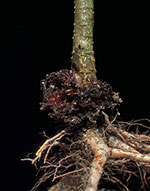
Photograph courtesy of Eugene Nelson, Colorado State University.
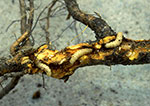
A wet spot on the bark or the presence of oozing, gummy sap offers external evidence of peach tree borer tunneling (Figure 2). The sap near wounds is clear or translucent and often dark from the sawdust-like excrement of the insect. Most injuries occur along the lower trunk beneath the soil line. Lower branches rarely receive injuries. (Note: Oozing wounds on peach that produce an amber-colored gum may be caused by cytospora canker, a common fungal disease of stone fruits that produces symptoms that may be mistaken for those produced by peachtree borer. The presence of small particles of wood and bark within the gum may help distinguish the damage caused by peachtree borer.)
Life History and Habits
The life cycle of the peachtree borer requires one year to complete. Only the immature larval stage results in damage to trees (Figure 3). Upon hatching from the eggs, young larvae immediately tunnel into the sapwood of the tree, usually through cracks and wounds in the bark. Larvae continue to feed and develop until the onset of cold weather. The larvae spend the winter below ground under the partially developed bark.
With the return of warmer soil temperatures, resume feeding. Most visible injuries are produced in mid-to late spring as the larvae mature. The larvae finish feeding and change to the pupal stage in late May through early July. Pupation occurs in a cell made of silk, gum, and chewed wood fragments, located just below the soil surface (Figure 5).
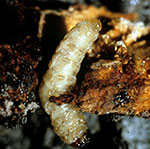
of Ken Gray Collection, Oregon State University
The adults emerge within a month and in the process often will pull out the pupal skins, which may then be seen around the base of the trunk. Adults of the peachtree borer are a type of “clearwing borer” moth that resembles wasps. However, as they are moths, they are harmless and incapable of stinging. Unlike most moths, peachtree borers (and other clearwing borers) fly during the daytime.
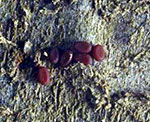
The first adults, males, may emerge as early as mid-June. Females typically emerge a couple of weeks later than the males. Most adult activity – mating and egg laying – occur during July and August. During this time, the female moths lay eggs on the bark of the lower trunk and in soil cracks near the tree base (Figure 4). Eggs generally hatch in about 10 days.

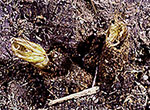
tree after adult emergence. Photograph courtesy of
David Shetlar, Ohio State University
Preventive Sprays
Peachtree borer is most easily controlled by sprays of insecticides applied to the lower trunk and base of the tree. These are preventive sprays that target the eggs and early larval stages exposed on the bark of the tree. Once larvae have migrated into the tree, insecticides are not effective.
Depending on seasonal temperatures one can expect peachtree borer to begin laying eggs in very late June or early July. Most eggs will be laid during July and August, although a few adults may still be present until September.
Using lures and traps is the best way to determine when adult peachtree borers are active. Males are attracted to sticky traps, by chemical lures that mimic sex pheromones female peachtree borers use to attract mates. This trapping method helps to determine when adults are present, which is associated with egg laying
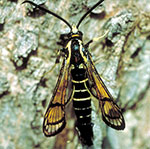
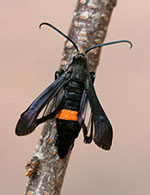
courtesy of David Leatherman.
In the absence of trapping, as a general guideline, preventive trunk sprays should be applied around the first week of July. If large numbers of peachtree borers continue to be active later in summer, a second application in early August may be useful.
To be effective as a preventive spray, the insecticide must have some residual activity, allowing it to kill young peachtree borer larvae emerging from eggs for several weeks after application. Presently certain formulations containing the active ingredients permethrin or carbaryl are the only insecticides that can legally be applied to backyard fruit trees, have reasonably good residual activity on bark after application, and are labeled for control of peachtree borer.
Reference: CSU Fact Sheet 5.566