


Emerald Ash Borer (EAB) was first identified in Michigan in 2002; since then it has spread to 22 states, including Colorado. It was introduced from East Asia likely through infested shipping or packing material. The most likely route of introduction to Colorado was probably in firewood or nursery stock. EAB impacts all species of ash (Fraxinus spp.), white, purple, green and their cultivars. Colorado has many ash in the urban forest (we estimate about 15% of trees are ash). Boulder has approximately 98,000 public and private ash trees. The Denver Metro area has an estimated 1.45 million ash trees. Some neighborhoods and developments may be up to 80% ash.
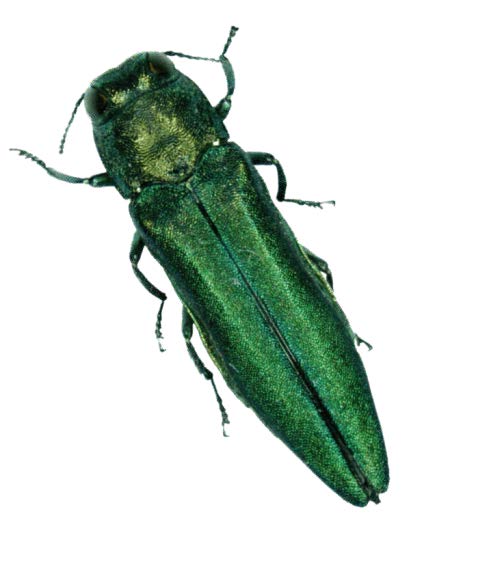
Figure 1. Emerald ash borer
Conservation and Natural Resources –
Forestry Archive
What does EAB do?
- Kills ash trees.
- Larvae feed under the bark, eventually girdling the tree and cutting off nutrients.
- Trees are killed within 2-4 years of first symptoms, even previously health trees.
- Trees of all size can be attacked, from 1/2 inch saplings to largest mature trees.
- This insect is very difficult to detect because it is under the bark and the adults are only around from May to September.
Movement
Infestations result from movement of infested ash trees and wood. It does not fly far on its own. Some of the items it moves on or in:
- Firewood
- Packing material/industrial wood material
- Live plant material (nursery stock, etc.)
- Ash wood such as logs, branches, chips, etc.
Potential Impacts of Emerald Ash Borer to Colorado Communities
- Green and White Ash widely planted in Colorado over the past 50 years
- Ash comprises 15%-80% of community trees depending on location
- Ash is still planted extensively due to its tolerance of urban growing conditions, fast growth, and nice fall color
- Green ash is also naturalized along creeks and ditches throughout Eastern Colorado and parts of the Front Range. It has been found along Boulder Creek.
Total ash tree population for Metro Denver is estimated to be 1.45 Million trees.
Boulder has an approximately 98,000 ash trees.
In the greater Denver Metropolitan area, direct economic impact could be:
- Removal of public and private trees: approximately $435 Million total
- To replace those trees: approximately $580 Million total
- Treatment costs are unknown but could be around $36 million per year for at least the next 10 years (Calculation: Treat 10% of trees, most high valued, average 25 inch diameter at breast height, $10 per inch (145,000 trees X 25 inches X $10 = $36.25 million))
Benefits provided by Colorado’s Urban Forests
- Increased property values (4-7%) may lead to increased tax revenue
- Urban tree cover increases property value in Denver Metro Area an estimated $435 million
- Reduced heating and cooling expenses (estimated at $27 million in savings for the Denver Metro area)
- Trees attract businesses and people to an area
- Reduced storm water costs
- Carbon sequestration
Issues
- We do not know the extent of the infestation and it is difficult to detect
- EAB populations may expand exponentially
- Ash trees will most likely die if not treated with pesticides and will need to have regular pesticide treatments for the remaining life of the tree
- When left untreated, entire ash populations in Midwest communities were beyond treatment in 10 years
- Standing dead ash trees present a potential liability to communities
- Dead ash tree material must be disposed of appropriately (chipping to 1 inch or smaller, composting, milling into lumber, or taken to landfill.
Colorado State Forest Service’s Role
The Colorado State Forest Service (CSFS) is the main agency focused on detecting, controlling, and preventing the human spread of the emerald ash borer beetle. CSFS works with affected communities, city, county, state agencies, to track and mitigate the spread of EAB. Both the CSFS and CSU Extension offer site visits to evaluate trees for EAB, among other tree issues.