


In this section, we’ll provide resources for living with wildlife. Wildlife lived on and utilized the resources on your property prior to you. There are things you can do to co-exist with them.
Wildlife
Colorado is known for its abundance and variety of wildlife that traditionally lived throughout the state on the plains, mesas and mountains but is now venturing into the more populated urban areas that were built on their former habitat. Humans increasingly live and recreate in wildlife habitat resulting in more animal encounters and displaced wildlife. Expect to see and have more contact with wildlife in a rural area. Keep your property clean to limit problems with mice, rats, skunks, raccoons and other wildlife. Livestock, pets and wildlife do not always mix. Small dogs and cats can be easy prey for coyotes, foxes, raptors and other wildlife. Do not leave pet food out as it is an easy wildlife food supply. Clean up gardens and fruit trees to prevent attracting wildlife. Bears are easily attracted by downed apples. Compost piles, bird feeders and bee hives can also attract wildlife. If you are in an area with bear activity, consider installing unwelcome mats or electric fencing around your bee hives. Poorly designed and constructed poultry coops and runs and free ranging poultry are easy prey for raptors and carnivores. Providing a secure wildlife proof-covered run is the best way to ensure that your poultry doesn’t become someone else’s dinner.
Observing wildlife is fascinating and yet some people get dismayed because it might appear that an animal has been abandoned. Despite what could look like an abandoned or injured animal, it’s vitally important not to interfere. Do not harass, try to capture, or feed wildlife. Animals that grow up in the wild do not make good pets. Learning to respect the wildness of wildlife is essential.
Another important concept of living with wildlife (especially birds and big game) is to keep cats and dogs contained or leashed to prevent them from chasing wildlife. There is a law protecting wildlife such that if an adult observes a dog chasing wildlife, he or she can shoot the dog. Dogs, even the sweetest and gentlest, can find great fun chasing wildlife. This causes additional stress to wildlife and can result in the animal being caught in fencing, in highway encounters, or using up critical energy reserves.
Feeding wildlife causes major problems and in most cases, is illegal. Feeding birds is allowed but is best done only during winter when other food supplies are low. It can be harmful to big game, such as deer, elk, and bear. That’s because the animals can become dependent on unnatural foods sources found in trash, landscaping, crops, or feeds. Feeding wildlife causes animals to congregate and potentially transmit disease throughout the population, create traffic hazards when wandering close to roads, draw them away from their historic winter range, or alter migration patterns. The key to avoiding wildlife conflict issues is due diligence in securing homes and outbuildings. Cover window wells with grates or hardware cloth; close holes around, through and under foundations, sheds, and outbuildings; use locking tops for garbage cans or bear proof cans as well as pet or animal food containers; and fence gardens.
Bird feeders should not be accessible to wildlife other than birds and the area under the feeder cleaned up daily and should only be used when natural food supplies are low i.e. winter. Many birds (except starlings, sparrow, and pigeons) are federally protected. Shooting or the use of poisons to kill birds and animals maybe illegal and strictly regulated by the federal and state governments. Contact your local Colorado Parks and Wildlife office for information and advice on how to handle wildlife problems before you take any action. You can also contact the Boulder County Extension Office and ask to speak to a Wildlife Master volunteer who can help you with your wildlife conflict issue.
Rats and Mice
Keeping your home and property clean and food sources stored in rodent proof containers is a good first step. Check around the foundation for openings larger than ¼ inch and fill in those holes. Mice can enter openings of ¼ inch while rats can get into holes that are ½ inch diameter. Look under sinks and other locations where pipes come through the foundation or from a lower floor or crawl space. You can stuff steel wool into the gaps to prevent rodents from entering the home. You can use spray in foam to hold the steel wool in place but do not use only the foam. Rodents like to chew the foam and will eat through it.
Raccoons, Skunks, and Squirrels
Removing tree branches that overhang buildings, capping chimneys, and repairing siding and roof holes or decayed wood can help prevent entry by wildlife. To prevent wildlife from invading desirable locations such as under your deck, shed or your chicken coop, bury wire mesh (hardware cloth) twelve inches underground or down 1 foot and out 1 foot in an “L” shape. Raccoons are especially adept at pilfering garbage and pet food. Tight fitting metal lids that clamp or tie down can help if they are tipped over. Take away any food sources that might draw these critters to your home!
Wiring on newer automobiles is often coated with a soy-based plastic. Squirrels enter your vehicle motor cavity and chew on the coating causing a short. If this is more than a one-time problem, consider using a repellant to deter the squirrels or parking your vehicle in a garage.
Moose, Deer, and Elk
These ungulates tend to move to lower elevations during winter months often placing them in areas that are more heavily populated. In areas where deer are common, shrubbery and gardens may be damaged. There is no 100% deer proof plant. Elk and moose tend to avoid human interaction more than deer. They seek haystacks, alfalfa, corn and vegetable fields and landscape vegetation if native vegetation is not available or the other options are readily available. While they may not prefer certain plants under most conditions, never assume that they will never eat them. At certain times of the year, they can be dangerous if interacting with humans because they are extremely protective of their calves. Dogs are a problem around moose. Moose sees your dog as a wolf which is their main predator.
Bears
Bears enter residences and vehicles in search of food causing potential damage to both them and to homes and vehicles. Since a bear’s sense of smell is 100 times more powerful than ours, it is easy to understand how pet food containers, garbage cans, and the smells from last night’s food on the BBQ grill, your kitchen table or leftover fries in your car can attract bears. Take appropriate precautions to bear-proof your property including hanging bird feeders only during seasons when bears are hibernating, and birds can use the food, using locking or bear proof garbage canisters, and remove items with sweet odor including candles, etc.
Coyotes and Foxes
Coyotes and foxes can become a problem when they attack pets and chickens. As with other wildlife, the best management method is to not attract them by feeding pets outside and leaving other food sources for them. When allowing small pets outside after dark, go out with them to discourage the wildlife. Chicken coops and runs should be sturdy to prevent wildlife from being able to enter the coop or the run.
References:
Living with Wildlife, Colorado Parks and Wildlife
https://cpw.state.co.us/living-wildlife
Research-based Wildlife Damage Management Information, Internet Center for Wildlife Damage Management
http://icwdm.org/
Pets and Other Animals, CDC Healthy Pets, Healthy People
https://www.cdc.gov/healthypets/pets/wildlife.html
Predator Management
Numerous predators make raising livestock difficult. Predation management for cattle, sheep, or goats may be necessary if the animals are put into pastures where they are vulnerable to predation exists. For cattle, this is usually confined to the calving period. Except for a few losses to mountain lions and bears, most predation management is directed at coyotes.
Coyote Management
Coyotes are opportunistic feeders. They prey on small mammals, domestic pets, livestock, and domestic fowl but being omnivores (they eat both meat and vegetation), they readily eat carrion and plants. A coyote adjusts its diet depending on the food that is available.
In Colorado, coyotes are classified as a game species and may be taken year-round with either a small game or a furbearer license. Landowners may kill coyotes, without a license, on their land if the coyotes threaten their safety or livestock. Most unfavorable encounters with coyotes are due to the animal becoming habituated to humans as a food source (i.e. feeding either intentionally or unintentionally).
Several variables (availability of alternative prey, coyote pup-rearing, and an even age structure of the coyote population) may affect predation rates on calves, lambs and kids. For open range calving where coyotes can be a problem, predation rates can approach 5%, with a 3% rate being considered average. With predation management in place, calf losses to coyotes should be <1%. However, with predation management in place, losses can still be expected to approach 5% for lambs, 2% for adult sheep, and 12% for goats. The predation problem becomes more pronounced as pasture size decreases, with some evidence that coyotes use the fences to aid in their hunting strategies.
Strategies to protect livestock from predators include specific confined birthing areas, and coyote removal immediately prior to calving. Effective predation management for calf protection may also involve calving in pastures close to people, where increased human activity reduces coyote presence. Removing coyotes in or near calving pastures immediately prior to calving increases the predation management effectiveness. Recent research, as well as decades of practical field experience, suggests that removal of dominant coyote pairs at the beginning of breeding season may substantially reduce predation on livestock for up to a year. Another option is to use netted fencing to exclude them from the livestock.
While it is expensive and difficult to construct a completely coyote-proof fence, a fence that discourages coyotes has the following design characteristics. Fence height should be a minimum of 5-1/2 feet and be higher on sloping terrain. Net wire-mesh should be no larger than 6 inches between stays. Electric fences of various designs have been effective in excluding coyotes. Retrofitting existing fences by adding electrified wires may provide an added degree of effectiveness. Electric fencing can be less expensive to construct than conventional woven-wire fence, but it requires substantially more maintenance to keep it in working condition. Adding an extra larger size pipe on the top rail can keep coyotes from being able to push off the top rail when jumping over a fence (Coyote Roller).
Using sound or visual stimuli to keep coyotes away from livestock provides only temporary control. Such efforts are likely to work best in localities where coyotes are wary because of continuing predator management efforts and where the stimuli can be frequently varied in type and location.
Certain guard dog breeds, as well as llamas and donkeys, can exclude coyotes from pastures. Livestock operators who have had the best success with guard animals typically place them in small, flat, fenced pastures where the guard animal can see and challenge any intruding coyotes. Guard animals are most effective when they are behaviorally bonded (introduced to the flock when both are young) to the sheep or goats they are protecting.
Mountain Lion Management
The mountain lion is called by more names than any other Colorado mammal – cougar, puma, panther, catamount or just plain lion – and all connote respect for this magnificent hunter. They are Colorado’s largest cat, weighing 130 pounds or more. Mountain lions are most abundant in foothills, canyons or mesa country in brushy areas and woodlands rather than in forests or open prairies.
Mountain lions are active year-round, with deer as their main food and adults eating a deer a week. They prefer to kill their own prey and hunt by stealth, ambushing or pouncing on prey from a tree or rocks overhanging a game trail. The deer is often killed cleanly with a broken neck. They drag the carcass to a sheltered spot beneath a tree or overhang to feed on it. The cat gorges on the carcass until it can eat no more, then covers the remainder with leaves or conifer needles, fasts for a few days, digesting and resting. Generally, they move the carcass and re-cover it after each feeding. They are most active from dusk to dawn, although they travel and hunt in daylight. Lions prefer to eat deer; however, they also kill elk, porcupines, small mammals, livestock, and a variety of domestic animals such as pets.
As with coyotes, mountain lions cause the most damage to cattle during the calving season since healthy adult cattle are too large for most lions. Sheep and goats are more vulnerable at all life stages due to their size. Mountain lions typically avoid human interactions, so birthing close to human proximity or in enclosed areas are deterrents.
Black Bear Management
Black bear is a species, not a color. In Colorado many black bears are blonde, cinnamon or brown. Over 90% of a bear’s natural diet is grasses, berries, fruits, nuts and plants. The rest is primarily insects and scavenged carcasses. The black bear is generally not a threat to livestock but are certainly a concern when they locate food sources in, or around, our homes. Black bears often break into chicken enclosures and kill and eat large portions of or entire flocks. Thus, building an extremely strong coop, and locking poultry inside at night is advised.
Black bears are naturally shy, and very wary of people and other unfamiliar things. Their normal response to any perceived danger is to run away. Most bears are active from mid-March through early November. In preparation for hibernation, black bears forage for 20 hours a day consuming over 20,000 calories (approximately 37 Big MacsTM) a day. When the weather becomes colder, daylight is less, and food sources dwindle they head for winter dens.
With a nose that’s 100 times more sensitive than ours, a bear can literally smell food five miles away. Bears are very smart, and have great memories-once they find food, they come back for more.
Predator Management Actions
- Prompt removal of all carcasses.
- Dead animals attract coyotes and other scavenging predators (i.e. bears). One Canadian study found that on farms that promptly removed dead livestock, predator losses were lower than on farms where dead livestock was not removed promptly.
- Use larger size livestock in pastures with histories of predator problems. Pastures with a predator history problem should be avoided, especially during calving, lambing and kidding. Pastures with rough terrain or dense vegetation provide good cover for predators. Placing larger guard animals such as llamas or donkeys in these pastures usually reduces predation incidence. As mentioned earlier, certain guard dog species may be effective in protecting livestock.
- Noise, light, and other deterrents.
Predators display uncanny abilities to outwit a producer’s attempts to protect livestock. Producers should use more than one practice concurrently and need to vary the practices occasionally (Integrated Pest Management). Most predators are wary of any changes in their territory and shy away from anything different until they become familiar with it. The following are several devices that help discourage predators.
- Developed by the USDA/APHIS/Wildlife Service, the Electronic Guard is a light-sensing device that is activated at dusk and de-activated at dawn. It combines a strobe light and a siren going off in random order. The random intervals help prevent predators from becoming accustomed to it.
- Lighting corrals at night may serve to frighten some predators away but may attract roaming dogs to the stock. Lights allow the producer to see any predators that are in the pen. Lighting doesn’t usually affect the livestock, and they adapt quickly. In a 1977 Kansas study involving 100 Kansas sheep producers, lighting corrals at night had the most obvious effect on losses from predators. Of the 79 sheep killed by coyotes in corrals, only three were lost in corrals with lights.
- Eugene L. Fytche, author of “May Safely Graze”, cites a producer who used visual distractions around the edges of his pasture. These included large pieces of Styrofoam, wheel discs, aluminum pie plates, windchimes, plastic oil containers filled with a variety of liquids, balloons, old clothes, and whatever came to hand. Fytche commented that the producer didn’t have any losses in three years despite living in a high-risk area.
Chickens/Poultry and Predators
Poultry is an easy caught and favored food for many predators from domestic dogs to snakes, rats, owls and hawks. You should expect to lose a bird to predation occasionally, but these tips can reduce your losses.
- Husbandry is a first step to take to reduce predation, and includes:
o Keeping the grounds around your poultry coops clean
o Removing piles of yard debris, trash, and construction waste, which provides cover and housing for rats
o Eliminating food sources that attract nighttime visitors
o Clean under bird feeders
o Keep poultry housing and runs out in the open, if possible, away from the edges of woodlands and riparian areas. Forbs in the coop provide entertainment for your birds but forbs around the coop and run provide predator cover. - Train your birds to return to the coop every evening – and be sure to secure the door. If you raise your birds in that coop, they naturally return to lay eggs and roost at night if you let them range for the day. Make sure the house is varmint-proof and you do not have any opening larger than ¼ inch diameter. Raise the coop off the ground by a foot or so to discourage rats, skunks and snakes from taking up residence beneath it and stealing eggs, chicks or young hens. To keep them from getting underneath, enclose the area with hardware cloth that is buried 12 inches underground or extends out from the coop in an “L” shape (12 inches down into the ground and 12 inches out). Bury galvanized hardware cloth or other welded-wire fencing around the perimeter of the run if you have problems with predators digging beneath your surface fencing. Be certain to keep the house floor tight and patch any holes that snakes and rats can get through. Mice can get in a ¼ inch diameter hole and rats in a ½ inch diameter hole.
- Enclose the coop in a secure poultry run to discourage dogs, coyotes, bobcats and other four-legged carnivores from gaining access to your flock. You can choose poultry wire, welded-wire mesh (hardware cloth), electric netting or other fencing materials with sufficiently small openings and heavy enough wire to prevent them from accessing your birds (or sufficiently high-voltage electrical pulses) to keep your birds in and predators out. Bobcats and coyotes are fantastic jumpers and can easily clear 4-foot-high fences, so build your enclosure appropriately tall, or add a cover net to keep the varmints from vaulting the fence. The wire should extend below ground to keep predators from digging under it to access the run. • Cover the run with welded-wire fencing, poultry wire or game-bird netting, or install a random array of crisscrossing wires overhead to discourage hawks and owls. If you shut your poultry in the coop at night, owl attacks will not be an issue. But hungry owls are cagey and may grab their meal right at dusk, or slightly beforehand, so if owls are a problem in your area, don’t wait until after dark to close the coop.
- Choose small-mesh fencing materials for enclosing coops and runs when raccoons and members of the mink or fisher family are among the predators. Raccoons and other dexterous animals are infamous for reaching through larger meshed fencing or poultry wire and killing the birds they can snag. This is especially important when you keep your poultry in a fully enclosed wire coop/run, such as various chicken tractor (moveable coops without a floor) designs. Although 2-by-3-inch welded-wire fencing is less expensive, you will lose fewer birds if you use 1-by-2-inch mesh or smaller welded wire.
- Provide a night light (motion-sensor-activated) that floods the run with light after dark or install a set of Nite Guard Solar predator-deterrent lights. This keeps most nocturnal predators away from the coop.
- Give your poultry-friendly dogs the run of the yard – particularly at night. Be sure your dogs aren’t tempted to chase running, squawking poultry if you choose not to close the coop at night or choose to leave the dogs in the yard during the day.
- Prepare yourself to take swift action when you discover predation. You can take measures to eliminate the predator or to eliminate its access to your birds. Failure to do so will result in subsequent losses, if the predators think the buffet line is open.
- Create a predator danger zone around the coop and yard. Most terrestrial predators are uncomfortable crossing an area with minimal cover. You can plant bushes inside the run – your birds love the shade and nibbling on the leaves – but leave the perimeter as cover-free as you can. Raccoons are less likely to try to work their “hands” into a welded-wire enclosure when they must sit in the open to do it.
Dogs as Predators
Free-roaming dogs can be a serious threat to livestock. When dogs chase livestock, they put undue stress on the animal as well as create the risk of physical injury. Additionally, dogs can kill livestock, especially lambs, kid goats, and poultry.
Ranchers legally have the right to protect their livestock and can destroy animals threatening their livestock. To prevent an incident from occurring, be sure your pet stays on your property and is always under control. Even the nicest, most well-behaved dog can chase livestock, especially when running with other dogs.
References:
Identification of Livestock and Animal Predation, Internet Center for Wildlife Damage Management
https://icwdm.org/identification/inspection/outdoors/livestock/
Protecting Livestock from Predators, USDA APHIS https://www.aphis.usda.gov/aphis/ourfocus/wildlifedamage/operational-activities/SA_Livestock/CT_Protecting_Livestock_Predators
Helping Producers Manage Predators, USDA APHIS Wildlife Services https://www.govinfo.gov/content/pkg/GOVPUB-A-PURL-gpo28153/pdf/GOVPUB-A-PURL-gpo28153.pdf
Moose, Elk, and Deer Management
Moose, deer and elk commonly impact agricultural resources by competing with domestic livestock for pasture and damaging cereal grain, corn and hay crops, ornamental plants, orchards, and livestock fences. Elk also damage forest resources by feeding on seedlings and saplings of coniferous and deciduous trees.
Because elk is a highly desired game animal, management efforts in the last few decades have concentrated on increasing the local herd size. As elk numbers have gradually increased, the damage incidence and intensity to agriculture and forestry has increased. In some cases where forage supplies are good year-round, elk are foregoing their normal migration to higher elevations and staying in one area causing even more crop and landscape/vegetation damage.
Elk tend to roam over greater habitat expanses than deer, so elk damage is more widespread and sporadic than damage by deer. Because elk move in large herds instead of singly or small groups, the impact of their foraging to crops and pastures can be more severe.
Damage by elk is often seasonal. Foraging on hay crops generally occurs in spring when the first succulent vegetation emerges, and native forages are in short supply. If native forages are chronically limited, damage to crops may persist through harvest. Young conifers are often damaged after they are planted on clear cut or fire scarred sites. Elk are drawn to conifers when other food supplies are limited and/or of low nutritive value. Elk are also attracted to new growth on conifers that is especially palatable and highly digestible. Haystack damage occurs during winter when there is little food available on winter ranges. Elk damage to pastures usually occurs during winter and during migration periods when elk move between summer and winter ranges. Crop damage (corn and alfalfa) occurs during the growing season and can be severe. The damage caused by the herd trampling or bedding down add to the destruction.
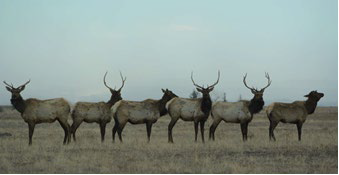
Elk usually damage areas that border standing timber or other “safe” areas such as open space properties because they have learned not to venture far out into large “unsafe” areas. They prefer riparian zones and benches as opposed to steep slopes, and damage is usually distributed accordingly.
Moose damage is a new Colorado phenomenon since moose introduction in the 1970’s. As the population has increased, they have moved into areas where they now conflict with humans. Moose are browsers, so they prefer trees and shrubs including willows, pines, firs and aspens. Small backyard ponds are not a problem, but an irrigation pond surrounded by willows would be perfect habitat.
Wolves are their main predator, so they see your dog as a wolf. They are naturally unpredictable, so it is best to not approach them any closer than 25 yards (75 feet). If you have a moose that is frequenting your property, contact Colorado Parks and Wildlife for information on how to deter them from your property. If you live in the mountains, they may become frequent visitors that you just need to learn how to tolerate. They tend to be the most aggressive during the fall rut, any time they feel threatened by a dog, a person gets too close and a cow with her young in the spring.
Here are some tips on what signs they may exhibit when they are agitated or aggressive. Please do not wait for them to exhibit these signs prior to retreating.
- Ears are laid back flat
- Fur on their shoulders stands up “shoulder mohawk”
- Lowering their head while they are looking at you
- Stomping or pawing the ground
- Licking their lips
- Charging you. They may kick their feet forward knocking down the threat and then kicking and stomping with all four feet
- Males using their antlers on trees
- As people encroach further into deer, elk and moose habitat, they naturally wander into lawns and gardens. While deer resistant plants are helpful, if they persistently browse your landscape, you may need to use fence or wildlife repellents. There are no truly wildlife resistant plants, only those they won’t eat until they are very hungry.
- Wire mesh fences are more effective than wood, although not generally 100 percent effective. Vertical wire garden fences should be at least eight feet high. Slanted fences should lean away from the garden at a 30 to 45-degree angle from the ground and should be at least six feet high. This creates both a physical and psychological barrier to deer. Electric fences also can be used. To make them more effective treat them with a mixture of peanut butter and peanut oil. The smell attracts the animals and when they lick the wire, they get a shock that discourages them in the future. Their hide is thick enough that just putting up an electric fence does not discourage them.
- Fences protecting individual plants or small groups of plants should be at least four feet high. These enclosures are effective because deer avoid tight, penned-in sites. Garden netting may protect flowerbeds and other low-growing plants.
- Tubes placed around the smaller tree trunks can help prevent trunk damage. Tubes do not prevent trunk damage when bucks use the trees to scrape the velvet off their antlers. Fencing trees can prevent or limit deer damage.
- Effective commercial repellents include Deer-Off and Deer-Away. The most effective homemade repellent is made by mixing one-part whole eggs with four parts water (strain before putting into a sprayer). Apply on a dry day with temperatures above freezing. This egg spray does not readily wash away and is not harmful to plants. The repellant needs to be re-applied periodically.
- Deer browse from the top of a tree or shrub to the bottom. Apply or hang repellents in the new growth. Young trees should be completely treated, but older trees may be treated only on the branch tips. In the fall and winter, treat trees six feet above the maximum expected snow depth. Re-apply the repellent every 30 days.
- No repellent is permanently effective, and deer may get accustomed to egg sprays. When this happens, try other measures and be persistent. It is always a good idea to rotate repellants, so the deer do not adjust to them and eat the vegetation anyway.
Damage Prevention and Management Methods
In some situations, only one technique for managing damage is necessary. In many situations, however, the greatest reduction and prevention of future damage will be accomplished by application of more than one damage management technique.
- Fencing provides relief from moose, elk and deer damage where plants cannot be protected individually, such as in hay and grain fields, large orchards, and pastures. Six-foot-high woven-wire fences, topped with two strands of smooth or barbed wire will prevent access, but the cost is high.
Recently, high-voltage (3,500- to 7,500-volt) electric fences have proven to be a relatively inexpensive and effective alternative to woven-wire fences. They feature 8 to 11 smooth strands of triple-galvanized, high-tensile steel wire supported by conventional fence post systems. Considerable expertise is required to construct these fences, but when built properly, they can provide nearly as much protection from damage as mesh fences.
Researchers in Pennsylvania developed 4- to 5-strand electric fences that provided 80% or more protection from deer damage. In Oregon, an 8-foot electric fence consisting of 11 wires successfully kept elk from entering a rhododendron nursery that previously had sustained persistent trampling damage. A key component of electric fences is the high-voltage charger or “energizer.” These are available as 110 volt or battery-operated units.
For a fence to be effective, it must be seen by moose, elk and deer. In the case of an electric fence, which a herd can easily run through, it must be seen and associated with an electric shock. Place branches along the top of livestock fences and drape light-colored surveyor tape from electric fences to make them more visible to elk and deer. To help “initiate” them to the shocking power of fences, place peanut butter or peanut oil on tinfoil strips and attach the strips to electric fence wires 3 feet above ground or directly on the wires. The animals lick the peanut butter and get a shock warning them about the fence. Their hair is dense enough that just contacting the fence is not enough. They need the shocking experience to respect the wire. For more details on fencing, see the Colorado Parks and Wildlife “Fencing with Wildlife in Mind”. - Haystacks have traditionally been protected by wooden panels. Because panels are expensive to build and unwieldy to place in position, they are no longer recommended except in cases where nothing else is available. With the advent of the effective and less expensive electric fencing, it is now feasible to place perimeter fences around hay yards. They allow ranchers easier access to hay and greater mobility in moving the hay within yards.
Haystacks can be protected from ungulates for one or two seasons by wrapping plastic barriers or tarps around them. - Protectors for individual coniferous and deciduous tree seedlings are effective until the leader (growing tip) or lateral branches grow out of the protectors and are exposed to browsing. Use rigid diamond-pattern plastic or nylon tubes, netting, and waterproof paper cylinders (bud caps) to protect conifer seedlings. The plastic tubes extend from ground level to above the seedling top. Netting and bud caps fit over the growing tips of the leader stem and lateral branches. The plastic tubes are more expensive than netting and bud caps but have a longer lifespan (about 5 years).
- Where elk and livestock compete for the same forage, a long-term solution may be a system of succession cropping. Cattle graze the pasture from late spring through late summer and do not remove all the forage. Allowing the pasture time to recover
can provide quantities of high-quality elk forage in winter. The elk, in turn, graze the forage and stimulates regrowth, providing good cattle forage returning to the pasture in spring. Such a system can increase forage availability and livestock and wildlife numbers and carrying capacity. Careful planning is required to ensure that proper livestock and elk numbers use the pasture.
a. A well-designed grazing system incorporating the rest-rotation principles can improve rangeland over time and thus improve the quantity and quality of habitat available for both wildlife and cattle.
b. Conflict between wildlife and cattle use of summer range can be eliminated by designing and implementing grazing systems that take into consideration habitat preferences of both cattle and wildlife in combination with proven grazing principles.
c. By taking advantage of elk spring preference for pastures grazed by livestock the previous year, elk can be directed to public game ranges and away from adjacent private lands, thus reducing depredation conflicts. - Repellents may reduce moose, deer and elk damage in orchards, vineyards, and conifer plantations. Repellents must be applied more than once. Repellents break down in our intense sunlight and are washed away by rain and snow. Damage can be prevented without treating the entire area by applying odor repellents to plants within a 25-foot-wide (10-m) strip around field edges where most damage occurs. Successful repellents include formulations of putrescent egg solids and hot sauce containing high levels of capsaicin.
Rabbits
Rabbits have become a problem in both urban and rural areas. The most effective method to keep their damage minimal is exclusion along with removing habitat (places to hide and give birth). To recognize their damage, look for stems/branches cut at a precise 45-degree angle. Enclosing plants or areas that contain valued plants is the only sure-fire way to keep them from damaging plants. There are no truly rabbit resistant plants. Repellents can work for short time periods but are not a complete solution. Repellents that have been shown to work at least temporarily are based on capsaicin (hot pepper) or Thiram (a fungicide). There is new research that Milorganite™ (a processed human waste product) may deter rabbits as well as acts as a fertilizer. It is fully processed and safe to use.
Racoons
Raccoons kill poultry, eat our sweet corn, den in our attics and create their latrines in our yards. As with all wildlife, minimizing what attracts them to our yards is the first defense. Cleaning your grill after using, not feeding your pet outside, frequently cleaning dropped bird seed under bird feeders, enclosing poultry coops and runs and replacing rotted wood to prevent them from entering the attic can keep them at bay. If you do have a latrine on your property, you need to be very careful in cleaning it up as their feces contain roundworms that can infect humans. Please contact the Extension Office for information on safely cleaning a raccoon latrine.
Prairie Dogs
While prairie dogs are a keystone species on native rangeland and prairies, we have often confined them to such small areas that they cannot interact normally with the environment and often do more damage to vegetation than they would to a larger prairie or rangeland. Small landowners can remove them from their property. If the infestation is just beginning, the use of visual barriers whether tall grasses, plastic fencing, hay bales or other vegetation can deter them. They prefer to be able to see into an area for possible predators. You can haze them by continually filling in their holes or using irritating smoke bombs. Removal is by trapping or poisoning. The Extension Office can provide information on dealing with prairie dogs.
Other Wildlife
Contact the Extension Office for information and techniques on dealing with other wildlife species.
References:
Predation Management for Livestock and Wildlife Enterprises, USDA APHIS Wildlife Services
https://texnat.tamu.edu/files/2010/09/004.pdf
Preventing Deer Damage, CSU Extension Fact Sheet
http://extension.colostate.edu/topic-areas/natural-resources/preventing-deer-damage-6-520/
Utah State University Extension Resources https://www.usu.edu/search/?q=livestock+and+wildlife
Wild Aware Utah Resources
https://www.wildawareutah.org/
Elk Damage Prevention and Control Methods, Internet Center for Wildlife Damage Management
https://icwdm.org/species/other-mammals/elk/elk-damage-prevention-and-control-methods/
Burrowing animals: Determining species by burrows & damage, CSU Extension Fact Sheet
https://boulder.extension.colostate.edu/wp-content/uploads/sites/7/2021/09/06521.pdf
Coping with Skunks, CSU Extension Fact Sheet
https://extension.colostate.edu/resource/coping-with-skunks/
Preventing Deer Damage, CSU Extension Fact Sheet
https://extension.colostate.edu/resource/preventing-deer-damage/
Rabbits, voles, and gophers…OH MY, CSU Extension Fact Sheet
https://extension.colostate.edu/resource/rabbits-voles-and-gophers-oh-my/
Managing Prairie Dogs, CSU Extension Fact Sheet
https://www.extension.colostate.edu/docs/pubs/natres/06506.pdf
Managing Voles in Colorado, CSU Extension Fact Sheet
https://extension.colostate.edu/resource/managing-voles-in-colorado/
Coping with Snakes, CSU Extension Fact Sheet
https://extension.colostate.edu/resource/coping-with-snakes/
Preventing Woodpecker Damage, CSU Extension Fact Sheet
https://extension.colostate.edu/resource/preventing-woodpecker-damage/
Fencing With Wildlife in Mind
During the time of western explorer John C. Fremont, his diaries were full of descriptions of large herds of deer, elk, grizzlies, black bears, mountain lions and pronghorn throughout Colorado. Wildlife herds migrated through these areas to find food, water and shelter. Fences and loss of habitat from human development and even extreme weather conditions have played a role in preventing or altering this natural migration for food, water and shelter and have caused unnecessary loss of animal lives.
When settlers came west, fences were used to designate ownership boundaries and protect special areas. Fences have a purpose and careful fence design with wildlife in mind, can indeed serve “both masters” of needing barrier protection/designation and allowing Colorado’s wildlife an opportunity to do what they do best … to be a part of our great Colorado landscape.
Fences that are a problem to wildlife are:
- Too high to jump over
- Too low to crawl under
- Too loose that legs can get tangled
- Woven wire that traps calves or fawns
- Closely spaced wires that tangle legs of jumping deer and elk
- Wires that are hard for wildlife to see, any kind of fence that makes a complete barrier, like woven wire with two strands of barbed wire on top (see picture).
Elk and deer go over fences and jump with their back feet forward. This means that their legs can get caught in the fence material. The result is a desperate and painful death as they struggle to free their legs. Fawns or calves that are unable to jump a high fence and unable to crawl under find themselves separated from their mother and then become victims of predators, vehicles or starvation.
A woven wire fence with barbed wire strands on the top is one of the deadliest fence types since animals get caught going over and cannot go under the fence. Researchers at Utah State University completed a study of wildlife mortality along more than 600 miles of fences in 2005 and 2006 and some of their key findings include:
- Juveniles are eight times more likely to die in fences than adults.
- Woven-wire fence topped with a single strand of barbed-wire was the most lethal fence type; ungulate’s legs are easily tangled and snared between the top barbed wire and the woven base.
- Fences higher than 40 inches accounted for 70% of all mortalities.
- Fawn carcasses made up 90% of those found. These young animals, unable to cross with their mothers became caught in the fence and died there.
Ideal Wildlife Fence
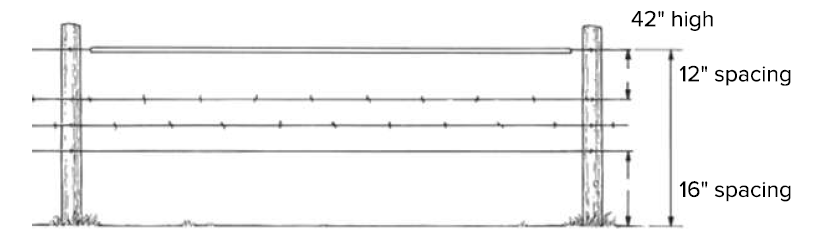
The friendliest wildlife fences are ones which are highly visible and allows animals to easily jump over or go under the fences. The Colorado Division of Wildlife recommends the following types:
- Fencing wire placed on the side of the fence posts where the livestock is located
- Smooth wire on the top and on the bottom
- Top wire height of 42 inches
- At least 12 inches between top two wires
- At least 16 inches between the ground and the bottom wire.
- For sheep and goats, a 12 inches smooth wire may be the best method to keep in your livestock
- Consider high tensile wire
Landowners may want to consider installing a high-tensile fence. This fence type is very strong, a 12.5-gauge wire which doesn’t elongate until 1,350 pounds of pressure is applied and a breaking point of 1,650 pounds. This means that most wildlife is less likely to get tangled or caught in this type of wire and it has amazing “spring”. This fence would spring back even after a tree fell on it, where other fences would simply break or stretch out of shape.
High tensile wire is less expensive to install and easier to maintain than traditional barbed-wire fences. High tensile wire can be strung up to 100 feet between posts. For more information and details on building high tensile wire fences and other types of wildlife friendly fences, contact Colorado Parks and Wildlife.
Resources:
Fencing with Wildlife in Mind, CSU Extension Fact Sheet
https://extension.colostate.edu/resource/fencing-with-wildlife-in-mind/
Montana
Predator Damage Management in Western Montana, USDA and APHIS
https://www.aphis.usda.gov/sites/default/files/mt-1996-pdm-west-ea.pdf
Wildlife Extension Program, Montana State University
https://animalrangeextension.montana.edu/wildlife/
Livestock and Wildlife Interactions, Wildlife Extension Program, Montana State University
https://animalrangeextension.montana.edu/wildlife/livestock_wildlife_interactions/index.html
Living with Deer, Montana Fish, Wildlife & Parks
https://fwp.mt.gov/conservation/living-with-wildlife/deer
How to Build Fence with Wildlife in Mind, Montana Fish, Wildlife & Parks https://defenders.org/sites/default/files/publications/wildlife_friendly_fences_2008.pdf
Wyoming
A Wyoming Landowner’s Handbook to Fences and Wildlife, Wyoming Wildlife Foundation
https://jhlandtrust.org/wp-content/uploads/2023/04/A-Wyoming-Landowners-Handbook-to-Fences-and-Wildlife_2nd-Edition_-lo-res-1.pdf
Pollinator Habitat on Small Acreages, Farms and Ranches
Here are a few steps that landowners can take to improve pollinator habitat on their property.
- Keep variety and diversity in your fields. A plant monoculture is not healthy habitat for pollinators, soil organisms or plants. For example, a mix of grasses and legumes (i.e. alfalfa, clover) makes a better pasture than a pasture with only smooth brome. A diversity of plants provides forage throughout the growing season.
- Leave native plants in pastures and fields. When spraying for invasive weeds, spot spray instead of spraying the whole field. Some native plants may be poisonous to livestock so know what plants you have and when they might be the most poisonous or tempting and either fence them off or graze at a different time of year.
- Areas of bare ground are not necessarily bad as our native bees don’t nest in colonies like honeybees (not native to the U.S.). They may nest in the ground by making underground tunnels, or in cavities in wood or other plant material. Areas of untilled bare soil can be nesting sites for native ground nesting bees. Not every single inch of a property needs to be covered with vegetation. When possible, leave dead trees or other old wood on the property to provide nesting locations for pollinators to build nests. Obviously, if a tree is a safety hazard, remove it but you might want to leave some larger branches on the property for nesting sites.
- Take waste or unused areas and plant native flowering plants to provide additional pollinator forage. Consider what pollinator species you would like to attract and plant species that provide pollinator forage, egg laying or larval food possibilities. Allow plants in your vegetable garden to go to flower (i.e. lettuce, radish, etc.) before removing them when they are done producing.
For the health of your forage plants, soil health as well as pollinator health, manage your grazing and haying. Never cut or mow your forage plants below 4″. This maintains forage plant and soil health. If you can, leave other “waste” areas higher than 4″, these areas provide habitat for pollinators. Obviously if you have noxious weeds in this area, you need to manage them. This is not a license to allow you to ignore weeds. Time your mowing or grazing to wait until native flowers have finished blooming. This is not always possible if you are haying.
Practice IPM, Integrated Pest Management, when managing weeds or undesirable plants or insects. Weeds take advantage of disturbance (construction, tillage) to get established. IPM consists of these steps: Preventative (purchase seed with minimal weed seed in it, don’t bring home weed seeds on your equipment); Cultural (keeping desired vegetation healthy by not over grazing/mowing, after disturbing an area plant either desired seed or a cover crop to compete with weeds); Biological (insects or livestock to help manage the weeds), chemical (“organic” and “synthetic” herbicides). When using an herbicide, read and follow the label to minimize the impact to pollinators (time your spraying to when the pollinators are not out, spray when plants are not blooming, spot spray). Monitor your property for undesirable vegetation and deal with it when it is a small population.
Pollinator Resources
Pollinator Partnership
https://pollinator.org/
Pollinators, U.S. Fish & Wildlife Service
http://www.fws.gov/pollinators/
Pollinators, U.S. Forest Service
https://www.fs.usda.gov/managing-land/wildflowers/pollinators
Insects and Pollinators, USDA Natural Resources Conservation Service
http://www.nrcs.usda.gov/wps/portal/nrcs/main/national/plantsanimals/pollinate/
Gardening for Native Bees in Utah and Beyond, Utah State University Extension
https://extension.usu.edu/pdfs/sustainability/files/Gardening-for-Native-Bees-in-Utah-and-Beyond.pdf
Gardening and Landscaping Practices for Nesting Native Bees, Utah State University Extension
https://extension.usu.edu/planthealth/research/gardening-for-native-bees.pdf
Xerces Society for Invertebrate Conservation
https://xerces.org/
Attracting Butterflies to the Garden, CSU Extension
https://extension.colostate.edu/resource/attracting-butterflies-to-the-garden/
Attracting Native Bees to Your Landscape, CSU Extension
https://extension.colostate.edu/resource/attracting-native-bees-to-your-landscape/
Creating Pollinator Habitat, CSU Extension
https://extension.colostate.edu/resource/creating-pollinator-habitat/