


Animal Science
Jefferson County 4-H Market Swine Project
Raising and showing market swine gives youth a hands‑on chance to learn responsibility and essential animal‑care skills. While starting out can feel overwhelming, the Market Swine Project introduces members to the basics of selecting, feeding, managing, and showing pigs. Exhibitors are encouraged to ask questions and seek support as they gain confidence throughout the project.
How to prepare for purchasing your animal
Before purchasing an animal and bringing it home, it is important to consider the needs of that animal. First, you need to decide if your pigs will be kept indoors or outdoors. You can change existing facilities or build a new one. A well-drained pasture or lot enclosed with net wire fencing and containing a shed for protection from inclement weather works well as housing for show pigs.
Pigs grow better if there is another pig in the pen or at least if they have fence line contact (fence or divider built so pigs can see each other). Regardless of the facility you use to house the show pig, it is handy to have a fenced area available to exercise the pig and practice showmanship.
Pigs kept in a pen inside a building should have at least 8 square feet of pen space per pig when several pigs are housed together. But for only one or two pigs, it is recommended at least a 5-foot × 10-foot or similar size pen.
For pigs housed outside with a shed for shelter, provide at least:
- 6 square feet inside shade space at all times
- 12 to 16 square feet of outside space per pig
Pigs will likely need heat lamps in winter months and fans in the summer months to regulate temperature. Pigs have a difficult time regulating their body temperature and cannot sweat. You will also want to ensure they have protection from too much sun. Pigs, especially light colored, can easily sunburn.
Purchasing your animal
The majority of market hogs are born between December and February and are purchased in March–April if they are being shown at Jeffco 4-H Fair. You can buy them slightly earlier or later than that but it is important to consider what weight they are when you buy them. A few things to consider for this are:
- Average daily gain
- Number of days you will have them on feed
The deadline for ownership and 4HOnline identification is May 1st.
- The weight range at the Jeffco 4-H Fair is 215–300 lbs.
- Average Daily Gain (ADG) for hogs is 1.5–2.0 lbs.
Calculate # of days on feed:
Purchase date – weigh in date = total days on feed
Mar 24 to Aug 1 = 130 days
Calculate pounds to be gained:
Total days on feed * ADG = pounds to be gained
130 days * 1.75 lbs ADG=227.5 lbs
Find start weight:
Target weight – total pounds to be gained = target starting weight
270 lbs – 227.5 lbs= 42.5 lbs
Feeding your animal
Three feeding methods are most commonly used in preparing a pig for show:
- Self-feeding: The pig decides when and how much to eat per day.
- Hand-fed: The owner decides when and how much the pig will eat per day. Two meals per day: morning and evening.
- Combination self-feeding/hand feeding: The pig is generally fed through a self-feeder until it reaches 100 to 150 pounds and is then hand-fed until show time.
It takes 3 lbs of feed to achieve 1 lb of gain for pigs on average. You likely will need 12–15 bags of feed for each pig. There are many different types of feed. Store feed in a cool dry place. It is also beneficial to use a food scale (kitchen scale) to weigh out feed, especially in the beginning. You may want to adjust the percentages above depending on your pig’s muscling and fat. You can add top dressings if you have different pigs with different needs. A pig’s rate of gain and the amount of feed they need should be determined on current weight. You should feed 1–2% of the animal body weight per day. This means you will want to weigh your pig often. There is a scale available at the fairgrounds.
Weight range for Jeffco 4-H Fair: 215–300 lbs
Teaching pigs to walk with a whip
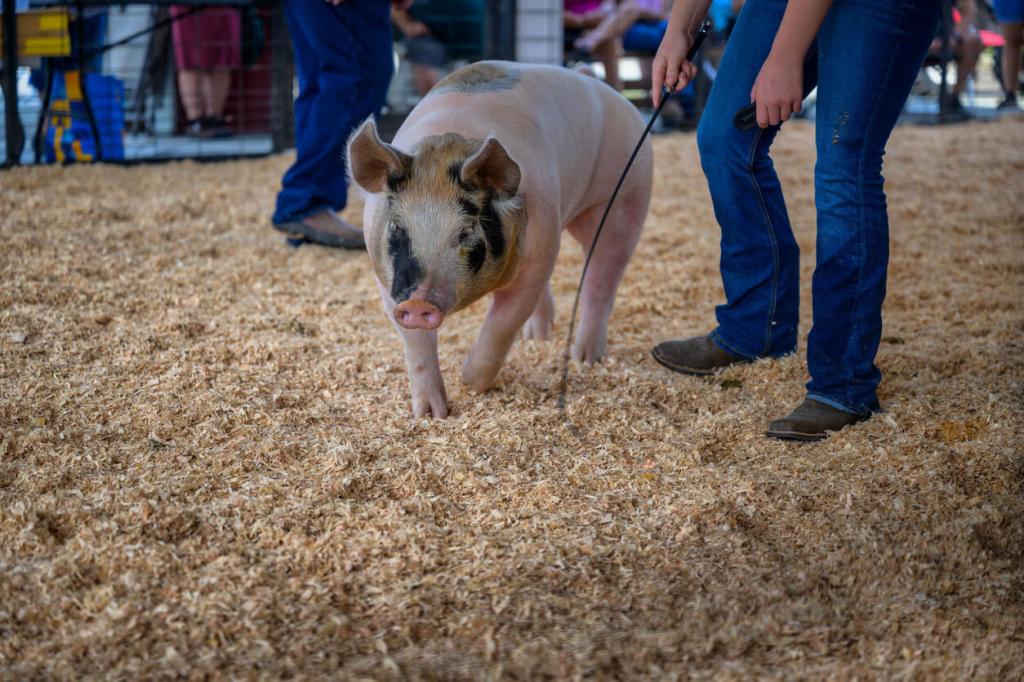
The first week to ten days of having your pigs should be used to allow them to get used to new people and the new environment. Try to make sure first interactions in this time are all positive. Once the pigs are familiar with you, you can start to walk them. A lot of show pigs will naturally be inclined to walk with a whip. It’s important that you hold your whip with a firm grip. You should always hold the whip with your thumb and index finger extended. This will give you much better control over the whip. The best way to ensure your pig walks when you want him to—and walks at a steady, even pace, it to tap him gently on what’s referred to as the “go button.” The go button is on your pig’s side between his shoulder and his flank. You should never hit your pig on their head or on their rear end to make them walk. Only soft taps on their face will be used to turn your pig.
Leading your pig
When you are first walking your pig, start small. Walk your pig from its pen to a short distance until it becomes comfortable. Gradually increase the distance. The best way to turn your pig is to gently tap the side of his face. If you want him to turn left, tap the right side of his face. If you want him to turn right, gently tap the left side of his face. Tap your pig on the jaw—when you do, they raise their head. How much you need to do this depends on your pig. Be patient with your pig. The best way to smoothly train your pig is to stop bad habits before they happen. Also, do not ever take your frustrations out on your pig. Trust is very hard to rebuild once broken.
Clipping your pig for the show
Clipping your pig can change the pig’s appearance and accentuate its muscularity, leanness and balance. Here are some tips for clipping your pig:
- Cordless clippers are a game changer.
- Train your pig to enjoy clippers, beforehand. Simply take your clippers into their pen, with no intention of actually clipping them, and get them used to the sound. Rub the vibrating clippers all over their body. This will make the process much easier when it comes time to clip.
Common health concerns
- Parasites: Worms, mites, and flies can cause a lot of harm to pigs. Worms can live in almost any environment and can infect many organs. It is important to regularly deworm pigs. Mites can really damage the skin and ears of pigs. To treat mites, you can use Avermectin products, Phosmet products, and Pyrethrins. Most are pour-on or sprays. Flies can bite pigs and are also known to spread disease. Control flies with traps and sprays frequently.
- Digestive Diseases: Campylobacteriosis, clostridial enteritis, Transmissible gastroenteritis, Swine Dysentery and more. Most of these diseases will cause diarrhea which can lead to dehydration and even death. Some of these diseases do have vaccines available so be sure to talk to your vet. Do not let diarrhea persist too long before contacting a vet. Dehydration can be serious. Clean pens well and isolate sick pigs from healthy.
- Respiratory Diseases: These include Influenza, pseudorabbies, pneumonia, atrophic rhinitis and pasteurellosis. Symptoms include lethargy, coughing, red eyes, discharge from the nose and eyes, and more. Vaccinate for diseases whenever possible. Provide good ventilation for your facility. Work with a vet to use antibiotics when you needed.
- Sunburn: Pigs that are white or lighter skinned are prone to sunburn. Sunburn can lead to excess stress and lowered feed intake. Provide shaded areas in summer months for prevention.
Approximate project expenses
Livestock projects can really add up in cost. It is important to ensure that you can afford your project before buying animals. It also is important to consider what you are likely to make from your project to offset the cost. Below is a breakdown:
Cost of purchasing your animal: $400-$1,000+
Cost of feed:
Bags of Feed Needed = (Pounds of Gain Needed*Feed Conversion Ratio)/50 lbs
(227.5 lbs x 3 lbs)=682.5 lbs
525/50=13.6 bags (round up to 14 bags)
- 14 bags of feed x $28.00 (appx cost of 50 lb bag of feed)= $392.00/pig
- Cost of vet/health: $200/pig (estimation but should be budgeted into figure)
- Supplies: $200/pig (estimation but should be budgeted into figure)
- Total Cost: $1,192-1,792/pig
- Approximate Jeffco 4-H Sale Price (Auction or Private Treaty): $500-1,000