


Animal Science
Jefferson County 4-H Market Goat Project
Preparing for and showing livestock can be an extremely rewarding and educational experience for youth. The lessons learned in showing and raising livestock are invaluable. However, it can feel very intimidating to begin. This is a broad overview at how to prepare for showing market goats. All exhibitors are encouraged to ask questions as they grow through the program.
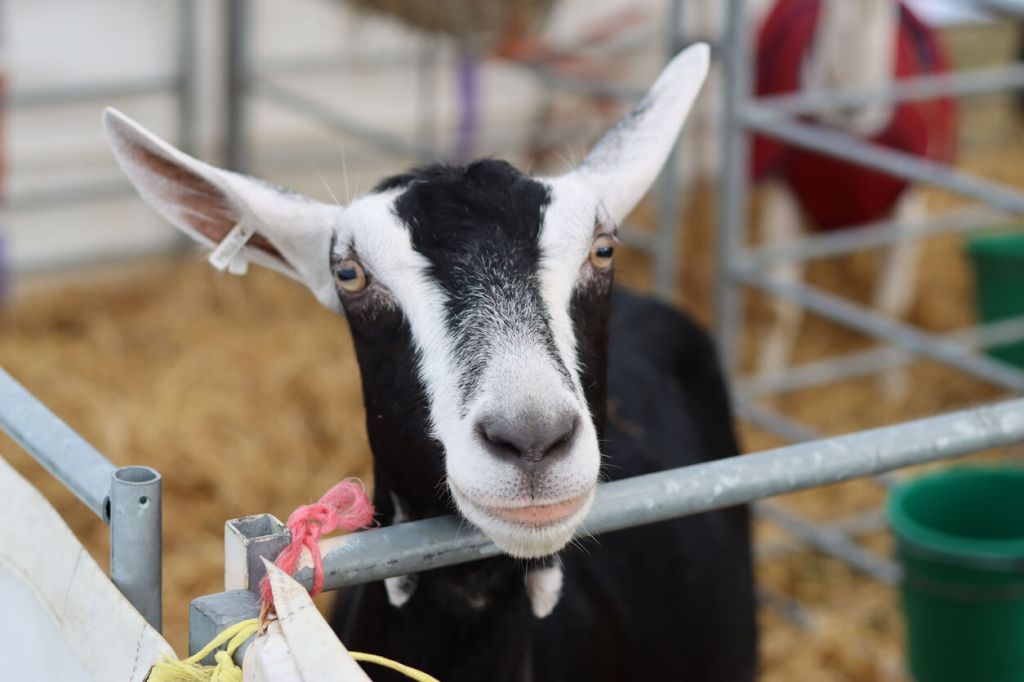
How to prepare for purchasing your animal
Before purchasing an animal and bringing it home, it is important to consider the needs of that animal. First, do you have a well fenced area? It is recommended to have at least a 10-15 square feet foot space for each goat. This will give ample room for them to exercise. It is also important to consider feeders and waterers. When considering a feeder, remember to make it a goal to eliminate waste and protect your goats from consuming debris like rocks. Be sure to offer at least 1-3 gallons of fresh water daily. Fun fact!: goats will drink 4x more water during the day than at night. Use a tank or bucket that is heavy enough they cannot tip or easily break it.
Your market goats will also need a wind or snow break or some sort of shelter for them to escape the snow, rain, wind, hail, and other weather. Goats may need heat lamps in the winter and they must stay dry and protected from the weather. In the summer, goats do well in the heat and do not need fans or misters. In some instances, existing shelters can be made to use for goats.
Purchasing your animal
The majority of market goats are purchased in March-April. You can buy them slightly earlier or later than that but it is important to consider what weight they are when you buy them. A few things to consider for this are: average daily gain and the number of days you will have them on feed. The deadline for ownership and 4HOnline identification is May 1st. The weight range at Phillips County Fair is 45-120 lbs. Average Daily Gain (ADG) for goats is 0.25-0.3 lbs. Below is how to calculate the weight your animal needs to be at time of purchase:
Calculate # of days on feed:
Purchase date – weigh in date = total days on feed
April 19 to Aug 1 = 104 days
Calculate pounds to be gained:
Total days on feed * ADG = pounds to be gained
104 days * .25 lbs ADG=26 lbs
Find start weight:
Target weight – total pounds to be gained = target starting weight
95 lbs – 26 lbs = 69 lbs
Feeding your animal
There are many feeds available for your market goats. You can do your research to determine which you feel most confident about. You can ask your breeder, leader and other livestock exhibitors for advice on what to feed. You will want to consider the breed of your animal when selecting a feed.
Nutrients for market goats:
Protein: 16-18%
Total Digestible Nutrients: 65-70%
As a general rule of thumb, goats will consume 2 to 4 percent of their body weight on a dry matter basis in feed. This means you will need to periodically weigh your animal to estimate what to feed. Kitchen food scales can be helpful in weighing feed, and it’s always recommended to feed based off weight, not cups. Feed conversion ratios are the amount of feed it takes to achieve one pound of gain. It takes 4.5-5.5 pounds of feed to achieve one pound of weight gain in goats.
Cost of feed = (Pounds of Gain needed x Feed Conversion Ratio) x Cost of 1 lb of feed
(26 lbs of gain x 5 lbs conversion) x ($33.00/50lbs) —> 130 x $0.66 = $85.80
of Bags of Feed Needed = (Pounds of Gain Needed x Feed Conversion Ratio)/50 lbs
(26 lbs x 5 lbs) = 130 lbs / 50lbs =2.6 bags —> Round up to 3 bags
Teaching to brace
Once you have accomplished walking with your goat, you can start working on bracing. To brace, you will want to set their legs square, not stretching them out too far. Make sure the goat’s neck is at a 90 degree angle. To brace, the goat should be pushing against your body, not being pulled on by their head, ears or neck. Keep your hands soft and cradle the jaw and ear and encourage the goat to push against your inner thigh. If the goat tries to back up instead of pushing, you can train them by pushing their hocks against a fence or wall. Just do not take frustrations out on your animal. Try to work with a parent, sibling, or friend so they can give feedback on leg placement. Or, you can use a large mirror to watch yourself. Practice daily so this becomes a habit for the animal and for yourself.
Clipping your goat for the show
- To make clipping your goat easier, you will likely want a stand. Adjust the stand to where the animals head is held at a 90 degree angle.
- You will want to wash your goat very well. Dirt and debris left behind are very hard on clippers and will make your clipping less smooth.
- To clip the belly, keep the skin stretched. This will allow the clippers to obtain a smoother job and prevent nicking or cutting the goat. Pay close attention not to cut or nick the sheath (penis), teats, neck or rear flank.
- Begin clipping the body by making two upward strokes per strip from the base of the foreleg over the top of the shoulder and back. Upward strokes will make the goat look taller and trimmer. You will want to clip only from the knee and hock up.
- The strokes on the neck should be lengthwise to emphasize the length and trimness of the goat. To shear the region at the base of the neck and shoulders, remove goat’s head from the stand and hold the head. Again, pull the skin tight to obtain a smooth and uniform clip.
- For the legs, sheer above the knee and hock and leave hair longer below. Longer leg hair should be carded and trimmed to create an overall appearance of balance.
Common health concerns
- Urinary Calculi: Urinary calculi is similar to kidney stones in humans. It is most common in wether goats (castrated males). Risk in males can be reduced by delaying castration as long as possible, giving the diameter of the urethra time to grow. The addition of hay or some other type of long fiber to the animal’s diet is absolutely critical to help avoid urinary calculi.
- Ringworm: Ringworm is caused by many types of fungi. It causes circular lesions in the skin and hair loss. Prevent by sanitizing combs, halters and other items frequently and washing animals with Ring Out (or similar product) after shows. Treat with topical creams obtained from a veterinarian.
- Orf Virus (Sore Mouth): Sore mouth presents with sores on the lips, nose and inside of the mouth. It resolves after 3-4 weeks. You may see lowered feed intake during an outbreak. It can spread to humans so wash hands, halters, and muzzles.
Approximate project expenses
Livestock projects can really add up in cost. It is important to ensure that you can afford your project before buying animals. It also is important to consider what you are likely to make from your project to offset the cost. Below is a breakdown:
Cost of purchasing your animal: $200-1,000
Cost of feed:
Bags of Feed Needed = (Pounds of Gain Needed x Feed Conversion Ratio)/50 lbs
(26 lbs x 5 lbs) =130 lbs of feed/50 lbs per bag = 2.6 bags (round up to 3 bags)
- 3 bags of feed* $33.00 (appx cost of 50 lb bag of feed)= $99.00/goat
- Cost of vet/health: $200/goat (estimation but should be budgeted into figure)
- Supplies: $200/head (Estimation but should be budgeted into figure)
- Total Cost: $699-1,499/goat
Approximate Jeffco 4-H Sale Price (Auction or Private Treaty): $500-1,000