


Quick facts…
- Yellow toadflax (Linaria vulgaris) and the Dalmatian toadflaxes (Linaria dalmatica and Linaria genistifolia) are invasive, perennial weeds that are noxious in Colorado and other western states.
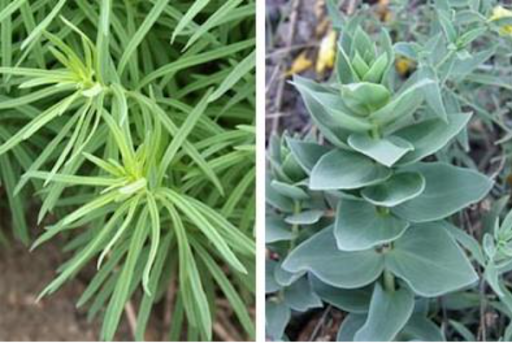
- The easiest way to identify which toadflax species is by the leaves. Yellow toadflax has lance-shaped, long leaves, and Dalmatian toadflax has broad, heart-shaped leaves.
- Seeds of Dalmatian and Yellow toadflax germinate and emerge in the spring.
- Toadflax invasion is favored by disturbance, and they invade degraded areas such as roadsides, abandoned lots and fields, gravel pits, clearings, and overgrazed rangeland.
Introduction
Yellow toadflax (Linaria vulgaris) and the Dalmatian toadflaxes (Linaria dalmatica and Linaria genistifolia) are invasive, perennial weeds in the Plantaginaceae family that are noxious in Colorado and many other western states. Toadflax spread is favored by disturbance, and they invade degraded areas such as roadsides, abandoned lots and fields, gravel pits, clearings, and overgrazed rangeland. In Colorado, these weed species are found at elevations from 5,000 feet to over 10,000 feet. Yellow toadflax has spread into high mountain valleys and parks. Yellow toadflax infests approximately 40,800 acres in Colorado, and Dalmatian toadflax infests approximately 34,200 acres. The easiest way to distinguish between Yellow and Dalmatian toadflax is by the leaves. The lance-shaped, gray-green, 2” long leaves of yellow toadflax are stalkless and pointed at both ends. Dalmatian toadflax has broad leaves that can be classified as clasping, heart-shaped, or egg-shaped. The leaves of both species are alternate but may appear to be opposite because they are crowded together. (Figure 1).
Origin and History
Dalmatian toadflax is native to the Mediterranean region. Broad-leaved Dalmatian toadflax (L. dalmatica) has been cultivated as an ornamental for many years. Both toadflaxes were introduced into the western U.S. as an ornamental many years ago. Yellow toadflax is native to south-central Eurasia, where it was used as a fabric dye and for medicinal purposes. It was widely distributed in North America by the mid-20th century. Unfortunately, in states where yellow toadflax is not noxious, it is still being sold by some plant nurseries as “butter and eggs” or “wild snapdragons.”
Germination
Yellow and Dalmatian toadflax seeds germinate and emerge early to mid-May, while Dalmatian toadflax seeds may germinate and emerge earlier after the last frost. First-year Dalmatian toadflax plants often produce prostrate shoots in fall that survive into the following spring. Mature Dalmatian toadflax may produce prostrate shoots, but to a lesser extent, and these typically die before winter, and shoots emerge the following spring from roots. Yellow and Dalmatian toadflax shoots that grow from roots emerge as early as mid-March along the Front Range in Colorado, but vegetative shoot emergence may not begin until mid- to late June at 9,000 feet to 10,000 feet. Vegetative shoots start to emerge when soil temperatures range from 42°F to 50°F.
Phenology
Yellow toadflax shoots are usually 1 to 3, and leaves are narrow, linear, somewhat pointed at both ends, and 1 to 2 inches or more in length. Dalmatian toadflax shoots typically are 2 to 3 feet tall, and leaves are waxy, broad, spade-shaped, and the bases tend to wrap around shoots. However, Dalmatian toadflax leaves are more heart-shaped or cordate. Like yellow toadflax, Dalmatian toadflax can dominate plant communities after it invades.
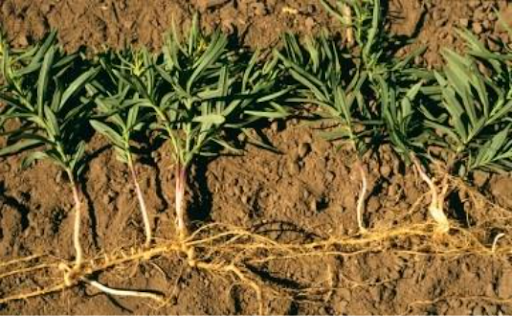
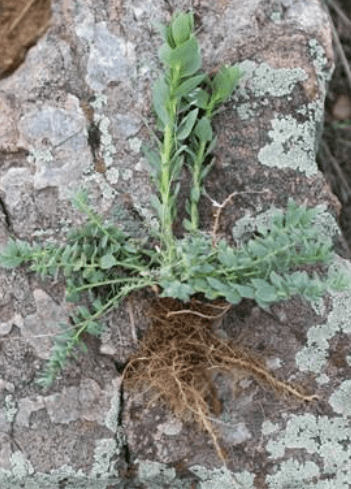
Seedling root development is slow and represents a life stage vulnerable to control attempts and plant competition. Disturbance promotes toadflax invasion and may be necessary for establishment. However, once established, toadflaxes will readily spread into adjacent disturbed areas (Figure 2). Much of this spread is by vegetative means, reflecting a vigorously growing root system. Dalmatian toadflax roots may grow 20 inches deep or more, nine weeks after seedlings have emerged and have vegetative buds that give rise to new shoots. Patch expansion can be dramatic. Yellow toadflax seedlings produce vegetative shoots from root buds two to three weeks after germination. Mature toadflax has well-developed and extensive root systems. Dalmatian toadflax roots may penetrate the soil 4 feet to 10 feet, and lateral roots may extend 10 feet from the parent plant; while yellow toadflax roots grow 3 feet deep or more, with lateral roots that may extend several yards.
Flowering
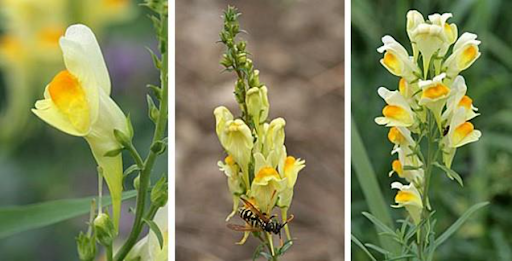
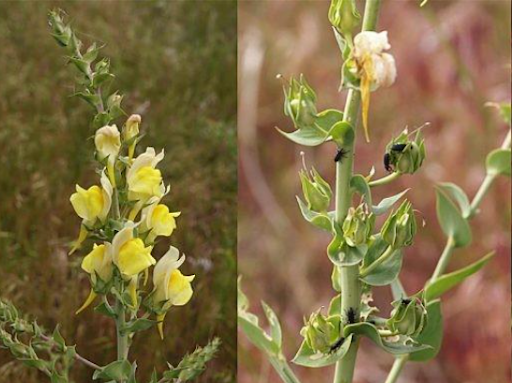
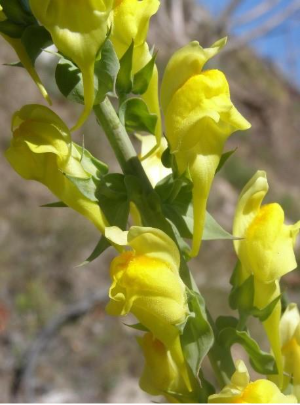
Dalmatian toadflax typically flowers in Colorado beginning in late May or June and may continue until fall, particularly if moisture is not limited. Yellow toadflax begins to flower when shoots are from 16 to 24 inches tall, mid- to late May, along the Front Range in Colorado, although at higher elevations (9,000 feet or more), flowering may not begin until late July. Yellow toadflax may not flower until fall under drought conditions. Yellow toadflax shoot phenology in any given patch may range from vegetative to flowering to seed set, depending on the time of season and environmental conditions (particularly moisture). This contributes to management difficulties. Flowers for both toadflaxes are very similar, defer to other parts to identify which species you are controlling (Figures 3 and 4).
Control
All toadflax species are difficult to control, and management plans should integrate as many strategies as possible to increase the potential for success. Assess the condition and composition of the existing plant community in an infested area, then determine the approximate composition of the desired plant community needed to achieve land management goals and objectives. Create a management plan that combines various control strategies to foster the development of the desired plant community.
Necessary: Always follow herbicide label directions, wear appropriate personal protective equipment, and check local regulations regarding herbicide use near water and sensitive areas.
Table 1. Herbicides used to control Dalmatian Toadflax.
| Herbicide | Rate (Product/A) | Application Timing | Comments |
|---|---|---|---|
| Tordon 22K | 2 pt. | Flowering or fall | Best control when applied at full bloom or fall. |
| Telar | 2 oz. | Fall | Improved control achieved with 1% v/v silicone/methylated seed oil surfactant; NIS at 0.25% v/v can be used if collateral injury to native forbs and shrubs at risk, but control will decrease. |
| Plateau | 12 oz. | Fall | Apply when 25% of the plant is necrotic, usually after a hard frost. Use methylated seed oil at 1 qt/A. Cool-season grass injury often occurs from high rates of Plateau applied in the fall. |
Table 2. Herbicides used to control Yellow Toadflax.
| Herbicide | Rate (Product/A) | Application Timing | Comments |
|---|---|---|---|
| Tordon 22K | 2 to 4 pt. | Late flowering to seed capsule/seed set in fall | Control is best at the seed capsule growth stage. Use a high rate for old, dense stands. |
| Tordon 22K + Overdrive | 2 pt + 8 oz | Late flowering to seed capsule/seed set in fall | Control is best at the seed capsule growth stage. |
| Telar | 1.5 to 2 oz | Late flowering to seed capsule/seed set in fall | Control is best at the seed capsule growth stage. Add crop oil concentrate or methylated seed oil. |
Mechanical Control of Yellow Toadflax
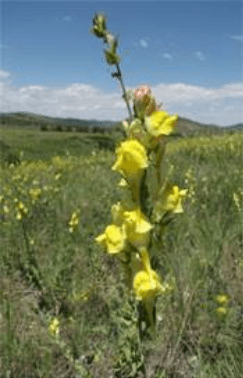
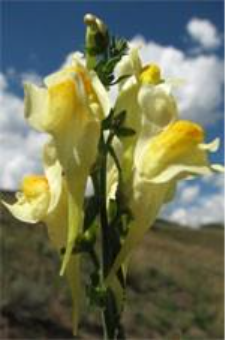
Tillage beginning in the early summer and continuing at 3–4-week intervals has been somewhat successful in controlling this weed. Mowing will help reduce seed production but generally will not eliminate established populations (Figures 5 and 6). Burning is not deemed effective, as it doesn’t kill the roots.
Biological Control
Currently, the Colorado Department of Agriculture has one biocontrol available for Dalmatian toadflax plants. This biocontrol is a stem-boring weevil, Mecinus janthiniformis. The adult weevils overwinter in Dalmatian toadflax stems and emerge in the spring. After mating, female weevils lay their eggs in the stems of newly emerged toadflax plants. The larvae hatch from the eggs and begin to feed on the inside of the stem. When the larvae are finished feeding inside the stem, they will pupate there and eventually become adults. The adult feeds inside the stem until temperatures grow too cold for feeding. The adult then hibernates within the stem until spring, when it chews its way out to continue the life cycle. One generation is produced per year.
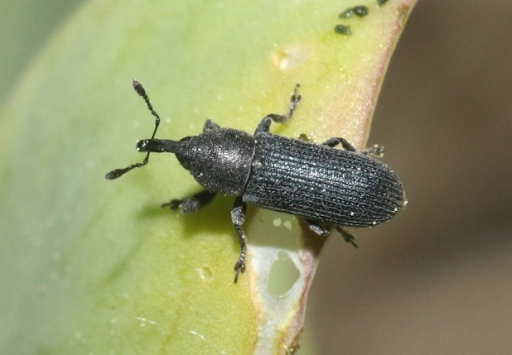
Other naturally occurring biocontrols can be found on toadflaxes. Such as a defoliating moth (Calophasia lunula), an ovary-feeding beetle (Brachypterolus pulicarius), and two seed capsule-feeding weevils (Rhinusa antirrhini and Rhinusa neta) a stem-boring weevil (Mecinus janthinus) and a root-boring moth (Eteobalea intermediella) are all known species that control toadflax populations through varied means. These species are not for purchase in Colorado, only the stem-boring weevil is. If used alone, however, it is not an effective management strategy.
Integrated Management
Proper herbicide use, land management, and mowing can be combined with biocontrol for a complete integrated management. To combine chemical and biological control methods, apply herbicides when they won’t interfere with insect development. That is, allow the control insects to complete their life cycle. Or use herbicides in areas that aren’t sensitive to their use and biological control in areas where herbicides are impractical or environmentally unsafe. Always follow the herbicide label and biocontrol release instructions. Cultural methods that favor desirable plant growth can be combined with chemical or biological control by implementing proper rangeland and pasture management.
For More Information
Contact your local Extension office or the Colorado Department of Agriculture for:
- Current toadflax distribution data
- Biological control availability
- Site-specific management recommendations
- Updated herbicide information
Always read and follow herbicide labels. Herbicide use recommendations are provided only as guidelines. The user is always responsible for herbicide residues and application according to label directions.