


Quick facts…
- Cicadas are large insects whose immature stages (nymphs) develop underground, feeding on sap from the roots of grasses, shrubs, and trees.
- In Colorado, cicadas typically emerge as adults every 3 to 5 years, though some may remain underground longer depending on species and environmental conditions.
- Periodical cicadas, such as the 17-year and 13-year cicadas found in the eastern U.S., do not occur in Colorado.
- Male cicadas produce loud, shrill buzzing or clicking sounds—often described as “singing”—to attract females.
- Cicadas cause little direct damage to plants when feeding. However, females may harm small twigs and branches when they insert eggs, creating slits that can weaken or break the wood.
- Cicadas are active during the warmest parts of summer and are most often heard during the heat of the day.
- Their emergence is beneficial to many animals, providing an abundant seasonal food source for birds, mammals, and reptiles.
Cicadas are among the largest Colorado insects in the order Hemiptera, which includes other sap-sucking groups with prominent beaks such as leafhoppers, aphids, and spittlebugs. Twenty-nine species occur in the state (Table 1). The largest (Megatibicen spp.) are stout-bodied insects that are 1 to 1 ½ inches, but Colorado’s cicadas range considerably in size. Beameria venosa, Cicadettana calliope and C. kansa are small species (ca. ½ inch) that are developed on grasses and shrubs growing on hillsides of canyons and arroyos of both eastern and western Colorado. The Putnam cicada (Platypedia putnami) is a small black and orange species that reproduces in stands of Gambel oak (Quercus gambelii), one of the few oak species native to Colorado that provides numerous ecological benefits.
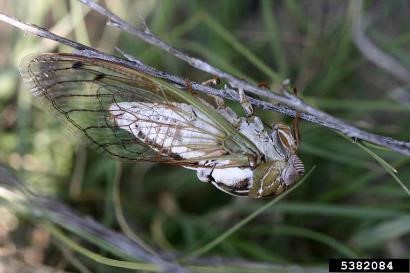
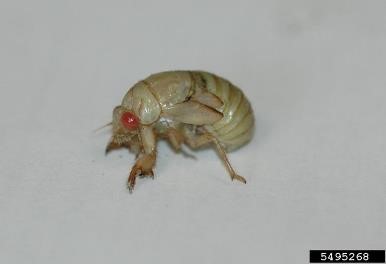
Though plentiful, cicadas are much more often heard than spotted. Males make a variety of sounds to attract females. Once the female approaches, both species begin clicking, engaging in courtship to locate and communicate with each other.
Most commonly heard are loud, often shrill, buzzing calls, sometimes with several individual insects synchronizing their songs. Other cicadas make rustling or clicking noises.
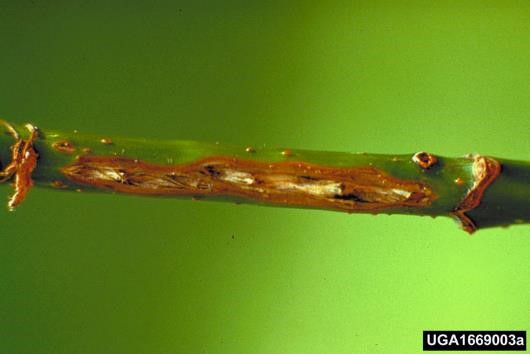
Despite their large size, cicadas cause little injury. The immature stages (nymphs) burrow in the soil and insert their beaks into roots and feed on plant fluids but develop slowly causing no detectable harm to the plants. The greatest injury occurs when large numbers of certain cicadas, such as the Putnam’s cicada, insert eggs into stems of trees and shrubs (oviposition injury). This egg laying injury can cause some twig dieback or weaken smaller branches that can snap off during wind. This type of damage is known as flagging.
Cicadas are sometimes called locusts. This is incorrect, as locust is a term properly used to describe insects in different groups – for example certain grasshoppers (order Orthoptera) that occur in large migratory bands or flights.
Life History and Habits
Cicada nymphs develop underground, feeding on fluids they suck from the roots of grasses, shrubs, and trees. The nymphs are generally pale brown, rather hunch-backed, and have stout forelegs they use to dig through soil.
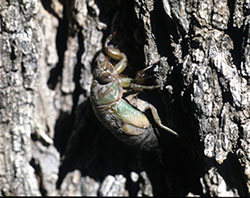
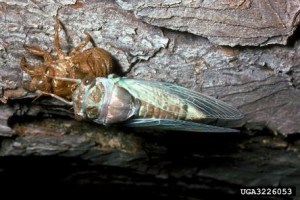
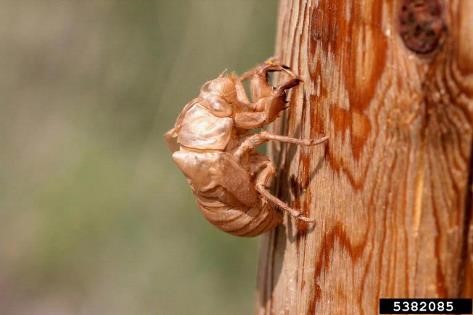
When full-grown, nymphs emerge from the soil. They crawl up a nearby plant or wall, and the nymphal exoskeleton (“skin” or exuvia) splits along the back. The adult form then emerges, pulling themselves from the old skin. The new adult will then hang for several hours, while blood is pumped to extend the wings. The new exoskeleton hardens and darkens rapidly, and the adult cicada then flies away, leaving behind the discarded nymphal skin
In most species, only male cicadas “sing,” which is done primarily to attract females by their characteristic songs. Most cicadas produce sound using a structure known as a tymbal located on the abdomen of the insect. The tymbal can produce high frequency clicking that resonates within chambers of the body. Very loud songs can be produced in this manner. Some cicadas, such as the Putnam’s cicada, lack tymbals and produce soft rustling songs using their wings. In these species, females also can make return calls.
Adult cicadas normally will live about four to six weeks after they emerge from the soil. This length of time can vary depending on weather conditions. After mating, the adult females lay their eggs which they insert into stems of plants. Egg laying punctures produce some plant wounding (oviposition wounds) and may cause damaged twigs to break and die (“flagging”). A few weeks after eggs are laid, nymphs hatch from the eggs, drop to the ground, burrow into the soil, and move to roots on which they feed.
The life cycles of Colorado’s cicadas take years to complete, and they are among the longest lived of all insects. Most probably require 3-5 years to develop, but some may live as long as 8 years. In all cases, most of a cicada’s life takes place underground.
Periodical cicadas, (Magicicada species), such as the 17-year and 13-year cicadas, live even longer. Periodical cicadas emerge during synchronized periods, often in spectacular numbers, every 17th or 13th year, respectively. Periodical cicadas are largely restricted to areas east of the Mississippi River and do not occur in Colorado.
Some Commonly Observed Colorado Cicadas
Megatibicen species (“dog-day cicadas”) are the largest and among the loudest of the Colorado cicadas, producing loud droning buzz during midsummer into the fall. Three species occur but Megatibicen dealbatus (plains harvest-fly) is the most common. Native to forested areas along waterways in southeastern Colorado, it has adapted well to urban forest landscapes and has been extending its range northward through much of the Front Range. Occasionally, M. dorsatus (giant grasslands cicada) can be heard calling from fence posts or grassland shrubs throughout eastern Colorado and including some open space grassland areas along the Front Range.
Platypedia putnami (Putnam’s cicada) is one of the most common species statewide, it can be particularly abundant in shrublands of Gambel oak or mountain mahogany in foothills areas but has moved into irrigated landscapes of some urban areas along the Front Range. Noticeable plant wounding during egg laying has been noted with this cicada, occurring on plants such as maple, crabapple, and honeylocust. Males lack tymbal organs and instead communicate with songs produced striking their wings together making producing a soft rustling click, similar to that produced by striking together two coins. This is the clicking sound often heard in the trees and shrubs from spring into early summer. In late summer and early autumn, a common clicking sound is produced by a different insect, Microcentrum rhombifolium, known as the broadwinged or greater anglewing katydid).

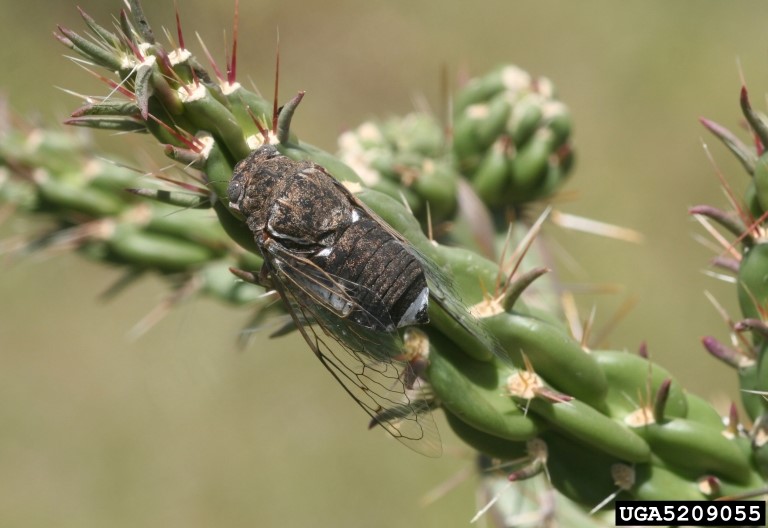
Cacama valvata (cactus dodger) is a large gray/black species often associated with tree cholla cacti (Cylindropuntia) that grows in southeastern Colorado, and other shrubs in southwestern Colorado. When disturbed they can make a shrill, ear-splitting call that is the loudest produced by any of the Colorado cicadas.

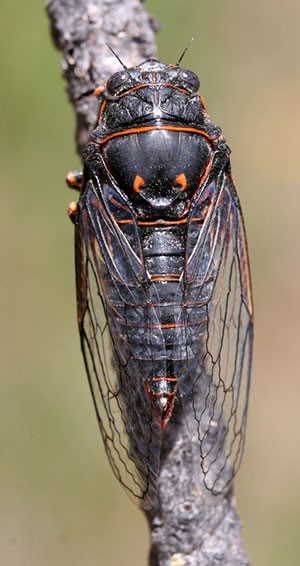
Okanagana bella (mountain cicada) is a black and red species that somewhat resembles a large Putnam’s cicada. It occurs where aspen grows intermixed with conifers. Males make a long, shrill song that often lasts one to two minutes. The mountain cicada can be found in montane and urban regions of Colorado.
Natural Enemies of Cicadas
Cicadas have several natural enemies, many with unusual habits. Perhaps most spectacular are the cicada killer wasps (Sphecius species) of southeastern and southwestern Colorado that somewhat resemble enormous yellowjacket wasps. Cicada killers capture, sting, and paralyze adult cicadas of large species, such as the “dog-day” cicadas. Cicadas become prey items for the ecoparasitic eggs of the Sphecius spp. wasps. The cicada remains paralyzed for weeks while the wasp larva grows larger where it obtains its nutrients from the living but paralyzed cicada. The wasps dig nest cells a foot or more underground and return with the cicada prey to provide food for their young. In some nests, multiple cicadas are stored to feed the wasps young, so they may successfully complete development.

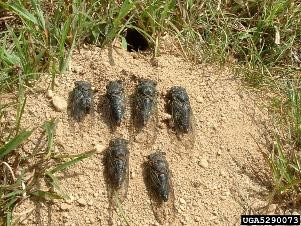

Another insect enemy found in eastern Colorado is the cedar beetle, Sandalus niger. These develop as parasites of cicada nymphs. Several kinds of birds will also feed on cicadas. The Mississippi kite, a large predatory bird normally found along the Gulf Coast, has expanded its summer range into the Arkansas Valley, where it subsists almost entirely on cicadas.
Additional Reference
Insects of Western North America. 2. The Cicadas of Colorado (Homoptera: Cicadidae, Tibicinidae). 2002. Kondratieff, B.C. A.R. Ellingson, D.A. Leatherman. Contributions to the C.P. Gillette Museum of Arthropod Diversity. Colorado State University. 81 pp.
Table 1. Checklist of Cicadas Known from Colorado
| Cicadas Known to be from Colorado |
|---|
| Cacama valvata (cactus dodger) |
| Diceroprocta apache |
| Diceroprocta eugraphica |
| Megatibicen dealbatus (plains arvest-fly) |
| Megatibicen dorsatus (giant grasslands cicada) |
| Megatibicen tremulus |
| Hadoa bifida |
| Hadoa duryi |
| Hadoa inaudita |
| Neotibicen pruinosus |
| Beameria venosa |
| Pacarina shoemakeri |
| Okanagana bella (mountain cicada) |
| Okanagana canadensis |
| Okanagana funipennis |
| Okanagana gibbera |
| Okanagana hesperia |
| Okanagana magnifica |
| Okanagana occidentalis |
| Okanagana schaefferi |
| Okanagana striatipes |
| Okanagana synodica |
| Okanagana utahensis |
| Cicadettana calliope |
| Cicadettana kansa |
| Platypedia minor |
| Platypedia mohavensis |
| Platypedia putnami (Putnam’s cicada) |
| Neoplatypedia constricta |
Reference: CSU Fact Sheet 5.590