


Quick facts…
- The elm seed bug feeds on the seeds of Siberian elm.
- Elm seed bug cause nuisance problems by moving into buildings in summer and early autumn. They do not reproduce indoors.
- The best management of elm seed bugs is to seal cracks and crevices on the exterior of buildings so the insects cannot enter. Indoors, they are best managed by vacuuming.
- Movement of the bug to indoors can also be limited by use of certain insecticides applied to areas of the building exterior where the bugs can enter.
The elm seed bug (Arocatus melanocephalus) is a pest native to Europe and the Mediterranean region and was first detected in 2012 in Idaho. Since then, it has been detected in Utah, Oregon, Washington, Colorado, New Mexico, Canada, and parts of Asia. The first Colorado detections of this insect were made in 2017 on the Western Slope, and it has since spread through much of Colorado, including the Front Range.
This insect feeds primarily on elm seeds but has also been reported on linden and oak trees in Utah. Elm seed bug adults become a nuisance pest, similar to the boxelder bug, by entering homes and buildings in great numbers.
Unlike boxelder bugs , which appear in homes in the fall, the elm seed bugs most often appear in homes from mid-June through September and may become active in homes during the winter if temperatures are favorable outside. Adults will overwinter in structures, but do not reproduce in the home. When spring arrives, they will venture out from overwintering sites to feed on developing elm seeds. The elm seed bugs are a further nuisance because they can produce a pungent odor similar to bitter almonds from abdominal scent glands.
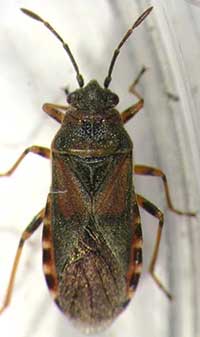
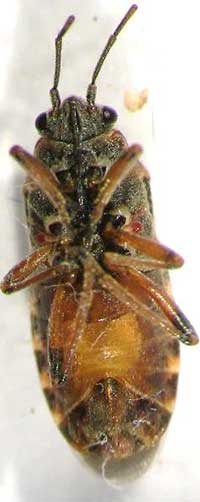
The adult bugs are the stage normally present in a home. These are about 1/3 inch long with dark, rusty-red and black coloration (Fig. 1). The underside of the insect is red (Fig. 2). On the back, behind the head, there is an upside-down black triangle set inside two rusty-red triangles. Next to the edges of the wings are noticeable white dots interspersed with rusty-red and black dots (Fig. 3). Wings are held crossed over the back and half of the wing is black and the other half is red and black.
Immature elm seed bugs (nymphs) that develop outdoors on seeds lack wings and are smaller than adults. As they grow, black wing pads develop and the abdomen appears a lighter red color with two black dots in the middle (Fig. 4).
Elm seed bugs are only one of several insects that are seasonal “nuisance invaders” of Colorado homes. Perhaps best known is the boxelder bug, which can be common indoors from autumn through most of spring. It is slightly larger than elm seed bug and has distinctive orange red striping. Also present in buildings during late summer and autumn is the western conifer-seed bug, which also produces a noticeable odor.
Life Cycle and Habits
The elm seed bug overwinters as an adult in and around structures, wood piles and in the landscape. In the spring, adults will move from their overwintering habitats out into the landscape. Egg laying begins when elm trees begin to flower, with eggs deposited on the elm flower cups. Egg laying can continue through June, so a large number of eggs may be present on the trees. Once eggs hatch, the immature nymphs will start feeding upon the elm seeds and go through five nymphal stages before winged adults appear.
Adults appear in late June and remain present until fall. Adult elm seed bugs can be seen congregating on plants and structures. Periods of extremely high temperatures may trigger mass migrations of nymphs and adults to seek more favorable climates inside homes during the summer. Fortunately, there is only one generation produced each year.
As nymphs and adults feed on the elm seeds and leaves, using their piercing and sucking mouthparts, they cause little to no damage to overall tree health. After the elm seeds mature and fall off the tree, the bugs become more mobile and can be found in large numbers congregating on tree trunks, on the ground, and on structures. These insects do not damage the structure, but can congregate in large numbers in soffits, around windows, and under vinyl siding. When temperatures exceed 100° F during the summer, adults may congregate on the northern side of buildings or in shaded areas attempting to escape the heat. They may also be seen in the fall congregating on the southern side of structures seeking radiant heat from the sun.
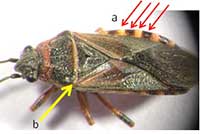
abdomen (a) and black triangle behind the head (b).
It is also during the fall when the insects start to seek overwintering habitats and will often start invading homes. They may enter homes via cracks and crevices, but most commonly enter via windows and doorways that have poor seals and no door sweeps. Upon entering the home, they may be seen around window sills, walls, ceilings, furniture, and behind wall hangings. When aggravated or touched, these bugs can give off a foul odor sometimes described as smelling like bitter almonds. Excluding these bugs from the home can be done by sealing windows and doors with weather stripping while insuring screens and door sweeps are in good condition. Ensure the caulking around windows and door frames are in good condition with no cracks. Caulk and seal gaps in soffits, gas, electrical, and plumbing lines leading into the house.
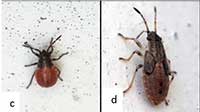
Photo by Ryan Davis Utah State University
Management of Elm Seed Bugs
These bugs are a nuisance pest and should be excluded from entering the home. Some exclusion tactics are:
- Vacuum elm seed bugs found in the home and dispose of them outside or flush down the toilet. A bagless vacuum works best with these insects as they can be easily emptied when full of bugs.
- Spraying elm trees or cutting them down to reduce elm seed bug populations is ineffective, as the bugs and elm trees are in high populations and highly mobile in the Western Slope area of Colorado.
- A perimeter barrier of insecticide around window and door entryways may be the best way to deter bug entry into the home.
- Products containing pyrethroids have been recommended for outdoor structural spraying including beta-cyfluthrin, bifenthrin, deltamethrin, cyfluthrin, cypermethrin, lambda-cyhalothrin, and permethrin. These are common active ingredients in many retail insecticides sold for outdoor use.
Reference: CSU Fact Sheet 5.619