


Quick facts…
- Most evergreens prefer full sun; some will tolerate partial shade.
- When selecting evergreens, consider available space, soil and site conditions, and weather factors.
- Evergreens have different soil moisture preferences. Group drought-tolerant types separately from those that require more moisture.
- All evergreens benefit from mulches. All need sufficient water to become established after transplanting.
- Most evergreens benefit from supplemental water during dry, warm or windy periods from November to March.
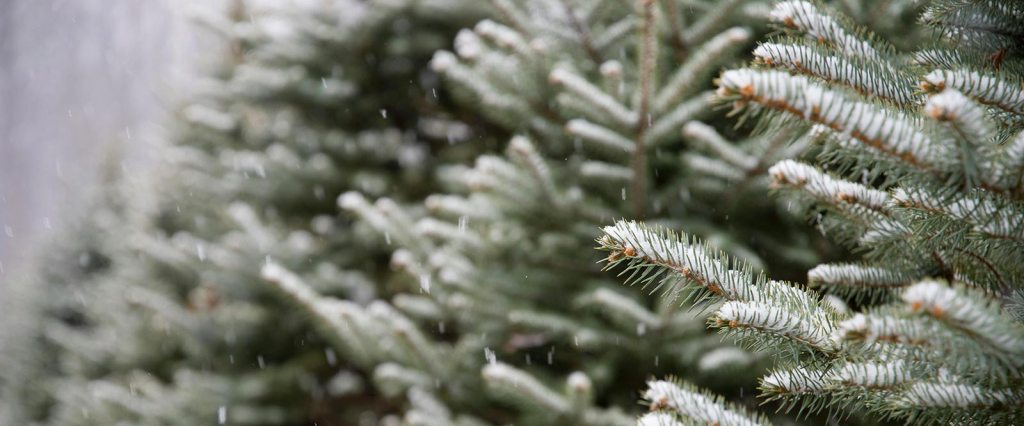
Photo by David Dibert
Introduction
Narrowleaf evergreen (conifer) trees give a landscape year-round interest, color and texture. Conifer trees are versatile and can be used as specimens, hedges, privacy screens, backdrops for smaller flowering plants, or as a windbreak planted on the north and west to deflect or intercept winter winds. Refer to Landscaping for Energy Conservation.
“Evergreen” refers to trees that normally retain most of their foliage (needles) through the winter. Such trees, however, do not keep all their needles indefinitely. For example, ponderosa pine drops needle each year that are three years old. These older needles are the innermost ones toward the main trunk. Younger needles, further out on the branch, are retained until they are three years old. This annual browning and drop of innermost, older needles can cause concern, but it is a natural process.
Selection
Examine the intended planting space for good soil drainage, adequate sunlight and sufficient space to accommodate the desired evergreen tree at its mature size. Allow for clear access to driveways, sidewalks and entryways. Determine whether the tree’s growth will affect any overhead utility lines. Before planting, call the utility companies’ hotline (dial 811) to mark the location of any underground lines to avoid damaging them while digging.
For smaller sites, consider smaller trees or shrubs. If there is sufficient space, use several kinds of evergreens to add variety to the landscape.
Watering and Maintenance
The following list (Table 1) indicates the relative moisture needs of evergreens. Plant species with similar water needs in the same general area – do not mix trees with widely different water needs.
Evergreens that need less moisture may work well on slopes. All evergreens usable in Colorado prefer well-drained soils. Avoid planting them in swales or poorly drained, soggy areas. Evergreens that need less moisture may not do well in lawn areas because of the amount of water needed to sustain the lawn. Even for those trees that need more moisture and are compatible with lawn watering, leave the planting area free of sod to allow for good root development. An organic mulch is recommended over the entire planting area.
Most evergreens growing in Colorado landscapes, whether recently transplanted or well-established, benefit from supplemental water during winter dry spells. Often, such spells are accompanied by drying winds or unseasonably warm temperatures, further emphasizing the need for watering.
For gardeners above 6,000 feet, some of the plants listed in Table 1 are not adapted.
Planting Evergreen Trees
Growing a healthy evergreen tree begins with proper planting techniques. Mistakes such as planting a tree too deep are common in the landscape, and lead to trunk-girdling roots which can shorten the life span of the tree significantly. Proper planting techniques promote rapid root growth while reducing water stress from the harvest and planting process.
Table 1: Recommended evergreen trees for Colorado.
| Scientific Name | Cultivar | Common Name | Mature Size (H x W) |
|---|---|---|---|
| Abies concolor | White fir | 60’ x 20’ | |
| Abies concolor | ‘Candicans’ | White fir | 40’ x 15’ |
| Hesperocyparis arizonica | Arizona cypress | 30’ x 20’ | |
| Juniperus chinensis | ‘Blue Point’ | Chinese juniper | 12’ x 8’ |
| Juniperus chinensis | ‘Hetzi Columnaris’ | Chinese juniper | 15’ x 5’ |
| Juniperus chinensis | ‘Spartan’ | Chinese juniper | 12’ x 5’ |
| Juniperus chinensis | ‘Spearmint’ | Chinese juniper | 15’ x 6’ |
| Juniperus scopulorum | Rocky Mountain juniper | Variable | |
| Juniperus scopulorum | ‘Cologreen’ | Rocky Mountain juniper | 15’ x 8’ |
| Juniperus scopulorum | ‘Gray Gleam’ | Rocky Mountain juniper | 15’ x 6’ |
| Juniperus scopulorum | ‘Moonglow’ | Rocky Mountain juniper | 15’ x 8’ |
| Juniperus scopulorum | ‘Skyrocket’ | Rocky Mountain juniper | 15’ x 3’ |
| Juniperus scopulorum | ‘Wichita Blue’ | Rocky Mountain juniper | 12’ x 6’ |
| Juniperus virginiana | Eastern Redcedar | 40’ x 15’ | |
| Juniperus virginiana | ‘Blue Arrow’ | Eastern Redcedar | 15’ x 3’ |
| Larix decidua | European Larch | 45’ x 18’ | |
| Picea abies | Norway spruce | 50’ x 25’ | |
| Picea abies | ‘Cupressina’ | Norway spruce | 15’ x 5’ |
| Picea glauca | White spruce | 50’ x 20’ | |
| Picea glauca | ‘Pendula’ | White spruce | 20’ x 5’ |
| Picea glauca var densata | Black Hills spruce | 30’ x 15’ | |
| Picea pungens | Colorado spruce | 60’ x 25’ | |
| Picea pungens glauca | Colorado blue spruce | 60’ x 25’ | |
| Picea pungens glauca | ‘Baby Blue Eyes’ | Colorado blue spruce | 15’ x 8’ |
| Picea pungens glauca | ‘Bakeri’ | Colorado blue spruce | 30’ x 15’ |
| Picea pungens glauca | ‘Hoopsii’ | Colorado blue spruce | 45’ x 15’ |
| Picea pungens glauca | ‘Fat Albert’ | Colorado blue spruce | 45’ x 15’ |
| Picea pungens glauca | ‘Iseli Fastigiate’ | Colorado blue spruce | 15’ x 5’ |
| Picea pungens glauca | ‘R.H. Montgomery’ | Colorado blue spruce | 12’ x 8’ |
| Picea pungens glauca | ‘Sester Dwarf’ | Colorado blue spruce | 10’ x 5’ |
| Pinus aristata | Bristlecone pine | 25’ x 15’ | |
| Pinus aristata | ‘Formal Form’ | Bristlecone pine | 20’ x 12’ |
| Pinus edulis | Piñon pine | 20 x 15’ | |
| Pinus flexilis | Limber pine | 40’ x 20’ | |
| Pinus flexis | ‘Vanderwolf’s Pyramid’ | Limber pine | 35’ x 20’ |
| Pinus heldreichii | Bosnian pine | 20’ x 12’ | |
| Pinus heldreichii | ‘Emerald Arrow’ | Bosnian pine | 20’ x 12’ |
| Pinus heldreichii | ‘Iseli Fastigiate’ | Bosnian pine | 20’ x 8’ |
| Pinus heldreichii | ‘Mint Truffle’ | Bosnian pine | 12’ x 8’ |
| Pinus mugo | Mugo pine | Variable | |
| Pinus mugo | ‘Tannenbaum’ | Mugo pine | 12’ x 6’ |
| Pinus nigra | Austrian pine | ||
| Pinus nigra | ‘Arnold Sentinel’ | Austrian pine | 15’ x 5’ |
| Pinus nigra | ‘Frank’ | Austrian pine | 20’ x 7’ |
| Pinus nigra | ‘Oregon Green’ | Austrian pine | 15’ x 12’ |
| Pinus ponderosa | Ponderosa pine | 50’ x 25’ | |
| Pinus strobiformis | Southwest white pine | 45’ x 25’ | |
| Pinus strobus | Eastern white pine | 50’ x 20’ | |
| Pinus strobus | ‘Fastigiata’ | Eastern white pine | 35’ x 10’ |
| Pinus strobus | ‘Pendula’ | Eastern white pine | 15’ x 15’ |
| Pinus sylvestris | Scotch pine | 40’ x 25’ | |
| Pinus sylvestris | ‘Fastigiata’ | Scotch pine | 20’ x 5’ |
| Pseudotsuga menziesii | Douglas Fir | 60’ x 20’ | |
| Thuja occidentalis | Eastern or American arborvitae | 20’ x 10’ | |
| Thuja occidentalis | ‘Degroot’s Spire’ | Eastern or American arborvitae | 12’ x 4’ |
| Thuja occidentalis | ‘Smaragd’ (‘Emerald’) | Eastern or American arborvitae | 12’ x 4’ |
| Thuja occidentalis | ‘Green Giant’ | Eastern or American arborvitae | 30’ x 15’ |
Reference: CSU Fact Sheet 7.403