


Quick facts…
- Flea beetles are small beetles that jump when disturbed.
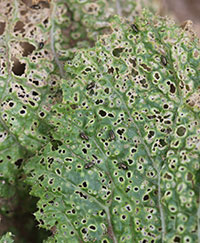
- They damage plants by chewing small “shotholes” in the foliage.
- Flea beetles can be found on a wide variety of plants. However, most flea beetles attack only a few closely related plant species.
- Flea beetle injury is most important when seedlings are becoming established or in the production of leafy vegetables. Injuries are usually minor and easily outgrown on established plants.
Introduction
Flea beetles are small beetles that jump. The adult beetles feed on leaves, chewing small pits that produce shothole wounds, resembling injuries that might be produced by fine buckshot. Young stages (larvae) of most flea beetles feed on the roots but some develop chewing leaves.
Young plants and seedlings are particularly susceptible to flea beetle damage. Growth may be seriously retarded and in severe infestations plants can be killed. The holes in leaves also damage plant appearance, which can be important when growing certain leafy vegetables and ornamental flowers.
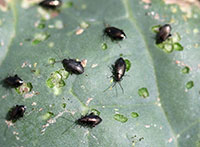
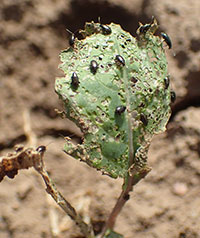
Dozens of species of flea beetles are found in Colorado (Table 1). Although there is some overlap of host-preference, each type of flea beetle has a decided preference for certain plants. For example, some flea beetles feed only on potatoes, tomatoes and other members of the nightshade family. Others have a taste for broccoli, cabbage, and other crucifer crops. One group of flea beetles (Aphthona species) was purposefully introduced into the state to feed on and help manage leafy spurge, an important invasive weed.
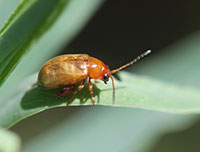
occur in Colorado that feed on leafy spurge, a serious invasive weed.
Life History and Habits
Flea beetles spend the winter in the adult stage, hidden under leaves, dirt clods, or in other protected sites. They typically begin to become active during warm days in early-mid Spring and then seek out the types of plants on which they feed. Flea beetles can fly well and may fly long distances in search of suitable plants.
Adults of all flea beetles feed on leaves of plants. However, immature stages (larvae) may have differing habits. Most develop in the soil, feeding on plant roots. Soil-dwelling flea beetle larvae are very small, pale-colored and worm-like. Normally, they cause little, if any, significant damage to plants. Exceptions include larvae of the tuber flea beetle, which can cause scarring of potato tubers, and larvae of flea beetles that feed on leafy spurge. Flea beetles that develop in the soil as larvae often can produce 2 or 3 generations a season, such as the “cabbage flea beetles” and the “potato flea beetles.”
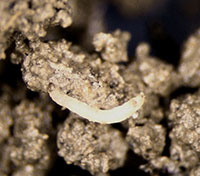
flea beetle larvae develop on the roots of plants.
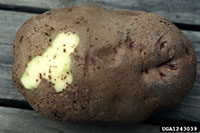
feeding injuries of the tuber flea beetle.
A small number of flea beetles have larvae that develop on the leaves of plants. Apple flea beetle, which has larvae that develop on evening primrose, is an example of a flea beetle with this habit. Apple flea beetles have larvae that are black or gray and have small legs. The larvae produce large and irregular holes in leaves rather than shotholes. Flea beetles that develop on leaves are generally the larger kinds of flea beetles, with apple flea beetle being the most common species. Adults do not make shotholes but chew in a more generalized pattern. Flea beetles with larvae that develop on leaves often have only a single generation a year, but the adults may be present for several months.
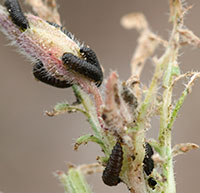
the leaves and flowers of evening primrose.
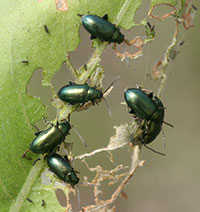
Flea Beetle Management
Although flea beetles are common, injuries often are insignificant to plant health. On established plants, 20-30 percent or more of the leaf area must be destroyed before there is any effect on yield. The plants most likely to benefit from treatment are sensitive seedlings, plants grown for ornamental purposes or for edible greens, and potatoes that may be affected by tuber flea beetle larvae.
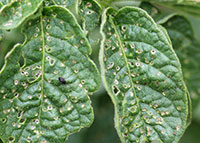
effect to well established plants. These injuries were
produced by potato flea beetle, a common flea beetle
on potatoes and tomatoes.
Cultural Controls
Because seedlings are most at risk, use transplants or plant seeds in a well-prepared seedbed to hasten growth and allow plants to overcome injury. In home gardens, try high seeding rates to spread the injuries produced by adult feeding. Thin the plants once they are established and less susceptible to damage. Trap crops work in some situations. Trap cropping involves purposefully planting a highly favored crop to attract flea beetles away from the main crop. The best regional example of this practice involves use of radish or daikon to protect seedlings of other crucifers (e.g., broccoli, cabbage, Brussels sprouts) that are susceptible to western black flea beetle and crucifer flea beetle. The trap crop may then be harvested or destroyed after the main crop has established itself sufficiently to outgrow flea beetle injury.
It may also be possible to avoid injury by scheduling plantings so that seedlings are emerging during periods of low flea beetle activity. Cabbage flea beetles are usually most damaging in June, when they move from winter annual mustard weeds, such as flixweed, on which the early spring generation develops. Most vegetable crops that are well established can tolerate a large amount of injury by flea beetles without affecting yield.
Mechanical and Physical Controls
Floating row covers or other screening can exclude the beetles during seedling establishment. In isolated plantings, thick mulches may also help reduce the number of flea beetles by interfering with activity of the root and soil stages of the beetle. Flea beetles can be collected off foliage using sweep nets or a portable vacuum. Care must be made when using these methods as flea beetles will readily jump from plants and escape treatment. Sweep net/vacuum treatments must be repeated frequently as reinvasion of plants can be rapid.
Biological Controls
There are numerous natural enemies of flea beetles – predators, parasitoids, and disease producing pathogens. Most of these attack larval stages and these regularly help reduce overall populations of flea beetles. However, flea beetle adults are highly mobile and no biological controls that can be applied by a gardener will likely reduce flea beetle damage in a planting.
Chemical Controls
When high numbers of flea beetles are present on plants and threaten injury, insecticides are usually the most effective means to manage the problem (Table 2). Some flea beetle products act to repel flea beetle feeding (e.g. diatomaceous earth, kaolin clay) but most can kill flea beetles. However, among those insecticides there is a considerable range in how long they can work to protect plants from flea beetles – from a few hours (pyrethrins) to several days (cypermethrin, cyhalothrin). Since the most serious problems with flea beetles involve species that are highly mobile and readily reinvade plantings (cabbage flea beetles, apple flea beetle), insecticides with longer persistence will usually work best. More than one application may be needed to protect seedling crops since leaf growth produced after application will be little protected.
As with all pesticides, carefully read and follow all label directions. Pay particular attention to ensure that any flea beetle insecticides being considered are properly registered for use on the crop.
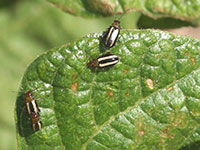
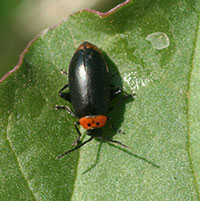
Table 1: Some common flea beetles found in Colorado.
| Common name | Scientific names | Host plants, comments |
|---|---|---|
| Cabbage flea beetle (western black flea beetle, crucifer flea beetle) | Phyllotreta pusilla, P. cruciferae | Wide host range, primarily of cabbage family plants (Cruciferae family). Western black flea beetle is the most damaging flea beetle species in the state. Two and occasionally three generations are typical. Winter annual mustards, such as flixweed, are important early season hosts for these insects. |
| Palestriped flea beetle | Systena blanda | Has the widest host range of all flea beetles including squash, beans, corn, sunflowers, lettuce, potatoes and many weeds. |
| Potato flea beetles | Epitrix cucumeris, E. subcrinita, E. parvula | Tomato, potato and other nightshade family plants. Occasionally they may chew on and scar developing fruit. |
| Tobacco flea beetle | Epitrix hirtipennis | Eggplant and some other nightshade family plants. Most common in warmer areas of the state. |
| Tuber flea beetle | Epitrix tuberis | Potatoes. Larvae are associated with tuber injuries. |
| Horseradish flea beetles | Phyllotreta armoraciae, P. albionica | Horseradish, occasionally other mustards. |
| Leafy spurge flea beetles | Aphthona flava, A. lacertosa, A. nigriscutis | These three flea beetles were purposefully introduced into Colorado to help control leafy spurge, an invasive weed. Younger larvae develop on roots and late stages burrow into the crown of the plant. |
| *Apple flea beetle | Haltica foliaceae | Larvae feed on evening primrose (Oenothera); Grape, Epilobium, crabapple, Zauschneria and other plants are occasionally damaged by the adults. |
| *Sumac flea beetle | Blepharida rhois | Skunkbush sumac. |
| * “Spinach flea beetles” | Disonycha triangularis. D. xanthomelas, D. collata | Mostly pigweeds and other Amaranthus species. Beets, spinach and related plants are occasional hosts. |
| *Larvae and adults feed on leaves. Larvae of other flea beetles develop on roots. | ||
Table 2: Some insecticides that can be used for managing flea beetles.
| Common name | Comments |
|---|---|
| acetamiprid | Use allowed on most vegetable crops. Fairly long persistence of control (several days). |
| permethrin | Use allowed on most vegetable crops. Fair persistence of control (couple of days). |
| gamma-cyhalothrin | Use allowed on most vegetable crops. Fairly long persistence of control (several days). |
| zeta-cypermethrin | Use allowed on most vegetable crops. Fairly long persistence of control (several days). |
| spinosad | Use allowed on most vegetable crops. Fair persistence of control (couple of days). Most formulations allow use in Certified Organic production. |
| pyrethrins | Use allowed on most vegetable crops. Very short persistence (hours). Many formulations allow use in Certified Organic production. Some formulations combined with horticultural oils. |
| diatomaceous earth | Has some repellent effect on flea beetles. Most diatomaceous earth products do not allow use on growing plants; check labels to ensure product can be use on garden plants. |
| kaolin clay | Has some repellent effect on flea beetles. Presently available only through mail order. Use allow in Certified Organic production. |
Reference: CSU Fact Sheet 5.592