


Quick facts…
- Gambel oak is commonly found throughout western Colorado between 6,000 and 9,000 feet in elevation.
- Recurring fires often cause oak stands to develop into large thickets; younger thickets created in this way can become exceptionally dense and almost impenetrable for livestock and wildlife.
- Control, or eradication, of Gambel oak requires physically removing the stem and as much of the root system as possible.
Gambel Oak Ecology
Gambel oak (Quercus gambelii), commonly found throughout western Colorado between 6,000 and 9,000 feet in elevation, generally dominates the region between the lower piñon-juniper zone and the aspen or ponderosa pine zone above. This shrub can be found throughout southern Colorado and along the Front Range. Gambel oak is usually found in conjunction with serviceberry (Amelanchier alnifolia), snowberry (Symphoricarpus oreophilus), mountain mahogany (Cercocarpus montanus), chokecherry (Prunus virginiana), and a variety of forbs and grasses. In south-central Colorado, Gamble oak is often associated with sumac and New Mexico locust.
Figure 1
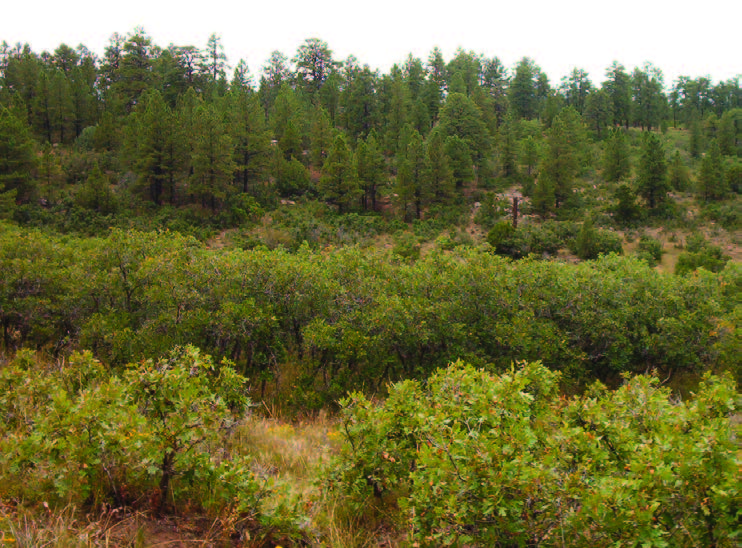
Gambel oak rarely reproduces from acorns; most reproduction is vegetative with sprouts occurring from a deep, extensive root system. Clones of oak brush spread slowly but tend to persist in previously colonized areas.
Recurring fires often cause oak stands to develop into large thickets; younger thickets created in this way can become exceptionally dense and almost impenetrable for livestock and wildlife. Older stands tend to form clumps with a lush understory of grass and forbs, often attaining tree-like form with heights up to 20 feet.
Gambel oak provides cover and nesting habitat for many forms of wildlife (birds, mammals, amphibians, etc.). The foliage and acorns offer valuable food for many of these wildlife species, such as wild turkey, mule deer, and black bear. Acorns produced by the larger stands of oak brush are critical for turkey.
Figure 2
Although not highly palatable, the availability and abundance of Gambel oak, particularly on winter ranges, make this an important wildlife plant. Gambel oak is especially important to mule deer; on some summer ranges it reportedly provides more deer forage than all other species combined. Elk generally rely on Gambel oak during the spring and winter. Acorns of Gambel oak are an important mast crop in many areas, particularly for black bears in the fall.
Gamble oak makes excellent firewood and is used extensively for this purpose. Occasionally, this species is used for fence posts but, as a rule, does not grow to the size necessary to produce sawn wood products.
Standard Treatment Methods for Oak Brush
Various treatment methods may be used to Gambel oak, including herbicides, mechanical treatment, and prescribed burning. In many cases, the objective of these treatments is to increase available forage for wildlife or livestock. Managed grazing of goats is also an effective treatment to reduce or eradicate oak.
Appropriate treatment is tied directly to land management objectives. Generally, managing Gambel oak dominated landscapes with the goal of achieving a diversity (mosaic) of shrub species, size, and densities can often accomplish multiple objectives (i.e., reducing wildfire hazards, enhancing aesthetics, screening, stabilizing soil and watershed outputs, increasing forage production, and enhancing various elements of wildlife habitat, food, cover, etc.).
Control, or eradication, of Gambel oak requires either physically removing the stem and as much of the root system as possible (typically not practical or desired) or continued top-killing of the plant so that stored energy in the root system is depleted to a greater degree than energy is restored through photosynthesis. The second option requires commitment and persistence.
Chemical Treatment
Most studies using herbicides report significant above-ground stem kill, but subsequent sprouting. In recent years, applications with Garlon have shown to be effective at completely killing oak brush when applied as either a foliar spray or as a stump treatment. For greatest effectiveness, stump treatments must be applied before the wood dries, usually within one hour of cutting.
Mechanical Treatment
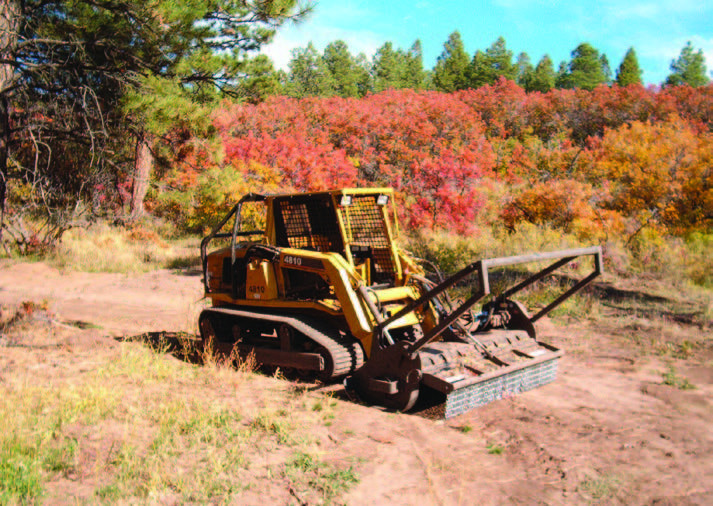
Thinning oak brush by hand can be time consuming and labor-intensive due to the density of the vegetation. Prolific sprouting follows cutting unless herbicides are applied to the cut stumps. Mechanical treatments such as chaining, root plowing, dozing, and roller-chopping are somewhat expensive and cannot be used on steep slopes. Various forms of mastication equipment can also be used on oak brush such as a Hydroaxes©, Bull Hog© mowers, timberaxes, or Fecon© rotary cutting heads. Suckering normally follows these treatments, even when the overstory is completely removed. So, additional action is needed if oak control is desired. Mechanical treatment can also make the site susceptible to weed invasion.
Figure 3
Figure 4
Prescribed Burning
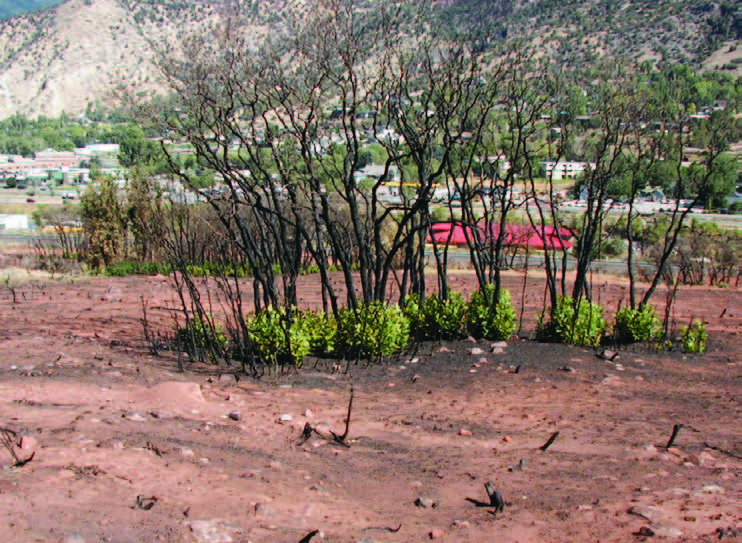
Fire readily kills the above-ground portions of oak brush. However, intense suckering follows almost immediately and usually causes the stands to become even denser. With prescribed burning, a commitment to repeated burning on the same is necessary to effectively reduce the oak brush over the long term.
Figure 5
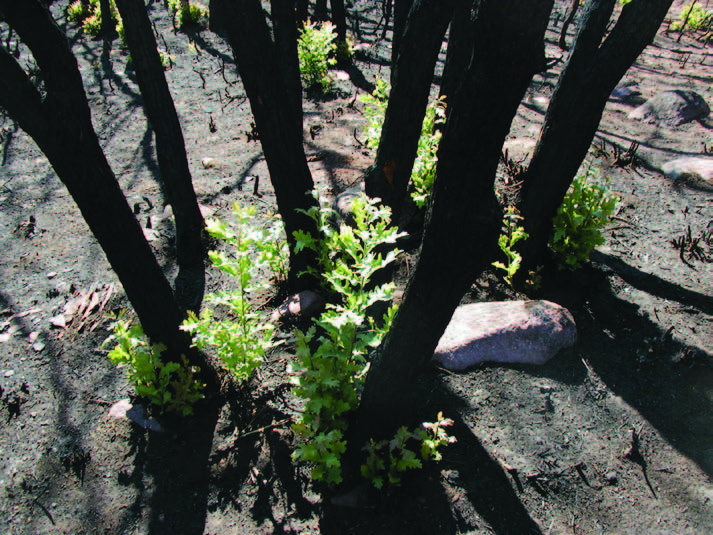
Prescribed fire also can be an effective tool to produce younger plants that are more palatable to wildlife.
Treating Gambel Oak for Wildfire Safety
Gambel oak does not burn readily except under favorable conditions such as during continued drought or in the fall or early spring when vegetation dries out. Late spring frosts that kill the leaves can cause extreme fire behavior later in the summer; the dead leaves tend to cling to the stem and act as dry aerial fuels. Under certain conditions, fires in oak brush can spread quickly and fire behavior can be similar to fuel models in southern California.
Fuel Hazards
Fuel hazard measures refer to the continuity, both horizontal (across the ground) and vertical (from the ground up into the vegetation crown). Fuels with a high degree of vertical and horizontal continuity are the most hazardous, particularly when they occur on slopes. Heavier fuels (brush and trees) are more hazardous, producing more intense fires than light fuels (grass). Mitigation of wildfire fuel hazards focuses on breaking up the continuity of fuels. Increasing distances between fuels is necessary on slopes.
Standards for Fuel Mitigation
Trees: woody perennials, usually having one dominant vertical trunk and a height greater than 15 feet at maturity. Spacing requirements between trees are a minimum of 10 feet from the edges of the crowns. (This does not apply to mature stands of aspen trees where ladder fuels have been removed as described below. Follow the spacing requirements in areas with young aspen.)
Brush and Shrubs: woody plants, smaller than trees, often formed by a number of vertical or semi-upright branches arising close to the ground. Brush is smaller than shrubs and can be either woody or herbaceous vegetation. Thinning of brush and shrubs can often be accomplished by separating clumps rather than individual stems. Spacing requirements between clumps of brush and/or shrubs are 2½ times (2½X) the height of the vegetation. The maximum diameter of clumps is 2 times (2X) the height of the vegetation. (Make all measurements from the edges of vegetation crowns.)
Example: Spacing between shrub clumps 6 feet in height is 15 feet or more. The diameter of shrub clumps is less than 12 feet (measured from the edges of the crowns). Branches are pruned to a height of 3 feet. Certain brush species, such as Gambel oak, serviceberry, and snowberry re-sprout vigorously following cutting. Applying herbicide to stumps immediately following cutting may be necessary to effectively reduce long-term fire hazards. An alternative to herbicide treatment is to mow sprouts annually.
Ladder Fuels: vegetative materials with a vertical continuity that allows fire to burn from ground level up into the branches and crowns of trees. While potentially very hazardous, ladder fuels are relatively easy to mitigate. The first step in fuel mitigation is to remove all ladder fuels beneath tree canopies. In the remaining areas, prune all branches of shrubs or trees up to a height of 10 feet above ground (or one-half the height of the plant, whichever is least). Lastly, chip and/or remove pruned material from the site.
Grasses: mow dead, dry grass to a height of less than 6 inches.
Figure 6
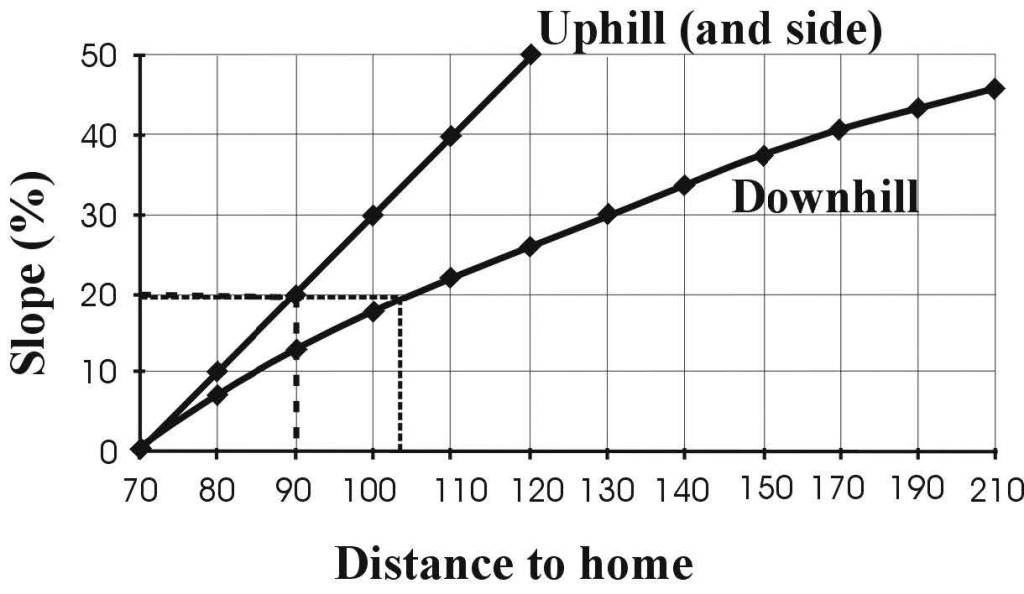
Slope Adjustment Factors
The minimum distance from a structure for brush, shrub, and tree fuel treatment is 75 feet on level ground. (Where only grasses exist and no additional vegetative landscaping is planned, the minimum distance is 30 feet.)
On slopes downhill from structures, complete defensible space thinning according to the distances in Table 1. Uphill and side distances remain 75 feet, unless the property slopes in multiple directions.
Table 1. Defensible space thinning guidelines.
| 1 percent to 20 Percent slopes = | |
|---|---|
| Brush/shrubs | 75’ from structure; 3X height separation distance between vegetation. |
| Trees | 75’ from structure; 10-foot crown separation distance between trees. |
| Grass | 30’ from structure; mow dead, dry grass to 6 inches or less in height. |
| 21 percent to 40 percent slopes = | |
|---|---|
| Brush/shrubs | 150’ from structure; 4X height separation distance between vegetation. |
| Trees | 150’ from structure; 20-foot crown separation distance between trees. |
| Grass | 50’ from structure; mow dead, dry grass to 6 inches or less in height. |
| Greater than 40 percent slopes = | |
|---|---|
| Brush/shrubs | 200’ from structure; 6X height separation distance between vegetation. |
| Trees | 200’ from structure; 30-foot crown separation distance between trees. |
| Grass | 75’ from structure; mow dead, dry grass to 6 inches or less in height. |
For more information:
From Colorado State Forest Service, Colorado State University, Fort Collins, CO 80523-5060; (970) 491-6303; csfs.colostate.edu
- FireWise Construction – Design and Materials
- Home Fire Protection in the Wildland Urban Interface
- Landowner Guide to Thinning
From Colorado State University Extension, 115 General Services Building, Fort Collins, CO 80523-4061; (970) 491-6198; E-mail: resourcecenter@ucm.colostate.edu:
Pesticide disclaimer: This publication may contain pesticide recommendations that are subject to change at any time. These recommendations are provided only as a guide. It is always the pesticide applicator’s responsibility, by law, to read and follow all current label directions for the specific pesticide being used. Due to ever-changing labels and product registrations, some of the recommendations given in this writing may no longer be legal by the time you read them. If any information in these recommendations disagrees with the label, the recommendation must be disregarded. No endorsement is intended for products mentioned, nor is criticism meant for products not mentioned. The author(s), Colorado State University, and Colorado State University Extension assume no liability resulting from the use of these recommendations.