Dryland pasture condition assessment & guidelines
Maintaining healthy dryland small acreage pastures can be challenging in Colorado, but it is a realistic goal. This guide will help pasture managers assess pasture condition and offer suggestions for improvements. Key strategies, such as determining carrying capacity, implementing rotational grazing, using indicator grasses to monitor when to start and stop grazing, and keeping grazing records, will help improve pasture health and production.
Too many weeds and not enough grass?
Proper grazing techniques can produce greener and more forgeable pastures or rangeland. This simple technique involves allowing grass time to regrow between grazing intervals, and avoiding overgrazing. Pasture management will reduce weeds by maintaining healthy vegetation. The roots of the desired forbs, grasses and shrubs will out-compete weeds.
Why will grazing management produce more forage?
Animals will seek out the most palatable forage in a pasture. If animals are allowed to continuously graze an area, they will re-graze and re-graze the most palatable and succulent re-growth rather than eating more mature plants. Eventually, the most valued grasses will disappear and undesirable weeds will flourish.
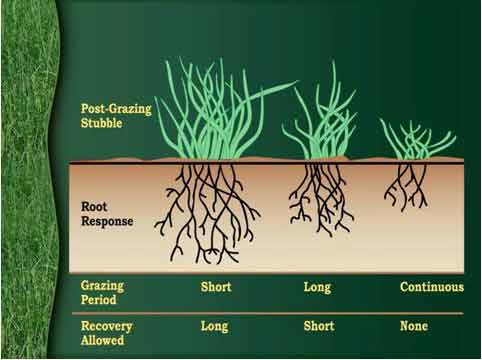
Continuous grazing is hard on plants, using up their root reserves and slowing their recovery. This picture shows how grass roots are affected by overgrazing. The plant on the right has been continuously grazed while the plant on the left has been grazed for a short period and allowed to recover and regrow for a longer period.
General grazing guidelines
Realize that the amount of forage animals eat can not exceed half of the plant production in your pasture. Keep animals in a barn or in a small sacrifice area. Only allow limited grazing and exercise time in the pasture to reduce overgrazing. Try these simple grazing management techniques for healthier grass:
- Learn about the dominant forbs, grasses, and shrubs in your pasture or rangeland. Determine if the plants are warm or cool season. Cool season grasses grow in the spring and fall, while warm season grasses grow in the heat of the summer.
- Graze for short periods of time (7-10 days) and allow long re-growth periods (70-120 days) where the grass has time to recover with no grazing stress. Designate a small sacrifice area or corral to keep animals while grasses are recovering.
- Allow grass to reach the proper height in inches before grazing. This will enable your grass to build strong roots for vigorous photosynthesis and growth.
- Know when to remove your animals from an area. A rule of thumb is Take Half Leave Half. Never allow the grass to be grazed below a protective height.
- If you have limited acres of pasture, always supplemental feed before putting animals on pasture. This will reduce the amount of pasture plants eaten.
- Walk your pastures and monitor grass growth. Be flexible. Temperature and precipitation will vary from year to year, as will grass recovery time.
- Develop a grazing plan with help from your local NRCS and CSU Extension.
How can I make the most of my pasture or rangeland?
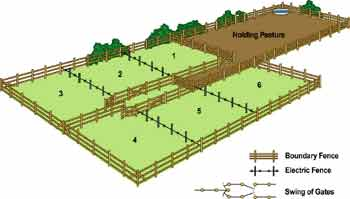
Establishing a rotational grazing system will allow you to make the most of your grass. Rotational grazing is defined as a practice in which 2 or more pastures are alternately rested and grazed in a planned sequence. The system at an intensive management level provides 70-120 days of rest periods followed by 7-10 days of grazing. Temporary fencing can be set-up to create smaller paddocks within a large pasture. Ten or more pastures are recommended per heard to create a high-intensity system.