


In blackberries, the receptacle, which is the white core of the fruit, is part of the fruit when picked. In raspberries the receptacle remains on the plant when picked.
Types and Cultivars
Trailing blackberries produce vigorous primocanes (first-year vegetative canes) from the crown of the plant rather than roots. Second year floricanes produce long shaped fruit with relatively small seeds and a highly aromatic, intense flavor. They are not hardy in climates like Colorado, experiencing damage at temperatures of 13ºF and below mid-winter, and in the 20ºF late winter/early spring. [Figure 1]
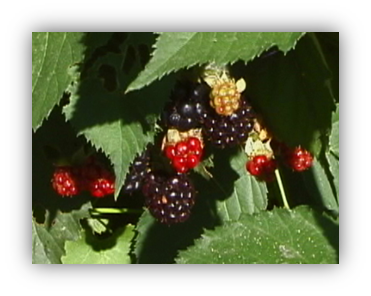
Erect blackberries have stiff arching canes that are somewhat self-supporting. However, they are much easier to manage when trellised and pruned. Plants can become invasive to an area as they can produce new primocanes (suckers) from roots. Summer prune or tip primocanes to encourage branching and increase fruit production on the second year floricanes.
Semi-erect blackberries are thornless and produce vigorous, thick, erect canes from the crown. No primocanes are produced from the roots (suckering). Prune primocanes in the summer to encourage branching and increase fruit production on floricanes. A trellis is required to support the canes. Semi-erect blackberries generally produce a higher fruit yield than trailing or erect types. Fruit quality is similar to erect blackberries. Suggested cultivars include Triple Crown and Chester Thornless.
Blackberry/red raspberry hybrids are usually natural crosses between blackberries and raspberries. Because the receptacle (white core) comes off with the fruit, they are generally considered a type of blackberry. Popular cultivars include Boysen (Boysenberry), Logan (Loganberry), and Tay (Tayberry).
Planting and Care of Blackberries
Blackberries produce best in full sun but are tolerant of partial shade. They are more tolerant of clayey soils than raspberries. However, good drainage is essential. Because blackberries may last ten to fifteen years, extra attention to improving the soil organic content to 5% gives big dividends.
For semi-erect cultivars, space plants five to six feet apart. Space erect cultivars two to three feet apart. Space trailing cultivars four to six feet apart. Start with certified disease-free nursery stock. Planting would be similar to raspberries. To reduce virus problems, do not plant blackberries adjacent to raspberries.
Irrigation, fertilization, and pest management are similar to raspberries. Refer to CMG GardenNotes #761, Growing Raspberries in Colorado Gardens.
Trellising and Pruning
Trellising is recommended for all blackberries.
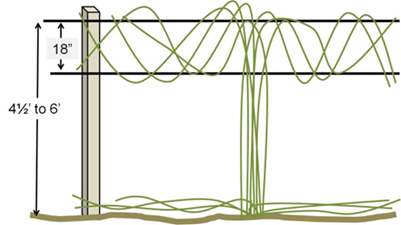
Trailing Blackberries. These are easy to grow on a two-wire system. Run a top wire at five to six feet with a second line eighteen inches below the top wire.
After the first year, there will be fruiting floricanes along the wires. Train the new primocanes into a narrow row below the fruiting canes. Directing all canes in one direction may make it simpler.
After the fruit harvest period, the old fruiting (floricanes) should be removed. However, unless there is a significant disease present, it is best to delay removing the old fruiting canes until they have died back considerably. This allows the dying canes to move nutrients back into the crown and roots. After the old fruiting canes are removed, train the primocanes up on the wires. Work with one or two canes at a time in a spiral around the trellis wires. Canes from adjacent plants may overlap a little. No pruning of healthy primocanes should be necessary. [Figure 2]
In areas with low winter temperatures, leave the primocanes on the ground for the winter where they can be mulched for winter protection. In the spring, after the chance of extreme cold has passed, train the old primocanes, which are now floricanes, up onto the wires. Avoid working with the canes in cold weather, as they are more prone to breaking.
Erect Blackberries. These produce stiff, shorter canes that come from the crown and root suckering, forming a hedgerow. A T-trellis supports erect blackberries well.
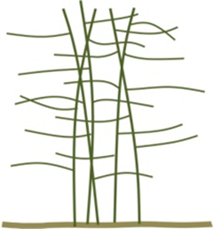
Erect blackberries require summer pruning. Remove the top one to two inches of new primocanes when they are four feet tall. This causes the canes to branch, increasing next year’s fruit yields. This will require several pruning sessions to tip each cane as it reaches four-foot height. Primocanes, suckers, which grow outside of the hedgerow should regularly be removed.
In the winter, remove the dead floricanes (old fruiting canes) from the hedgerow. Shorten the lateral branches to 1½ to 2½ feet. [Figure 3]
Primocane-Fruiting Erect Blackberries. For the best quality fruit, cut all canes off just above the ground in the late winter. In the summer, when the primocanes are 3½ feet tall, removed the top six inches. The primocanes will branch, thereby producing larger fruit yields in the fall.
Semi-Erect Blackberries are vigorous and easier to manage on a Double T trellis. Install four-foot cross arms at the top of a six foot post. Install a three-foot cross arm about two feet below the top line. String high-tensile wire (purchase at your local hardware store) down the rows, connecting to the cross arms.
Semi-erect blackberries require summer pruning. When the primocanes are five feet tall, remove the top two inches to encourage branching. This will require several pruning sessions to prune canes as they reach this height.
In the winter, remove the dead floricanes (old fruiting canes). Spread the primocanes (next season’s floricanes) out along the trellis. Canes do not need to be shortened; however they can be if they are difficult to train.
This publication, reference GardenNotes #762, is developed as part of the Colorado State University Extension Master Gardener Program.