


Types and Cultivars
June-bearing cultivars have one large crop in early summer (late June to early July along the Colorado Front Range) with larger fruit and higher yields. They are less hardy in climates like Colorado because of rapid springtime temperature swings. They are often damaged by late spring frosts. Strawberries are popular for freezing and making jams with flavorful, aromatic berries. Suggested cultivars include Honeoye, Guardian, Kent, Redchief, Delite, Jewel, Mesabi, A.C. Wendy, Cabot, Bloominden Gem, Carskill, and Geneva.
Ever-bearing cultivars have two crops, one in early summer and a second crop in the fall. They tend to be more dependable than June bearing cultivars in cold climates like Colorado. Berries are smaller than the June bearing types. Suggested cultivars include Quinault, Ogallala, and Fort Laramie.
Day-neutral cultivars blossom most of the summer and fall in cycles lasting around six weeks each. Blossoming will slow or stop during hot weather. Fruit is typically small. These provide a light, daily harvest through most of the summer and fall. They need constant, light fertilization, and regular removal of runners. Suggested cultivars include Tribute, Tristar, Fern, and Mara Des Bois.
Plantings
The key to a good strawberry patch is well-drained soil high in organic matter. Strawberries need full sun (eight hours minimum), but do not perform well in reflected heat. They need protection from wind. In clayey soils, they grow better in raised beds that provide better drainage. Strawberries are shallow rooted and intolerant of weed competition. [Figure 1]
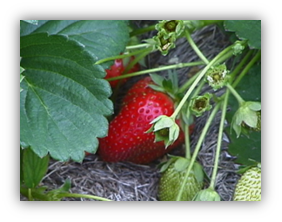
Due to soil borne diseases, avoid soils where strawberries, raspberries, tomatoes, peppers, eggplant, potatoes, and vine crops (squash, melons, pumpkins, and cucumbers) have been growing in the past four years.
Spring is the best time to plant strawberries. Make sure that plants are certified disease and insect free. If ordering bare rooted strawberries, ensure that they are shipped at the right time for your plant hardiness zone. If plants arrive and conditions are not favorable to plant, temporarily cover the roots with soil in a furrow to ensure that roots do not dry out. Do not plant roots that are dark or appear unhealthy. The strawberry patch may need to be covered for spring frost protection.
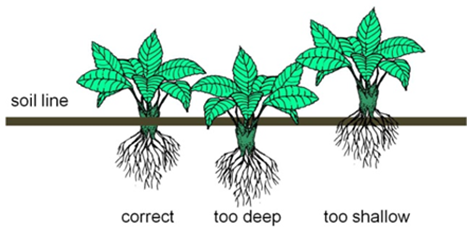
At the time of planting, strawberry plant crowns (short segment with roots below and leaves above) need to be at the soil line. If the plant is too deep (leaf stems buried), the plant rots. If too shallow (roots exposed), the plant dehydrates. [Figure 2]
June-Bearing Cultivars
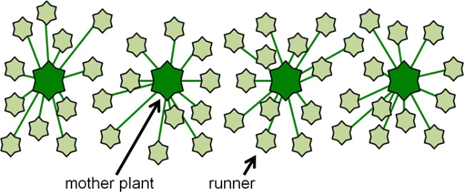
Planting – Since June-bearing cultivars set a lot of runners, they are planted in a matted row system. Set plants eighteen to twenty-four inches apart in rows four plus feet apart. Allow runners from the “mother” plant to fill in a matted row, to a plant population of five to six plants per square foot. Remove excessive runners. Prune off runners outside the matted row and all new runners after September 1st. [Figure 3]
First Season Care – Remove all flowers the first year. Flowering the first year decreases the growth and next season’s yields. If growth is weak and leaves are light green, fertilize lightly in June, July, and August. Use water-soluble fertilizers (like Miracle-Gro®, Peters, Rapid Gro, etc.) or one cup of 21-0-0 per one hundred square feet (broadcast over the bed and water it in).
General Care – Fertilize after the summer crop is growing with water solubles or one cup 21-0-0 per one hundred square feet (broadcast over the patch and water in). Strawberries need one inch of water (rain plus irrigation) per week during blossoming/fruiting. Water needs will be significantly less when not in fruit production. Iron chlorosis (yellow leaves with veins remaining green) is a symptom of over watering. Renovate every year or restart bed every two to four years.
Renovation of June-Bearing Growing Bed
- After the fruiting period, mow or cut foliage to two inches. Remove all plant debris.
- With shallow cultivation, create alternating strips (eight to ten inches wide) of plants left and plants removed.
- Allow runners to spread into the cleaned area, up to an optimum plant density of five to six plants per square foot.
- Remove excessive runners and all runners after September 1.
- In future years, alternate the strips by taking out the plants from the plant strips left the previous year.
Everbearing and Day-Neutral Cultivars
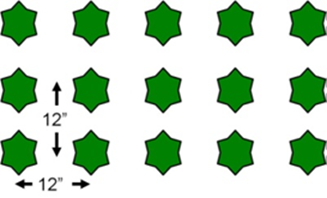
Planting – Because ever-bearing and day-neutral strawberries have fewer runners, the hill system is typically used. Set plants twelve inches apart in a double or triple wide row bed. Remove all runners as they develop. [Figure 4]
First Season Care – Remove the first flush of flowers and allow flowers to develop after July 1st.
General Care – Periodically remove all runners. Fertilize lightly throughout the growing season using water-soluble or ¼ cup 21-0-0 per one hundred square feet (broadcast this and water it in). Start a new patch every three to four years.
Harvesting
Pick strawberries every other day during the peak of the season. If berries are eaten or preserved immediately, harvest only red-ripe fruit and leave the caps on the plants. If the fruit will not be used for a few days, harvest the berries, caps and all, while still pink.
Winter Care
Blossom potential for the following year is based on plant health in the fall. Keep soil damp until fall frost. Then, withhold water to help harden off the plants. A final November watering before soils freeze helps prevent winterkill from drying.
In cold winter climates, like Colorado, a winter mulch of clean, seed-free straw (or similar material) is recommended. Apply it when the ground freezes (around December 1st along the Colorado Front Range). Apply two inches, but not more as it could smother the plants. In windy areas, bird netting over the mulch helps hold it in place. Mulching helps protect plants from drying winter winds and from root damage by alternative freezing and thawing of the ground.
In climates with late spring frosts (like Colorado), leave the mulch on as long as possible to restrain plant growth in the early spring. In March, start checking plants under the mulch for growth. As growth begins, remove mulch over time, allowing sunlight into the plants. Some mulch may remain on the soil to keep strawberry fruit off the ground.
Summer Mulch
Because strawberries are shallow rooted, summer mulch helps stabilize soil moisture and also helps suppress weeds. Use grass clippings (that contain no weed killers), seed-free straw, or other mulching materials. On ever-bearing and day-neutral cultivars (where runners are not allowed to set), black plastic mulch may be used. Plants must spread and cover the plastic mulch before summer heat sets in or it will be too hot.
Common Strawberry Pests
Abiotic
- Iron chlorosis (yellow leaves with green veins) is a symptom of over-watering. For additional information, refer to CMG GardenNotes #223, Iron Chlorosis of Woody Plants.
- Winter injury often kills plants.
- Drought injury (Strawberries are shallow rooted, requiring frequent, light irrigations).
- Hail readily defoliates strawberries.
- Wind.
Insects and Insect Relatives
- Lygus bugs feed on fruit. Control weeds, alfalfa, and legumes. Use insecticidal soap, avoid treating during bloom.
- Aphids.
- Slugs and millipedes. Decrease free moisture with proper watering. Remove fruit and decaying debris. Mulch to raise fruit up off the soil.
- Spider mites bronze leaves. Populations explode in hot weather and following the use of the insecticide Sevin (carbaryl).
- Spotted wing drosophila flies can affect ripening strawberries.
Diseases
- Strawberry leaf spots show as red spots with tan centers on leaves.
- Powdery mildew appears as white mold on leaves.
- Botrytis gray mold is the fuzzy mold on fruit.
- Red stele and black root rot complex are common root disorders.
- Verticillium wilt is a common soil borne disease.
- Virus complex. Strawberries are prone to a variety of viruses.
Wildlife
- Birds. Bird netting may be necessary to spread above and over the strawberry patch.
- Rabbits.
- Deer.
For addition information, refer to the following CSU Extension Publications:
- Fact Sheet #2.931, Strawberry Diseases.
- PlantTalk Colorado #1441, Strawberry Pests and Diseases.
This publication, reference GardenNotes #763, is developed as part of the Colorado State University Extension Master Gardener Program.