


Extending the Growing Season
Off-season vegetable production in a hobby solar greenhouse can be an enjoyable way for year-round gardeners to extend the harvest season of fresh vegetables. However, without the expense of a greenhouse, a gardener can extend the growing season weeks or even months with cold frames and tunnel gardening.
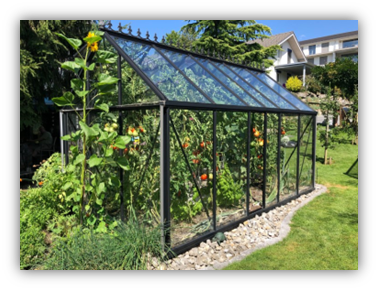
Winter vegetable production in a greenhouse is only cost effective with an energy efficient greenhouse structure, a well-designed solar collector, and optimum management. Winter vegetables have a slower growth rate due to low light intensity. Crops should be planted to obtain a near harvestable size by mid-October. The use of artificial light for vegetable production (except for starting transplants) is generally not cost effective.
A gardener’s success is dependent on the greenhouse design and construction to conserve energy and on the care given the greenhouse crops.
Before investing in a greenhouse, carefully consider your real interests in extending the gardening season. Are you only interested in adding a few weeks to the harvest season? Are you interested in year-round gardening in a solar greenhouse OR do you need a winter break?
Cool Season Vegetables
Cool season vegetables do well in the greenhouse or under a cold frame. High temperatures are not desirable, and an occasional near freezing dip will not harm crops. High light intensity is not as critical for cool season crops as for warm season crops.
General temperatures for cool season crops:
- Daytime: 50ºF to 70ºF.
- Short-term temperature extremes: 35ºF to 90ºF.
- Nighttime: 45ºF to 55ºF.
- Germination: 40ºF to 75ºF.
Table 1. Cool Season Vegetables Planting Guidelines
| vegetable | minimum container size* | minimum container spacing | remarks |
|---|---|---|---|
| Beets | 8” deep | 6” | Grow in fall and hold in cool greenhouse for winter use. Properly thin. |
| Broccoli, Cabbage, Cauliflower | 10” deep, 5 gallons per plant | 18” | High yield for space used. Avoid long-term temperature extremes. Heads split with warm, humid conditions. |
| Carrots | 12” deep | 3” | Extremely sweet with adequate water and cool temperatures. Use short varieties, like Short & Sweet or Scarlet Nantes. Questionable use of greenhouse space. |
| Chard | 8” deep | 9-12” | Does exceptionally well. |
| Kohlrabi | 8” deep | 9” | Does exceptionally well. |
| Leaf lettuce | 4” deep | 9” | Easy to grow in fall, winter and spring in solar greenhouse. Use softhead or leaf types. Keep temperatures under 70 ºF. |
| Green onions | 6” deep | 3” | Never let onions get dry. Sensitive to photoperiod (length of night). With short days (long nights), growth goes into leaf production. With long days (12-16 hours) energy goes into bulb production. |
| Peas | 8” deep | 6” | Use dwarf, edible-pod or snap types for salads and stir-fry. Avoid temperature extremes. Questionable use of space. Do not transplant well, not well suited to container gardening. |
| Radishes | 5” deep | 2-3” | Avoid water and heat stress. Must have 12 hours of light to root. For fall and spring crops in greenhouse. |
| Spinach | 8” deep | 6” | Needs cool greenhouse (45ºF to 50ºF) for best quality. Avoid temperature fluctuations. |
| Turnips | 8” deep | 6” | Good for fall and spring crops. |
*Larger container sizes will make crop easier to care for, providing a bigger supply of water and nutrients.
Warm Season Vegetables
Warm season vegetables require high light intensity and moderate night temperatures. They cannot be cost effectively grown during the winter in a hobby greenhouse without solar heat collectors or supplemental heat. Greenhouse climates control is critical for these fruiting crops to produce. Warm season crops are not compatible with cool season crops due to differing temperature needs.
General temperatures for warm season crops:
- Daytime: 60ºF to 85ºF.
- Short-term temperature extremes: 50ºF to 95ºF.
- Nighttime: 55ºF to 65ºF.
- Germination: 60ºF to 85ºF.
Table 2. Warm Season Vegetables Planting Guidelines
| vegetable | minimum container size* | minimum container spacing | remarks |
|---|---|---|---|
| Beans | 8” deep | 6” | Not a common greenhouse crop. Good production with adequate light and spacing in spring and fall. Poor winter production. May be questionable use of greenhouse space. |
| Cucumbers | 8” deep, 3-4 gallons/plant | 18” | Requires high humidity, high light intensity, and good moisture. Needs 75ºF to 80ºF day temperatures and 50ºF minimum nights. Avoid temperature fluctuations greater than 20ºF. Poor mid-winter production. Plant gynoecious greenhouse types. Needs good air circulation to minimize powdery mildew. |
| Eggplant | 8” deep, 4-5 gallons/plant | 24” | Hand pollination required. |
| Muskmelon | 8” deep, 5 gallons/plant | 24” | Uses lots of space for yield, try trellising. Needs 80ºF day temperatures. Requires hand pollination. Needs good air circulation to minimize powdery mildew. |
| Peppers | 8” deep, 2-5 gallons/plants | 15” | Minimum night temperatures of 55ºF. Hand pollination required. |
| Summer Squash | 8” deep, 5 gallons/plant | 24” | Hand pollination required. Needs good air circulation to minimize powdery mildew. Productive with good sunshine. |
| Tomatoes | 12” deep, 2-5 gallons/plant (depending on cultivar/plant size) | 24” | Minimum night temperature of 55 F. Hand pollination required. Productive with good sunshine. |
*Larger container sizes will make crop easier to care for, providing a bigger supply of water and nutrients.
This publication, reference GardenNotes #723, is developed as part of the Colorado State University Extension Master Gardener Program.