


Herbicides are products designed to kill plants. When applied incorrectly around trees they can damage or kill them. Herbicide labels contain information that can help you determine if and when they are safe to use near trees. Some tree species are more sensitive to certain herbicides than others. Some herbicides have a higher risk of damaging trees than others.
How Herbicides Can Damage Trees
- A tree or its suckers are directly sprayed – The tree is either accidentally sprayed or suckers coming from its root system (aspens, cottonwoods, crabapples are examples of trees that often produce root suckers) are mistaken for weeds and intentionally sprayed.
- Absorption through a tree’s root system – A tree’s root system can extend several times the width of its canopy. A larger shade tree can have roots across several residential yards. Root-absorbed herbicides applied even some distance from a tree’s truck can be absorbed and damage or kill a tree in this manner. This can occur with applications of extended-control herbicides or other root-absorbed products. [Figure 1]
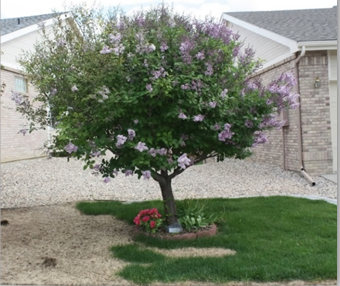
- Herbicide drift – This occurs when droplets of spray solution are blown onto non-target plants. Spraying during times when there is minimal wind and spraying in a manner that produces larger droplets (using lower pressure or specific nozzles designed to create larger droplets) are the simplest ways to avoid drift.
- Volatilization – This occurs when a pesticide volatilizes, normally due to high temperatures, and becomes a gas. The gaseous pesticide can then drift into nontarget plants. There are a number of factors that determine when a pesticide volatilizes, including air temperature, relative humidity, elevation, and the chemical properties of the specific pesticide. [Figure 2]
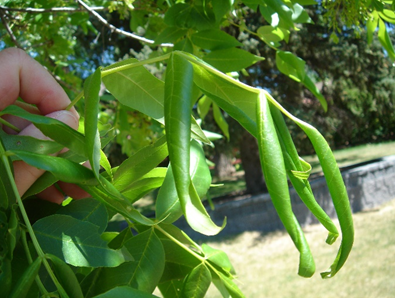
It is also important to understand the herbicide’s “mode of action” (how it works). Some may be contact herbicides, some may be root-absorbed, and some may be systemic.
How to Avoid Damaging Trees
Use Other Weed Control Methods Near Trees
Always use wide canvas straps with grommets at either end to attach staking wires to trees, like in Figure 2. These wide straps help distribute the pressure evenly. Wire threaded through hose concentrates the pressure, causing girdling and other damage.
Common Mistakes to Avoid
Common mistakes include applying 2,4-D when temperatures are too warm (greater than ~85-90 degrees F), applying extended control products in areas where a tree is rooting, and spraying suckers coming from a tree’s root system thinking they are weeds.
Apply Herbicides Properly
Read the label of any herbicide you are considering using and follow all instructions given there. Along with other information, the label will give the rate at which to apply the product and what protective equipment to wear while applying it. It is a crime to use an herbicide in a manner not consistent with the instructions on its label.
This publication, reference GardenNotes #656, is developed as part of the Colorado State University Extension Master Gardener Program.