


Garden Irrigation
In vegetable production, an adequate supply of water during the growing season is directly related to produce quality and yields. Many vegetables become strong-flavored or stringy with water stress. Overwatering some vegetables, like tomatoes, can reduce their flavor and texture.
Several gardening techniques (including soil preparation, mulching, and efficient irrigation) help conserve water in the vegetable garden.
As a rule of thumb, vegetables use around ¼ inch of water per day during typical summer weather. If the garden is watered every four days, apply one inch of water per irrigation. Hot, windy weather will increase water demand significantly. Beans and corn will be significantly higher in water demand during blooming or tasseling/silking.
Checking Soil Moisture Content
Check soil moisture regularly. Irrigate when the top two to four inches of soil is dry to the touch. This is especially important if using mulch, where surface evaporation is reduced.
Evaluating when the soil needs irrigation is rather subjective. The stick method which is judging moisture by the relative ease or difficulty of pushing a stick or screwdriver into the soil, is an old farmers’ standard. This will be easier when soil is wet than when dry. However, this very subjective method is specific to soil types and can be misleading to the novice. On compacted clayey soils, inserting a screwdriver may be somewhat difficult when moist and very difficult when dry. On sandy soils, a screwdriver may easily insert when somewhat wet or dry.
To check moisture levels, a soil probe is a useful tool to pull up soil samples from the rooting zone at a six-to-eight-inch depth. A small garden spade could be used.
Soil moisture meters are helpful in evaluating the soil moisture content under mulch. Realize however, that these inexpensive meters are slightly inaccurate. If the fertility level is high, the meter will read on the wet side. If the fertility is low, the meter will read on the dry side. Learn to interpret the meter reading for a specific soil by trial and error.
Automate the System With Controllers
Sprinkler or drip systems can be easily automated with a multi-zone controller like one used for the lawn. A small garden could be connected to the lawn’s controller as a separate zone and run on a different program. However, do not place the lawn and vegetable garden on the same zone, as each area’s water needs are not the same.
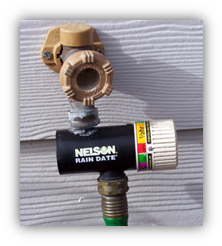
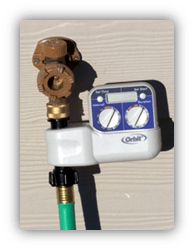
Single zone controllers are connected to the water spigot/garden hose. Some simple models are manually turned on and automatically turn off after the set number of minutes or gallons. More elaborate battery-operated models turn the water on and off at the day and time interval set by the gardener. [Figure 1]
Figure 1. Single zone controllers connect to the hose line.
Furrow Irrigation
For gardeners who use irrigation water from a ditch, furrow irrigation in the traditional row-style garden layout may be most practical. As a rule of thumb, adjust water flow for the furrow so that the water reaches the end of the row one-third of the time into the irrigation period. For example, if the irrigation period is fifteen minutes, the water should reach the end of the row in five minutes. Soil erosion and runoff are major disadvantages of furrow irrigation.
Sprinkler Irrigation
Sprinkler irrigation is considered to be a more efficient water delivery method than furrow irrigation. It is easy to measure the amount of water applied and easy to manage.
Because sprinklers wet the entire soil surface, weed seed germination may be high. Sprinkler irrigation is discouraged for use with vegetables prone to foliar diseases such as Early Blight (tomatoes, peppers, and potatoes). Splashing water spreads disease organisms and water on the leaves creates favorable conditions for disease development. Tall crops, such as corn and pole beans may interfere with water delivery patterns by blocking water streams to other plants and interior plants.
Generally, vegetables use around a quarter inch of water per day, depending on temperature, wind, and stage of crop development. For example, if the garden is watered every four days, apply one inch of water per irrigation. The gardener can quickly learn how long to run the sprinklers by measuring the amount of water in several straight-sided cans placed around the garden.
Delivery rates depend on the type of sprinkler heads used, pressure, and the spacing of heads in the garden. For example, pop-up spray heads deliver around one and a half inches per hour and would typically run forty minutes to apply one inch of water. Rotor type heads deliver around one-half inch per hour and would typically run for one hundred-twenty minutes to apply one inch of water.
Because the water needs of the vegetable garden are different from a lawn, it should be on a different irrigation zone than the lawn. Water use will be low in the spring when crops are small, and temperatures are cool. Water needs will increase as temperatures rise and crops come into bloom.
Drip Irrigation
Drip irrigation is well suited for the block-style garden layout and raised beds. Several different types of drip systems are available including:
- In-Line Drip Tubing – Emitters are found in the tubing every six, twelve, or twenty-four inches; twelve inches is most common in the home garden trade.
- Soaker Hose and Soaker Tubing – Emits water along the entire length of the hose.
- Bubblers and Drippers – Emitters or drippers are placed to water individual plants.
A disadvantage of drip systems is that they require relatively clean water. This is generally not a problem when using drinking quality municipal water supplies. Depending on water quality, drip irrigation may not be practical for many non-potable water sources such as gray water and rain barrel water. Systems readily plug with dirt, algae, or salts in the water. The filtering system required may be expensive and high maintenance.
Ideally, an in-line drip hose or soaker hose is placed on the soil surface under the mulch. The soaker hose may also be buried two inches into the soil to protect the hose from breaking down by sunlight.
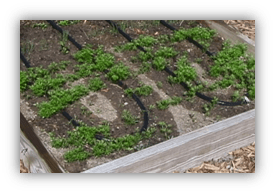
On a raised-bed box, space the drip line/soaker hose at twelve inch spacing. A four-foot-wide box would have four runs of the drip line/soaker hose up and down the box as illustrated in Figure 2. For larger vegetables like corn, squash, and cole crops (three plants across a four-foot-wide bed) make three runs up and down a four-foot-wide box. On a two-foot-wide raised bed box for tomatoes or beans, the drip line/soaker hose runs down and back.
Drip systems are designed to run on low pressure. High pressure may split the hose and pop connections. The desired low pressure is easy to achieve with pressure regulators that have hose-end fittings (found with the drip system supplies). If the garden plantings have changing elevations, a pressure regulator will be needed for every two-foot change in elevation. [Figure 3]
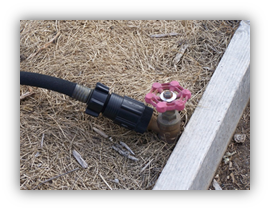
Determine the drip system’s run time by examining the soil moisture content. Timing will vary with the brand of hose, water pressure, and spacing of emitters and plants.
Soaker Hose and Soaker Tube
The soaker hose and soaker tube type of drip systems allow water to seep out the entire length of the hose as seen in Figure 4. It is easy to use in traditional row-style or raised-bed gardens.
These can be connected by manually connecting the garden hose to each line at each irrigation session or by connecting a series of dedicated garden hoses to a series of lines. On raised-bed gardening, it is easy to run a water line with a tap to each box. Several small boxes may run together in the same zone.
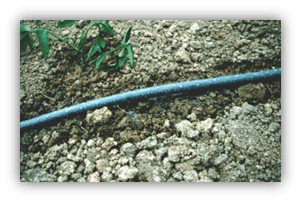
For uniform water delivery, keep soaker hose and soaker tube lines short, generally twenty-five feet or less. With longer lengths, water delivery will be greater at the top of the hose line and less at the bottom. The ground must be reasonably level. On slopes, run several short lengths.
Several brands and styles of soaker hoses and tubes are available in the home garden trade.
Half-Inch Soaker Hose – These are found in the garden hose section of many local retailers. Most brands are half-inch diameter hose that can be cut to any length and connects with standard hose fittings.
A small plastic disc fits inside the female hose connection as a pressure regulator (actually a flow regulator). With the reduced water flow, it may need to run for around an hour to adequately water the garden. It works better to use the pressure regulators with hose-end fittings found with the drip irrigation supplies. With this type of regulator, the drip line runs need to run ten to twenty minutes to adequately water the garden. Without a pressure regulator of some type, the soaker hose tends to rupture sending out steams of water to specific spots rather than dripping along the line.
This half-inch hose style is more tolerant of small amounts of dirt, algae, or salts in the water than other types of drip systems and may be successful on some non-potable water sources. Periodically, open up the end of the hose and flush out soil deposits.
Quarter-Inch Soaker Tubing – A quarter inch soaker tube is available in the drip irrigation section at garden stores. Cut the soaker tubing to desired length and connect with drip system components. An in-line pressure regulator is required; otherwise, the fitting may pop or leak.
Because the soaker tubing has a higher delivery rate, it cannot be on the same zone as other in-line drip hoses, button emitters, or bubblers.
View these other sources for more information about vegetable irrigation.
CMG GardenNotes:
- #710, References and Study Questions.
- #715, Mulches for the Vegetable Garden.
- #716, Water Conservation in the Vegetable Garden.
Planttalk Colorado™
- #1842, Watering Vegetables.
- #1826, Water Related Problems in Vegetable Gardens.
This publication, reference GardenNotes #714, is developed as part of the Colorado State University Extension Master Gardener Program.