


Quick facts…
- About 80 different species of lady beetles (a.k.a., “ladybugs” and “ladybirds”) are present in Colorado.
- Adults and larvae feed on a variety of pest insects and mites, notably aphids and scales.
- Lady beetles can be invited into a garden by providing plants that adults use as nectar/pollen sources, sustaining levels of aphids or other prey, and using insecticides with care.
- The Mexican bean beetle feeds on bean leaves and pods. The multicolored Asian lady beetle may be a nuisance when they enter homes during winter, often in large numbers.
Introduction
Lady beetles, also known as “ladybugs” or “ladybird beetles”, are familiar insects. Some 70 species are native to Colorado, and about 10 to 12 additional species have established during the past century.
Overwhelmingly, the habits of lady beetles are highly beneficial to human interests. Both the adult lady beetles and the grub-stage larvae have chewing mouthparts and are voracious predators of other insects. Although each type of lady beetle has preferences for what they will eat (e.g., aphids, scales, spider mites, mealybugs, etc.), they tend to have fairly broad tastes and feed on almost any small arthropods (insects, mites) or insect eggs that they can successfully attack and ingest.
In general, most commonly observed Colorado lady beetles (the genera Hippodamia, Coccinella, Harmonia, Coleomegilla, and Hyperaspis) feed primarily on aphids. Very small lady beetles in the genus Stethorus are important predators of spider mites, although they are not commonly observed. The genera Exochomus, Coccidophilus and Chilocorus specialize in scale insects.
Although most lady beetles are strictly predators when larvae, adult lady beetles may occasionally supplement this diet by feeding on pollen, nectar, or honeydew. One species of lady beetle, known as the Mexican bean beetle (Epilachna varivestis), feeds solely on plants and is an important pest of beans.
Figure 1
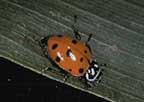
Figure 2
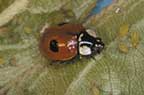
Figure 3
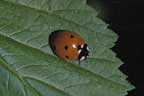
Figure 4
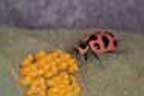
Figure 5
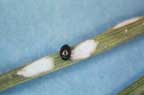
Figure 6
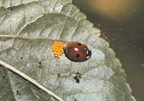
Figure 7
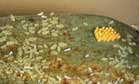
Figure 8
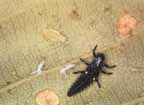
Figure 9
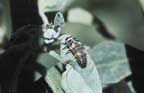
Figure 10
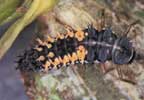
Figure 11
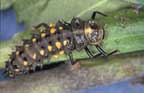
Figure 12
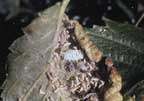
Figure 13
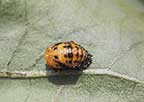
Figure 14
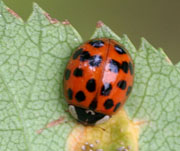
Figure 15

Life History and Habits of Lady Beetles
Most adult lady beetles are easily identified. They are broadly oval in shape and often brightly colored. Most species are spotted, and the amount of spotting usually is characteristic of the different species. However, there are some important exceptions. For example, the smaller lady beetles that feed on mites (Stethorus) or scales (Coccidophilus, Scymnus) usually are uniformly black or dark brown. A few lady beetle species are even striped.
Lady beetles, like all beetles, undergo “complete metamorphosis” during development. Their life-cycle involves eggs, mobile feeding-stage larvae that molt four times as they develop, transition-stage pupae that undergo changes to the final, adult form, and ultimately the familiar adults.
Most lady beetle eggs are spindle-shaped and yellowish or orange-red in color. They are laid in clusters on leaves or other surfaces near aphids and other prey. Lady beetle eggs are distinctive and easily separated from most other insect eggs. However, a few species of leaf beetles produce egg masses of generally similar form–such as the Colorado potato beetle, cottonwood leaf beetle, and elm leaf beetle. Small differences in size and color differentiate these from lady beetle eggs. In addition, these leaf-feeding insects restrict their egg laying to the few plants on which they develop; whereas lady beetle eggs can be laid wherever there is nearby insect prey. As with all insects, the development rate depends on temperature. The lady beetle egg stage typically lasts five to seven days. Shortly before eggs hatch, the color changes to more greyish.
Lady beetles that feed on scale insects or spider mites do not lay their eggs in masses. Instead, eggs are laid singly on leaves or under the cover of the scale insect.
Most lady beetle larvae are elongated in form and slightly pointed at the rear. Their legs stick out prominently from the sides, giving the appearance of being somewhat bow-legged. Overall color is grey or black, but most have some distinct spotting of yellow, orange, or blue. Fleshy projections extend from the bodies of some lady beetle larvae, notably the twice-stabbed lady beetle and multi-colored Asian lady beetle. The larvae of lady beetles that feed on aphids found in dense colonies of curled leaves, and those that feed on mealybugs, often are covered with waxy strands and appear similar to mealybugs.
Larvae complete their development in three stages (instars). Instars are separated by molting that typically occurs every 10 to 14 days. After lady beetle larvae finish feeding, they attach themselves to a solid surface by the hind end, head down. They remain motionless and shrink in form, appearing more compact. This stage, called the prepupa, lasts for a couple of days before the insect molts to the pupal stage.
Lady beetle pupae are usually round in shape, attached to a surface by their hind end. The old split skin of the previous larval stage may still partially cover the pupa or, more often, slough off around the base of the pupa. Lady beetle pupae usually are dark orange or red, often with spots. Although the pupa is fixed to the surface at its base and does not crawl or feed, it is not completely immobile and often reacts with a jerk if disturbed. During summer, development of the pupa typically takes about five to eight days.
After the adult emerges from the pupal skin, it is light colored and soft (teneral adult). Over the course of a day or two, the beetle wing covers harden and darken.
Most lady beetles have two to three generations per year and are found throughout the growing season. However, prior to human settlement and irrigated gardens, many common lady beetles are thought to have had only one generation per year, synchronized with the flush of aphid populations occurring in spring.
At the end of the season, or when food runs out, adult lady beetles move to winter quarters. This typically is in protected sites such as under plant debris, behind bark flaps, or within the walls of homes. During this period (which may last six months or more) the development of the beetle is temporarily suspended, a condition known as diapause.
Some lady beetles also may migrate for winter cover and travel long distances. This habit is particularly notable in the convergent lady beetle, Hippodamia convergens. This species may make summer migrations to the mountains where they spend the winter. Often, they will aggregate in large groups, usually around prominent points and often at high elevations, above 9,000 feet. Such mass aggregations annually occur in several Front Range locations in Colorado. Interestingly, they are not observed in the state west of the Continental Divide.
Lady beetles that have only one generation per year live about one year. However, some lady beetles (Stethorus species) are known to occasionally go into diapause and survive a second year. A small number of species spend the winter as larvae. Perhaps the most common example is Coccidophilus atronitens, a predator of pine needle scale.
Purchase of Lady Beetles
A great many nurseries and garden catalogs sell lady beetles for control of garden pests. Essentially all those sold are the convergent lady beetle, Hippodamia convergens. These insects are field-collected from mountainous areas of the West Coast of the United States, where the beetles periodically migrate and aggregate in large masses when their normal prey are absent at lower elevations.
Unfortunately, the record for effective use of lady beetles released in a garden is typically poor. One reason for this is that the beetles are highly dispersive, poised to migrate long distances from their collection areas. With few exceptions, expect released lady beetles to fly away from gardens where they have been introduced. Furthermore, these field-collected lady beetles usually are in a state known as reproductive diapause, during which time they do not produce eggs. Only after feeding for several weeks after release do they resume egg laying.
Another concern raised about field-collected lady beetles is that a proportion of them contain a natural enemy of the convergent lady beetle. A small wasp, Perilitus coccinellae, develops as an internal parasite of these lady beetles. Their presence is evident when the larva completes development and subsequently pupates within a cocoon underneath the lady beetle (Figure 15).
Protecting and Encouraging Native Lady Beetles
Far more effective than purchasing lady beetles for pest control are steps taken to conserve and enhance the activity of naturally occurring species. Lady beetles require food for themselves and their young and an important way to encourage lady beetles is to have a source of aphids or other preferred prey for them to feed on. Since lady beetles are actively moving about and seeking food during most of the growing season, they will eventually find your garden.
Adult lady beetles may also feed on other foods, such as pollen and nectar. A garden environment that provides these is also important. Lady beetles most often visit and use shallow flowers that are accessible to their mouthparts, such as dill, coriander, or alyssum. Artificial foods, such as sugar-water sprays or mixtures of sugar, water, and yeast, are sometimes used to retain lady beetles in a garden.
Sometimes the efforts of lady beetles are inhibited and we can take actions to eliminate these limiting factors. Ants that tend aphids in order to collect their honeydew will often attack and drive off lady beetles and other predators. By controlling ants, lady beetle activity can increase in many cases.
Of course, use of insecticides in and around gardens can also greatly affect lady beetles, which are susceptible to many garden insecticides. Certain selective insecticides, such as soaps, horticultural oils, pyrethrum, and neem are largely compatible with lady beetles as long as the beetles are not directly sprayed. Bacillus thuringiensis products do not affect lady beetles.
The Multicolored Asian Lady Beetle
Since the late 1990s, the multicolored Asian lady beetle (Harmonia axyridis) has been found in parts of Colorado. Originally introduced to North America to control aphids associated with fruit and nut crops, this insect has steadily expanded its range. The multicolored Asian lady beetle has proved to be an important aphid predator on trees and shrubs in Colorado.
The multicolored Asian lady beetle gets its name because it is highly variable in coloration and patterning. Some beetles are highly spotted, while others entirely lack spots. The basic color may range from pale orange to dark red. A white border around the edge of the prothorax (behind the head) also is distinctive. Larvae of this insect also differ somewhat from the “typical” species encountered in Colorado, with their body being marked with prominent fleshy spines.
An unfortunate aspect of this insect’s behavior is that it often uses buildings for overwintering shelter. Large masses may be observed in fall, lending to them the popular name “Halloween beetles”–a name that reflects both their bright coloration and the time during which they are most commonly encountered. Although they are largely harmless within a home, they can produce a mildly disagreeable odor when disturbed. Fortunately, serious problems with this insect in Colorado have not been reported.
Table 1. Some of the More Common Species of Lady Beetles Present in Colorado.
| Common name | Scientific name | Comments |
|---|---|---|
| Sevenspotted lady beetle | Coccinella septempunctata | This is the Ladybird, a European species that has become established in Colorado. |
| Twospotted lady beetle | Adalia bipunctata | A common native species marked with two spots on its reddish wing covers. This species is primarily found on trees and shrubs; less common in vegetable gardens. |
| Convergent lady beetle | Hippodamia convergens | A native species and the most abundant lady beetle. In parts of the state, mass migrations occur during late summer to overwintering sites at high elevations. This species is collected from similar aggregation sites in California and is commonly sold by nurseries. |
| Pink lady beetle | Coleomegilla maculata | A pink or reddish species with abundant black spotting. It is an important predator of insect eggs and is common in gardens and agricultural crops. |
| Multicolored Asian lady beetle | Harmonia axyridis | Non-native species. Appearance of adults is variable, ranging from being highly spotted too unspotted. Overwintering adults often move into buildings, sometimes in very large numbers. |
| Mexican bean beetle | Epilachna varivestis | A plant-feeding species that develops on bean foliage and developing pods. |
Reference: CSU Fact Sheet 5.594