


Soil Tilth
The term soil tilth refers to the soil’s general suitability to support plant growth, or more specifically to support root growth. Tilth is technically defined as the physical condition of soil as related to its ease of tillage, fitness of seedbed, and impedance to seedling emergence and root penetration.
A soil with good tilth has large pore spaces for adequate air infiltration and water movement. (Roots only grow where the soil tilth allows for adequate levels of soil oxygen.) It also holds a reasonable supply of water and nutrients.
Soil tilth is a function of soil texture, structure, fertility, and the interplay with organic content and the living soil organisms that help the soil ecosystem.
Gardening in Colorado can be a challenge due to poor soil tilth. Sandy soils hold little water and nutrients. Along Colorado’s Front Range, many soils are clayey and compact readily. These soils may have poor drainage, which may lead to salt problems. Due to low soil oxygen levels, root systems are typically shallow, reducing the crop’s tolerance to drought and hot windy weather.
Special attention to soil management is the primary key to gardening success. While gardeners often focus their attention on insect and disease problems, a large number of plant problems begin with soil conditions that reduce the plant’s vigor.
Gardeners often address the soil’s nutrient content by applying fertilizers. However, fertilization is only one of the keys to a productive garden.
Managing Soil Tilth
Gardening on Coarse-Textured, Sandy Soils
The major limitation of sandy soil is its low capacity to hold water and nutrients. Plants growing on sandy soils do not use more water; they just need to be irrigated more frequently but with smaller quantities. Heavy irrigation wastes water because it readily leaches below the root zone. Water-soluble nutrients, such as nitrogen, also leach below the rooting zone with excessive irrigation or rain.
The best management practice for sandy soils is routine applications of organic matter. Organic matter holds ten times or more water and nutrients than sand. Sandy soils with high organic matter content (4-5%) make an ideal gardening soil.
Gardening on Fine-Textured, Clayey Soils
The limitations of clayey soils arise from a lack of large pores, thus restricting both water and air movement. Soils easily waterlog when water cannot move down through the soil profile. During irrigation or rain events, the limited large pore space in fine-textured soils quickly fills with water, reducing the roots’ oxygen supply.
The best management practice for clayey soils is routine applications of organic matter and attention to fostering the activity of soil microorganisms and earthworms. As soil microorganisms decompose the organic matter, the tiny soil particles bind together into larger clumps or aggregates, increasing large pore space. This improvement takes place over a period of years. A single large application of organic matter does not do the trick.
A gardener may start seeing improvement in soil conditions in a couple of years as the organic content reaches 2-3%. As the organic content increases, earthworms and soil microorganisms become more active; this over time improves soil tilth. The ideal soil for most gardens has 4-5% organic matter. However, some native and xeric plants do not like this high organic content, having evolved for poor soils.
Take extra care to minimize soil compaction in soils. Soil compaction reduces the large pore space, restricting air and water movement through the soil, thus limiting root growth. Soil compaction is the primary factor limiting plant growth in landscape soils. Soils become compacted during home construction and need to have organic material added over several years to develop its tilth.
Gardening on Gravelly and Decomposed Granite Soils
Soils in Colorado foothills and mountains change with topography and precipitation. Soils may be well developed with organic matter on north and east facing slopes and in valley floors, but on dryer south and west facing slopes soils are often shallow and extremely low in organic matter.
Gardening in the gravelly and decomposed granite soils, common to many foothills and mountain areas, may be extremely challenging. Large rocks, erratic depths for bedrock, little organic matter, pockets of clayey soil and rapid drainage with poor water holding capacity characterize these coarse textured soils. They erode readily once disturbed.
If the soil has been disturbed with the surface layer removed, decomposed granite soils will benefit from organic matter. Add up to 25% by volume. For example, if tilling to a depth of eight inches, add two inches of compost or other organic materials. If only tillable to a depth of four inches, add one inch of compost. Use well decomposed materials. In some situations, mixing in the organic matter may be very labor intensive or impossible.
When Soil Amendment Is Not Practical Or Possible
In real world settings, the ideal approach of improving soils by adding soil amendments may not be practical or possible. For example:
- In existing landscapes, it is easy to add amendments to annual flower beds and vegetable gardens, but amendments cannot be worked into the soil in the rooting zone of trees, shrubs, perennials, and lawn.
- In working with new landscapes, the new homeowner may not have the financial resources to purchase the amendments desired.
- The gardener may not have the physical ability for this intense labor.
- On slopes, removing the plant cover predisposes the soil to erosion.
- On rocky soils, it may be physically impractical or impossible to work in amendments.
Where amending is not practical or possible, gardeners need to consider alternatives. Primarily, understand that without soil improvement the gardener may need to accept less than optimum plant growth and increased maintenance.
When amending is not practical or possible, consider the following options:
- Focus on selecting plants more tolerant of the soil conditions. This includes tolerance to low soil oxygen and reduced root spread (compaction issues), poor drainage (tolerance to wet soils), drought (tolerance to dry soils), and low fertility (fertilizer need). These are characteristics of some rock garden or alpine garden plants. However, be careful about assuming that these characteristics apply to native plants as it may or may not be the case.
- Space plants further apart to reduce competition for limited soil resources.
- Small transplants may adapt to poor soils better than either larger transplants or trying to grow plants from seed.
- Raised-bed gardening and container gardening may be a practical option when soils are poor.
- Pay attention to minimizing additional soil compaction with the use of organic mulches and management of foot traffic flow.
- Organic mulch (wood/bark chips) helps improve soil tilth over a period of time as the mulch decomposes and is worked into the soil, by soil organisms. To allow this process to occur, do not put a weed fabric under the mulch and add material periodically.
- Established lawns, which have been in place for more than twenty years, come to equilibrium between root dieback and soil organic content.
Soil Practices To Avoid
The following is a summary of common practices that should be avoided in Western soils to maximize soil tilth and plant growth potential.
- Avoid working the soil when wet. Water lubricates soil particles, making the soil easier to compact.
- Avoid excessive fertilization. This has the potential for surface and ground water pollution and adds salts to the soil that can become toxic to plants. Heavy fertilization will not compensate for poor soil preparation. Many gardeners have over applied phosphate and potash.
- Avoid adding too much organic matter. This leads to salt build-up, large release of nitrogen, the build-up of excessive phosphorus, and an imbalance in potassium, calcium, magnesium, and iron.
- Avoid adding lime or wood ashes. Being calcium sources, they are used to raise the soil pH. Most Colorado soils have a neutral to high pH. Lime or wood ashes would only be used on soils with a soil pH below 5.5.
- Avoid adding gypsum (a calcium source). Gypsum is used to reclaim sodic soils by displacing the sodium with calcium.
- Avoid creating texture interfaces. For example, when making a raised bed, adding a different soil in the box creates an interface at the change line. Use similar soils and mix the soils.
- Avoid trying to make dramatic changes in soil pH. If the soil is high in free lime (calcium carbonate), lowering the pH is not effective.
Texture
Texture refers to the size of the particles that make up the soil. The terms sand, silt, and clay refer to relative sizes of the individual soil particles. [Table 1 and Figure 1]
Table 1. The Size of Sand, Silt, and Clay
| name | particle diameter |
|---|---|
| Clay | Less than 0.002 mm |
| Silt | 0.002 to 0.05 mm |
| Very fine sand | 0.05 to 0.10 mm |
| Fine sand | 0.10 to 0.25mm |
| Medium sand | 0.25 to 0.5mm |
| Coarse sand | 0.5 to 1.0 mm |
| Very coarse sand | 1.0 to 2.0 mm |
| Gravel | 2.0 to 75.0 mm |
| Rock | More than 75 mm |
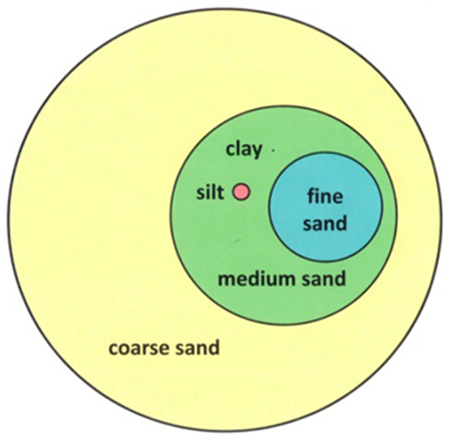
The percentage of sand, silt and clay determine the texture class. (For example, a soil with 30% clay, 10% silt, and 60% sand is called a sandy clay loam. A soil with 20% clay, 40% silt and 40% sand is a loam.)
A fine-textured or clayey soil is one dominated by tiny clay particles. A coarse- textured or sandy soil is one comprised primarily of medium to large size sand particles. The term loamy soil refers to a soil with a combination of sand, silt, and clay sized particles.
Some types of clayey soils expand and contract with changes in soil moisture. These expansive soils create special issues around construction and landscaping. For homes on expansive clays, limit landscaping along the foundation to non-irrigated mulch areas and xeric plants that require little supplemental irrigation. Avoid planting trees next to the foundation and direct drainage from the roof away from the foundation.
Clay
Clay particles are flat, plate-like, negatively charged particles. They are so tiny in size that it takes 12,000 clay particles in a line to make one inch. Clay feels sticky to the touch. Soils with as little as 20% clay size particles behave like a sticky clayey soil. Soils with high clay content have good water and nutrient holding capacity, but the lack of large pore space restricts water and air movement. Clayey soils are also prone to compaction issues. Clay particles are the source of most of the chemical properties of soil and retain many of the plant nutrients such as calcium, magnesium, potassium, trace elements, and some of the phosphorus. As organic matter breaks down, clay reacts with it to stabilize the humus in the soil. A soil without clay particles can be infertile.
Silt
Silt has a smooth or floury texture. Silt settles out in slow moving water and is common on the bottom of an irrigation ditch or lakeshore. Silt adds little to the characteristics of a soil. Its water holding capacity is similar to clay.
Sand
Sand, being the largest sized particles, feels gritty. There is a major difference in soil characteristics between fine sands and medium to coarse sands. Fine sands add little to the soil characteristics and do not significantly increase large pore space. An example of fine sand is the bagged sand sold for children’s sandboxes.
True sandy soil requires greater than 50% medium to coarse sized sand. Sandy soils have good drainage and aeration, but low water and nutrient holding capacity.
Gravel and Rock
Some Colorado soils are dominated by gravel and rock, making them difficult for the gardener to work. Gravel and rock do not provide nutrients or water holding capacity. They often drain readily with low nutrient holding capacity.
Texture effects how water and nutrients move through a soil profile as shown in Table 2.
Table 2. Comparison of Fine-Textured (Clayey) Soil and Coarse-Textured (Sandy) Soil
| Soil attribute | clayey soil | sandy soil |
|---|---|---|
| Water-holding capacity | High | Low |
| Nutrient-holding capacity | High | Low |
| Compaction potential | High | Moderate |
| Ability to form crusts | Yes | No/Sometimes |
| Drainage | Slow | Fast |
| Salinity build-up | Yes | Seldom |
| Warming in spring | Slow | Fast |
Structure
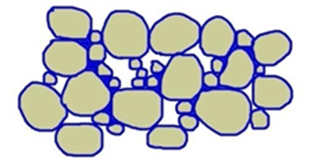
Structure refers to how the various particles of sand, silt and clay fit together, creating pore spaces of assorted sizes. Sand, silt, and clay particles are “glued” together by chemical and biological processes creating aggregates (clusters of particles). Mycorrhizae, earthworms, soil microorganisms and plant roots are responsible for creating aggregates. [Figure 3]
Undisturbed native soils often have a granular structure in the upper layer (with rapid drainage) and block structure (with rapid to moderate drainage) in the lower layers. A platy structure (with slow to no drainage) is common in soils high in clay.
Compacted, unamended landscape soils typically have a massive structure with no defined layers, little organic matter, low total pore space, and most significantly low large pore space.
The term peds describes the soil’s individual aggregates or clods. Soils that create strong peds tolerate working and still maintain good structure. In some soils, the peds are extremely strong, making cultivation difficult except when the soil moisture is precisely right. Soils with soft peds may be easy to cultivate but may readily pulverize destroying the soil’s natural structure.
Primary factors influencing structure include the following:
- Texture.
- Activity of soil mycorrhizae, earthworms, and other soil organisms.
- Organic matter content.
- Soil moisture (year-round).
- The freeze/thaw cycle.
- Cultivation – Tilling a soil has a direct impact on structure by breaking apart aggregates and collapsing pore spaces. Avoid tilling except to mix in organic matter, control weeds (limited use), or to prepare a seedbed.
- Soil compaction.
To maintain good structure avoid over-working the soil. Acceptable ped size depends on the gardening activity. For planting vegetable or flower seeds, large peds interfere with seeding. In contrast, when planting trees peds up to the size of a fist are acceptable and pulverizing the soil would be undesirable.
Pore Space
Pore space is a function of soil texture, structure, and the activity of beneficial soil organisms. Water coats the solid particles and fills the smaller pore spaces. Air fills the larger pore spaces. [Figure 3]
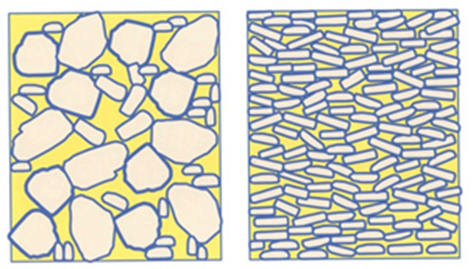
To help understand pore space, visualize a bottle of golf balls and a bottle of table salt. The pore space between golf balls is large compared to the pore space between the salt grains.
The relative percent of clay size particles versus the percent of medium to coarse sand size particles influences the pore space of a soil, along with organic matter content. Silt and fine sand particles contribute little to pore space attributes.
The quantities of large and small pore spaces directly effect plant growth. On fine-texture, clayey, and/or compacted soils, a lack of large pore spaces restricts water and air infiltration and movement, thus limiting root growth and the activity of beneficial soil organisms. On sandy soils, the lack of small pore space limits the soil’s ability to hold water and nutrients.
Water Movement
Characteristics of water molecules:
- Cohesion Force is where water molecules are attracted to one another. Cohesion causes water molecules to stick to one another and form water droplets.
- Adhesion Force is responsible for the attraction between water and solid surfaces. A drop of water can stick to a soil particle surface as the result of adhesion.
- Surface tension, from cohesion, causes water surfaces to behave in unusual ways. Water molecules are more attracted to other water molecules, as opposed to air particles, and water surfaces behave like expandable films.
- Capillary action, also referred to as capillary motion or capillarity, is a combination of cohesion/adhesion and surface tension forces. Capillarity is the primary force that enables the soil to retain water, as well as to regulate its movement. Water moves upwards (against gravity) through soil pores, or the spaces between soil particles. The height to which the water rises is dependent upon pore size, with the smaller the soil pores, the higher the capillary rise.
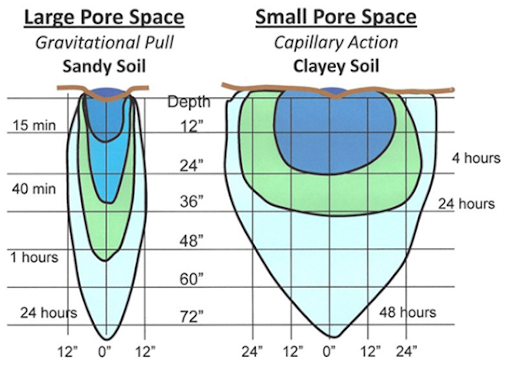
The lack of large pore space leads to drainage problems and low soil oxygen levels. In sandy soils with large pores, water readily drains downwards by gravitational pull. Excessive irrigation and/or precipitation can leach water-soluble nutrients, like nitrogen, out of the root zone and into ground water. [Table 3; Figure 4]
Table 3. Comparative Movement of Water in Sandy and Clayey Soils
| depth | Time to reach depth in Sandy Soil (large pore space) | Horizontal Spread after 24 hours in Sandy Soil (large pore space) | Time to reach depth in Clayey Soil (small pore space) | Horizontal Spread after 48 hours in Clayey Soil (small pore space) |
|---|---|---|---|---|
| 12 in | 15 min | 12 in. | 60 in. | |
| 24 in | 40 min | 24in. | 4 hours | 60 in. |
| 36 in | 24 in. | 24 hours | 60 in. | |
| 48 in | 1 hour | 24 in. | 48 in. | |
| 60 in | 18 in. | 36 in. | ||
| 72 in | 24 hours | 6 in | 48 hours | 12 in. |
Texture Interface
Within the soil profile, a texture interface (abrupt change in actual pore space) creates a boundary line that affects the movement of water, air infiltration, and root growth. Water and air are very slow to cross a texture interface. [Figure 5]
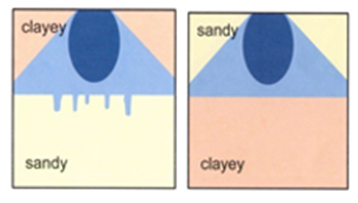
When a clayey and/or compacted soil layer (primarily small pore space) is on top of a sandy soil layer (primarily large pore space) water accumulates just above the change. Water is slow to leave the small pore space of the clayey soil due to the water properties of cohesion.
Likewise, when water moving down through a sandy soil layer (primarily large pore space) hits a clayey and/or compacted soil layer (primarily small pore space) water accumulates in the soil just above the interface. This back up is due to the slow rate that water can move into the small pore space of the clayey soil. It is like a four-lane freeway suddenly changing into a country lane; traffic backs up on the freeway.
Perched Water Table
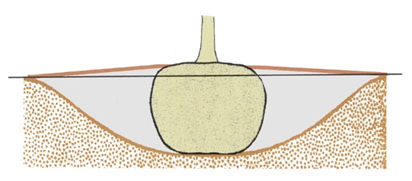
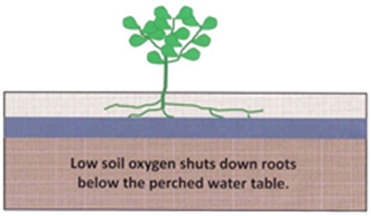
This change in water movement creates a perched water table (overly wet layer of soil) six inches thick or greater just above the change line. When creating raised bed boxes, mix the added soil with the soil below to avoid creating a texture interface. In tree planting, to deal with the texture interface between the root ball soil and the backfill soil it is imperative that the root ball rises to the surface with no backfill soil over the root ball. In landscape soils that have a texture interface between soil layers, a perched water table may sit just above the interface line. In this situation, be cautious about frequent irrigation creating an oxygen deficiency in the roots below the perched water table. [Figures 6 and 7]
This publication, reference GardenNotes #213, is developed as part of the Colorado State University Extension Master Gardener Program.