


Introduction
Maintaining healthy dryland small acreage pastures can be challenging in Colorado, but it is a realistic goal. This guide will help pasture managers assess pasture condition and offer suggestions for improvements. Key strategies, such as determining carrying capacity, implementing rotational grazing, using indicator grasses to monitor when to start and stop grazing, and keeping grazing records, will help improve pasture health and production.

Pasture condition assessment
Instructions: The following questions will help grazing managers conduct a basic self-assessment of their grazing management and pasture condition. Answer questions below to identify recommendations to improve grazing and pasture management strategies.
- Are weeds increasing in the pasture?
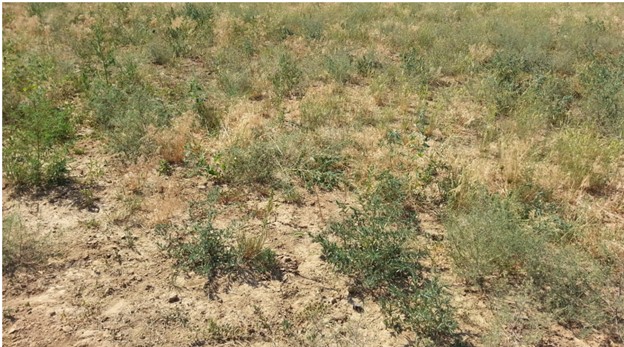
- If yes, weeds should be managed. Identify the weeds and develop a weed management plan. Consult your local Extension or USDA-NRCS for assistance. If more than 80% of the pasture is weeds, consider reseeding (see Figure 2)
- If no, you are managing weeds well. Continue routine scouting and managing weeds.
- Are livestock allowed to graze on a pasture continuously, or do you rotate them from pasture?
- If they graze continuously, you may try subdividing the pasture into smaller units to rotate livestock. Rotational grazing allows grass leaves to grow back prior to being grazed again. Consider keeping livestock in a holding area and only allowing access to the pasture after grasses have fully recovered.
- If they rotate among pastures, be sure to allow grass leaves time to regrow between grazings.
- Note: Learn what grasses your animals prefer the most by watching them graze. Then, refer to Table 1 to determine when to start and stop grazing these key forage species based on grass height. Plant recovery time should be extended if grazed too low.
- How long is a pasture allowed to recover after grazing?
- Less than 30 days:
- Dryland pastures in Colorado typically need more than 30 days to regrow after grazing.
- Depends on the time of year, grass growth cycle, and precipitation received.
- 30-45 days is recommended during the fast growth period (typically May and June in Colorado). Drought conditions will extend regrowth time.
- 60-90 days is recommended during the slow growth period (typically July to October in Colorado). Drought conditions will extend regrowth time.
- Less than 30 days:
| Dominant forage Species | Minimum starting height in inches (turn animals in) | Minimum grazing height in inches (do not graze below this protective height) |
|---|---|---|
| Alfalfa | 6 | 4 |
| Alkali sacaton | 6 | 4 |
| Blue grama | 3 | 2 |
| Little bluestem | 6 | 4 |
| Orchard grass | 5 | 3 |
| Russian wildrye | 5 | 3 |
| Sand bluestem, big bluestem | 8 | 6 |
| Sideoats grama | 6 | 4 |
| Smooth bromegrass | 5 | 3 |
| Switchgrass | 8 | 6 |
| Wheatgrasses (pubescent, intermediate, crested or Siberian) | 5 | 3 |
| Wheatgrasses (Western, bluebunch, slender or thickspike) | 6 | 4 |
| Tall Wheatgrass | 8 | 6 |
| Yellow Indiangrass | 8 | 6 |
| Tufted hairgrass | 6 | 4 |
| Nebraska sedge | 6 | 4 |
| Prairie cordgrass | 8 | 5 |
| Prairie sandreed | 8 | 6 |
| Tall fescue | 5 | 3 |
| Green needlegrass | 6 | 4 |
Tips:
- Circle the dominant forage species that are growing in your pasture.
- The grazing heights listed for each species should be maintained.
- Use a ruler to monitor grass growth. Monitor grasses before, during, and after grazing periods.
How many animals can I graze?
Instructions: This section will help you determine the average dryland forage production in a normal growing season and will lead you through calculations to determine the number of animals you can graze and/or available grazing days per year. Productivity of rangeland is limited by climate, soil type, topography, and vegetative species present.
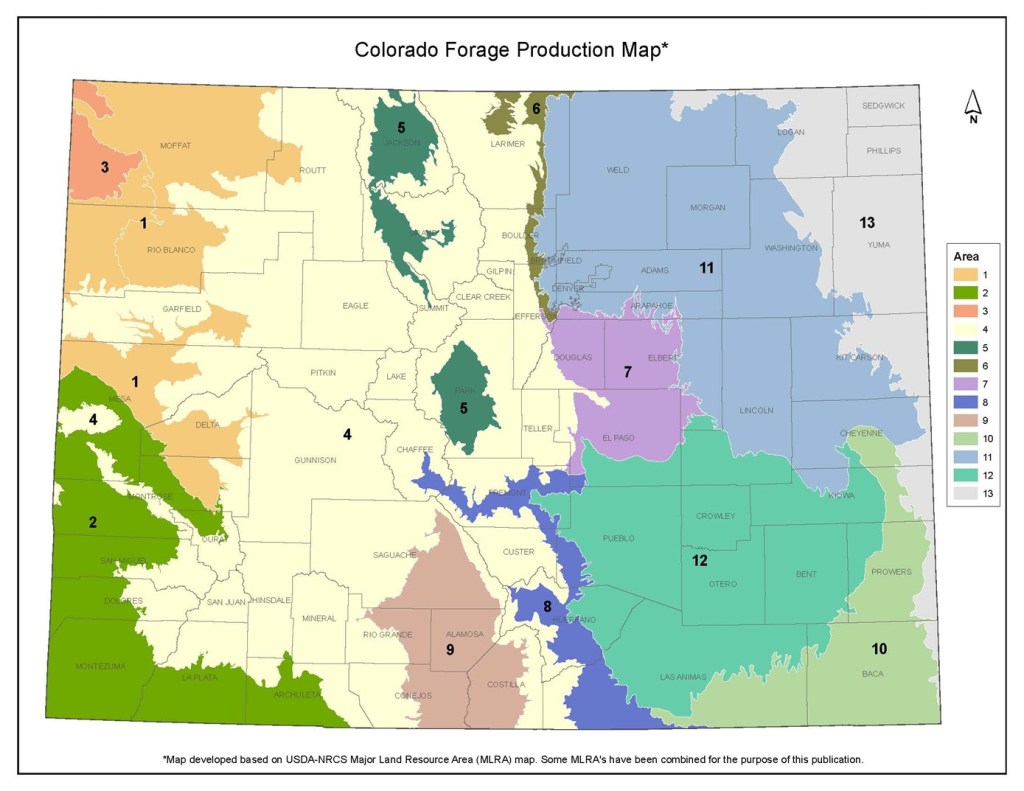
- Use the map (Figure 3) to determine the area in which your property is located.
- Use Table 2 to select the estimated dryland forage production (AUM/AC) based on forage condition for your pasture/range.
- Follow the carrying capacity calculations to determine number of animals and/or length of allowable grazing per year.
| Area (Figure 3) | Good Forage Condition AUM/AC* | Average Forage Condition AUM/AC* | Poor Forage Condition AUM/AC* |
|---|---|---|---|
| 1 | 0.34 | 0.23 | 0.12 |
| 2 | 0.30 | 0.22 | 0.13 |
| 3 | 0.36 | 0.25 | 0.14 |
| 4 | 0.50 | 0.34 | 0.18 |
| 5 | 0.30 | 0.20 | 0.10 |
| 6 | 0.33 | 0.25 | 0.16 |
| 7 | 0.50 | 0.38 | 0.25 |
| 8 | 0.40 | 0.29 | 0.17 |
| 9 | 0.37 | 0.27 | 0.16 |
| 10 | 0.43 | 0.33 | 0.22 |
| 11 | 0.55 | 0.40 | 0.25 |
| 12 | 0.29 | 0.21 | 0.12 |
| 13 | 0.60 | 0.45 | 0.30 |
- Good forage condition: 67-100% of the vegetation is a mixture of desirable plants (grasses, legumes, forbs, and shrubs)
- Average forage condition: 34-66% desirable plants.
- Poor forage condition: 0-33% desirable plants, with mostly undesirable weeds, forbs and shrubs present.
The Estimated Dryland Forage Production values listed above are weighted average estimates based on USDA-NRCS range condition classes and ecological site descriptions for each area. For site specific forage production values, contact your local USDA-NRCS, Extension office, or other local experts. Forage production can vary from year to year based on precipitation and management practices. These values assume normal annual precipitation. Drought years will need to be adjusted accordingly.
Animal Unit Equivalents (AUES)
- Cow or cow/calf pair (assuming a 1000lb cow) = 1.0
- Bull (1800lb) = 1.8
- Weaned calf (500lb) = 0.5
- Heifer/steer (13-19 months or 700-900lb) = 0.7 – 0.9
- Heifer/steer (19-24 months or 900 – 1100lb) = 0.9 – 1.1
- Other animals = 0.1 AU for each 100lb of body weight
- Ewe = 0.15
- Lamb (12 months) = 0.1
- Ram = 0.2
- Goat = 0.15
- Bison = 1.0
- Horse (average 1250lb) = 1.25
Rotational Grazing
Rotational grazing is a practice in which two or more pastures are alternately rested and grazed in a planned sequence for a period of years. If rotational grazing is not practiced, then range condition may not improve, even with proper carrying capacity. We want to avoid continuous grazing because it allows animals to selectively graze. Desirable plants will continue to be overused and undesirable plants, like weeds, will continue to flourish.
Guidelines for Rotational Grazing
- After determining the carrying capacity, then a rotational grazing system should be considered. However, the total number of days/hours grazed in a rotational grazing system per year should not exceed the number of days/hours allowed by the carrying capacity (as calculated) for the grazed area per year.
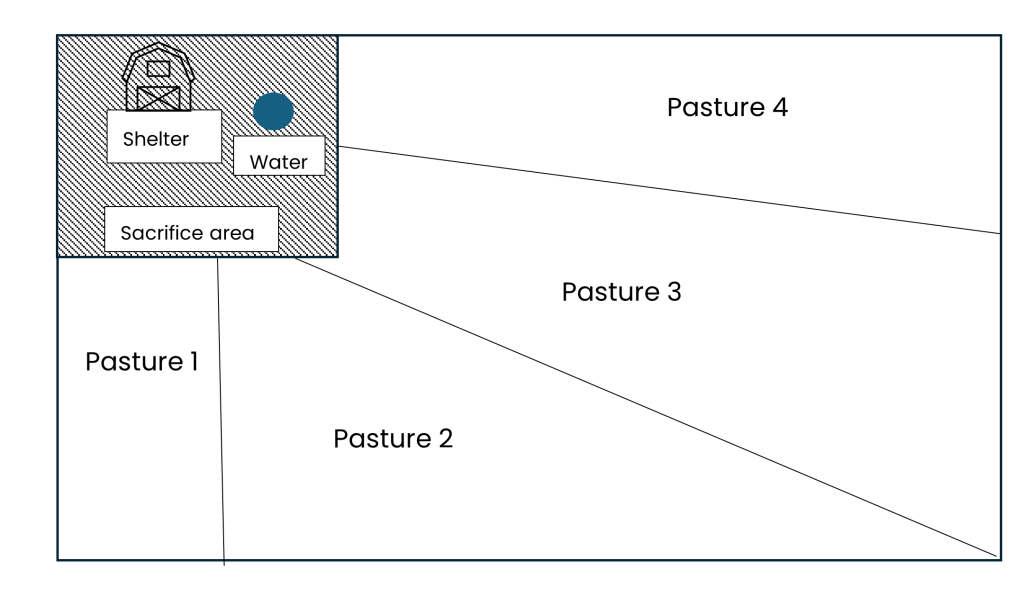
- A rotational grazing system should provide for 30-90 days of recovery (no grazing) for each pasture following each grazing period, depending on the time of year and amount of moisture received. No more than two grazing periods should occur in each pasture during a growing season, depending on climate and precipitation conditions. Figures 1 and 4 are examples of how to subdivide a pasture.
- Use the following formula to determine the grazing period of each pasture:
- Recovery period desired / Number of pastures being rested
- This assumes pastures of relatively equal production (AUMs). If you have different sized pastures, then the grazing period will need to be adjusted accordingly.
- Create a sacrifice area and subdivide the pasture to control when and where animals are grazing. Rotate animals as one unit. Use a planned grazing schedule to monitor recovery days and grass height to determine when to move animals.
- Grazing periods should be relatively short (10 days or less), but the recovery periods take priority. This may require cross-fencing existing pastures to increase the number of available pastures. Ten or more pastures are recommended per herd to implement a short-duration, high-intensity grazing system (10 days or less per grazing period and 90+ days of recovery following each grazing event) to improve range condition. Again, this assumes that the total number of days/hours grazed does not exceed carrying capacity.
- The animals should be rotated as one herd to allow for maximum pasture recovery.
- Cross fencing may consist of 1 or 2 strand portable or permanent electric fence.
- Start grazing in a different pasture each spring.
Recordkeeping
Keeping records will allow you to keep track of the total grazing days per year. This is very useful if there are multiple managers. Use this example to create your won recordkeeping system.
| Pasture | Recovery period (days since last grazed) | Total grazing days or hours available this year | Grass height before grazing | Date in | Date Out | Grass height after grazing | Total grazing days or hours used this year | Total grazing days or hours left after grazing period | Comments |
|---|---|---|---|---|---|---|---|---|---|
| 1 | 45 Days | 5 Days | 6″ | 7/10/26 | 7/14/26 | 3″ | 4 Days | 1 Day | Mullein on east side |
Useful Resources
- Managing Small Acreage Pastures During and After Drought | Colorado State University Extension.
- Grass Growth and Response to Grazing | Colorado State University Extension.
- Rangeland Analysis Platform | USDA ARS.