


Quick facts…
- Pine wilt is a lethal disease caused by a nematode (Bursaphelenchus xylophilus), vectored to trees by a native wood-boring insect, the pine sawyer beetle (Monochamus spp.).
- Popular landscape pines including Scots, Austrian, and Mugo are susceptible to infection by the nematode. Some degree of resistance has been observed in native pines, however, they may still be infected.
- High average summer temperatures are required for the nematode to develop in the beetle and within infested trees.
- The disease is a threat in both eastern and western Colorado. Best management practices include timely sanitation and chemical injections.
What is Pine Wilt?
Pine wilt disease is a lethal wilting disease caused by the pine wilt nematode (PWN), Bursaphelenchus xylophilus. PWN causes rapid wilting and mortality in susceptible host trees, typically Pinus species exotic to the US, including Scots pine (P. sylvestris) and Austrian pine (P. nigra). Damage from PWN varies based on host species and environmental conditions – especially temperature and moisture. PWN is thought to be endemic to the Southeastern U.S., where native pine species seem to be resistant. Pine wilt disease has caused widespread damage to forested landscapes where it has been introduced, including Europe, Japan, South Korea, and China. In the US, the westward movement of PWN has been tracked through Missouri and Kansas since 1979.
Pine Wilt in Colorado
Figure 1
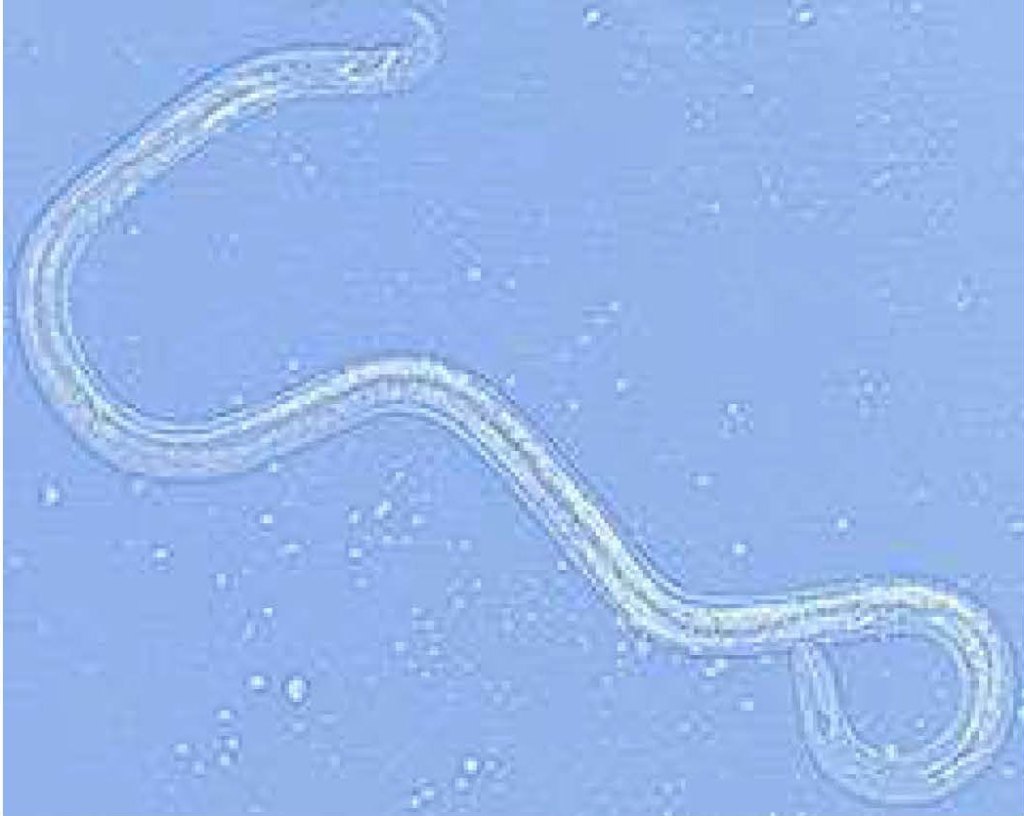
In Colorado, PWN is vectored primarily by two species of wood-boring beetles called pine sawyer beetles (Monochamus scutellatus & M. clamator) that are native to western coniferous forests (Figure 3). Primary transmission of PWN occurs when newly emerged adult beetles feed on the new shoot growth, typically in the early summer. Transmission of PWN can also occur during egg-laying (Akbulut & Stamps, 2012). Monochamus beetles are typically considered secondary pests with minimal impact, and management is usually not recommended in the absence of PWN. Pine sawyer beetles begin flight in early July and continue until October, with peak flight occurring between the last week of August and mid-September. Flight phenology may vary greatly between species and locations on a larger scale (Boone et al. 2019).
Figure 2
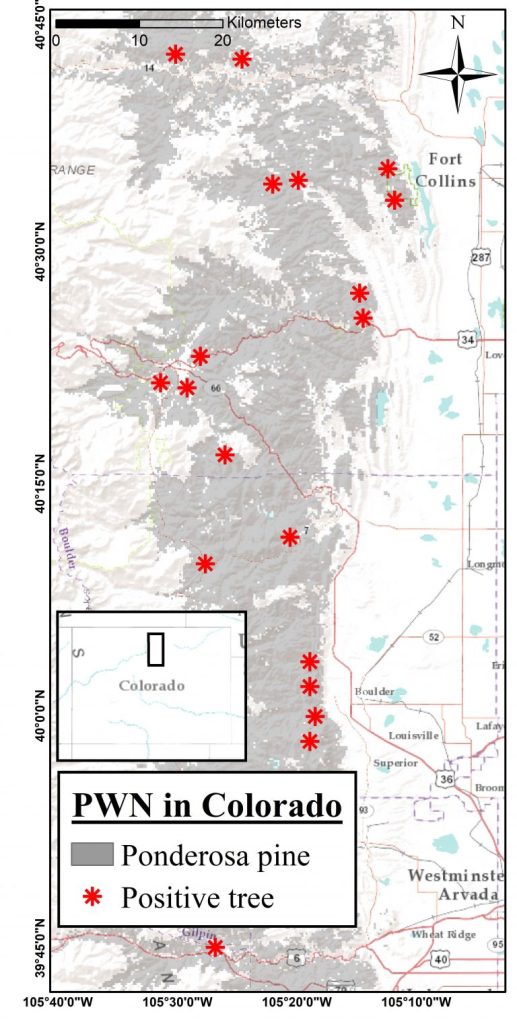
Figure 3

Is Pine Wilt a Potential Threat to Native Ponderosa pine forests?
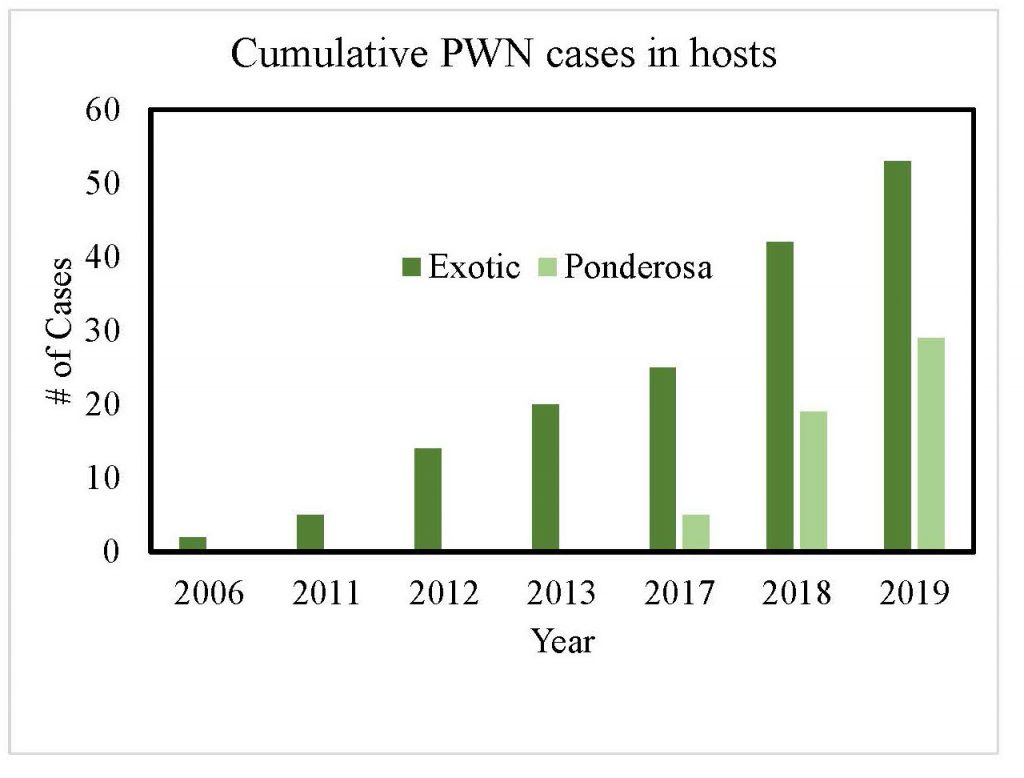
PWN is likely to have arrived in Colorado via the transport of infected firewood. The discovery of PWN in native ponderosa pine forests is concerning on two fronts. While mortality rates may be lower in ponderosa pine compared to many exotic species, persisting populations of PWN in ponderosa pine will increase the disease pressure faced in urban settings. Previous studies have shown that there are areas of the southeastern U.S. where asymptomatic native ‘carrier trees’ serve as disease reservoirs for PWN dispersal into landscape plantings. Additionally, studies that suggested that PWN was not a significant threat to native trees in the U.S. (Bergdahl 1988; Wingfield et al. 1984) were conducted close to 40 years ago. Pine wilt disease is more severe at higher temperatures, and new cases documented in Colorado continue to increase (Figure 4).
Diagnosis of Pine Wilt
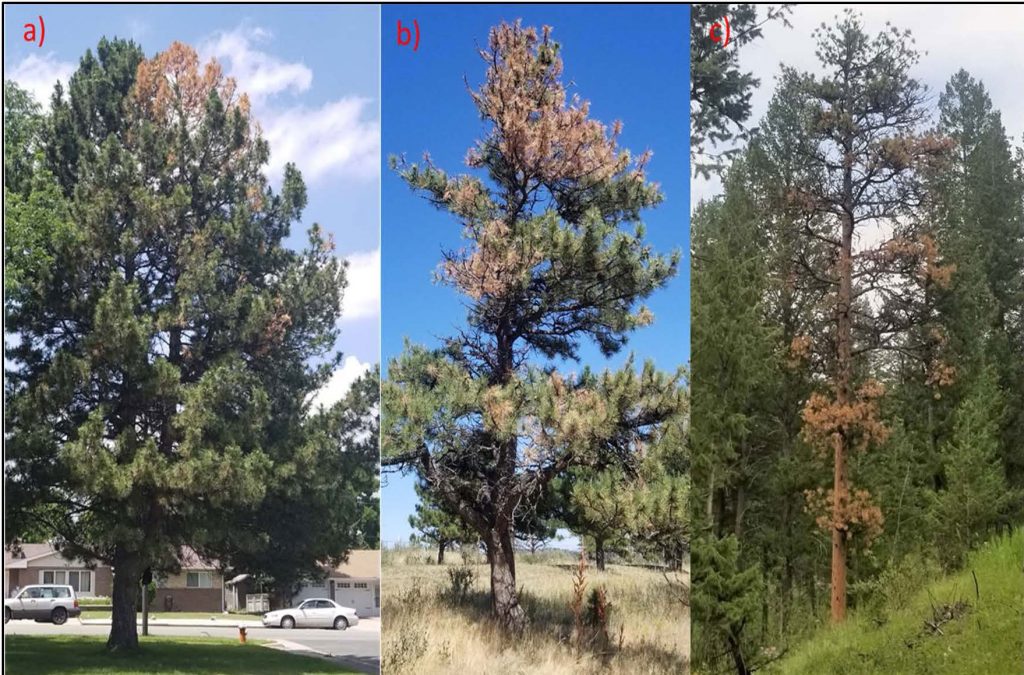
Pine wilt has several distinguishing symptoms that can be used to identify whether a diseased tree is PWN-infected. Ponderosa pine infected by PWN exhibit wilting of the needles, which show browning rather than red needles associated with bark beetles. Symptoms progress rapidly until tree death, sometimes within 3 weeks for susceptible hosts, typically Scots and Austrian pines. Pine wilt disease has been found in all landscapes from urban centers to wildlands. Trees infected by PWN exhibit dieback of whole branch segments, and needles will turn light brown occasionally with a tinge of green (Figure 5).
If a tree is suspected to be infected with PWN, confirmation with molecular testing of a wood sample is available through the CSU Plant Diagnostic Clinic services. The best method for collection is to take a 1-2 in. (3-5cm) axial cross-section (‘cookie’) from breast height of the main trunk of the tree. If felling the tree to take a cookie is not an option, it is also possible to test for PWN using drill shavings. Shavings should be collected at breast height from 3-4 sides of the tree. The drill bit should be 5/8 in. (15mm) or wider, and the drill hole should extend >2in (5cm) into the solid wood tissue beyond the bark. A spade, spoon, or auger bit can be used. It is best to collect tissue samples as soon as possible after symptoms become apparent. Samples can be stored in a zipper-top plastic bag and kept in the freezer before testing.
Look a-likes
Dieback of branch tips in a mottled pattern should be investigated for twig beetle (Pityophthorus & Pityogens spp.) galleries, which appear as small holes appx. 1-2 mm in diameter (see Hammon & Foley; CSU Ext.) in the bark when viewed in cross section of a broken twig. Pitch tubes may also be present. Trees that show necrosis in the distal portion of needles or that occur near roadsides are likely suffering from salt damage or winter burn. A tree with light yellow needles, particularly partial yellowing, is likely damaged from needle chlorosis due to causes that could include cold and winter damage. Diplodia (Sphaeropsis) tip blight infection may often also resemble early symptoms of pine wilt and commonly affects the same host species. Diplodia tip blight typically affects mostly the tips of new growth and will appear randomly throughout the tree crown (see Pecknold 2016; Purdue Ext.). Pine wilt symptoms mainly manifest at the top portion of the tree and progress downward, often appearing in a spiral pattern before affecting the entire crown. Diplodia tip blight, as well, has rarely been observed in Colorado.
Management of Pine Wilt
Pine wilt presents a growing threat to native and introduced pines in Colorado, and continued monitoring and reporting from stakeholders is necessary to best inform research and management efforts. If you suspect that a pine tree may be infected with PWN, contact the Plant Diagnostic Clinic at CSU (https://plantclinic.agsci.colostate.edu) or a local licensed arborist for a consultation. The following management options are currently recommended for pine wilt disease.
Sanitation
Trees killed by pine wilt in late summer or fall should be removed and destroyed before the emergence of pine sawyers in late June of the following year. Do not leave stumps above ground level and do not save infested wood for firewood or transport logs that are potentially infested. Diseased trees should be chipped, burned, or buried. There is minimal risk in moving the nematode in wood chips; therefore, chips can be used for landscaping purposes. Because adult pine sawyers infested with PWN may be attracted to any freshly cut pine logs, even native pine logs, and the PWN can potentially persist and multiply in these cut logs by feeding on blue stain fungi, do not store any fresh pine wood (firewood, logs, etc.) near exotic pines.
Tree Selection
The incidence of pine wilt will increase in the future if the current, warmer climate trend continues. Therefore, limit future planting of the highly susceptible Austrian and Scots pines, especially in areas where it is impractical or too expensive to preventively protect trees with chemical injections. There currently are no selections of these pine species that are resistant. Deciduous trees and other conifers can be safely planted as replacements at sites where exotic pines have been killed from pine wilt.
Chemical Protection
Two avermectin compounds (abamectin and emamectin benzoate) are labeled for the prevention of pine wilt. These products are directed towards killing the nematode and not for killing the pine sawyer beetle vector. They must be injected into the pine, usually at pressures ranging from 30-50 psi (2-3.4 atmospheres), prior to infection. They are not effective if the tree is symptomatic or once the PWN has colonized the tree. Several commercial injection systems are available, but pine injections are almost always done by professional arborists. Injections can be made anytime the weather is warm (to allow for uptake and translocation), although late fall is perhaps the ideal time. Injections should be completed by early May and before pine sawyer beetle emergence. Yearly injections provide the greatest protection, but the cost and potential damage associated with the injection process are issues to consider. Very good control has also been achieved by injecting every other year. The use of foliar insecticide applications to prevent pine wilt has not been researched but it has been suggested that this treatment would kill pine sawyer beetles during the maturation feeding process, thus preventing introduction of the PWN into the tree. However, insect mortality would not likely be instantaneous, and any movement of the PWN into feeding wounds, regardless of whether the pine sawyer beetle was ultimately killed, could result in pine wilt development. Furthermore, many of the insecticides used in foliar applications may not be toxic to the nematodes. Because there is no data to support this type of treatment, foliar applications are not currently recommended for pine wilt control.
References
Akbulut, S., & Stamps, W. T. (2012). Insect vectors of the pinewood nematode: a review of the biology and ecology of Monochamus species. Forest Pathology, 42(2), 89-99.
Bergdahl, D. R. (1988). Impact of pinewood nematode in North America: present and future. Journal of Nematology, 20(2), 260.
Boone, C. K., Sweeney, J., Silk, P., Hughes, C., Webster, R. P., Stephen, F., … & Berkvens, N. (2019). Monochamus species from different continents can be effectively detected with the same trapping protocol. Journal of Pest Science, 92(1), 3-11.
Blunt, T. D., Jacobi, W. R., Appel, J. A., Tisserat, N., & Todd, T. C. (2014). First report of pine wilt in Colorado, USA. Plant health progress, 15(3), 103-104.
Gleason, M., Linit, M., Zriba, N., Donald, P., Tisserat, N., & Giesler, L. (2000). Pine Wilt: A fatal disease of exotic pines in the Midwest.
Jacobi, W. R., & Tisserat, N. (2015). Pine wilt disease. Fact sheet (Colorado State University. Extension). Gardening series; no. 2.915.
Kennelly, M. (2018). Cut down and destroy dead pines to help prevent spread of pine wilt. Kansas State University blog. Retrieved from https://blogs.k-state.edu/turf/author/kennelly/page/7/ on 09/18/2019.
Pecknold, P. C. (2016). Sphaeropsis Tip Blight of Pines. Purdue University e-Pubs; Cooperative Extension Service.
Pimentel, C. S., Ayres, M. P., Vallery, E., Young, C., & Streett, D. A. (2014). Geographical variation in seasonality and life history of pine sawyer beetles Monochamus spp: its relationship with phoresy by the pinewood nematode Bursaphelenchus xylophilus. Agricultural and forest entomology, 16(2), 196-206.
Wingfield, M. J., Blanchette, R. A., & Nicholls, T. H. (1984). Is the pine wood nematode an important pathogen in the United States?. Journal of Forestry, 82(4), 232-235.
Reference: CSU Fact Sheet 2.915