


Nutrition and Fertilization
Plant nutrition refers to the chemical elements required for plant growth and reproduction. Most plants require at least sixteen different elements. Those that are used in greater amounts (Carbon, Hydrogen, Oxygen, Nitrogen, Phosphorus, Potassium, Calcium, Magnesium, and Sulfur) are known as macronutrients; those used in smaller amounts as micronutrients (Iron, Manganese, Zinc, Copper, Boron, Molybdenum, Chlorine, Nickel, and Cobalt). Both macro- and micro-nutrients are essential to plant growth; the prefixes refer to amount required rather than importance.
The term fertilization refers to the application of plant nutrients to supplement the nutrients naturally occurring in the soil. Nutrients may be applied as synthetic fertilizers, organic fertilizers, and/or as a component of other soil amendments, e.g., compost. Organic fertilizers and soil amendments are typically lower in plant-available nutrient content than their synthetic counterparts, i.e., more is required for the same nutritional benefit. Fertilizers are standardized and labeled with their nutritional content; soil amendments are not.
Adequate soil fertility is only one of the many soil-related factors affecting plant growth. Fertilizers will increase desirable plant growth only if the plant is deficient in the nutrient(s) applied and other growth factors are also not significantly limiting. Fertilization will not compensate for poor soil preparation, the lack of water, weed competition, or other non-nutrient growth limiting factors! Fertilization will not enhance desired growth if the nutrients applied are not deficient.
Plants obtain the macronutrients carbon, hydrogen, and oxygen from the air and water. The remaining plant nutrients must be absorbed as ionic forms from the soil. Typically, these ions are made available to the plant by the activity of soil microbes, though a few are provided by chemical reactions not requiring mediation by other organisms. A plant cannot “tell” if applied nutrients come from a manufactured fertilizer or a natural source. Soil microorganisms must break down organic soil amendments, organic fertilizers, and many manufactured fertilizers before the nutrients become usable by plants.
From a nutritional perspective, the primary difference between synthetic and organic fertilizers or soil amendments is the concentration of nutrients and the speed at which they become available for plant use. A non-nutritional benefit of certain organic fertilizers and soil amendments includes improved soil tilth (suitability of the soil to support plant growth). This should not be confused with fertilization, a distinctly different soil management objective.
Plant Nutrients
Because nitrogen, phosphorus, and potassium are used in the largest amounts by plants, they are often the most supplemented in the form of fertilizers, particularly in agriculture or intensive growing. [Table 1]
Micronutrients are needed in amounts typically available in most soils and are only supplemented in situations where soil chemistry particular to a place renders them less available, or in soilless growing systems like containers or hydroponics. [Table 1]
Table 1. Essential Plant Nutrients
| Nutrient, Chemical Abbreviation | Ions Absorbed by Plants |
|---|---|
| Macronutrients | |
| Carbon, C Hydrogen, H Oxygen, O Nitrogen, N Phosphorus, P Potassium, K Calcium, Ca Magnesium, Mg Sulfur, S | CO2 H2O O2 NO3–, NH4+ H2PO4–, HPO4-2 K+ Ca2+ Mg2+ SO4-2 |
| Micronutrients | |
| Boron, B Chlorine, Cl Cobalt, Co Copper, Cu Iron, Fe Manganese, Mn Molybdenum, Mo Zinc, Zn | H3BO3; B(OH)4– Cl– Co+2 Cu+2 Fe+2, Fe+3 Mn+2 MoO4-2 Zn+2 |
Roots take up nutrients as ions dissolved in the soil’s water. The ions may be positively charged (cations) or negatively charged (anions). The nutrient ion soup in the soil water is in a constant state of flux as the variety of ions dissolve into and precipitate out of solution.
Clay particles and organic matter in the soil are negatively charged, attracting the positively charged cations (like ammonium, NH4+, and potassium, K+) and making the cations resistant to leaching.
The Cation Exchange Capacity, CEC, is a measurement of the soil’s capacity to hold cation nutrients. More precisely, it is a measurement of the capacity of the negatively charged clay and organic matter to attract and hold positively charged cations. CEC is useful in comparing the potential for different soils to hold and supply nutrients for plant growth.
Negatively charged anions (like nitrate, NO3-) are prone to leaching from soil, quickly becoming unavailable to plants. They can become a water pollution problem.
Colorado Soils and Plant Nutritional Needs
While any particular soil could have a wide range of mineral concentrations and potential deficiencies for any given crop, a few more commonly cause problems for gardeners in much of the state.
Nitrogen
Nitrogen is the one nutrient most often limiting plant growth. The need for nitrogen varies from plant to plant. For example, tomatoes and vine crops (cucumbers, squash, and melons) develop excessive vine growth at the expense of fruiting with excess nitrogen. Potatoes, corn and cole crops (cabbage, broccoli, and cauliflower) are heavy feeders and benefit from high soil nitrogen levels. Bluegrass turf and many annuals also benefit from routine nitrogen applications. Trees and shrubs have a low need for nitrogen compared to vegetables and annuals, and many drought-tolerant plants are not limited by nitrogen in most cases. Plants growing in Colorado soils benefit from nitrogen fertilization of the right amount and frequency to meet plant needs. General symptoms of nitrogen deficiency are shown in Figure 1. Plants with nitrogen deficiency have leaves (especially older leaves) that are uniformly yellowish green, small or thin leaves, high fall color, and early leaf drop. Shoots are short and small, and may be reddish to reddish brown.
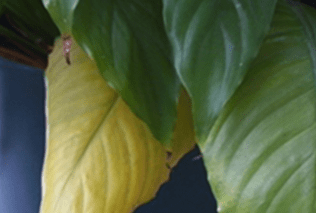
Soil tests have limited value in indicating nitrogen needs for a home garden or lawn because the nitrogen levels are constantly changing due to microbial activity, plant uptake, and changes in temperature and water. Soil tests for nitrogen need to be repeated at regular intervals through the growing season to be of use.
Plants can absorb nitrogen in its three ionic forms: ammonium (NH4+), nitrite (NO2–), and nitrate (NO3-). Ammonium is generated when microbes break down organic matter in the soil. Being positively charged, ammonium is attracted to the negatively charged soil particles and thus is resistant to leaching (movement down through the soil profile). Because microbial activity is closely tied to soil conditions, the temperature, moisture, pH, and soil oxygen can all have significant effects on soil nitrogen availability. Other soil microorganisms quickly convert ammonium to nitrate in well oxygenated soils. Nitrite and nitrate, being negatively charged, readily leach below the root zone. Nitrite is toxic to plants but extremely short-lived, usually being quickly further oxidized to nitrate, so is not absorbed by plants in most cases. Most plant nitrogen is absorbed as nitrate. Nitrate either quickly is absorbed by plant roots or is leached from the soil profile, so it is rarely found in soil tests of the root zone. Prevent water pollution by avoiding over-fertilization with nitrogen. Certain plants (legumes) develop mutualistic relationships with nitrogen-fixing bacteria and can therefore access elemental nitrogen (N2) directly from the atmosphere.
Soil microorganisms release nitrogen tied up in organic matter over a period of time. Release rates from compost are very slow (years). The need for nitrogen fertilizer is based on the organic matter content of the soil. [Table 2]
Table 2. Need for nitrogen fertilizer based on soil organic matter content.
| Soil Organic Matter Content | Routine Application Rate For Gardens |
|---|---|
| 1% 2-3% 4-5% | 2 pounds actual N / 1000 square feet 1-pound actual N / 1000 square feet 0 |
Iron
Most of the iron in soil is in the form of stable mineral compounds. At high pH, iron oxides (rusts) are resistant to entering the soil water solution. Only at lower pH can iron be reduced to a form that can be absorbed by plants. For every unit of increase in pH, the solubility of iron decreases by a factor of 1,000. Many soils in Colorado have high pH, making some plants grown in them susceptible to iron chlorosis. Iron chlorosis refers to a yellowing of leaves caused by an iron deficiency in the leaf tissues. Primary symptoms include interveinal chlorosis (yellowing of leaves with veins remaining green). Because iron is not readily moved within plants once incorporated, symptoms appear on younger leaves and on new growth. In severe cases, leaves may become pale yellow or whitish, while veins retain a greenish tint. Angular brown spots may develop between veins and the leaf margins may scorch (become brown along the edge). Symptoms may show on a portion or on the entire plant. General symptoms of iron chlorosis are shown in Figure 2.

In western, high pH soils, iron is not deficient in an absolute sense, rather, it is unavailable for plant uptake due to the soil’s high pH. At high pH, iron is quickly oxidized into rust compounds. Plant-available iron is the result of microbial activity generating local supplies of reduced iron (that is, not oxidized into rusts) in the soil profile. In addition to high pH, iron chlorosis can be exacerbated by conditions that reduce soil microbial activity, including the following:
- Cool, wet soils in spring. Attention to irrigation management can help correct iron chlorosis.
- Soil compaction and low soil oxygen (which limit microbial activity).
Furthermore, iron chlorosis can be a symptom of physical damage to trees and shrubs, including trunk-girdling roots and bark injury associated with winter sunburn.
Attention to these contributing factors can solve a chlorosis issue without the need for adding iron products.
Iron fertilizers typically take the form of chelated (KEY-lated) iron; iron that is part of a soluble complex of organic molecules. Not all chelation products are effective at high soil pH; in soils with a pH above 7, as in much of Colorado, only the product abbreviated EDDHA is capable of supplying iron to plants. Many plants, particularly those native to the arid regions of the western USA, are naturally able to extract iron from high pH soils and rarely display iron chlorosis.
Phosphorus
Phosphorus, P, is a primary nutrient in plant growth. Phosphate, P2 O5, is an ionic compound containing two atoms of phosphorus and five atoms of oxygen. The phosphorus content of fertilizer is measured in percent phosphate.
Phosphorus may be present in high concentrations in soils; however, it may not be in a plant available form. Deficiencies are most likely to occur in new gardens where the organic matter content is low, and the soil has a high pH (7.8 to 8.3). A soil test is the best method to determine the need for phosphorus fertilizers.
Phosphorus deficiency is difficult to diagnose because other growth factors will give similar symptoms. General symptoms include sparse, green to dark green leaves. Veins, petioles, and lower leaf surface may be reddish, dull bronze, or purple, especially when young. Phosphorus deficiency may be observed on roses in the early spring when soils are cold, but the condition corrects itself as soils warm.
Excessive phosphorus fertilizer can aggravate iron and zinc deficiencies, and increase the soil salt content. Many home gardener soils are significantly over fertilized with phosphates, aggravating soil salts and iron chlorosis. Typically, the over fertilization results from over application of compost.
Potassium
Potassium, K, is a primary nutrient in plant growth. The word potash, refers to various mined or manufactured potassium salts, including potassium chloride and potassium sulfate. The potassium content of fertilizer is measured in percent potash.
Potassium levels are naturally adequate and even high in most Colorado soils. Unlike nitrogen and phosphorus, which are usually found in soils in organic compounds, potassium is usually in minerals or mineral lattices and can therefore still be largely unavailable to plants, even if absolute potassium levels are high. Deficiencies more commonly occur in sandy soils low in organic matter. Organic matter and clay particles, with their many negatively charged binding sites, provide a reservoir of potassium that is available to plants.
A soil test is the best method to determine the need for potassium fertilizers.
Potassium deficiency is difficult to diagnose because other growth factors, including nitrogen deficiency, will cause similar symptoms. General symptoms include marginal and interveinal chlorosis (yellowing), followed by scorching that moves inward. Older leaves are affected first, because potassium is highly mobile within plants. Leaves may crinkle and roll upward. Shoots may show short, bushy, zigzag growth, with dieback late in the season. Excessive potassium fertilizer can aggravate soil salt levels. Many home garden soils are over fertilized with potash, leading to salt problems.
Zinc
Zinc concentrations in the soil are naturally quite low, and particularly low in soils with high pH and that contain calcium carbonates.
Sweet corn, beans, and potatoes are the most likely vegetables to be affected by zinc deficiency. Symptoms include a general stunting of the plant due to shortening of internodes (stem length between leaves). Leaves on beans typically have a crinkled appearance and may become yellow or brown. On young corn, symptoms include a broad band of white-to-translucent tissue on both sides of the leaf midrib starting near the base of the leaf, but not extending to the tip.
This publication, reference GardenNotes #231, is developed as part of the Colorado State University Extension Master Gardener Program.