


Why Prune?
Pruning has a major influence on a shrub’s flowering habit, shape, size, and pest problems.
Prune to Encourage Flowering
Pruning has a major influence on shrub flowering. Over time, an unpruned flowering shrub becomes woody, with little new growth to support flower bud development.
Spring-flowering shrubs bloom on one-year-old wood (new twigs that grew the previous summer). The flower buds develop from midsummer through fall, overwinter, and bloom the following spring. In the early spring, flowering shrubs can be thinned before flowering or growth starts. Thinning or rejuvenation pruning can also be done right after blooming to maximize the next season’s flowers. Pruning in the fall and winter will remove wood containing the flower buds, reducing blooms the following spring. [Figure 1]
Spring-flowering shrubs include forsythia (Forsythia spp.), Nanking cherry (Prunus tomentosa), quince (Chaenomeles spp.), bridal wreath and Vanhoutte spireas (Spiraea prunifolia, S. pleniflora ‘Plena’ and S. x vanhouttei), viburnum (Viburnum spp.), beautybush (Kolkwitzia amabilis), lilac (Syringa spp.), honeysuckle (Lonicera spp.), peashrub (Caragana spp.), deutzia (Deutzia spp.), and weigela (Weigela spp.).
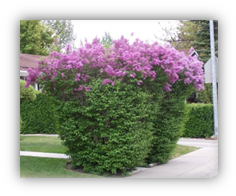
For spring-flowering shrubs, it is recommended to “deadhead” spent blooms (remove flowers after they fade). While time-consuming, deadheading conserves the plant’s energy, which would otherwise be spent on seedpod and seed development. For many flowering shrubs, the spent flowers and seedpods are not attractive and can be removed for aesthetic reasons (lilacs).
Summer-flowering shrubs bloom on new wood that grew earlier in the current growing season. Summer-flowering shrubs can be pruned by thinning or rejuvenation pruning in the early spring before growth starts.
Summer-flowering shrubs include most butterfly bush (Buddleia spp. and Cassia spp.), blue mist spirea (Caryopteris x clandonensis), Hancock coralberry (Symphoricarpos x chenaultii ‘Hancock’), mock orange (Philadelphus spp.), potentilla (Potentilla spp.), Bumald and Japanese spirea (Spiraea x bumalda and S. japonica), Annabelle and Peegee hydrangea (Hydrangea arborescens ‘Annabelle’ and H. paniculata), shrub althea or rose of Sharon (Hibiscus syriacus), snowberry (Symphoricarpos albus) and St. John’s wort (Hypericum spp.).
Removing older canes of flowering shrubs by thinning also allows for better sunlight penetration into the shrub. This results in better flowering throughout the shrub, instead of flowers just at the top where sunlight is plentiful.
On shrubs noted for their bark color, like red-twig dogwood (Cornus sericea), the new shoot growth has a more brilliant color. Routine pruning by thinning at the base encourages new shoots which have the desired red color.
Prune to Direct Shape
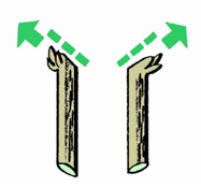
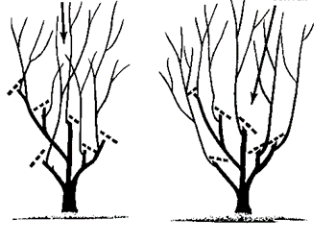
Shaping is another reason for pruning shrubs. Shape can be managed to some degree by pruning to side buds or branches growing in the desired direction. While pruning can provide some control over size, it is not an effective method to keep a large shrub in a small space. Where shrubs have overgrown their space, consider replacing the plants with smaller cultivars or other species. [Figures 2 and 3]
Prune to Manage Pests
Pruning is a management technique for some insect or disease problems. For example, removing the older wood in lilac can reduce oystershell scale and borer problems. Thinning a shrub to increase air circulation reduces the incidence of powdery mildew and leaf spot diseases.
Pruning Methods for Flowering Shrubs
The primary objective when pruning flowering shrubs is to encourage new (flowering) growth from the base. This is best accomplished by thinning at the base, or rejuvenation.
Branch-by-Branch Shaping
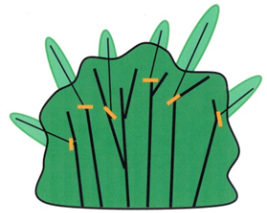
Branch-by-branch shaping involves shortening the length of excessively long branches by cutting them back one-by-one. Cuts are made back in the shrub, leaving branches at varying lengths. Avoid making cuts at a uniform “edge,” creating a rounded ball. Make cuts at appropriate branch unions (crotches) or buds. [Figure 4]
Branch-by-branch shaping is a slow process, but this method maintains a more naturally shaped shrub and does not significantly encourage new growth.
Shearing to Shape
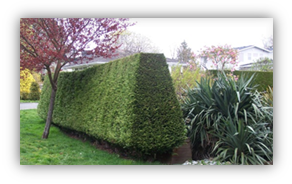
Shearing shrubs to round balls or other desired shapes is a common pruning technique because it is quick and easy. However, sheared shrubs lose their natural shape, and the rounded “balls” may detract from a more natural, informal landscape design. Shaping spring-flowering shrubs after midsummer removes the new wood with next year’s blossoms. In addition, frequent shearing does not encourage new growth from the base, which is needed to promote flowering.
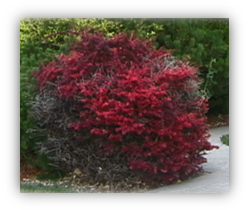
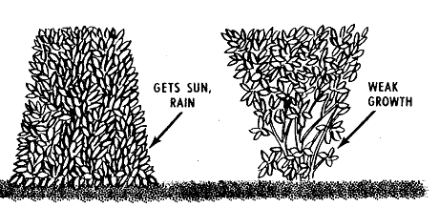
With frequent shearing, the plant becomes thicker and bushier toward the exterior. The thick outer foliage may shade out the interior and lower foliage, and the plant becomes a thin shell of foliage with a woody interior and base. The thin shell of foliage is prone to browning and burning from wind and cold weather. Over time, shrubs that are sheared become woody, with lots of dead branches and few flowers. When shrubs become overly woody from routine shearing, replacement is the best option to refresh the landscape design. [Figures 5 through 9]
Thinning
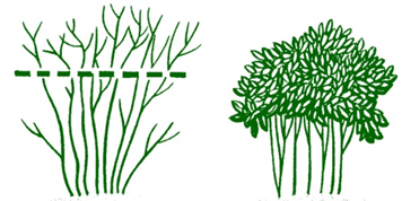
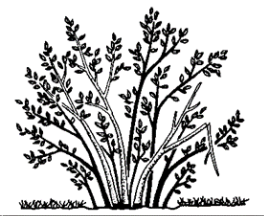
One method to encourage shrub flowering is annual thinning. The objective is to remove one-third of the oldest wood to the ground each year, which in turn stimulates new, better-flowering growth from the base of the shrub. Thinning is more easily done before growth starts using leafless branches in early spring but can also be done in summer if necessary. This method can be time-consuming and does not work well on twiggy, multi-stem shrubs, like spirea. [Figure 10]
Cutting back and thinning an overgrown shrub will not restore its natural, informal form. It will look like an overgrown shrub that has been pruned. Rejuvenation pruning followed by annual thinning is better for overgrown shrubs.
Rejuvenation Pruning
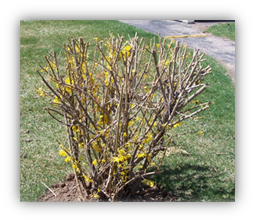
Many shrubs can be easily renewed with rejuvenation pruning. The shrub is cut entirely to the ground in the early spring before growth starts. The shrub regrows from roots, giving a compact, youthful plant with maximum bloom. Rejuvenation can have a major effect on size. This method is preferred for many flowering shrubs because it is quick and easy with great results. Initial rejuvenation should be followed by thinning new canes to several strong ones over the next several years. Remove weak cane growth at the base (ground level).
Rejuvenation is typically done no more than every three to five years when a shrub begins to look gangly and woody. It works very well on multi-stemmed, twiggy-type shrubs such as spirea (Spiraea spp.), blue mist spirea (Caryopteris), Potentilla, red-twig dogwood, sumac (Rhus spp.), and hydrangea. (Note: Caryopteris flowers best if renewed each spring.) Also use this method to rejuvenate lilac, privet (Ligustrum spp.), barberry (Berberis spp.), forsythia, flowering quince, honeysuckle, mock orange, flowering weigela, beautybush, many viburnums, elderberry (Sambucus spp.), and others.
Limitations:
- Spring-flowering shrubs will not bloom the year of rejuvenation.
- On shrubs with a rock and weed fabric mulch, rejuvenation may not be successful due to decreased root vigor and interference of the mulch with growth from the base.
- Extremely overgrown shrubs with large woody bases may not respond well to rejuvenation pruning.
- Shrubs with many dead branches will not respond well to rejuvenation pruning. As a general rule, if more than one-third of the branches are woody and, without healthy foliage, the shrub will probably not respond. Some shrubs are structurally similar to small trees, with only one or a few primary trunks, including several Viburnum and Euonymus species, and shrubby forms of Rhamnus (buckthorn). Do not cut these shrubs to the ground. Prune by thinning branches back to side branches.
- Lilac cultivars grafted onto common lilac rootstocks should not be cut to the ground. Regrowth will be of the common lilac rather than the selected cultivar.
Replacement
Shrubs that have been neglected or repeatedly sheared often become woody with many dead twigs. The best option may be to replace them.
Shrubs can also be overwhelmed by weedy invaders, seeded by birds, squirrels, or wind. For example: Common Buckthorn (Rhamnus cathartica), Walnut (Juglans spp.), Elm (Ulmus spp.).If routine clearing of these invading woody species is not done, the original shrubs may be compromised or lost. Replacement may again be needed.
This publication, reference GardenNotes #616, is developed as part of the Colorado State University Extension Master Gardener Program.