


Mature Trees and Pruning
Mature trees contribute a tremendous amount of aesthetic and financial value to a property. Trees take decades to reach maturity and cannot be easily replaced, so, caring for them correctly is critical. One important aspect of tree care is pruning. Proper pruning can prevent structural issues, mitigate hazards, improve a tree’s appearance, and generally ensure a tree remains healthy and structurally sound.
Mature trees are less tolerant of pruning than young trees and incorrectly pruning them can also have major consequences for their health and stability. This means mature trees should not be pruned unless there is a reason to do so. Common acceptable reasons to prune mature trees include removal of dead or diseased wood, removing or managing water sprouts, improving light penetration into, and air movement through the canopy, reducing the size of the crown in order to prevent interference with other landscape features, and mitigating their risk of failing.
Pruning larger trees is extremely dangerous work. Hundreds of arborists are severely injured or killed every year. It is important to know your limitations; mature tree pruning is best left to professional arborists. Never remove large limbs while on a ladder.
Finding a Good Arborist
A professional arborist is licensed and insured. Your local city forester may maintain a list of arborists that are licensed to work in your municipality.
Industry groups, such as the International Society of Arboriculture, administer arborist certification programs that train arborists and require them to adhere to a code of ethics. Accreditation is based on experience and demonstrated knowledge, and arborists must maintain accreditation by completing continuing education units. This continuing education requirement ensures they always have the most up-to-date training on proper tree care. Industry groups maintain searchable databases of certified arborists to aid the public in hiring a trained and certified professional. Not all tree care workers are certified arborists. It is a good idea to make sure any tree care company you hire has a certified arborist on staff and ideally, that one will be on site when your tree is pruned.
Pruning Specifications
A pruning specification is a document that describes how a tree or group of trees will be pruned. Having a good pruning specification or similar document agreed upon by the property owner and arborist limits the opportunities for misunderstanding and poor pruning. A good specification should state at a minimum which trees on the site will be pruned, the type of pruning the trees will receive, the objective of the pruning, the maximum percentage of a tree’s canopy that will be removed and the maximum diameter of live branches that will be removed. It may also specify that the tree will not be topped or “lion tailed.” An arborist may have a general set of specifications they use, or it may be provided by the property owner in some cases.
General Pruning Guidelines
Limitations on Diameter of Cut
Ideally all pruning cuts are made on branches two inches or less in diameter. Smaller cuts are more quickly covered with wound wood and avoid exposing large amounts of heartwood. Sapwood is the newer xylem rings. It is active in water transport and storage of photosynthates and is composed of both living and dead cells. Because it contains living cells it can actively resist the spread of decay organisms. On branches two inches and less in diameter, sapwood dominates the branch structure and in many cases is the only type of wood present.

Soil conditions contribute to many plant problems. What can the gardener do?
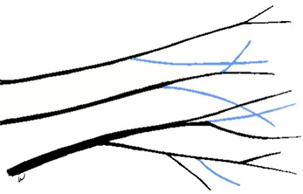
Heartwood, the older xylem rings no longer active in water transport, has no way to actively resist decay. Due to chemical changes in these nonliving cells, heartwood is often darker in color. Depending on species and growth rates, heartwood becomes significant as branches reach two to four inches in diameter. [Figure 1]
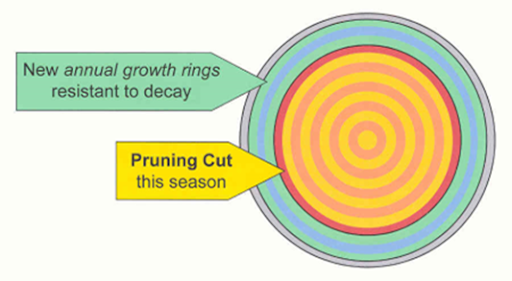
If decay organisms successfully colonize a tree’s heartwood, over time they can spread to all the heartwood in the tree, creating large columns of decay. When a pruning cut or other injury opens a branch to decay, the decay organisms will potentially affect the current season of xylem rings and everything older over time. Decay creates a pipe-like structure in the branch. The healthy, undecayed wood will be the xylem rings that grow in future years. [Figure 2]
Proper Pruning Cuts
For information on making proper pruning cuts, refer to CMG GardenNotes #612, Pruning Cuts.
Pruning Dosage: Maximum Amount of Live Wood/Foliage to Remove
Mature trees are less tolerant of pruning than younger trees. When pruning them you should remove the least amount of foliage required to meet your pruning objectives. From a plant health perspective, a maximum of 10% of a mature tree’s foliage should be removed during each pruning cycle. However, to meet your pruning objectives a larger pruning dose—or amount of live tissue removed during a single pruning cycle—may be necessary and is acceptable if the tree is in good health.
In situations where trees are pruned annually, the appropriate pruning dose will normally be smaller. However, trees are often pruned only once every several years. Here the appropriate pruning dose may be larger. In situations where heavy pruning is needed, complete the work over a period of years.
Excessive pruning can lead to water sprouts (sucker-like shoots on the trunk or branches). Water sprouts are structurally unsound because they are superficially attached to the tree. In contrast, structurally sound branches contain overlapping branch and trunk wood. This means branch wood is enveloped with trunk wood, and each year a new layer of branch and trunk wood form at the branch collar in a ball-and-socket fashion ensuring a strong branch attachment.
Excessive pruning also creates a hormone imbalance between auxins (produced in the terminal buds of the canopy) which stimulates root growth and gibberellins (produced in the root tips) which stimulates canopy growth. This puts the root system into a multi-year decline cycle, resulting in a multi-year decline in canopy growth.
Removal of dead wood does not count toward your dosage.
Pruning Objectives
Pruning is stressful and should only be undertaken with objectives (why to prune). Do not indiscriminately remove branches. Pruning objectives determine methods to be used (how to prune), which in turn determine the type of pruning cuts to be made. Below are common objectives, methods, and types of pruning cuts.
Objectives (Why)
Reduce Risk of Failure
Improve Structure
Maintain Health
Improve Aesthetics
Provide Clearance
Improve View
Reduce Shade
Influence Flowering and Fruiting
Methods (How)
Structural
Cleaning
Thinning
Raising
Reducing
Restoring
Pruning Cuts
Removal Cut
Reduction Cut
Heading Cut
Pruning Methods
Structural Pruning
Structural pruning centers around developing a dominant trunk with subordinate and properly spaced side branches and secondary limbs. To be most effective, it requires annual pruning over a period of years. It is a proactive practice that seeks to establish a resilient structure and prevent major structural defects in a tree. It is mostly carried out on younger trees as mature trees have already developed their structure.
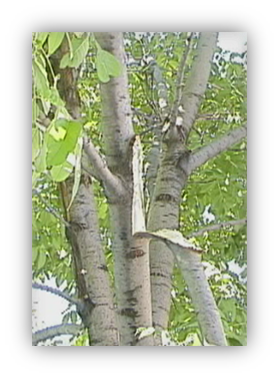
Some of the principles of structural pruning can be applied to mature trees to reduce the risk of branches failing due to wind or snow loading. For more information, see the section on reduction pruning later in this document. [Figure 3]
Cleaning
Cleaning is the most common type of pruning mature trees need and the most common type of pruning performed on them.
The objective of cleaning is to improve the tree’s health and reduce the risk posed to people and property by removing dead, broken, cracked or diseased wood, rubbing branches, and weakly attached branches. Examples of weakly attached branches include branch unions with included bark, unions where the branches are equal in size (codominant branches), and water sprouts.
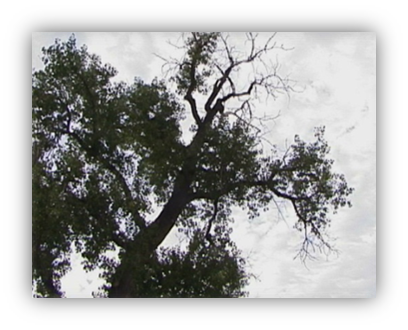
If a mature tree has many water sprouts, leaving some is considered good practice. They are a stress response and attempt by the tree to produce more energy. If water sprouts are abundant or associated with a wound, prune out approximately one third of them such that remaining sprouts are spaced evenly along branches. If there are only a few water sprouts and they are not associated with a wound, they should be removed. Water sprouts below the canopy and suckers from a tree’s root system should be removed. [Figure 4]
Removing Dead Branches
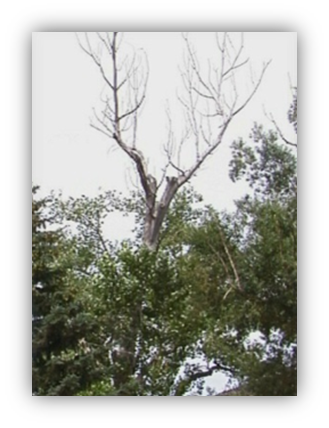
To minimize risk if the branch were to fail, it is advisable to remove any dead branch larger than two inches in diameter and higher than thirty feet. Dead branches may also become a source of insect and disease pressure in the tree.
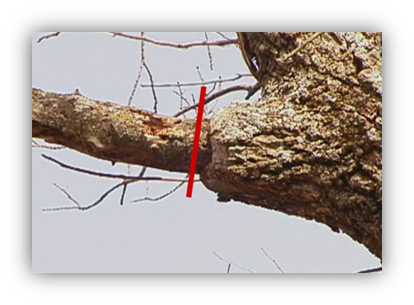
Remove the dead branches using the three-step pruning technique. For details refer to CMG GardenNotes #612, Pruning Cuts. Do not cut into the branch collar, which would result in a high potential for decay to spread into the trunk. If live wood has begun to grow out along the dead limb, cut just beyond the live wood, being cautious not to nick the live tissue. Never “flush cut” the dead branch even with the trunk. Always cut outside of the branch bark ridge and branch collar. [Figure 5]
Written specifications for cleaning should specify the minimum size of dead branches to be removed. For example, “Remove dead branches one inch in diameter and larger” or “Remove dead branches two inches in diameter and larger that are 30 feet and higher above the ground.” The location of the branch to be removed should be specific if the entire crown is not going to be cleaned.
Thinning
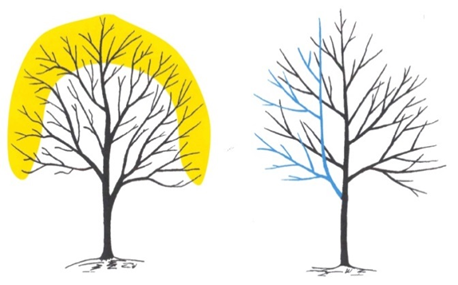
In properly executed thinning, some small branches are removed from a tree’s canopy, primarily from its outer edge, with the objective of increasing light penetration into, and airflow through, the canopy. [Figure 6] The potential benefits of this include a reduced risk of failure due to a reduction of branch weight and decrease in load placed on branches from wind or snow, better taper (increased diameter growth) of interior branches due to increased sunlight in the inner canopy and a reduction of foliar diseases.
The benefits of thinning are short lived as the tree continues to grow and replaces removed branches in future years. Thinning is frequently executed incorrectly with too many branches being removed from the interior of a tree’s canopy. Results of improper thinning can be similar to “lion tailing.” Thinning is most appropriate for trees that have a confined or reduced rooting area, are in windy sites to reduce wind loading, or for mitigating a specific hazard.
Potential Benefits of Thinning
- Thinning can reduce limb weight in order to compensate for structural defects.
- Thinning increases light penetration into the tree’s interior. This can invigorate the tree and help retain the tree’s natural shape. Thinning may adequately reduce shade for shade tolerant understory plants below the tree. However, thinning middle-aged and mature trees will not adequately promote growth of sun loving plants like Kentucky bluegrass growing in the tree’s shade.
- Thinning is a technique to partially open a view without removing or structurally influencing a tree. This is often referred to as vista pruning.
Limitations of Thinning
- On a tall tree, thinning may not be an effective technique to reduce wind sail and potential for breakage in strong winds. Reducing is the most effective way to deal with wind loading issues.
- In most situations the benefits of thinning will be short-lived as the tree puts on new growth. This makes it most relevant to higher value trees which have a known hazard.
Improper Thinning
- Thinning should be carried out on relatively small branches in the outer canopy. Thinning should not remove large branches or many interior branches. Doing so can have results similar to lion tailing which reduces the tree’s vigor and increases the risk of damage from wind. [Figures 7 and 8]

Written specifications for a thinning job should specify the following:
- Clarify the dosage (percent of the tree’s canopy that may be removed). For example, “Pruning should not exceed 15% of the total live canopy.”
- Clarify where in the tree the pruning will occur. For example, “Pruning should occur in the outer third of the crown.”
- Clarify size of branches to be removed. For example, “Pruning should remove branches up to two inches in diameter.”
Raising
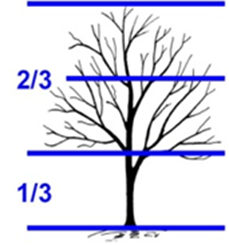
Raising is the removal of lower branches to provide clearance for people, traffic, buildings, or a view. When removing lower branches, maintain at least one-half of the foliage in the lower two-thirds of the tree. The lowest branch should originate in the bottom one-third of the tree (live crown ratio).[Figure 9]
Raising should be part of the tree’s structural training while young. Ideally raising would be done before branches to be removed exceed two inches in diameter. The potential for decay is high when the branch removed is larger than four inches or when a two inch and larger branch is greater than half the diameter of the adjacent trunk. Removing branches greater than half the diameter of the adjacent trunk leaves no branch collar to suppress decay.
On many trees, lower branches make up a significant portion of the tree’s entire canopy and cannot be removed without significantly influencing tree health and appearance. When the branch to be removed is larger than two inches, consider other alternatives. Can the clearance required be achieved with removal and reduction cuts out along the branch rather than removing the entire branch? Leaving some small diameter branches on the lower trunk for a year helps close pruning wounds and lessens the potential for trunk cracking. [Figure 10]
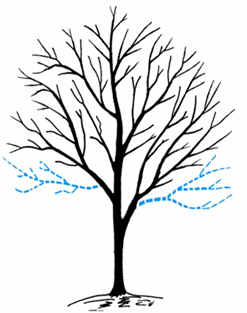
Excessive removal of lower branches increases the potential for tree failure by decreasing trunk taper, causing trunk cracks and decay, and transferring weight to the upper crown, increasing wind loading.
Written specifications for raising should include the following:
- Clarify the clearance required. For example, “The tree’s crown will be raised to seven feet.”
- Clarify what branch(es) will be pruned and the type of pruning cuts (removal or reduction cut) to be used. For example, “The lowest branch on the south side shall be removed back to the trunk with a removal cut. The lowest branch on the north side will be reduced with a reduction cut at the branch five feet out from the trunk and a removal cut to the lowest side-branch.”
- Clarify what size of branches will be pruned. For examples, “All cuts shall be two inches in diameter and smaller.”
Reduction
The objective of reduction pruning is to reduce the size of the tree’s canopy. Normally it is undertaken to provide clearance for a structure, power lines, or other element in a landscape. It can also be used to reduce the risk of tree failure.
Reduction pruning is best done before a tree outgrows its space and begins to interfere with structures or power lines. This allows for the use of smaller pruning cuts and for the natural shape of the tree to be preserved. Improper reduction pruning can quickly become topping. [Figure 11]
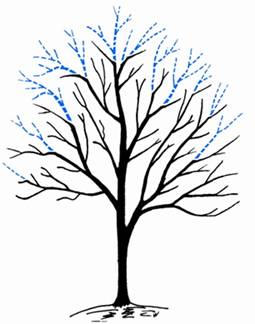
Not all trees can be reduced without predisposing the tree to decline and death. Crown reducing requires the extensive use of reduction cuts, which can predispose the remaining branch or trunk to internal decay. On older trees showing stress or decline, heading cuts can accelerate decline and death. The need for reduction pruning can be reduced by selecting a tree with an appropriate mature size for a site and by performing proper structural pruning as the tree grows. [Figure 12]
In a proper reduction cut, the side branch remaining after the cut will be at least one-third the diameter of the trunk/parent branch removed. Under American National Standards Institute (ANSI) pruning standards, if the side branch is less than one-third, it is considered a heading cut, which is generally unacceptable. For additional details on proper reduction cuts, refer to CMG GardenNotes #613, Structural Pruning of Young Shade Trees.
It is very time intensive to use crown reducing to permanently maintain a tree at a small size without causing tree decline. Ideally, trees should be selected with adequate space to accommodate their mature size. Where size control is necessary, it is best to begin reduction pruning as the tree reaches an acceptable size, rather than when the tree becomes overgrown.
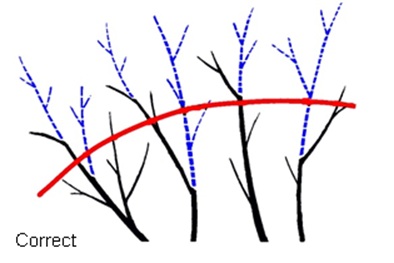
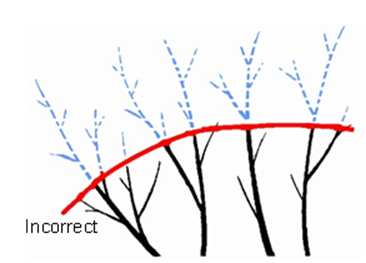
In crown reducing, first visualize the new outer edge of the smaller canopy. Then prune the tree back to appropriate branch unions for a proper reduction cut or removal cut. Some branches will be left taller than the visualized outer edge while others will be cut back below the visualized canopy edge. [Figure 13 and Figure 14]
In shortening primary upward growing trunks/primary branches to a lateral branch, a side branch that is somewhat upward growing with a narrow branch union angle may be stronger than a branch union with a wide angle. [Figure 15]
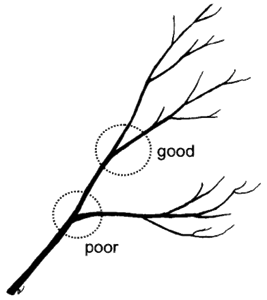
Just because a tree is tall does not indicate that it is structurally unsound. Potential risk of failure should be evaluated by an experienced arborist based on branching structure, branch union integrity, signs of internal decay, and previous damage.
Written specifications for reduction pruning should include the following:
- Clarify the desired reduction in height/spread.
- Specify criteria for reduction cuts. For example, “All cuts should be made on branches less than two inches in diameter. Diameter of the remaining lateral branch should be at least one-third the diameter of the branch removed.”
- Clarify the dosage (percentage of live wood/foliage to be removed). For example, “Pruning should not exceed 10% of the total canopy.”
Restoration
Restoration pruning is an advanced type of pruning which has the objective of helping a tree recover from storm damage or prior improper pruning. It seeks to manage the remaining branches and any water sprouts which result from the damage to restore a sound branch structure.
Before a storm damaged tree undergoes restoration pruning it is important to first decide if the tree can be saved. The loss of leaves or broken branches are both conditions a tree can recover from. Cracks or other significant damage to the main trunk often are not.
Actual pruning procedures vary with the situation. When dealing with situations of excessive water sprouts, a rule of thumb is to remove one-third of the sprouts and reduce one-third of the sprouts in height with each annual pruning. Removing all of the water sprouts at one time often stimulates the growth of more water sprouts.
Types of Pruning to Avoid
There are several types of pruning that should be avoided for mature landscape trees. These include, topping, rounding-over and lion tailing. Always have a reason to prune, do not just prune for the sake of pruning.
- Topping or Rounding Over:
- Topping is the arbitrary shortening of a tree’s branches or trunks during pruning without regard for tree anatomy or biology. It may produce an abundance of water sprouts which are vigorous and structurally unsound. In some cases, topped trees will decline and die. Topping often occurs when trees are planted in spaces that are too small for their mature size, such as under powerlines, or to give a tree a rounded shape. When planting a tree make sure that its mature size will fit the space and that it is a cultivar that has the shape you desire. Properly executed reduction cuts can be used to reduce the height of the tree while minimizing negative impacts on the health of the tree.
- Lion Tailing:
- Lion tailing is the practice of limbing up a tree taken to an extreme. In the worse cases of lion tailing, all the lower branches of the tree are removed leaving only a few leaves at the ends of long bare branches (like the puff of fur at the end of a lion’s tail). In less extreme cases only interior branches are removed creating a shell of foliage around a hollow center. To avoid lion tailing be sure that at least two thirds of a tree’s height is left as canopy with no more than the lower one third being bare trunk. Raise the canopy of trees slowly and only as far as needed based on the planting site. Interior branches are important to proper diameter growth of major limbs and trunks and should not be over thinned.
Frequently Asked Questions About Pruning Mature Shade Trees
What About Utility Right-of-Way Pruning?
Pruning for utility line clearance does not always follow desirable pruning techniques regarding appearance and health of the tree. In this situation, the needs of the utility right-of-way take priority over the tree.
When a tree under a power line requires frequent reduction, consider having the tree removed. Utility companies are generally eager to accommodate. In planting trees, selection criteria (i.e., size and placement) should be followed so that a tree’s health and appearance will never be compromised by the need for utility pruning.
How Should Storm-Damaged Trees be Pruned?
First, assess if the tree is safe to work on or around. Look for cracked or hanging branches that might fall, downed power lines and other hazards. Once you are sure the area is safe, focus on cleaning (removing broken and damaged limbs), keeping in mind the structural integrity of the tree.
Next, focus on structural pruning to restore the tree’s structural integrity and shape to the extent possible. Re-establishing good structure may take place over a period of years.
The maximum amount of tree canopy that can be removed without putting the tree and its root system under stress includes the live wood/foliage removed as a result of storm damage. When too much live wood/foliage is lost to storm damage, limit pruning to cleaning.
On trees where excessive live wood and foliage were removed by storm damage, wait until the roots and crown stabilize (as measured in canopy growth) before performing any pruning other than cleaning. This may take several years.
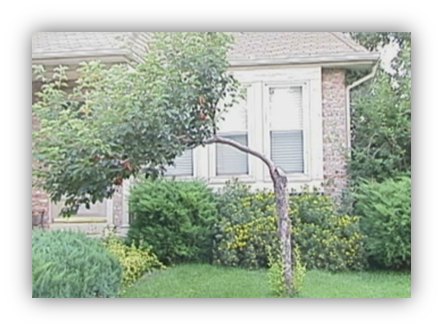
Keep the tree if it can be pruned back to structurally sound wood and will be esthetically pleasing. Often when more than half the tree is lost to storm damage, the best option is to remove the entire tree. [Figure 16]
How Should Trees With Root Damage Be Pruned?
Focus on cleaning. Avoid removing live wood and foliage as this could speed the decline. Removing live wood lowers the auxin content, which is the hormone that promotes root growth. Removing foliage reduces photosynthesis and levels of stored carbohydrates that the tree is living on during the recovery period. Trees in a construction site with damaged roots may require cleaning every three to twelve months for five plus years.
How Should Declining Trees Be Pruned?
Focus on cleaning. Avoid removing live wood and foliage as this could speed the decline. Removing live wood lowers the auxin content, which is the hormone that promotes root growth. Removing foliage reduces photosynthesis and levels of stored carbohydrates that the tree is living on.
This publication, reference GardenNotes #615, is developed as part of the Colorado State University Extension Master Gardener Program.