


Quick facts…
- Select a site in full sun with well-drained soil, free of competing tree and shrub roots.
- Procure plants from a reputable nursery or mail-order catalog and plant properly in good or improved soil.
- Plant bare-root and packaged roses in early spring and protect them from late frosts.
- Do not allow bare-root and packaged roses to dry out before and after planting.
- Plant grafted (budded) roses so that the graft (bud) union is 2 to 4 inches below the soil line. Plant own-root roses so that the crown is 1 to 2 inches below the soil line.
Introduction
Roses can grow in most communities in Colorado.
The American Rose Society lists 48 classifications for roses, but roses in Colorado can generally be said to fall into one of the following types: hybrid tea, miniature, floribunda, grandiflora, climber, shrub (which includes English and Canadian roses), polyantha and hybrid rugosa.
The hybrid tea rose, originally a cross between a tea rose and a hybrid perpetual, is the most popular garden rose. Generally, they produce large blooms on long stems and are preferred for exhibition and cut flowers.
Miniatures are naturally dwarf roses and remain popular, especially in small garden spaces. They can also be grown in containers or window boxes.
Floribunda roses are a cross between a hybrid tea and a polyantha rose. These roses usually have smaller blooms than hybrid teas, but they are borne in clusters. They typically repeat blooming each season. They are somewhat hardier than grandifloras and hybrid teas.
The original grandiflora was produced from a cross between a hybrid tea and a floribunda. Grandiflora plants are similar in size to hybrid tea roses but usually have slightly smaller yet more abundant flowers.
The climbing hybrid teas and climbing grandifloras are generally not recommended for most areas of Colorado because most will bloom only on the previous year’s growth. During severe winters, the previous year’s growth on these climbers is damaged by cold temperatures and drying. This results in little or no blooms or blooms of poor quality the following season. There are, however, several repeat-blooming, large flowered climbers (LCL) that do well in Colorado’s climate. Most of these climbers will bloom on the current year’s growth (new wood) and have the added advantage of repeat flowers.
The term “shrub rose” is used loosely to cover roses not previously mentioned. Some of the hardiest of all roses can be found in this group. Included in this group are the English Roses developed by David Austin. Canadian shrub roses were developed under the direction of the Canadian Department of Agriculture for winter hardiness, disease resistance, ease of propagation, and repeat blooming, and also make good choices for Colorado.
Hybrid rugosa roses are known for their fragrance, hardiness, and sturdiness in the garden. They can be identified by their numerous thorns and dark green leaves with deep veining. The hips, left from spent blooms, are often showy in winter. These roses can perform in poor soil and drought conditions.
Selecting Plants
Roses are sold through mail-order nurseries, local garden and nursery outlets, hardware and box stores, and grocery stores. Generally mail-order nurseries handle bare-root, dormant roses. Local nurseries usually sell potted roses. Box stores and grocery stores may offer bare-root or potted roses.
Most experienced rose growers prefer bare-root, dormant plants from a reputable nursery. Potted roses are a viable choice only when the nursery has used good culture in the potting and care of the plants. When purchasing bare-root packaged roses from nurseries, hardware, or big box stores, be sure the plant has not had a chance to dry out and deteriorate on the shelf.
Site Selection
Site selection is important. Roses prefer full sun, rich, well-drained soil, and good air circulation. In windy sites, protect the roses from the prevailing wind.
A good second choice is a location that gets full sun during the early morning hours. This might be on the east side of buildings or an area that is shaded by trees in the afternoon. Locate the plants so they receive a minimum of five to six hours of sunshine each day.
When choosing a location, avoid places where the roses have to compete with tree or shrub roots for water and nutrients.
Planting Bare Root Roses
For bare-root roses, spring planting is preferred over fall. It is best to finish planting bare-root roses by mid-April in lower elevation portions of the state.
Bare-root roses are normally shipped at the appropriate planting time. Plant them as soon as possible after you receive them. If bare-root plants appear dry when they are received, soak them in a bucket of water overnight, but not leave them in water for more than 24 hours. If you are not able to plant your roses right away, keep them somewhere cool but above freezing to prevent them from de-acclimating to outdoor conditions.
If planting in a previously prepared bed, dig the hole so it accommodates the root system, usually about 18-24 inches in diameter and 14-18 inches deep. If the roses are planted in soil that has not been prepared in advance, dig the hole at least that large. If the soil is compacted or needs improving, the planting hole may be as large as 36 inches in diameter and 18 inches deep (See Figure 1).
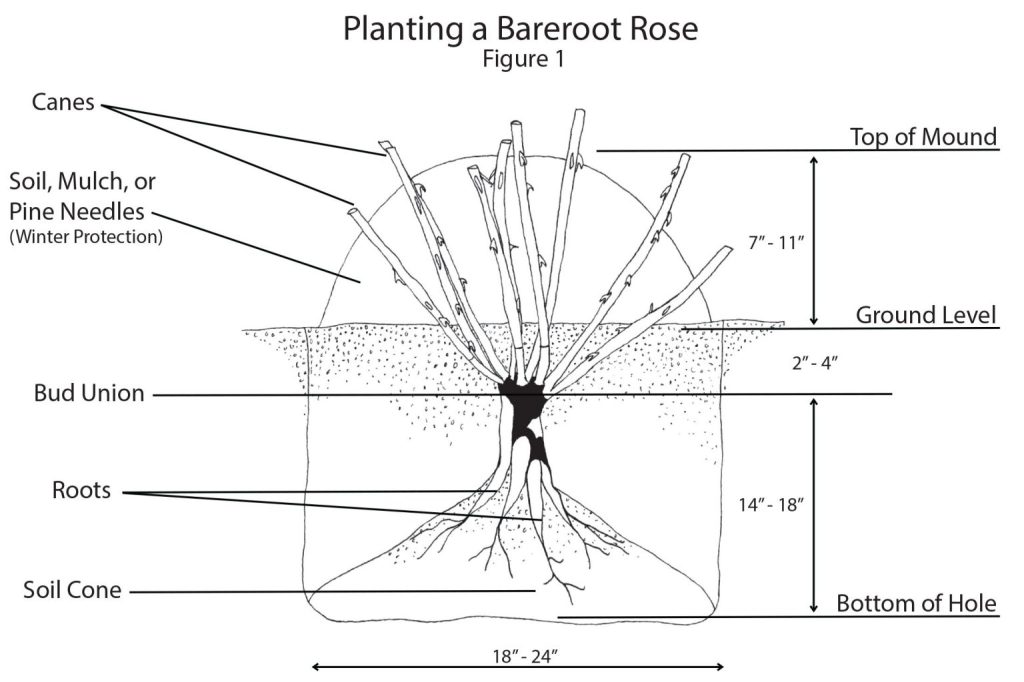
Never allow the plant roots to dry out. Roses may be kept in a bucket of water while the hole is being prepared. When the hole is ready, prepare the plant by pruning any damaged or broken roots. Excessively long roots may be shortened but leave 8 to 10 inches of healthy root if possible.
Support the plant by placing it on a small, cone-shaped mound of amended soil, spreading the roots out into the planting hole. Budded roses need to be planted so that the bud union is below ground level, typically two to four inches. Own-root roses can be planted with the crown less deep. Do not pack the soil around the roots. Firm gently with your hands but settle the soil primarily by watering it. Water deeply at planting.
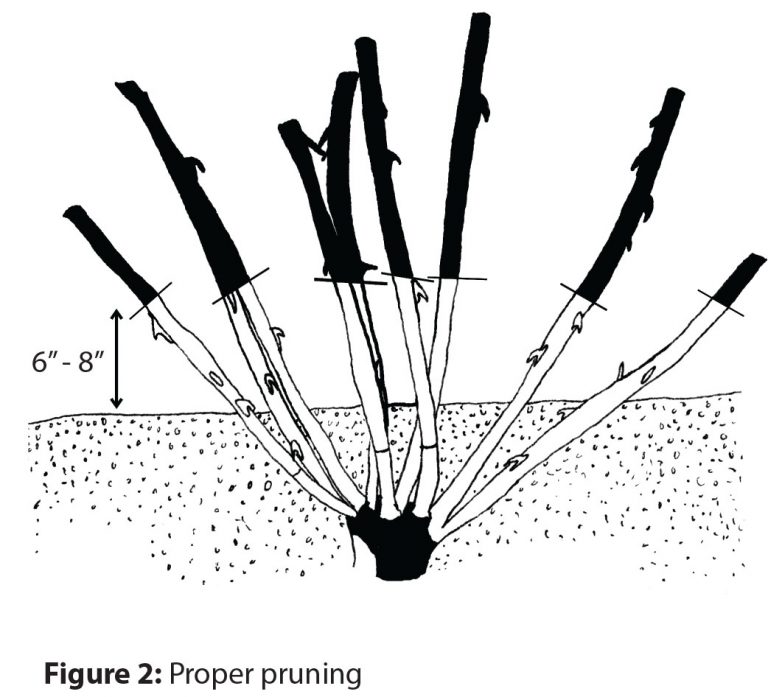
Bare-root roses may need pruning after planting, since they are harvested and prepared for shipping by machine, with no consideration for proper pruning. Make pruning cuts at a 30 to 45 degree angle, 1/4 to 3/8 inch above a bud eye, leaving about 5 to 12 inches of the cane. In order to keep the center of the plant open for better air circulation and light penetration, these cuts should be made to an outward facing bud eye (See Figure 2).
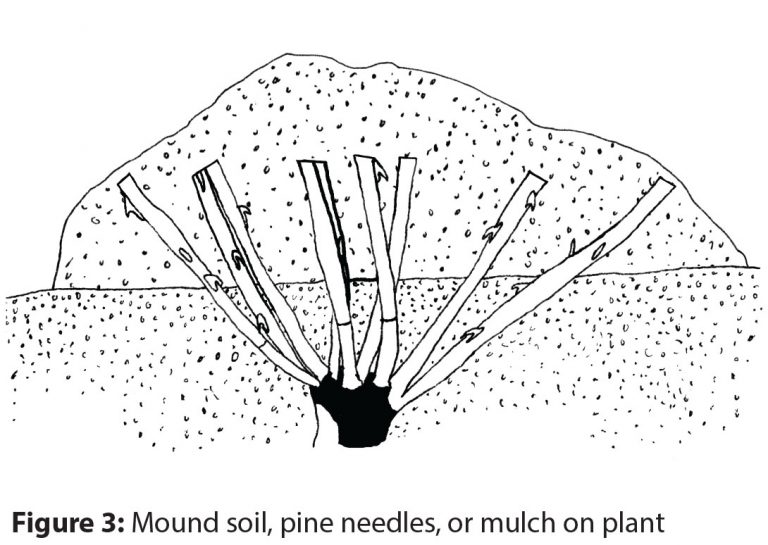
You may choose to cover the remaining canes with loose, loamy, moist soil or a mix of compost and soil, or mulch. This will keep the canes from drying out while the root system is being established and will protect the plant from possible frost damage. Preventing the canes from drying out is the most important step to take when planting a bare root rose in Colorado because of the dry climate (low humidity) (See Figure 3). This cover may be left on from two to seven weeks, depending on the weather, the plant’s progress, and the time of planting. Watch the progress of the plant by exposing the tips of the canes. Be careful when removing the soil from around the canes to avoid damage to the new, tender growth. Water from a garden hose may be the best way to remove this cover.
Planting Potted Roses
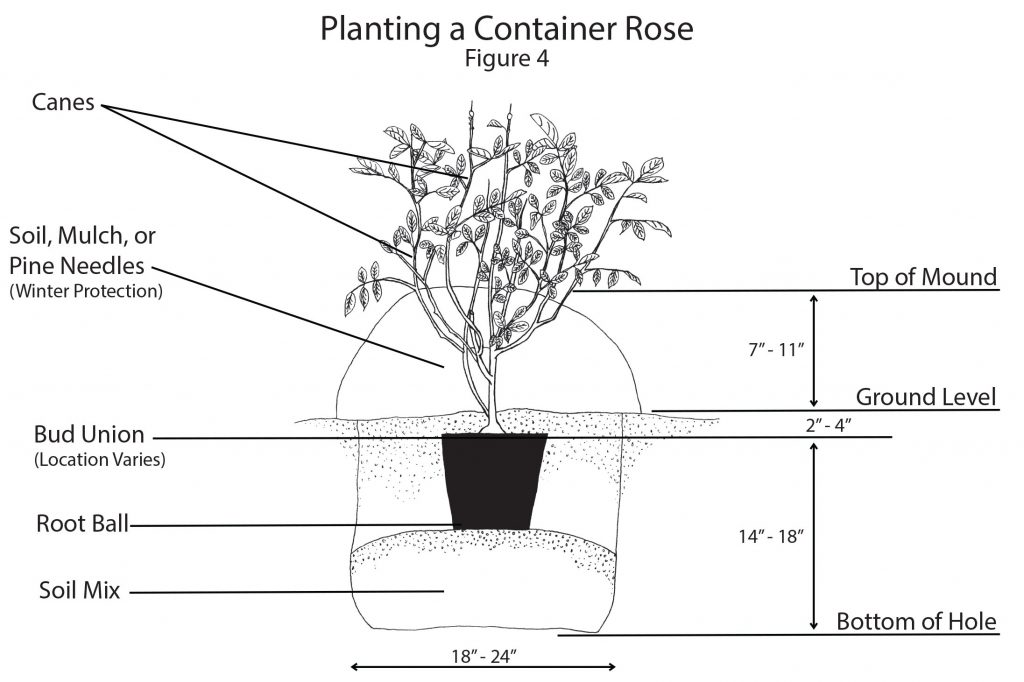
Potted roses can be planted during the growing season, any time after the last killing frost. If a potted rose is purchased directly from a greenhouse, then harden off the rose outdoors (leaving the rose in its container) for several days prior to planting. If planting late in the season, the plant should have time to become well established in its new location before the first killing frost. Prepare the planting hole much the same as for bare root roses, with the depth determined by the height of the bud union from the bottom of the container. Carefully remove the plant from the container and place it in the hole. If the rose roots are pot bound, break up the root ball with your hands or gently remove the outer layer of roots from the root ball. Not correcting circling roots at planting can be detrimental to your rose long-term. Make sure the bud union is planted two to four inches below ground level. Fill in around the root ball with soil and water thoroughly.
Some Recommended Varieties
Table 1a-1k: Recommended rose varieties known to do well in Colorado.
Includes Hybrid Teas, Grandifloras, Floribundas, Miniatures, Climbing Miniatures, Climbers, Shrub, English, Canadian Hardy, Hybrid Rugosa and Buck Roses.
Table 1A: Hybrid Teas
| Hybrid Tea Varieties | Color |
|---|---|
| Audrey Hepburn | Light Pink |
| Barbara Streisand | Mauve |
| Black Magic | Dark Red |
| Chicago Peace | Pink Blend |
| Chrysler Imperial | Dark Red |
| Crystalline | White |
| Dick Clark | Red Blend |
| Double Delight | Red Blend |
| Fragrant Cloud | Orange Red |
| Garden Party | White |
| Gemini | Pink Blend |
| Grand Dame | Rose Pink |
| Let Freedom Ring | Red |
| Marilyn Monroe | Apricot Blend |
| Mellow Yellow | Deep Yellow |
| Mister Lincoln | Dark Red |
| Moonstone | White |
| Olympiad | Medium Red |
| Peace | Yellow Blend |
| Perfect Moment | Red Blend |
| Pope John Paul II | White |
| Rio Samba | Yellow Blend |
| St. Patrick | Yellow Blend |
| Savoy Hotel | Light Pink |
| Secret | Pink Blend |
| Signature | Deep Pink |
| Sunset Celebration | Apricot Blend |
| Sunstruck | Apricot Blend |
| Timeless | Deep Pink |
| Touch of Class | Orange Pink |
| Tournament of Roses | Pink Blend |
| Veteran’s Honor | Dark Red |
Table 1B: Grandifloras
| Grandifloras Varieties | color |
|---|---|
| Arizona | Copper |
| Crimson Bouquet | Dark Red |
| Fame! | Deep Pink |
| Glowing Peace | Yellow Blend |
| Gold Medal | Medium Yellow |
| Lagerfield | Mauve |
| Queen Elizabeth | Medium Pink |
| Strike it Rich | Deep Golden |
Table 1C: Floribundas
| Floribundas Varieties | Color |
|---|---|
| Amber Queen | Apricot Blend |
| Apricot Nectar | Apricot Blend |
| Betty Boop | Red Blend |
| Bill Warriner | Orange Pink |
| Black Cherry | Deep Red |
| Chihuly | Red Blend |
| Cinco de Mayo | Russet |
| Class Act | White |
| Drop Dead Red | Red Velvet |
| Easy Going | Yellow Blend |
| Easy Does It | Orange Pink Apricot Blend |
| Edd Tide | Mauve |
| Europeana | Dark Red |
| Gruss an Aachen | Light Pink |
| Hot Cocoa | Russett |
| Ice Berg | White |
| Julia Child | Yellow Gold |
| Jump for Joy | Peachy Pink |
| Lavaglut | Dark Red |
| Livin’ Easy | Orange Blend |
| Mardi Gras | Pink Blend |
| Nearly Wild | Medium Pink |
| Playboy | Red Blend |
| Playgirl | Medium Pink |
| Purple Tiger | Purple White Stripes |
| Rainbow Sorbet | Multi; Red Yellow Pink White |
| Sally Holmes | White |
| Scentimental | Red Blend |
| Sexy Rexy | Medium Pink |
| Singin’ in the Rain | Apricot Blend |
| Sunsprite | Deep Yellow |
Table 1D: Miniatures
| Miniatures Varieties | Color |
|---|---|
| Bee’s Knees | Yellow to White; Pink Edges |
| Baby Grand | Medium Pink |
| Child’s Play | Pink Blend |
| Fairhope | Light Yellow |
| Giggles | Medium Pink |
| Gourmet Popcorn | White |
| Hot Tamale | Yellow Blend |
| Incognito | Mauve |
| Irresistible | White |
| Jean Kenneally | Apricot Blend |
| Kristen | Red Blend |
| Miss Flippins | Medium Red |
| Perrine | Orange Pink |
| Rainbow’s End | Yellow Blend |
| Ruby Baby | Red Blend |
| Ruby Ruby | Medium Red |
| Salute | Red |
| Sunsprite | Deep Yellow |
Table 1E: Climbing Miniatures
| Varieties of Climbing Miniatures | Color |
|---|---|
| Candy Cane | Pink Blend |
| Hi Ho | Orange Pink |
| Little Girl | Orange Pink |
| Jeannie LaJoie | Medium Pink |
| Pink Cascade | Medium Pink |
| Rainbow’s End | Yellow Blend |
| Ruby Penchant | Mauve |
Table 1F: Climbers
| Climber Varieties | Color |
|---|---|
| America | Orange Pink |
| Above and Beyond | Orange Apricot |
| Don Juan | Red |
| Dynamite | Dark Red |
| Fourth of July | Red Blend |
| Golden Showers | Medium Yellow |
| Handel | Red Blend |
| John Cabot | Medium Pink |
| John Davis | Medium Red |
| Lady in Red | Red |
| New Dawn | Light Pink |
| Polka | Apricot Blend |
| Ramblin Red | Red |
| White Dawn | White |
| Zephrine Droughin | Deep Pink |
Table 1G: Shrubs
| Shrub Varieties (*Denotes polyantha rose) | Color |
|---|---|
| Alba Meidiland | White |
| Apricot | Drift Apricot |
| Ballerina | Medium Pink |
| Bonica | Medium Pink |
| Carefree Delight | Pink Blend |
| Carefree Wonder | Pink Blend |
| Dortmund | Medium Red |
| Double Knock Out | Red |
| Flower Girl | Light Pink |
| Kaleidescope | Mauve |
| Kashmir | Red |
| Knock Out | Red Blend |
| Lady Shalott | Orange Red |
| Margo Koster* | Orange Blend |
| Pink Meidiland | Pink Blend |
| Princess Alexandra of Kent | Deep Pink |
| Princess Ann | Deep Pink to Red |
| Sally Holmes | White |
| Starry Night | White |
| Sunrise Sunset | Pink Blend |
| Super Hero | Red |
| The Fairy* | Light Pink |
Table 1H: English
| English Varieties (David Austin primarily) | Color |
|---|---|
| Abraham Darby | Orange Pink |
| Ambridge Rose | Apricot Blend |
| Evelyn | Apricot Blend |
| Gertrude Jekyll | Medium Pink |
| Golden Celebration | Deep Yellow |
| Graham Thomas | Deep Yellow |
| Heritage | Light Pink |
| Mary Rose | Medium Pink |
| Othello | Medium Red |
| Pat Austin | Orange Blend |
| Sharifa Asma | Light Pink |
| The Pilgrim | Medium Yellow |
| Tradescant | Dark Red |
Table 1I: Canadian Hardy
| Canadian Hardy Varieties | Color |
|---|---|
| Adelaide Hoodless | Deep Pink |
| Bill Reid | Apricot Blend |
| Champlain | Dark Red |
| Cuthbert Grant | Dark Red |
| Henry Hudson | White |
| Henry Kelsay | Medium Red |
| John Cabot | Medium Red |
| Morden Blush | Medium Pink |
| Morden Centennial | Medium Pink |
| Morden Sunrise | Yellow Blend |
| William Baffin | Deep Pink |
| Winnipeg Parks | Deep Pink |
Table 1J: Hybrid Rugosa
| Hybrid Rugosa Varieties | Color |
|---|---|
| Hansa Medium | Red |
| Linda Campbell | Medium Red |
| Therese Bugnet | Medium Pink |
Table 1K: Buck Roses
| Buck Rose Varieties | Color |
|---|---|
| Carefree Beauty | Medium Pink |
| Earth Song | Deep Pink |
| Mountain Music | Pink Blend |
| Prairie Sunrise | Apricot Blend |
| Quietness | Light Pink |
| Winter Sunset | Apricot |
Reference: CSU Fact Sheet 7.404