


Quick facts…
- The snailcase bagworm is an unusual insect that lives within a small, coiled case of soil and silk.
- Although snailcase bagworms feed on various plants, the primary concern occurs when full-grown caterpillars migrate and attach themselves to the sides of buildings, fencing, mailboxes and similar sites.
- Although developing insects may be controlled with insecticides, they are ineffective against the migrating stages.
Introduction
The snailcase bagworm (Apterona helix, Family: Psychidae) is an unusual moth, native to Europe, that was introduced to the United States in the 1940s. By 1996, it had been found in all the Western Slope counties and El Paso, Fremont, and Boulder counties in eastern Colorado. Although the individual insects are wingless and cannot fly, snailcase bagworms attach to many surfaces and can easily be transported to new sites.
The developing insects feed on a wide variety of plants but rarely cause significant plant injury. Instead, problems occur as the full-grown larvae migrate to sites to pupate. During this time, large numbers may firmly attach themselves to sides of buildings, fences, mailboxes and other surfaces, creating an aesthetic nuisance. After migrating to surfaces to pupate, the caterpillars attach themselves so firmly that attempts to dislodge them often dislodge paint chips as well.
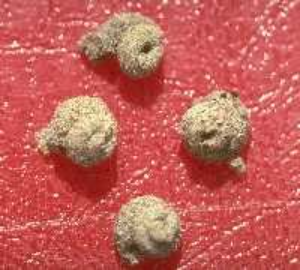
Figure 1: Snailcase bagworm.
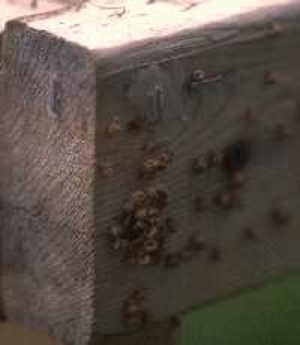
Figure 2: Snailcase bagworms attached to fence.
Life History
All stages of this insect take place within a coiled, snail-like case, approximately 1/8 inch in diameter. The caterpillars are greenish or reddish-gray with a black head. Adults are wingless and nearly legless moths. Only females are known to occur in Colorado, reproducing via parthenogenesis (a type of cloning).
Snailcase bagworms survive winter as young caterpillars protected within the case of the mother insect. They become active in mid-spring and feed on the leaves of a wide variety of native and cultivated plants, including sagebrush, saltbush, rabbitbrush, willow, mountain-mahogany, various fruit trees, squash, poverty weed, alfalfa, and other wild crucifers. The feeding injuries appear as small areas progressively gouged out of the leaf surface. Serious plant injury is rare.
As the larvae grow and develop, they produce a snail-like case of silk and soil particles. Later, they push their fecal matter out of an opening in the center of the case, allowing it to pile up on top of the insect. The larval insects are mobile and can carry the case upright. As they become full-grown, typically in late spring and early summer, snailcase bagworms migrate to high, shaded points. There they firmly attached themselves and transform to the pupal stage.
Transition to the adult moth takes place in the pupal covering after attachment. The moths are wingless, nearly legless, and do not feed. Only females are produced, but they can fertilize eggs asexually. About one to two dozen eggs are produced by the female. During midsummer, these eggs hatch. However, the young larvae remain in a dormant condition within the pupal covering throughout the winter. They emerge from the case the following spring and disperse, probably with the aid of wind, to new host plants.
Control
Controls for snailcase bagworm are seldom necessary. When control is desired, it should be directed at the larval stages feeding on plants. Insecticides used for controlling other types of bagworms, such as Orthene and various pyrethroids (e.g. Tempo, Talstar, Astro) can be effective. Organic insecticidal options exist as well, such as Spinosad (derived from soil bacteria) and Thuricide (B.t., a bacterial disease that spreads among caterpillars).
Full-grown, migrating larvae cannot be controlled with insecticides. To prevent the nuisance of migrating caterpillars attaching themselves to the sides of homes, temporary barriers (flanges, sticky tapes) may be feasible. Snailcase bagworms also may be dislodged with a vigorous jet of water (preferably soapy water) before they attach themselves to the surface in preparation for pupation. After attachment, these insects are not readily removed.
In most situations, controls for this insect are not warranted.
Disclaimer: This publication may contain pesticide recommendations that are subject to change at any time. These recommendations are provided only as a guide. It is always the pesticide applicator’s responsibility, by law, to read and follow all current label directions for the specific pesticide being used. Due to ever-changing labels and product registrations, some of the recommendations given in this writing may no longer be legal by the time you read them. If any information in these recommendations disagrees with the label, the recommendation must be disregarded. No endorsement is intended for products mentioned, nor is criticism meant for products not mentioned. The author(s), Colorado State University, and Colorado State University Extension assume no liability resulting from the use of these recommendations. Beginning July 1, 2024, pesticide products containing neonicotinoid active ingredients and do not meet the listed product type exemptions, are considered “limited – use” pesticides and may only be sold by a licensed dealer.