


Quick facts…
- Springtails are tiny, bouncy arthropods that launch themselves into the air with a built-in spring, a furcula, making them some of the most acrobatic creatures in the soil!
- They play a huge role in breaking down organic matter and keeping ecosystems healthy—a reliable clean-up crew.
- Springtails cannot bite, and they are harmless to humans and larger animals.
- During hot, dry periods in summer springtails sometimes migrate from lawns and outdoor areas to homes.
- Springtails tend to be fairly resistant to most insecticides, and migrations can involve continuous movement of new individuals. However, some yard and garden insecticides do make claims of springtail control on the label.
Introduction
Springtails are minute arthropods that may occur in tremendous numbers in soils, but they are rarely observed. These tiny, wingless arthropods play a big role in garden and ecosystem health, despite often going unnoticed. Living mostly in soil, leaf litter, and compost, they help break down organic matter and recycle nutrients, supporting plant growth and soil structure. Their presence is usually a sign of healthy, living soil. A cool fact: springtails breathe through their skin, which is why they need moist environments to survive.
Their activities most commonly come to the attention of humans only when large numbers migrate into homes. Another unusual event involving springtails is their occurrence as ‘snow fleas’ found on the surface of thawing snow.
Appearance
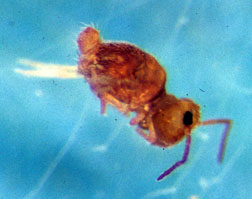
Springtails, tiny hexapods in the order Collembola, come in a surprising variety of forms—from plump, soft-bodied, and globular to slender and elongated—but all share the signature forked furcula tucked beneath their abdomen, launching them into the air like miniature acrobats when disturbed. These tiny, pinhead-sized arthropods do have two major types of appearances. The most commonly seen species have a somewhat elongated body, but others have a rounded globose body form. Springtail colors vary, but most are gray or purplish. Others are pale colored and most, under microscopic observation, are patterned. The coloration of most Colorado springtails is produced by protective scales that cover the body
Figure 1a
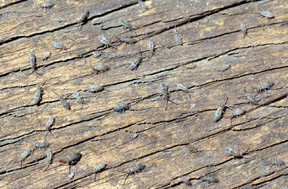
Figure 1b
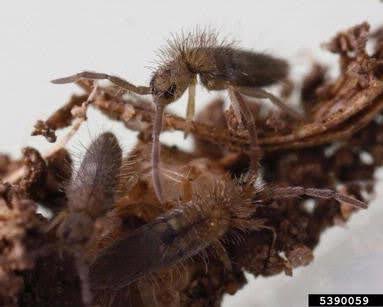
Springtails are wingless and crawl slowly, but have a unique means of locomotion – the “spring tail.” This involves a fork-like structure (furcula) attached to the hind end that can fold under the body. Upon release, the furcula pushes the springtail and allows it to jump short distances. Because of this jumping habit and their small size, springtails are sometimes described as “jumping dirt.” Springtails possess six legs, as do insects. Formerly, they were typically classified as an order of insects. However, they have many features that are not found in insects and are now usually classified as Entognathous Hexapods, a separate sister group from the insects (subclass Insecta). All springtails are classified as being within the order Collembola, with several different springtail families present in Colorado.
Life History and Habit
Habits of the springtails vary. You can find springtails just about anywhere there’s moisture and organic matter—they love damp soil, leaf litter, compost piles, and even the soil in your potted plants. If you look closely at the surface of wet soil or under a log after it rains, you might spot them as tiny, hopping specks that look like they’re dancing across the surface! The great majority develop in soil, feeding on fungi, algae, decaying plant matter, and bacteria. Some are predators of small soil animals, and a few may damage tender plants. However, none of them can bite and they are harmless to humans and larger animals.
Springtail life cycles are completed rapidly when temperatures allow, and springtails may produce periodic population explosions. In moist soils with high amounts of organic matter, tremendous numbers may be present – thousands per square foot. Overcrowding and soil drying may induce migrations. Sometimes springtails may be seen on the surface of puddled water, often in such numbers as to form a large raft of their floating bodies.
Springtails in Homes
During hot, dry periods in summer springtails sometimes migrate from lawns and outdoor areas to homes. This occurs when the soils and leaf litter where they develop dry out, forcing springtails to seek sources of moisture, which shaded, more humid buildings provide. Household migrations of springtails in Colorado typically occur when a period of moist weather in spring, favorable to developing high populations, is followed by sustained hot and drying during early to mid-summer.
If springtails can find their way into a building, they will usually be found most abundantly in areas where water sources are present, such as bathrooms, drains, tubs or kitchen sinks—anywhere moisture collects. While their sudden presence might seem alarming, it’s usually temporary; they’re simply seeking moisture and will disappear once things dry out and the humidity drops. Keeping bathrooms well-ventilated and fixing any leaks typically resolves the issue of them being present indoors. Outdoors, a faucet or pooled water in a garden is attractive.
Springtails within a home will not bite, feed on household items, nor cause any significant damage. They can be a temporary nuisance, but migrations usually last less than a week, and springtails trapped indoors soon die out.
If migrations occur, try to eliminate all obvious moisture sources around the building. Alternatively, providing moisture at some point distant from the building may help divert migrations.
The effectiveness of insecticides to manage springtail migrations is questionable. When possible, it’s best to avoid using insecticides inside your home, as many pests—like springtails—can be managed effectively by reducing moisture or giving them some time to move on. Simple steps like sealing entry points, fixing leaks, and using a dehumidifier often solve the problem without the need for chemicals, helping keep your living space pest free. Springtails tend to be fairly resistant to most insecticides and migrations can involve continuous movement of new individuals. However, some yard and garden insecticides do make claims of springtail control on the label.
Figure 2
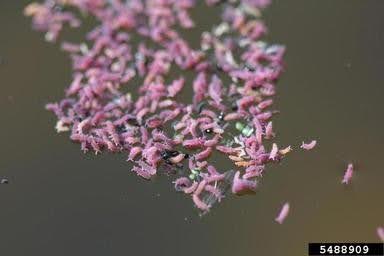
Figure 3
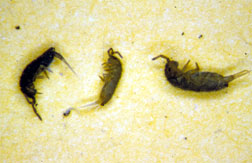
Figure 4
Springtails and Houseplants
Springtails occasionally develop in the soil of houseplants. Most often they are noticed just after watering, when they may move temporarily from the saturated soil to the surface.
In houseplant soils, springtails function as they do outdoors—scavenging dead plant matter and feeding on soil microorganisms. They do very little, if any, damage to the houseplant. Problems can be limited if the soil is allowed to dry down a bit more between waterings, which discourages high soil moisture that allows them to survive and reproduce well.
The ‘Snow Flea’ Phenomenon
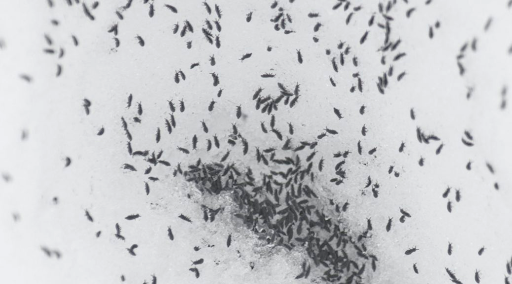
Perhaps the most bizarre springtail behavior that people may observe is when they are seen massing on the surface of thawing snow. This is often described as the “snow flea” phenomenon, since the minute springtails jump as might a tiny flea.
The “snow fleas” are springtails normally found feeding in leaf litter and soil that work their way to the surface of the snow. They crawl up the trunks of trees, plant stems, and sides of rocks where an open channel allows their migration. Tremendous numbers can sometimes be found on the surface, which superficially looks like dirt. Footprints or other depressions may collect very dense populations.
There are still questions regarding this behavior. It is suggested that migrations are triggered because of overcrowding and lack of food. Springtails may feed on small particles of debris that have collected on the snow surface. Many of the springtails may later work their way back down to the soil through the same type of channels, but many are trapped and will ultimately die.
Figure 5
Reference: CSU Fact Sheet 5.602