


Quick facts…
- Female tarantula hawks have one of the most painful stings of all insects but are docile and rarely sting humans.
- The tarantula hawk provisions larvae with paralyzed tarantulas that the larvae feed on until metamorphosis.
- Six species of tarantula hawks are found in Colorado.
- Adult tarantula hawks are important pollinators of milkweed (genus Asclepias).
Overview and description
Tarantula hawks are parasitoid wasps and are members of the genera Pepsis and Hemipepsis within the family Pompilidae. There are over several hundred named species globally, but only six are found in Colorado (Schmidt 2004, SCAN 2025). They range in size from about 10-50 mm (1/2 –2 inches), or about the same length as a matchstick (Schmidt 2004), and they are large-bodied wasps.

They are metallic blue or black and often with an iridescent hue, with orange to yellow wings (Figure 1), making them very conspicuous. These color patterns are an example of ‘aposematic coloration’, meaning that they may serve to warn would-be predators of the tarantula hawk’s toxic venom (Schmidt 2004). Males typically have straight antennae, while the female antennae are curled (Essig 1929).
Tarantula hawks have virtually no natural predators due to their venom, intense odor, and hard exoskeleton (Schmidt, 2004). While not preyed upon, they are a critical component of the food web. Female wasps paralyze tarantulas and feed them to their young, and adult tarantula hawks are one of the main pollinators of milkweed and adults feed on its nectar and pollen (Vardy 2000).

Distribution and life history
Tarantula hawks in the genus Pepsis are widespread and are found throughout North and South America (Figure 2). They have among the largest quantity of venom per body mass of any insect (Schmidt 2004).
Tarantula hawks are known for their unique reproductive strategy that involves paralyzing tarantulas (and sometimes other large spiders) to serve as a food source for their larvae. Male tarantula hawks’ role in reproduction is solely to mate, while females invest a significant amount of energy into provisioning nests for larvae after mating.
Females capture and sting male and female tarantulas, prepare burrows, and lay one egg on each spider’s abdomen. Typically one tarantuala is provisioned per developing larva (Scmhidt 2004). The wasp larvae are parasitoids, living inside and feeding on the host throughout their development, which ultimately kills the tarantula. They achieve this by consuming the tarantula slowly, ensuring the spider remains alive for as long as possible to sustain their growth (Burke and Sharanowski 2024, Figure 3).
Soon after the spider’s death, the larva spins a cocoon, developing into an adult wasp within two to three weeks (Alcock and O’Neill1987). If a wasp egg fails to hatch, the tarantula can recover from the venom after several months, but this happens infrequently (Costa et al. 2004).

Although they hunt tarantulas, adults have a nectarivorous diet, feeding on flowers of plants such as milkweeds, mesquite, and soapberry trees (National Park Service 2019, Figure 1). The energy they gain from nectar feeding not only sustains their survival, but also reproductive and foraging behaviors. The life span of an adult female is 40-50 days (Schmidt 2004).
Effects on agriculture, people, and homeowners
Tarantula hawks generally do not have negative effects on agriculture or homeowners, though they have been observed consuming grapes in California (Vardy 2000). Tarantula hawk females are capable of delivering an extremely painful sting, but they are typically docile towards people and require extreme provocation before stinging (Schmidt 2018). There are no recommended control measures and interventions are not typically needed. They are primarily found in desert and scrubland habitats, so are most likely to be encountered in the arid southern regions of Colorado. They sometimes prey on other spiders such as trapdoor spiders and wolf spiders.
Species of Colorado
There are six species in Colorado, including: Pepsis basifusca, P. grossa, P. mildei, P. pallidolimbata, P. thisbe, and Hemipepsis ustulata (SCAN, 2025). They can be distinguished from one another based on various traits, including coloration, range, and size (Table 1). The most commonly encountered species in Colorado is P. thisbe.
Table 1. A description of the coloration and size of different tarantula hawk species in Colorado, and their relative frequency as per iNaturalist observations. An image of each species is also provided.
| Species | size | Coloration* | range (scan data) | % of CO iNaturalist observations |
|---|---|---|---|---|
| Pepsis thisbe | Up to 50 mm (Vardy 2000) | Black body with a blue sheen, orange-brown wings | Western U.S. and Northern Mexico | 55% |
| Pepsis grossa | 25-50 mm (Vardy 2002) | Iridescent blue-black body, orange wings with black tips, black antenna | Southwestern U.S, Central America, and Northern South America | 15% |
| Pepsis mildei | 20-30 mm (Essig 1929) | Iridescent blue-black body orange-brown wings with black tips, orange antennae | Southwestern U.S and Central America | 8% |
| Pepsis basifusca | 11-30 mm (Vardy 2005) | Black body with stripes of iridescent blue, orange-black wings, black antennae | Colorado, Arkansas, and Arizona | 6% |
| Pepsis pallidolimbata | 17-31 mm (Vardy 2000) | Iridescent blue-black body, orange-brown wings, black antennae | Southwestern U.S and Northern Mexico | 4% |
| Hemipepsis ustulata | Up to 50 mm (Schmidt 2004) | Black body, orange-brown wings with black tips, black antennae | Southwestern U.S and Central America | 12% |
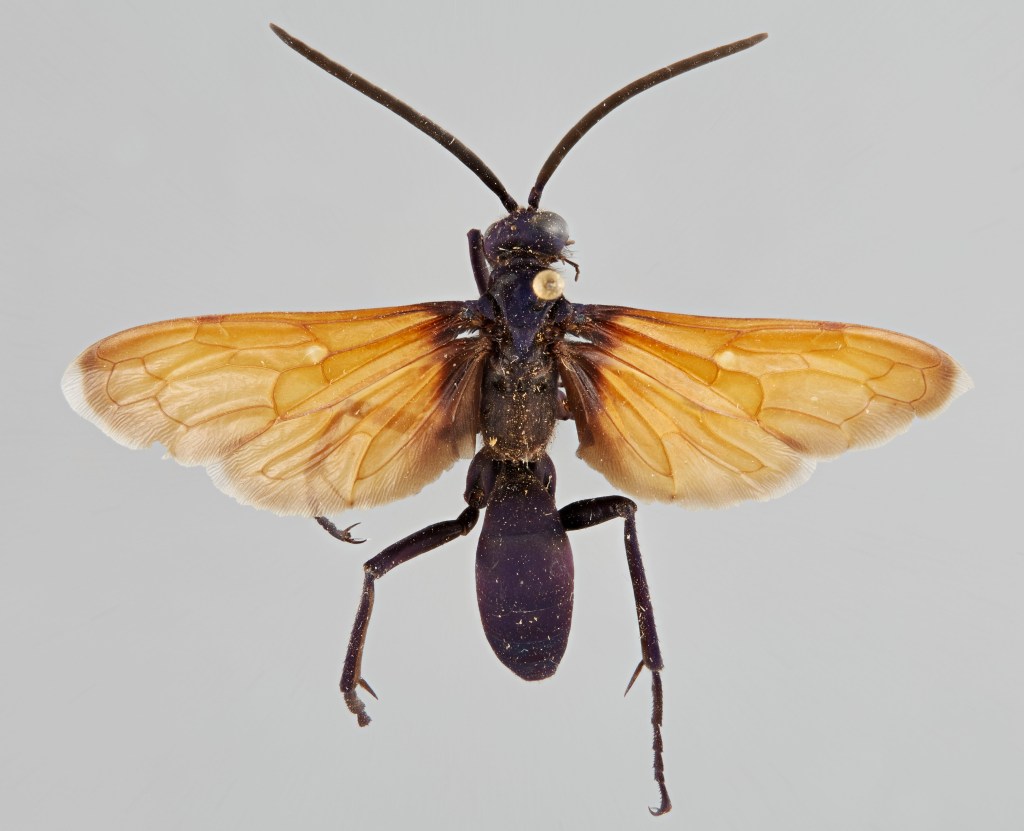
Photo credit: T.S. Davis, PhD
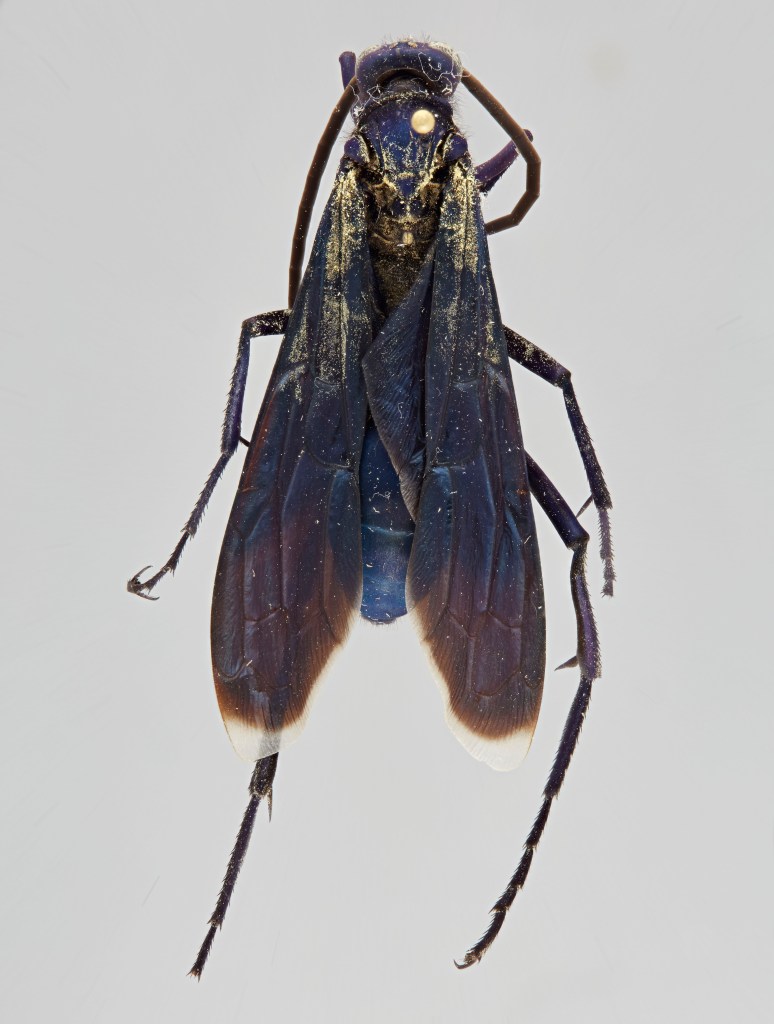
Photo credit: T.S. Davis, PhD
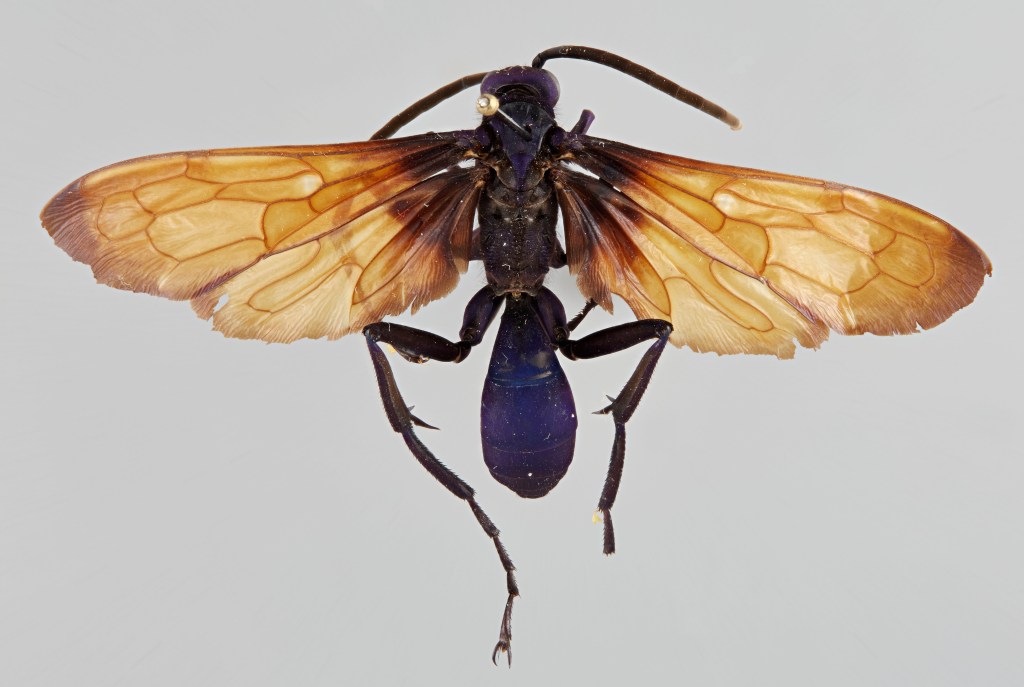
Photo credit: T.S. Davis, PhD
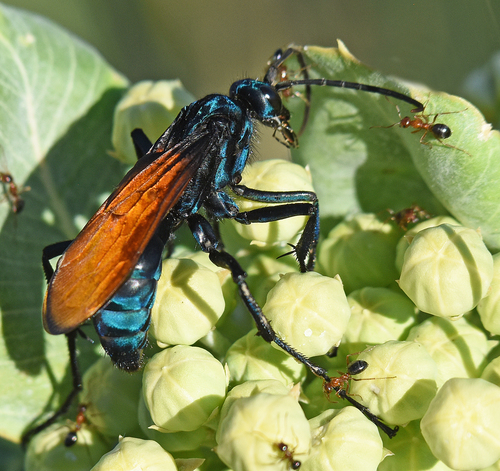
Photo credit: Steven Mlodinow – some rights reserved (CC BY-NC)

Photo credit: T.S. Davis, PhD
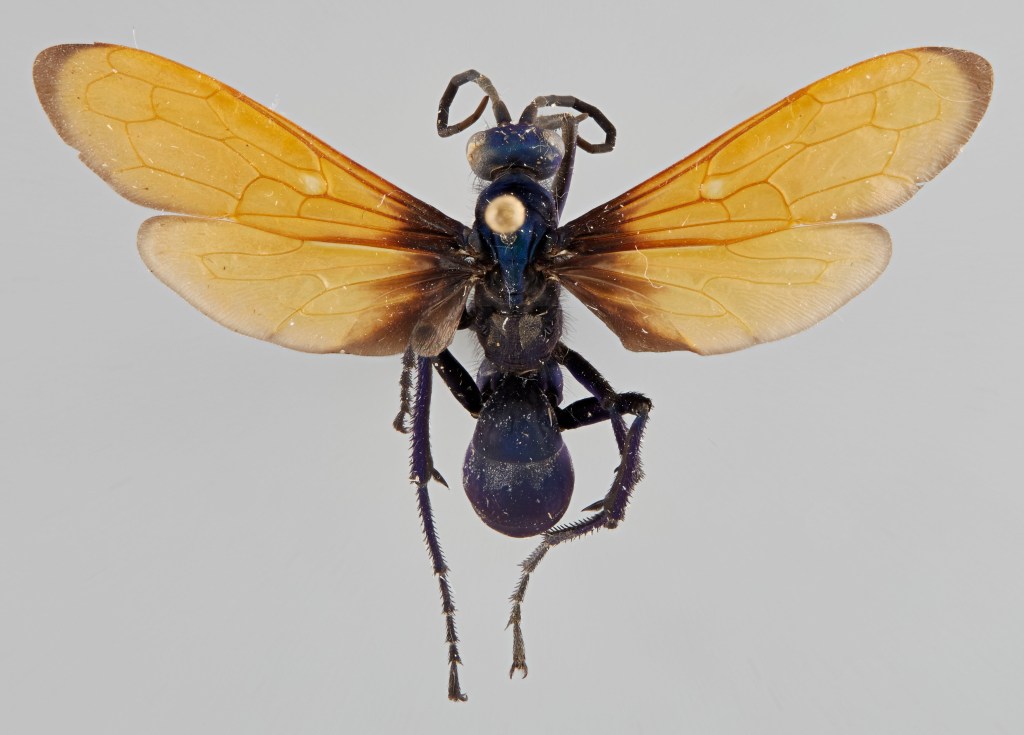
Photo credit: T.S. Davis, PhD
References
Alcock, J., & O’Neill, K. M. (1987). “Territory preferences and intensity of competition in the grey hairstreak Strymon melinus (Lepidoptera, Lycaenidae) and the tarantula hawk wasp Hemipepsis ustulata (Hymenoptera, Pompilidae)”. The American Midland Naturalist, vol. 118, no. 1, pp. 128–138. doi.org/10.2307/2425635.
Burke, G. R., & Sharanowksi, B. J. (2024). “Parasitoid wasps”. Current Biology, vol. 34, no. 10, pp. 483–488. doi: 10.1016/j.cub.2024.03.038.
Costa, F. G., Pérez-Miles, F., & Mignone, A. (2004). “Pompilid wasp interactions with burrowing tarantulas”. Studies on Neotropical Fauna and Environment, vol. 39, no. 1, pp. 37–43. doi.org/10.1080/01650520412331270945
Essig, E. O. (1929). “Insects of western North America”. HathiTrust. pp. 883–884. babel.hathitrust.org/cgi/pt?id=iau.31858046836296&seq=901
National Park Service (2019).“Tarantula Hawk Wasp – Grand Canyon-Parashant National Monument (U.S. National Park Service)”. www.nps.gov/para/learn/nature/tarantula-hawk-wasp.htm.
SCAN (2025). “Specimens and Observations-Pepsis”. Symbiota Collection of Arthropods Network, scan-bugs.org/portal/collections/index.php
Schmidt, Justin O (2004). “Venom and the good life in tarantula hawks (Hymenoptera: Pompilidae): How to eat, not be eaten, and live long”. Journal of the Kansas Entomological Society, vol. 77, no. 4, pp. 402-413, http://www.jstor.org/stable/25086231
Schmidt, J. O. (2018). “Clinical consequences of toxic envenomations by hymenoptera.” Toxicon, 150, 96–104. https://doi.org/10.1016/j.toxicon.2018.05.013
Vardy, C.R. (2000). “The New World tarantula-hawk wasp genus Pepsis Fabricius (Hymenoptera: Pompilidae). Part 1. Introduction and the P. rubra species-group”. Journal of Zoology, vol. 332, no. 29, pp. 1-86, figs 1-102. repository.naturalis.nl/pub/219443/ZV332_003-086.pdf
Vardy, C.R. (2002). “The New World tarantula-hawk wasp genus Pepsis Fabricius (Hymenoptera: Pompilidae), Part 2. The P. grossa– to P. deaurata-groups”. Journal of Zoology, vol. 338, pp. 1-134. repository.naturalis.nl/pub/220200/ZV338_003-135.pdf
Vardy, C.R. (2005) “The New World tarantula-hawk wasp genus Pepsis Fabricius (Hymenoptera: Pompilidae), Part 3. The P. inclyta– to P. auriguttata-groups”. Journal of Zoology, vol. 79-5, pp. 1-305, repository.naturalis.nl/pub/210789/ZM79-05_001-305.pdf