


Quick facts…
- Subterranean termites do not reside in the wood they consume, commuting via mud tubes. Drywood termites reside in the wood they consume and are very rare in Colorado.
- Termites can damage homes and other wooden structures.
- They are an increasing problem in Colorado, particularly in urban areas.
- Precautions can be taken to avoid termite infestations. Effective controls are available.
- Termite infestations build up slowly. There is plenty of time once an infestation is discovered to select the best course of action and to make sure that all corrective measures are done properly.
Introduction
Termites are small to medium-sized, soft-bodied insects that live in colonies and feed on wood and wood products. In these colonies, different individual types or castes are responsible for specific tasks involved in colony maintenance. Each caste has a distinctive appearance.
The form of termites most commonly seen is the winged (alate) form. These are produced in great numbers at specific times of the year, usually spring or fall. These are the new kings and queens that leave the colony in large groups, fly briefly, mate, and form a new colony. These mating flights usually occur on cool, overcast days with low wind speeds. If these winged termites appear inside a structure, an infestation is present. Before a new colony is formed, they break off their wings, leaving only a small stub where the wings were attached.
Winged termites often are confused with ants, especially carpenter ants. There are several distinguishing characteristics shown in Figures 1 and 2 and Table 1. (See related fact sheet 5.554, Carpenter Ants).
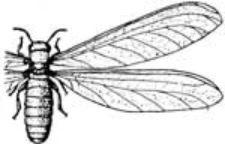
Figure 1: Winged termite.
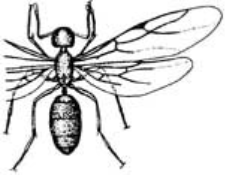
Figure 2: Winged ant.
| Table 1: Characteristics of termites and carpenter ants. | ||
| Characteristic | Termite | Carpenter Ant |
| Antennae | Straight, look like strings of beads | Elbowed |
| “Waist” (attachment between thorax and abdomen) | Broad, not constricted | Pinched or narrow |
| Wings | Both pairs are same size | Second pair smaller than front pair |
| Coloration of winged form | Mostly black, sometimes have lighter markings on legs | Varies from orange-brown to black |
| Coloration of workers | Cream-colored | Varies from orange-brown to black |
| Nest | No sawdust, interior may be caked with mud, may be connected to soil with mud tubes | Coarse sawdust at entrance, nests follow grain, interior smooth or polished |
Worker and soldier castes are wingless and unpigmented. They usually are not seen unless there is a break in the nest structure or connecting tubes. Soldiers are distinguished by their larger heads, which may be hardened and dark. Their jaws are larger than those of workers.
Detection
Termites are classified by the type of nest they build. In Colorado, the eastern subterranean termite is usually responsible for damage to structures. This is the same species that is a pest in the Northeast. These termites usually maintain contact with the soil in which the main nest is found. They search outside their nest for wood to feed on and construct earthen tubes from the nest to the food source. There is also a small area in Grand Junction affected by drywood termites, which require different management tactics.
Eastern subterranean termite nests are designed to maintain high humidity. Termites quickly die from loss of body fluids if exposed to outside conditions for very long. A break in the nest structure will quickly be detected and repaired by workers.
The most common way to detect termites is by spotting the winged adults emerging from inside a building, generally in the spring or fall. Termites often fly to windows or other light sources. Less common signs of infestation are 1/4- to 1/2-inch wide earthen tubes from the soil over foundations, masonry or wooden supports, or wood lined with compacted, earth-like material, confined to the sapwood, that yields a dull thudding sound when tapped. These mud tubes can be found in crawl spaces or in the exterior corners of buildings. Mud tubes can be a sign of a current or past infestation. To confirm if a mud tube is part of an active infestation, destroy a section and observe if it is repaired (within hours). However, an abandoned mud tube does preclude the existence of additional, active mud tubes.
Prevention
Preventive measures can protect wooden structures. There should be no contact between wood and the soil. Remove all waste wood from the building site. Do not locate buildings over waste-wood burial sites. Also, cinder blocks, bricks or other hollow masonry in contact with wood and soil should be moved or capped shut with reinforced concrete or a metal shield. Any crack or gap in the foundation or plumbing is a potential point of entry and must be sealed. Wooden shingles or supports should have at least 8 inches of clearance above the soil or the termites may construct connecting tubes above ground for a short distance. These tubes are visible signs of an infestation. Use pressured-treated lumber in termite-prone areas. “Termite sand” (10-16 mesh sand) has been used as an effective termite barrier under buildings in other parts of the country. However, termite barriers can only be installed prior to a building’s construction.
High humidity helps promote termite infestations. Make sure that crawl spaces are well ventilated. If soil below the building is very moist, consider a barrier such as roofing paper to reduce moisture in structural wood. Poor grading or improper watering can cause soil around foundations to stay moist and favor termites.
Insecticides
A chemical barrier can prevent termites from reaching wooden structures as they tunnel through the soil. This is most effective when applied during construction. Injection holes can be drilled to introduce insecticides to the soil around and, if necessary, underneath a completed structure. The soil-applied insecticides can effectively deter termites for many years. As with other types of termite control, these procedures are best left to a professional pesticide applicator for the most effective control. They possess the specialized equipment needed for these applications. Furthermore, many of the insecticides involved in these treatments are only available to licensed pesticide applicators.
Insecticide laced baits are integral to the management of termites. On their own, insecticidal sprays fail to kill the entire colony because subterranean termites do not reside in the wood they consume (commuting via mud tubes). Insecticide laced baits are composed of a food source that is highly palatable to termites (e.g. cellulose-based materials) impregnated with insecticide. More recently developed baits employ a new class of insecticides known as insect growth regulators. While other insecticides target systems present in non-target organisms (e.g. the nervous system), these growth regulators (e.g. diflubenzuron, hexaflumuron) act on relatively insect-specific processes (e.g. chitin synthesis inhibition). By disrupting the synthesis of chitin, the main component of an insect’s exoskeleton, growth regulators kill juvenile termites when they attempt to molt. In contrast to other insecticides, these growth regulators do not kill adult termites outright and can take months to have an effect. As such, it is recommended to use them in conjunction with conventional insecticides.
If an infestation is discovered, don’t panic. A new colony grows very slowly. However, invasion from a well-established colony can be rapid. Get a reasonable assessment of the problem before undertaking control. In addition to conventional chemical barrier treatments, existing infestations can be eliminated using a combination of bait stations and low toxicity termiticides. Locate the point of entry and contact a reliable pest control operator. Use the same care in selecting this service as you would for any other service for your home. Once an existing infestation has been treated and eliminated, identify and correct conditions in the structure that may have contributed to the problem.
Disclaimer: This publication may contain pesticide recommendations that are subject to change at any time. These recommendations are provided only as a guide. It is always the pesticide applicator’s responsibility, by law, to read and follow all current label directions for the specific pesticide being used. Due to ever-changing labels and product registrations, some of the recommendations given in this writing may no longer be legal by the time you read them. If any information in these recommendations disagrees with the label, the recommendation must be disregarded. No endorsement is intended for products mentioned, nor is criticism meant for products not mentioned. The author(s), Colorado State University, and Colorado State University Extension assume no liability resulting from the use of these recommendations. Beginning July 1, 2024, pesticide products containing neonicotinoid active ingredients and do not meet the listed product type exemptions, are considered “limited – use” pesticides and may only be sold by a licensed dealer.
References
- Cranshaw, W., S. Armbrust, M. Brewer, and S. Lajeunesse. 1994. Household Insects of the Rocky Mountain States. Colorado State University Extension, Bulletin 557A.
- Potter, M.F. 1997. Termites. pp. 233-333 in Mallis, A., Handbook of Pest Control. Mallis Handbook and Technical Training Company, Cleveland.
- Truman, L.C., G.W. Bennett and W.L. Butts. 1976. Scientific Guide to Pest Control Operations. 3rd ed. Harvest Publishing Co., Cleveland. 276 pp.
- Weesner, F.M. 1965. The Termites of the United States, a Handbook. National Pest Control Assoc., Elizabeth, N.J. 70 pp.