


Early blight, caused by two related fungal species: Alternaria solani, and Alternaria tomatophila is common on garden tomatoes and potatoes, and occasionally infects eggplants and peppers.
Symptoms
Symptoms typically appear on lower leaves as tiny dark brown spots on lower leaves soon after fruit set. Spots enlarge to >0.5” in diameter and develop a grayish-white center with a darker border. As the spots enlarge, they develop concentric, target-like rings. Spots may also develop on fruit and stems.
As the disease progresses, leaves turn yellow, then brown, and drop off. Black pycnidia – fungal fruiting bodies that appear as pinhole sized black dots – form in the center of the spots as they mature. [Figure 1]
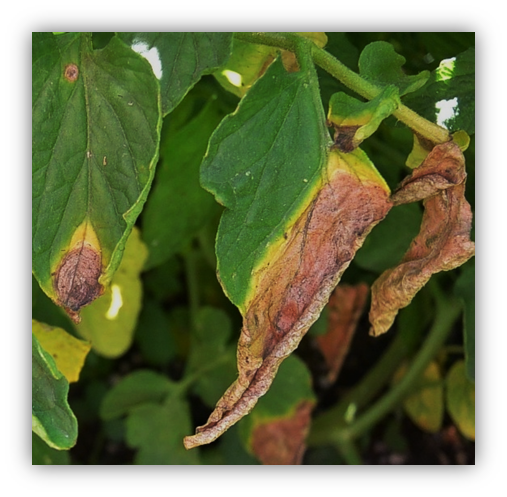
When the pycnidia become wet, fungal spores ooze out. The spores are spread by splashing water, insects, wind, and human contact. During rainy weather or from overhead irrigation, spores can quickly spread the disease through the planting.
Warm, wet weather and overhead irrigation create a successful environment for development of the disease. Plants that are thick and dense will dry more slowly which can allow the disease to develop. A moist 48-hour period is required for infections to occur. It is not necessary that this be a continuous period but may be cumulative over several days.
In the garden, the fungus can over-winter on diseased plant debris and in perennial weeds in the nightshade family such as horse nettle and nightshade. These serve as sources for inoculum and for primary infections in the spring.
Management
Control measures center around reducing the amount of inoculum (spores) available and promoting rapid drying of wet leaves. Removal of early infestation in lower leaves can slow development of the disease.
Resistant Varieties
There are many varieties of resistant tomatoes which will be described in seed catalogues. Resistance does not guarantee that early blight will not occur, but damage will be less severe.
Spacing and Trellising Plants
Space and trellis plants to allow for good air circulation that promotes rapid drying. Provide at least two feet of space between tomato plants to increase air movement. Crowding plants will not increase yields and increases disease problems.
Trellising also increases the distance of the upper leaves from the sources of inoculum on the soil and lower leaves. You can also prune the lower leaves as a preventative measure.
Mulch
Use a mulch (such as black plastic, fabric, straw etc.) to help protect the plant from inoculum splashing from the soil onto lower leaves. Removing leaves in the lower 8 to 12 inches of the plant (as the plant grows) also helps protect lower leaves from infections splashing from the soil.
Irrigation
Avoid overhead irrigation on tomato crops. Fungal spores are easily water-splashed from one leaf to another, and they depend on standing water on the plant surface to cause infections. If possible, use drip irrigation, soaker hoses, or careful watering by hand at the base of each plant. It may also be helpful to water in the morning so that plants dry quickly. Plants that remain wet all night from evening watering are prime targets for disease infection.
Fertilization
A mid-summer loss of plant vigor from inadequate moisture or fertilizer will leave the plant more susceptible to the fungi. In home gardens, early blight can become more prevalent due to low nitrogen levels in mid to late summer.
Fertilize tomatoes at planting, flowering, and fruiting (as the first fruits reaches two inches in diameter). An additional application can also be made to ensure the plants are not nutrient deprived. Avoid heavy applications of nitrogen that can over- stimulate vine growth at the expense of fruiting.
Water-soluble fertilizers (such as MiracleGro, RapidGro, and Peters) applied according to label directions can be used as summer fertilizer supplements.
If using a dry granular fertilizer (such as 21-0-0, ammonium sulfate), apply one level tablespoon per plant. Sprinkle the granular fertilizer in a wide circle 12 to 20 inches out from the plant, and water in. Dry granular fertilizers can easily kill the tomatoes if over-applied.
Weed Control
Keep the garden weed-free. Common weeds harbor many garden diseases. Volunteer potatoes and tomatoes can also be a source of inoculum for early blight.
Remove Infected Leaves
Remove infected leaves as soon as noticed. Wash hands with soap and water immediately after touching diseased leaves to prevent spreading spores to other plants. Avoid working with the plants when they are wet.
Rotation
Since fungal spores can be found on plant debris in the soil, crop rotation is a management tool. However, this may not be practical in most small, home garden situations because a rotation plan allows no tomatoes, potatoes, eggplants, vine crops, strawberries, or raspberries in the same growing area for at least four years. In a garden bed, moving the tomatoes a few rows to the left or right is not an effective rotation. The rotation cycle should be over 2 years without any of the above species to reduce re-inoculation of the spores.
Fall Clean Up
Remove all tomatoes and potato debris in the fall. Dispose of debris in municipal trash or by burial. Do not compost unless the compost heats to at least 145o and the pile is turned occasionally. Most home compost piles do not adequately heat to kill pathogens.
Fungicides
During years with frequent rains, supplementing the above cultural practices with fungicide applications may be necessary to protect the plants. Start spraying at the first sign of spotting on lower leaves, typically in July. Once the disease begins to cause yellow leaves, fungicides lose effectiveness. Note that fungicides are more effective as a preventative measure than as a treatment.
Complete coverage, including the lower leaves, is essential for control. Repeat applications at 10 to 14 day intervals as needed. Under moist conditions, reapplication may be needed at seven-day intervals.
Effective fungicides include Chlorothalonil (Daconil 2787, Ortho Multi-Purpose Fungicide) and EBDC fungicides (such as Mancozeb and Maneb).
The use of these fungicides calls for protective clothing, including rubber gloves, long sleeved shirt, and long pants. These fungicides are toxic to fish and aquatic life. Do not apply them directly to water (lakes, streams, ponds, or wetlands). Do not use them on lands adjacent to water or wetlands, where drift or runoff could become hazardous to aquatic life.
This publication, reference GardenNotes #718, is developed as part of the Colorado State University Extension Master Gardener Program.