


As forest scientists observed how trees respond to wounds, pruning techniques changed and pruning objectives were clarified.
This CMG GardenNotes provides background information on how trees grow and decay and therefore the implications of pruning cuts and structural training. For additional information, see CMG GardenNotes #610-617 on The Science of Pruning.
Note: In this publication, the term “trunk” refers to a trunk or parent branch, and “side branch” refers to a side branch arising from the trunk (parent branch). The same relationship would exist between a side branch and a secondary side branch.
Developing a Strong Branch Union
In Colorado (and other snowy climates) the most common type of significant storm damage in landscape trees results from failures at the branch union (crotch), primarily with codominant trunks (adjacent trunks of similar size). Primary objectives in training young trees are to develop strong branch unions and eliminate structurally weak codominant trunks. [Figure 1]
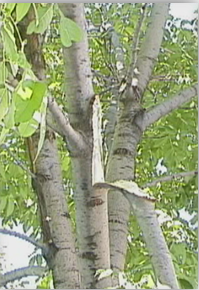
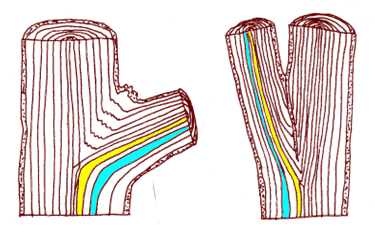
The structural strength of a branch union is based on the development of a branch collar. The branch collar is where the annual growth rings of the trunk overlap the annual growth rings of the side branch, like shuffling a deck of cards. In lumber, the branch collar is called the knot. [Figures 2 and 3]
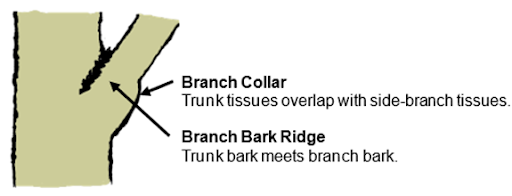
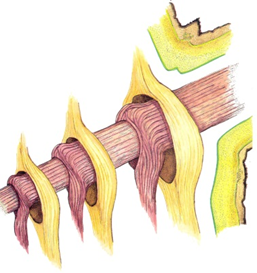
As the branch collar develops, side branch tissues connect into the trunk in a wedge shape, making a structurally strong unit. For the branch collar to develop, the side branch must be less than half the diameter of the adjacent trunk. Less than one-third is preferred.
If the side branch is too large in diameter, prune back the side branch by one-third to two-thirds to slow growth or remove the branch entirely. Over a period of years, a branch collar will develop. [Figure 4]
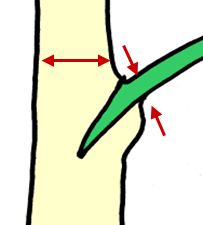
The size relationship between the trunk and side branch is called aspect ratio. A branch union with high aspect ratio, like one-to-one (two trunks of the same diameter), is highly prone to failure in wind and snow loading. A branch union with a low aspect ratio, like one-to-three (side branch is one-third the diameter of the adjacent trunk), would not likely fail due to the development of the branch collar.
A branch collar will not develop on codominant trunks (adjoining trunks of similar size), making this branch union structurally weak. [Figure 5]
Multiple branches arising at the same location also compromise the branch collar’s structural strength. Some tree species, such as elm, maple, and crabapple, naturally develop multiple branches at one location. This predisposes the tree to storm damage if the situation is not corrected by structural training when the tree is young. [Figure 5] Choosing structurally correct trees or fixing when young is ideal. Refer to CMG GardenNotes #632, Tree Selection: Right Plant, Right Place.
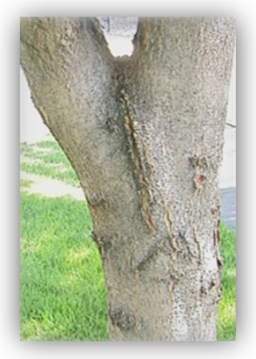
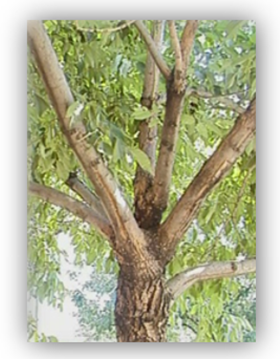
Spread of Decay. Due to the constriction of xylem cells where the side branch annual growth rings are overlapped by the trunk annual growth rings, the development of a branch collar significantly reduces the potential spread of decay. In addition, branch unions with a right angle of attachment are more effective in preventing the spread of decay.
To reduce the potential for decay, prune to develop branch collars. The side branch must be less than half the diameter of the adjacent trunk. Also select branch unions with a wide angle of attachment. In pruning, remove codominant trunks and narrow branch unions while young (smaller than two inches). If the branch is larger, a heading cut can be made one year, and removal can happen the following year to reduce the percentage of removal as needed. [Figure 7]
How Trees Grow
Xylem Tissues. Each year a tree puts a new outer ring of wood (xylem tissue) under the bark resulting in the increased diameter of a trunk or branch. The number of rings indicates the limb’s age, and the width of individual rings indicates that year’s growing conditions. [Figures 8 and 9]
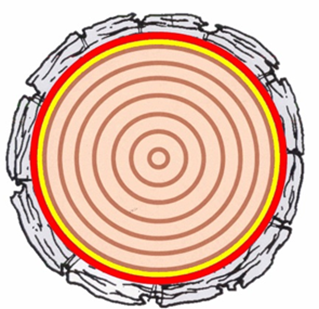
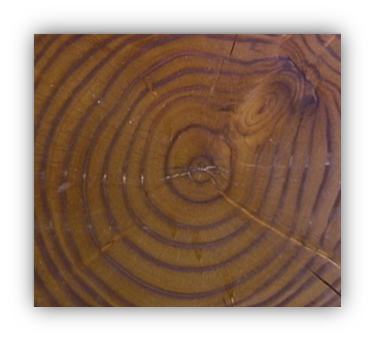
Younger annual growth rings (annual rings of xylem tissue) with their living cells active in water transport and storage of photosynthates are called sapwood. Depending on the species and vigor, sapwood comprises approximately the five youngest (outer) annual growth rings. Heartwood, the older annual xylem rings no longer active in water transport, is very susceptible to decay organisms. Due to chemical changes in these non-living cells, heartwood is often darker in color. [Figure 10]
Ray cells grow through the annual growth rings, functioning like staples or nails to hold the growth rings together. Ray cells also function as the path to move photosynthates in and out of storage in the xylem tissues. On some species, ray cells are not readily visible. On other species, ray cells create interesting patterns in the wood. [Figure 11]
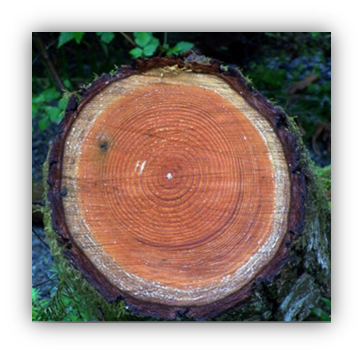
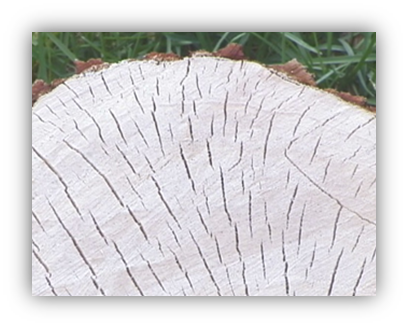
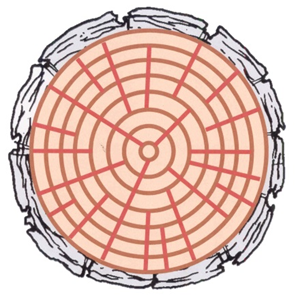
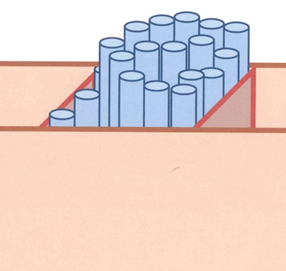
The wood is a series of boxes or “compartments” framed by the annual growth rings and ray cells. Each compartment is filled with xylem tubes in which water with minerals moves from the roots to the leaves. [Figures 12 and 13]
CODIT: Compartmentalization of Decay in Trees (How Trees Decay)
Unlike animals and people, trees do not replace damaged tissues. Rather, cells in the damaged area undergo a chemical change in a method to seal off or “compartmentalize” the damaged area from the spread of decay. This area of chemical change is called the reaction zone. In most species, a reaction zone appears as darker colored wood.
The spread of decay is related to this compartmentalization of the xylem tubes in a box-like structure created by the annual growth rings and ray cells. In this box-like structure, the four walls differ in their resistance to the spread of decay. [Figure 12]
Wall 1 – Resistance to the spread of decay is very weak up and down inside the xylem tubes. Otherwise, the tubes would plug, stopping the flow of water, and kill the plant. From the point of injury, decay moves upwards to a small degree, but readily moves downward. The downward movement may be twenty or more feet and can include the root system.
Wall 2 – The walls into the older xylem tissues (toward the center of the tree) are also rather weak, allowing decay to readily move into older annual growth rings.
Wall 3 – The walls created by the ray cells (being high in photosynthates) are somewhat resistant to decay organisms. This may help suppress the spread of decay around the tree.
Wall 4 – New annual growth rings that grow in years after the injury are highly resistant to the spread of decay.
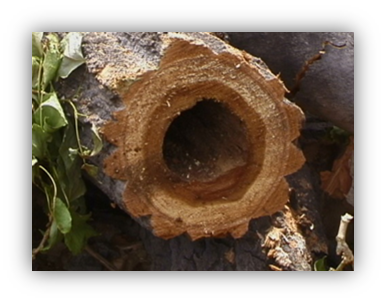
Resistance to the spread of decay by the new annual growth ring and ray cells creates a pipe-like structure, with a decayed center. This concept of how decay spreads in a tree (as controlled by the annual growth rings and ray cells) is called CODIT, for Compartmentalization of Decay in Trees. [Figures 14 and 15]
The spread of decay in trees is suppressed by the four walls created by compartmentalization of the annual growth rings and ray cells.
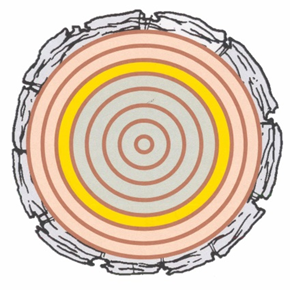
In the drawing [Figure 15], an injury occurred three years ago when the yellow-colored annual growth ring was the youngest. That year and everything older (grayed annual growth rings) are subject to a reaction zone and decay. The two new annual growth rings (brown color) that grew in years after the injury are highly resistant to decay.
Evaluating Decay
Evaluation of decay is challenging and should be performed by a qualified arborist. The International Society of Arboriculture (ISA) maintains a credential called the Tree Risk Assessment Qualification. ISA Certified Arborists and others can attain this credential, which indicates that they have attained a level of knowledge about tree risk assessment.
When evaluating tree risk, arborists look at a variety of factors: tree and site history, tree and site characteristics, potential targets, likelihood of failure, likelihood of impacting a target, consequences of failure and impacting a target, and mitigation options. When there is concern about tree risk, always consult a qualified professional. The following is for background knowledge only.
Indicators of Decay
When evaluating a tree, arborists can look for signs that indicate that decay is present or might be present. Just because decay is present does not necessarily mean that a tree or tree part has a high likelihood of failure. If there is concern, a qualified professional can perform a tree risk assessment. Below are some attributes that arborists look for when evaluating trees.
Definite Indicators of Decay
Cavities. Cavity-nesting birds, bees, and wildlife living inside the tree are signs of decay.
Fungal bodies. Mushrooms, conks, and brackets.
Carpenter ants and termites inhabiting parts of a tree or inhabiting tunnels
Potential Indicators of Decay
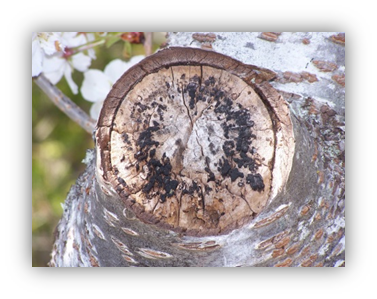
Large pruning wounds. Often decay may be observed within the pruning wound. [Figure 16]
Cankers suggest the potential for internal decay. If the canker extends down into the soil, decay organisms will always be active.
Valleys, ridges, cracks, and splits along the trunk/branch suggest the potential for decay.
Abnormal swellings or shapes could be a sign that the tree is growing around a decayed area.
Measuring Decay
There are tools arborists can use to evaluate and/or measure decay and help estimate the likelihood of failure for a tree or tree part. Simple tools may include a mallet that an arborist can use to “sound” a tree and listen for variations in tone that may indicate decay. More advanced tools for measurement, like resistance drills or sonic tomography equipment, are also available. Measurement and interpretation of decay is an advanced technique that should only be performed by a qualified arborist.
Coring Devices
Note: All coring devices may spread decay since the core is taken through healthy and decayed layers of the wood, so it is only used when evaluating risk. Coring devices only indicate the decay potential at the point of drilling and do not represent the entire trunk or branch.
The tools used to measure decay and health of trees can include an increment borer tool, a drill with a small bit, a Resistograph, digital microprobe, sonic tomograph, electrical impedance tomograph, sonic hammer, tree motion sensors, or chlorophyll fluorimeter.
Listening and Radar Devices
Various methods are used today to predict the risk potential of trees. These methods may include using instruments to measure sound to determine internal decay, visualizing sound waves, measuring the electric field of the wood, or using radar. Some of these methods are financially prohibitive tools for arborists.
Breaks in the Pipe-Like Structure
When a wound or pruning cut breaks the pipe-like structure of a trunk/branch, the tree is especially weak at this location creating a higher potential for tree failure. [Figure 17]
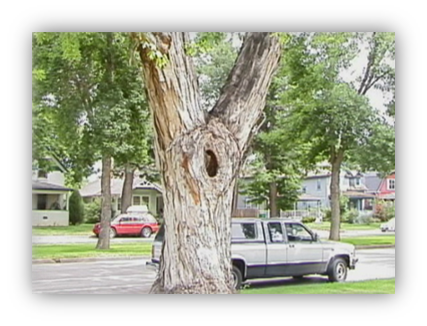
Lack of Trunk/Branch Taper
Branch failure (often breaking a few feet to one-third of the branch length out from the branch union) is a common type of storm damage. Branch failures often cause minimal damage to the tree. However, failure of a major branch may create holes in the tree canopy, introduce decay and cracking, and make the tree look unacceptable. Trunk failure refers to breaking of the lower trunk, above ground level (not at a branch union).
Branch and trunk failures are associated with lack of trunk/branch taper. That is, the trunk/branch does not thicken adequately moving down the trunk/branch. This can be caused by pruning up the trunk too fast and by removing small branches and twigs on the lower trunk or lower interior canopy of the tree.
Very upright branches without a lot of side branches also typically fail to develop adequate taper. For structural integrity, shorten these branches with appropriate reduction or heading cuts.
This publication, reference GardenNotes #611, is developed as part of the Colorado State University Extension Master Gardener Program.