


Take steps to prevent construction damage, as prevention is easier than correction.
This is written as an overview of tree preservation issues in a construction site. For additional information refer to:
- Protecting Trees During Construction , Eric Hammond, Colorado State University Extension
- Trees and Development, A Technical Guide to Preservation of Trees During Landscape Development, Nelda P Matheny, and James R Clark. International Society of Arboriculture. 1998. ISBN: 1-881956-20-2.
- Up By Roots: Healthy Soils and Tree in the Built Environment, James Urban. International Society of Arboriculture. 2008. ISBN: 1-881956-65-2.
- Protecting Trees From Construction Damage: A Homeowners Guide, Gary R. Johnson, University of Minnesota Extension.
Guiding Principles of Tree Preservation
1. Goals in tree preservation include both construction AND tree preservation.
- Both goals have to be valued.
- Both sides have to make compromises.
- Polarizations of attitudes include, that it is cheaper, easier, and faster to remove all trees at the start and that all trees need to be saved. For tree preservation, compromise must be found in the middle.
- The goal is not to preserve trees just until occupancy occurs, but rather for the potential lifespan of the tree.
2. Preservation requires commitment of all parties, as a team effort.
- Owners.
- Engineers.
- Architects and landscape architects.
- Grading and demolition crews.
- Construction and landscape crews.
- Government agencies.
- Arborists, who’s role includes:
- Technical resources and tree knowledge.
- Familiarity with local regulations and regulatory staff.
- Familiarity with local growing conditions.
3. Tree preservation cannot wait until construction or afterwards.
- Tree preservation takes place in the planning phase.
- Construction crews then follow the plans.
4. All trees cannot and should not be preserved.
- Trees require that space be protected for their roots.
- Trees in poor health simply will not tolerate construction stress.
- Trees with poor structure have limited value.
5. Tree preservation patterns must respect patterns of tree growth.
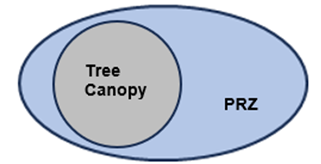
- All players in design and construction must respect the Protected Root Zone, PRZ. [Figure 1] This zone is defined as the area beneath the dripline of the tree, although roots will extend beyond that area. For details on calculating the PRZ see the Protected Root Zone section later in this document.
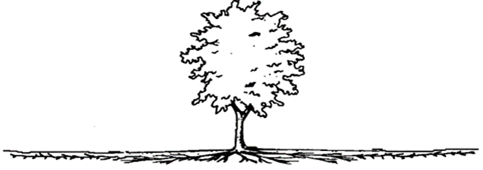
6. Tree preservation requires above and below ground space.
- Inside the PRZ there can be NO grading, trenching, parking, stock piling of building materials or dumping of waste products. [Figure 2]
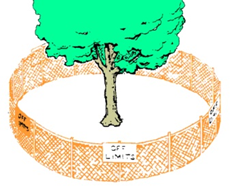
7. Preservation focuses on preventing injury to trees, as little can be done to correct injury.
8. Construction impacts to trees are cumulative. Small impacts add together for stress and tree decline. For example, a tree may be able to tolerate cuts to one side of its root system, but not all sides.
9. Tree preservation requires accurate site information.
- Location of buildings, utilities, and hardscape features. [Figure 3]
- Location of trees.
- Species identification and tolerances to construction stress.
- Evaluation of tree health and potential for preservation.
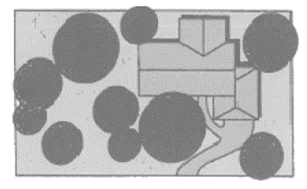
10. Arborists and design/construction professionals must communicate with each other.
- Talk in technical terms for clear understanding.
- Both sides must be willing to compromise.
11. Community attitudes and practices must support both tree preservation and development.
- A compromise must be found between the polarizations of aggressive tree preservation ordinances and practices that prohibit construction and those of ignoring tree preservation in favor of construction.
- The same standards should apply to both private and public sector development.
Development Sequence
- Site design including a Tree Report.
- Requires communication and compromise between all parties.
- This is the most important step in tree preservation.
- Review and approval by public agency.
- Conditions of approval.
- Bonding: appraised value of trees preserved.
- Permits.
- Site work.
- Tree protection work needs to be completed before other activities start.
- Due to construction schedules, the time frame for tree work may be very short.
- Tree protection needs to remain in place during site work.
- Demolition and clearing.
- Grading.
- Utilities and roads.
- Construction and landscaping.
- Tree protection needs to remain in place during site work.
- Implement tree maintenance during construction plan.
- Who and how will the tree be protected during construction?
- Who and how will the tree be watered and cared for during construction?
- Occupancy.
- Implement a post-construction maintenance plan.
- In tree preservation, it should be expected that the tree lives for twenty plus years, not just until site occupancy.
Tree Report
Step A – Inventory and Evaluation
Identify trees suitable for preservation.
- Species.
- Size.
- Health and vigor.
- Structural integrity.
- Age – Young trees are more tolerant of construction stress.
- Species tolerance to construction stress.
- Maintenance requirements.
- Trees suitability for new use.
- Group or specimen trees – Trees are often easier to preserve in a grouping rather than specimen trees.
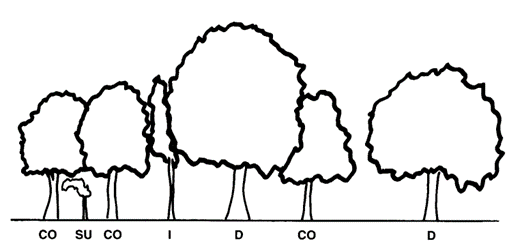
Crown Class
[See Figure 4]
- Co-dominant trees are best preserved in groupings.
- Subordinate trees make a poor choice for preservation due to inferior structure and sudden exposure.
- Intermediate trees make a poor choice for preservation.
- Dominant trees make the best options for preservation
Step B – Assess potential impacts by calculating the Protected Root Zone for each tree.
Trees under stress and/or decline are less tolerant of construction related stress and do not merit preservation. This classification may depend on the agreement of all involved parties
Step C – Modify Plan To Accommodate PRZ and Building Plans.
Step D – Identify Tree Work
- Necessary tree work is to be done by arborists not construction workers.
- There may be limitations on the time of year for work to be done.
- There may be a short time frame to complete work before construction begins.
Step E – Outline Tree Maintenance During Construction Plan
- Who and how will trees be protected during construction?
- Who and how will the tree be watered and cared for during construction?
- Who and how will the tree protection plan be communicated to all workers?
- Who and how will tree protection be monitored during construction?
- What penalties will be in place for individuals and companies who violate the tree protection plan?
Step F – Outline Post-Construction Maintenance Plan
- What will be done and who is responsible?
- Soil management.
- Pruning: Cleaning.
- General care (watering, pest management, etc.).
Assessing Tree Tolerance
Species
- For comparison, classify species as good, moderate, or poor tolerance.
- There is no comprehensive list of species tolerances.
- Ask experts about their experience with specific species.
Age and Longevity
- For comparison, classify as good, moderate, or poor tolerance.
- Young trees typically have good tolerance.
- Medium age trees typically have moderate tolerance.
- Over-mature and declining trees have poor tolerance and do not merit preservation.
Health and Vigor
- Trees in poor health will not survive construction related stress.
Actual Crown and Rooting Area
- May not be uniformly distributed.
Structural Stability
- Preservation efforts are not warranted on structurally unsound trees.
Cuts and Fills
[See Figure 5]
- Fills – Better tolerated by flooding tolerant tree species.
- Cuts – Better tolerated by drought tolerant species In all cases, retain the PRZ or larger at original grade whenever possible.
- In all cases, retain the PRZ or larger at original grade whenever possible.
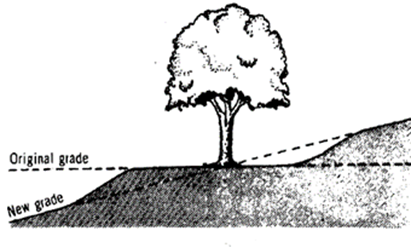
Removing Soil Inside PRZ
[See Table 1]
- On root severance tolerant species, may disturb up to 25% of PRZ area (not diameter).
- On root severance sensitive species, allow extra space beyond PRZ.
Table 1. Root Severance Tolerance
| tolerant | Intermediate | sensitive |
|---|---|---|
| Up to 25% of PRZ Area | PRZ Area | Allow Extra Space in PRZ |
| Ash: green, white, black. Aspen: quaking, big tooth. Birch: river. Boxelder. Cottonwood: Eastern. Maple: silver, red. Mountain Ash Pine: white, jack, red. Spruce: black, white. Willow. | Birch: paper, yellow. Buckeye: Ohio. Catalpa. Cherry: black. Kentucky coffee. Hawthorn. Hickory: bitternut. Maple: sugar. Spruce: Colorado blue. Oak: bur, bicolor. | Beech. Butternut. Ironwood. Oak: white, northern, pin, black. Walnut: black. |
Adding Soil Inside PRZ
[See Table 2]
- If a compaction/flooding tolerant species, may successfully add up to six inches porous fill.
- If a compaction-flooding sensitive species, do NOT change grade, and PRZ (as calculated with diameter method) may be too small.
Table 2. Root covering tolerance
| tolerant | Intermediate | sensitive |
|---|---|---|
| Add Up To 6” Porous Soil | PRZ Area | No Change in PRZ |
| Ash: blue, green. Cedar: Northern white. Birch: river. Boxelder. Fir: balsam. Catalpa. Cottonwood: Eastern. Maple: silver, red. Spruce: Colorado blue, black. Tamarack. Oak: bicolor. Willow: black | Ash: white. Buckeye: Ohio Butternut. Cherry: black. Kentucky coffee. Elm: American, slippery. Hackberry. Hawthorn. Hickory: bitternut. Honeylocust. Mountain Ash. Spruce: white. Oak: bur. Walnut: black. | Aspen: quaking, big tooth. Basswood. Beech: blue. Birch: paper, yellow. Cedar: Eastern red. Fir: white. Ironwood. Locust: black. Maple: sugar. Oak: red, white, black, northern pin. Pine: white, jack, red scotch. Plum: wild. |
Construction Alters the Water Received by Trees.
- Water trees before and after any kind of damage (i.e. cutting roots).
- Water regularly through the growing season.
Ability to recover from stress factors
- Insects and diseases.
- Irrigation changes.
Protected Root Zone, PRZ
Trunk Diameter Method
The size of the PRZ is based on the diameter of the trunk, increasing as the tree ages, and becomes less tolerant of stress factors. It may be calculated by measuring the trunk circumference or diameter at DSH (diameter at standard height, 4 ½ feet). For trees with a broad canopy in an open lawn, the PRZ is approximately 40% larger in area than the dripline method. [Figure 6]

Trunk Diameter Method by Circumference
- PRZ radius equals one foot per two inches of trunk circumference.
- Measure the tree’s circumference at DSH (4 ½ feet) in inches.
- Divide the number of inches by two.
- This is the radius, in feet, of the PRZ.
For example:
- Circumference = twenty-four inches.
- Twenty-four divided by two equals twelve (24 / 2 = 12).
- PRZ radius = twelve feet.
Trunk Diameter Method by Diameter
- PRZ radius = 1 ½ foot per inch of trunk diameter at DSH.
- Measure the tree’s diameter at DSH (4 ½ feet) in inches.
- Multiply the diameter (in inches) by 1 ½.
- This is the radius, in feet, of the PRZ.
For example:
- Diameter = eight inches.
- 8 x 1.5 = twelve.
- PRZ radius = twelve feet.
Area of the PRZ
The area of the PRZ can be calculated by the formula:
[PRZ radius]2 x π
For example – twelve foot radius:
12 feet by 12 feet by 3.14 = 452 square feet.
Stress Tolerance and Age Method
This method is used in a construction site when compromise must be made to minimize the PRZ, allowing for construction activities [Table 3]:
1. Evaluate Species Tolerance to Construction Stress (Good, Moderate, Poor)
- Transplant response.
- Drought response.
- Rooting pruning response.
- Compartmentalization (decay response).
- Native range – tolerance to stress outside native ecosystem.
Identify Tree Age
- Young = < ¼ life expectancy.
- Mature = ¼ – ¾ life expectancy.
- Over-mature = > ¾ life expectancy.
- Older trees are less tolerant of stress and require larger PRZ.
From Table 3, calculate minimum PRZ radius and area.
Additional space may be needed on compacted or clayey soils.
Table 3. Radius of PRZ
| stress tolerance | tree age | feet/inch trunk diameter |
|---|---|---|
| Good Moderate Poor | Young Mature Over-Mature Young Mature Over-Mature Young Mature Over-Mature | 0.5 0.75 1.0 0.75 1.0 1.25 1.0 1.25 1.5 |
PRZ Modifications
The methods above are based on trees in open area with unlimited rooting space. Additional space may be needed for shallow rooted trees, like spruce and on compacted clayey soils. If low branches interfere with work, extend the PRZ to include all the dripline area.
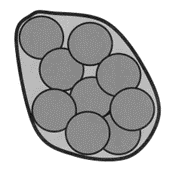
Trees in Groupings
[See Figure 7]
- Calculate and plot the PRZ for each tree.
- Plot outer edge of tree group as the PRZ for the grouping.
Multiple Trunk Trees
When counting multiple trunks, add the trunk areas together to determine the tree’s overall size.
- The trunk area for each trunk at DSH (4 ½ feet).
- Add the areas together.
- Calculate the diameter of a tree that would have this size area in a single trunk.
- Area = Radius2 by 3.14.
- Radius = √area / 3.14.
- Use this as the trunk size to estimate the PRZ.
- Note: these trees may be stressed and may not tolerate construction damage.
To Accommodate Site Needs, the PRZ Area May Be
[See Figure 8]:
- Offset slightly.
- Not necessarily round.
Sites With Urban Hardscape Restricting Root Spread
- Methods, as described above, will need adjustments.
- Need to check for root location in one of the following ways:
- Backhoe – A good operator knows when he hits roots and will stop before
- cutting them.
- Hand digging.
- Air spade.
- New sidewalks and parking areas are generally alright if they stay inside the footprint of the old area without invading the rooting area.
- New buildings are generally alright if they stay inside the footprint of the old building without invading the rooting area.
Tree Stability
For wind stability, do not invade the root plate.
- General Formula: Radius of root plate is three to six times DSH (trunk diameter at standard height, 4 ½ feet)
- Bartlett Tree Lab Model: Radius of root plate is five times DSH on one side AND three times DSH on the other three sides.
- Various mathematical models are also used in academic settings, combined with experimental validation, to predict tolerance of tree species to wind damage and windthrow.
Symptoms of Construction Damage
Symptoms of construction damage include generic symptoms of stress and decline. Trees generally decline due to root deterioration and death.
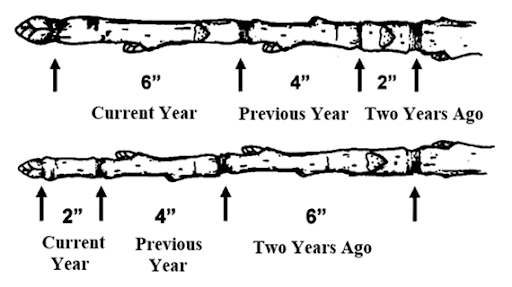
- Reduced canopy growth. Compare how annual growth changes from year to year. [Figure 9]
- Dieback on upper canopy.
- Dieback of upper canopy on side related to root damage.
- Small, poorly colored leaves.
- Adventitious sprouting along trunk or lower scaffold branches.
- Heavy seed set.
- Mechanical injury to trunk and limbs.
- New edge damage. Foliage and bark damage due to increased exposure to sun and wind.
Bottom line: Take steps to prevent construction damage, as little can be done to correct it. Some careful steps now can retain a long tree lifespan.
This publication, reference GardenNotes #652, is developed as part of the Colorado State University Extension Master Gardener Program.